
Best Accounting Software for Healthcare in 2026

Key facts8 tools compared: QuickBooks Online, Xero, Sage Intacct, Oracle NetSuite, FreshBooks, Wave…
- 8 tools compared: QuickBooks Online, Xero, Sage Intacct, Oracle NetSuite, FreshBooks, Wave, LiveFlow, Tebra
- QuickBooks Online (best for: Small/mid practices): $38 to $275/mo
- Xero (best for: Group practices, unlimited users): $25 to $90/mo
- Sage Intacct (best for: Multi-entity healthcare orgs): ~$10k to $35k/yr
- Oracle NetSuite (best for: Large systems, full ERP): ~$999+/mo + $99 to $200/user
Running the books for a medical practice is not like running them for a coffee shop. You have insurance claims that pay weeks after the service, contractual write-offs that turn a $400 charge into a $112 payment, and a patient ledger that no general accounting tool was ever built to understand. On top of that, you have HIPAA breathing down your neck the moment any patient detail touches your financial records.
So the "best" accounting software for healthcare depends entirely on what stage you are at. A solo therapist and a 40-provider cardiology group have almost nothing in common except the word "practice." I compared the tools clinics actually run on in 2026, checking current pricing against official pages, and separating the general-ledger software from the medical billing systems people keep confusing it with.
Short version: if you are a small-to-mid practice that wants clean financials without an implementation project, QuickBooks Online is still the default, and for good reason. If you are scaling past a few locations and need real revenue recognition, Sage Intacct is where serious healthcare groups end up. Everything else below fits a specific situation. Here is how I'd choose.
Quick comparison
| Tool | Best for | Price (USD) | Standout |
|---|---|---|---|
| QuickBooks Online | Small/mid practices | $38 to $275/mo | Huge ecosystem, every bookkeeper knows it |
| Xero | Group practices, unlimited users | $25 to $90/mo | Flat per-org pricing, no per-seat fees |
| Sage Intacct | Multi-entity healthcare orgs | ~$10k to $35k/yr | True revenue recognition + consolidation |
| Oracle NetSuite | Large systems, full ERP | ~$999+/mo + $99 to $200/user | One system for finance, ops, inventory |
| FreshBooks | Solo providers, cash-pay clinics | $23 to $70/mo | Easiest invoicing for non-accountants |
| Wave | Brand-new solo practices | Free (Pro $16/mo) | Genuinely free core accounting |
| LiveFlow | QuickBooks shops with 2+ locations | ~$30 to $100+/user/mo | Live consolidated reporting on top of QBO |
| Tebra | Practices that need billing + books linked | ~$99 to $399/provider/mo | Ties claims and collections to financials |
QuickBooks Online: the safe default
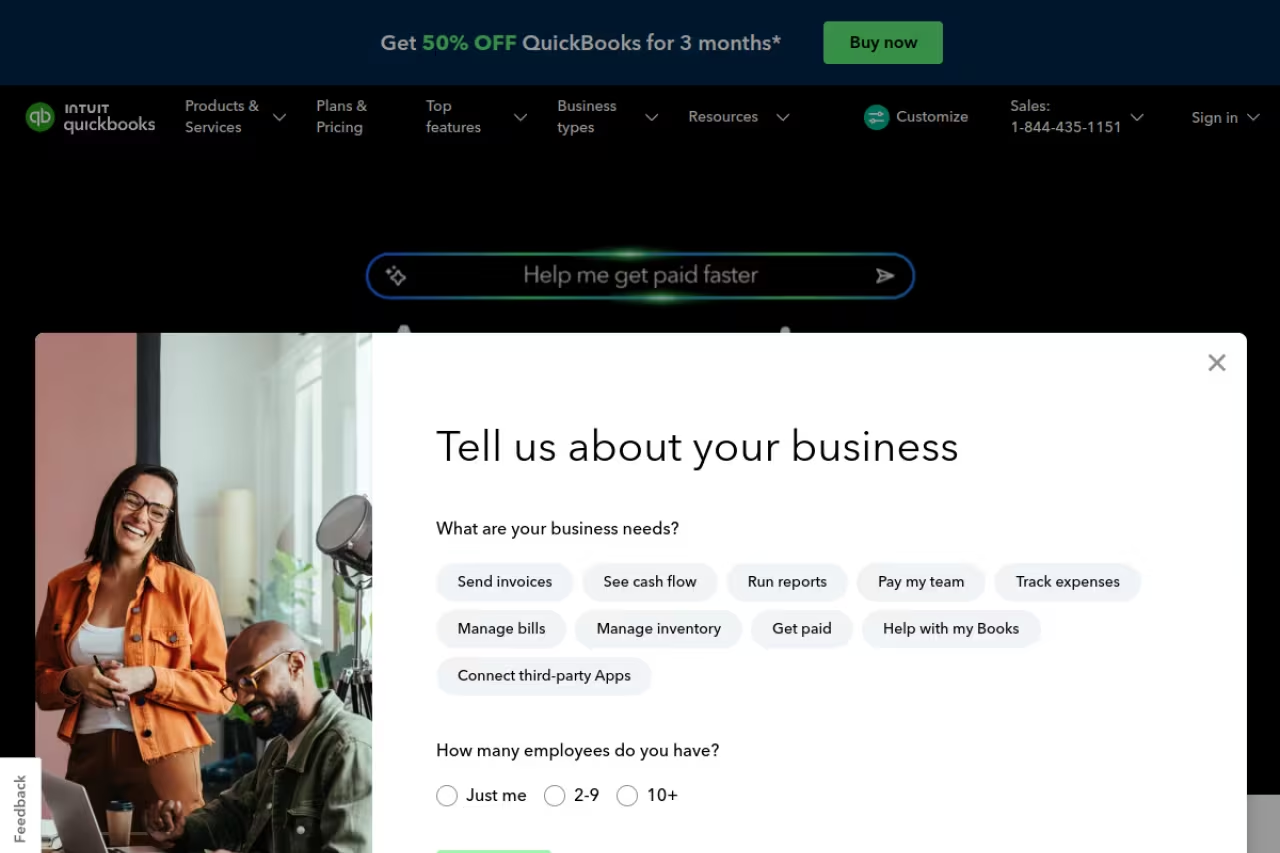
QuickBooks Online is the tool your accountant already knows, your bookkeeper already uses, and every integration on earth already supports. For a practice doing under a few million in revenue, that network effect is worth more than any niche feature.
It handles the accrual accounting that healthcare needs, class tracking so you can split revenue by provider or location, and bank feeds that cut reconciliation time to minutes. Pair it with a medical billing system feeding in claim data and you have a clean setup most CPAs are happy with.
Who it's best for: solo to mid-size practices, especially anyone whose accountant has an opinion (they'll want QuickBooks).
The safe default for solo to mid-size practices, with the broadest accountant and integration support and good class tracking by provider or location. It is not HIPAA compliant and Intuit will not sign a BAA, so keep patient data out entirely.
Pricing: per Intuit's current plans, Simple Start is $38/mo, Essentials $75/mo, Plus $115/mo, and Advanced $275/mo. Intuit raised prices roughly 15-20% in mid-2025, so older quotes you find online are low.
The catch: QuickBooks Online is not HIPAA compliant, and Intuit will not sign a Business Associate Agreement. That is fine as long as you keep protected health information out of it entirely. Use patient IDs or account numbers in memos, never names tied to diagnoses or treatment. Plenty of practices run QBO cleanly this way, but you have to be disciplined about it.

Xero: unlimited users, flat price

Xero is the tool I recommend when a practice has a real team touching the books: a manager, a bookkeeper, an external accountant, maybe an owner who likes to peek. QuickBooks charges per seat past a point. Xero does not. Every plan includes unlimited users, priced per organization.
The interface is cleaner than QuickBooks, the bank reconciliation flow is genuinely nice to use, and the open API means it plugs into most modern billing and payroll tools. For group practices that hate paying per login, this alone closes the deal.
Who it's best for: small group practices and clinics with several people in the financial workflow.
Pick Xero if several people touch the books, since every plan has unlimited users and the interface is cleaner than QuickBooks. The Early plan caps you at 20 invoices, so busy clinics land on Growing or Established, and US payroll is weaker.
Pricing: as of the 2026 US pricing, Early is $25/mo, Growing $55/mo, and Established $90/mo. You need Established the moment you want project tracking, expense claims, or multi-currency.
The catch: the Early plan caps you at 20 invoices and 5 bills per month, which a busy clinic blows through fast, so realistically you're on Growing or Established. Xero is also weaker on US-specific payroll and has a smaller ecosystem of American accountants than QuickBooks, which can matter at tax time.
Sage Intacct: when you outgrow small-business tools
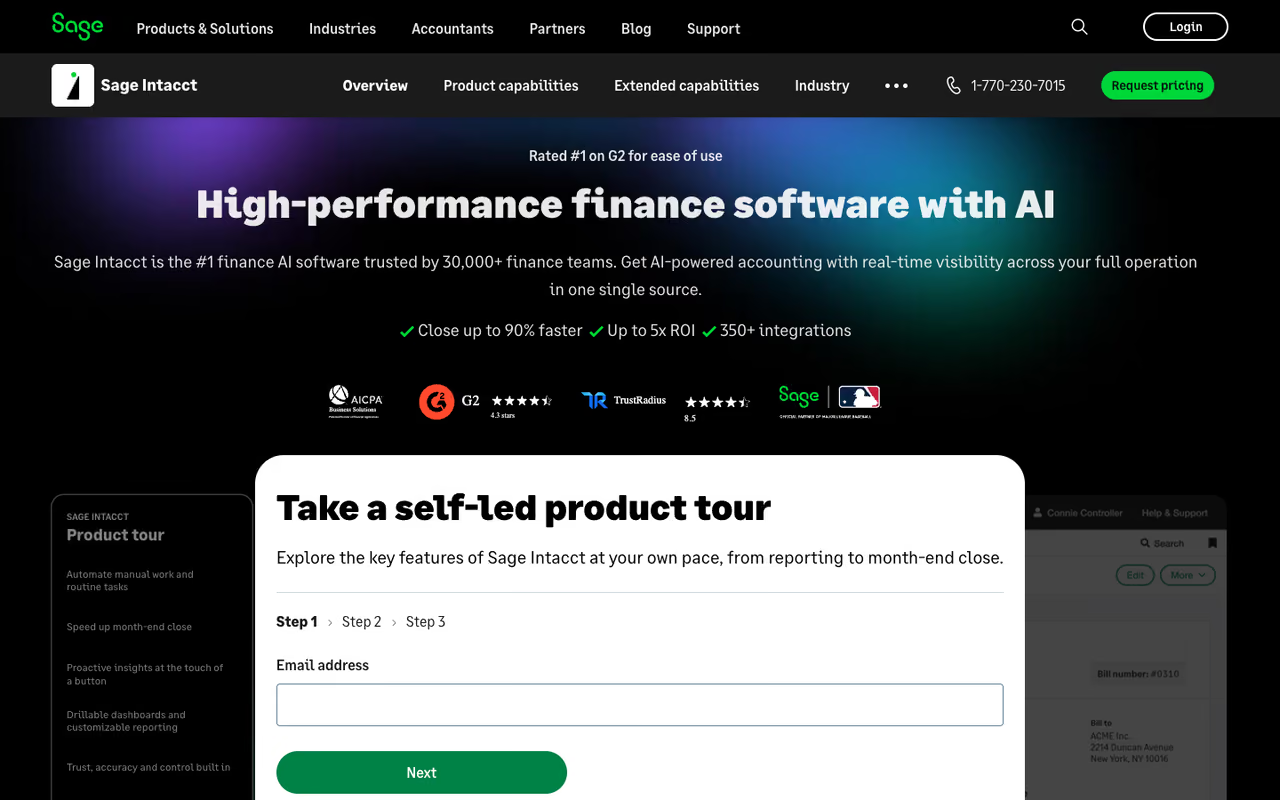
Sage Intacct is the jump most growing healthcare organizations make when QuickBooks starts buckling. Senior living networks, multi-site specialty groups, and behavioral health companies live here. It is built around dimensions (location, provider, service line, payer) so you can slice financials any way leadership asks, and it consolidates across entities automatically.
The killer feature for healthcare is revenue recognition. Sage Intacct defers and recognizes revenue under ASC 606 automatically, which matters a lot when you have contracts, capitation, and performance obligations that span periods. Doing that by hand in QuickBooks is a recipe for a painful audit.
Who it's best for: multi-entity healthcare orgs that have outgrown spreadsheet consolidation.
The natural next step for multi-entity healthcare groups that have outgrown QuickBooks, with dimensional reporting and automatic ASC 606 revenue recognition. Pricing is unpublished and independent estimates run roughly $9,000 to $35,000 per year plus implementation.
Pricing: Sage doesn't publish list prices. Independent estimates put most deployments between roughly $9,000 and $35,000 per year, with implementation often adding $10,000 to $30,000 on top.
The catch: this is real software with a real implementation. Budget for a partner, a project timeline, and a learning curve. It is overkill for a single-location practice, and the all-in first-year cost surprises people who only saw the subscription number.
If you're scaling a clinic group and your finance stack is starting to feel like duct tape, that's usually the signal to look at Intacct rather than bolting more onto QuickBooks. (Side note: the same "outgrowing your tools" moment is why we built Dupple X for marketing teams, so I have sympathy for the pain.)
Oracle NetSuite: the full ERP option
Oracle NetSuite goes one level beyond Intacct in scope. It is not just accounting, it is a full ERP: finance, procurement, inventory, even CRM in one system. Large healthcare systems, multi-state provider groups, and organizations with significant medical supply inventory choose it because everything lives under one roof.
For a health system juggling supply chain, multiple revenue streams, and complex reporting, having accounting and operations in the same database removes a whole category of reconciliation headaches.
Who it's best for: large healthcare organizations that want one platform for the entire back office.
A full ERP for large health systems that want accounting, procurement, inventory and CRM in one database. Cost and complexity are the catch: months to deploy and tens of thousands of dollars per year, so smaller groups should stay with Intacct.
Pricing: NetSuite is quote-only and built on a base license reported around $999/month plus roughly $99 to $200 per user per month, with a typical 10-user minimum. Real-world small deployments land around $3,000 to $5,000 monthly all in.
The catch: cost and complexity. NetSuite is a commitment measured in months to deploy and tens of thousands of dollars per year. If you don't need inventory and ERP-level operations, Intacct gives you most of the financial power for less pain.

FreshBooks: simplest for solo and cash-pay
FreshBooks wasn't built for medicine, but it's a great fit for a specific kind of provider: solo practitioners, cash-pay clinics, therapists, and concierge doctors who bill patients directly rather than wrestling with insurance. Its invoicing is the friendliest of any tool here, and the time-tracking is handy if you bill by the session.
If your "revenue cycle" is basically sending invoices and getting paid by card, FreshBooks removes most of the accounting anxiety.
Who it's best for: solo providers and direct-pay practices that don't run insurance claims.
Pricing: per the official pricing page, Lite is $23/mo (5 clients), Plus $43/mo (50 clients), and Premium $70/mo (unlimited). Frequent promos knock 50-90% off the first few months.
The catch: the client caps on lower tiers are tight, and FreshBooks is light on the accrual accounting and class tracking a growing practice needs. It's a starter tool, not a system you scale a multi-provider group on.

Wave: the genuinely free pick
Wave is the answer when a brand-new practice has zero budget for software. Its core accounting and invoicing are free, with no trial clock and no feature lockout. For a provider just hanging a shingle, that's hard to argue with.
You only pay when you process payments (2.9% + $0.60 per card) or want extras like receipt scanning and automatic reminders.
Who it's best for: first-year solo practices and side-practice providers watching every dollar.
The right call for a brand-new practice with zero software budget, since core accounting and invoicing are free. Support and depth are thin, with no class tracking, and you will outgrow it once you add a second provider.
Pricing: free for core accounting; the Pro plan runs $16/mo for automation features, and payroll starts at $40/mo plus $6 per employee.
The catch: you get what you pay for on support and depth. Wave is thin on integrations, has no real multi-entity or class tracking, and you'll outgrow it the moment you add a second provider or start dealing with insurance. Treat it as a starting point, not a destination.
LiveFlow: live reporting on top of QuickBooks
LiveFlow solves a narrow but real problem: you're already on QuickBooks across two, three, or five locations, and consolidating them every month is a manual nightmare. LiveFlow pulls your QBO entities into live, automatically updating reports in Google Sheets, so leadership sees a unified P&L without anyone rebuilding a spreadsheet.
It's not a replacement for QuickBooks, it's a layer that makes QuickBooks usable at multi-location scale, with healthcare-specific configurations for clinic groups.
Who it's best for: practices committed to QuickBooks that have hit the multi-location reporting wall.
Useful if you are committed to QuickBooks across multiple locations and tired of manual consolidation, since it builds live reports in Google Sheets. It buys time rather than a new foundation, so true multi-entity needs point toward Intacct.
Pricing: roughly $30 to $100+ per user per month depending on entities and access; complex consolidations are quoted.
The catch: it inherits QuickBooks' limits. If your underlying need is true multi-entity accounting with automated eliminations, you may be better off moving to Intacct than papering over QBO. LiveFlow buys you time, not a new foundation.

Tebra: when billing and books need to talk
Tebra (formerly Kareo + PatientPop) is not general-ledger accounting. It's a practice management and medical billing platform, and I include it because the most common healthcare "accounting" mistake is treating billing software and accounting software as the same thing. They aren't. Tebra handles the part QuickBooks can't: claims, denials, ERA auto-posting, and revenue cycle.
The smart setup for most independent practices is Tebra (or a similar billing system) for the revenue cycle, feeding clean numbers into QuickBooks or Xero for the actual books. Tebra is also HIPAA compliant, which is exactly where your patient data should live.
Who it's best for: practices that need their claims, collections, and financial reporting connected.
A billing and revenue-cycle platform rather than a ledger, and HIPAA compliant, so it is the right home for claims and collections. Pair it with QuickBooks or Xero for the books, and watch the opaque pricing and steep data-export charges.
Pricing: independent reviews put it around $99 to $399 per provider per month depending on modules, with billing and EHR bundles costing more.
The catch: pricing is opaque and quote-based, and reviewers flag occasional hidden fees and steep data-export charges if you leave. It's also a billing system, so don't expect it to replace your accounting tool.
How to choose
Forget rankings for a second. Match the tool to where you actually are.
Start by separating the two jobs. Billing software (Tebra, AdvancedMD, athenahealth) handles claims and collections. Accounting software (QuickBooks, Xero, Intacct) handles the general ledger. Almost every practice needs both, talking to each other, not one tool pretending to do everything.
Then size to your stage:
- Solo or cash-pay, tight budget: Wave to start, FreshBooks once you want better invoicing.
- Small-to-mid practice, one or two locations: QuickBooks Online if your accountant prefers it, Xero if you have a team and hate per-seat fees.
- Growing group, 2+ locations on QuickBooks: add LiveFlow before you've outgrown QBO entirely.
- Multi-entity org needing real revenue recognition: Sage Intacct.
- Large system needing ERP-level operations and inventory: Oracle NetSuite.
Two non-negotiables for every choice. First, HIPAA: keep PHI out of any tool that won't sign a BAA (that includes QuickBooks Online and Xero), and let your HIPAA-compliant billing system own the patient data. Second, integration: confirm the accounting tool actually connects to your EHR or billing system before you commit, because manual data entry between systems is where errors and burnout live.
If you want a broader scan of the software stack practices are running this year, our top tools directory and our guides on the best AI tools for finance teams and AI agents that automate back-office work are good next stops.
FAQ
Is QuickBooks HIPAA compliant for medical practices?
No. QuickBooks Online is not HIPAA compliant and Intuit will not sign a Business Associate Agreement. You can still use it for a practice's financials, but you must keep all protected health information out of it. Store patient data in your HIPAA-compliant billing or EHR system and feed only de-identified financial numbers into QuickBooks.
What's the difference between medical billing software and accounting software?
Billing software (like Tebra or AdvancedMD) manages the revenue cycle: submitting claims, handling denials, posting insurance payments, and tracking patient balances. Accounting software (like QuickBooks or Sage Intacct) manages your general ledger, financial statements, and taxes. Most practices need both, with the billing system feeding summarized revenue data into the accounting system.
How much does accounting software for a healthcare practice cost?
It ranges enormously by stage. A solo provider can run free on Wave or pay $23 to $90 a month on FreshBooks or Xero. A small group on QuickBooks Online pays $38 to $275 a month. A multi-entity organization on Sage Intacct typically spends $9,000 to $35,000 a year plus implementation, and a large system on NetSuite can run well into five or six figures annually.
Do I need different accounting software than other businesses use?
Often not for the core ledger. Many practices run perfectly well on QuickBooks or Xero, the same tools other small businesses use, paired with a healthcare-specific billing system. You only need specialized accounting software like Sage Intacct once you have multiple entities, complex revenue recognition, or consolidation needs that general tools can't handle.
When should a growing practice move off QuickBooks?
The usual triggers are multiple legal entities you have to consolidate by hand, revenue recognition rules you're tracking in spreadsheets, and month-end closes that take longer than they should. When you find yourself fighting QuickBooks more than using it, look at LiveFlow to buy time or Sage Intacct for a real upgrade.
Picking accounting software is one of those decisions you make once and live with for years, so it's worth matching the tool to your actual stage rather than the biggest name. Get the billing system and the books talking, keep PHI where it belongs, and revisit the choice each time you add a location.
And if your practice is at the point where back-office tooling is the bottleneck, the same thinking applies to growth. Try Dupple X to put your marketing on autopilot while your finance stack handles the rest.
Related guides
Some offers on this page may be paid placements or contain affiliate links.
Across our whole catalogue the median is $24 a month and 33% of tools advertise a free tier. Figures are the lowest recurring monthly price quoted in our own review of each tool, read on 2026-08-19. Full method and every category.
