
Best Employee Engagement Software (2026): 8 Tools I'd Actually Recommend

Key facts8 tools compared: Lattice, Culture Amp, 15Five, Bonusly, Workleap Officevibe, Nectar…
- 8 tools compared: Lattice, Culture Amp, 15Five, Bonusly, Workleap Officevibe, Nectar, Connecteam, WorkTango
- Lattice (best for: Engagement + performance in one): $4 engagement, $11 perform
- Culture Amp (best for: Enterprise depth + benchmarks): Quote-only (~$5-9 engagement)
- 15Five (best for: Mid-market, transparent pricing): $4 Engage, $16 full platform
- Bonusly (best for: Recognition-led culture): $5 (free up to 8)
Most engagement software gets bought by HR and ignored by everyone else. You run one annual survey, get a 47% response rate, stare at a heat map nobody acts on, and a year later you do it again. The tools aren't the problem. The way they get rolled out usually is. But the tool you pick still decides whether managers ever look at the data, and that part matters more than the feature list on the sales deck.
I spent the last few weeks watching demos, reading real pricing breakdowns, and comparing what each of these platforms actually does versus what it claims. Some are survey engines. Some are recognition feeds with a survey bolted on. A few try to be the whole people-management stack. They are not interchangeable, and buying the wrong category is the most common mistake I see.
If you want the short version: Lattice is my top pick for most companies that want engagement tied to performance and goals in one place. If you're a smaller team that mostly wants people to feel seen, Bonusly does more for less. If you manage frontline or deskless staff, neither of those fits and you want Connecteam. Here's the full breakdown, who each one is for, and where each one falls short.
Quick comparison
| Tool | Best for | Price (per user/mo) | Standout |
|---|---|---|---|
| Lattice | Engagement + performance in one | $4 engagement, $11 perform | AI driver analysis on surveys |
| Culture Amp | Enterprise depth + benchmarks | Quote-only (~$5-9 engagement) | Largest benchmark dataset |
| 15Five | Mid-market, transparent pricing | $4 Engage, $16 full platform | Published per-user prices |
| Bonusly | Recognition-led culture | $5 (free up to 8) | Peer recognition that sticks |
| Workleap Officevibe | SMBs that want it simple | ~$5 (free tier) | Lowest-friction setup |
| Nectar | Recognition + rewards catalog | $5-6 | Built-in swag and reward store |
| Connecteam | Frontline / deskless teams | Free up to 10, then ~$29/mo flat | Mobile-first, non-desk workers |
| WorkTango | Enterprise recognition + surveys | Quote-only | Recognition and surveys unified |

Lattice: best all-around for most companies
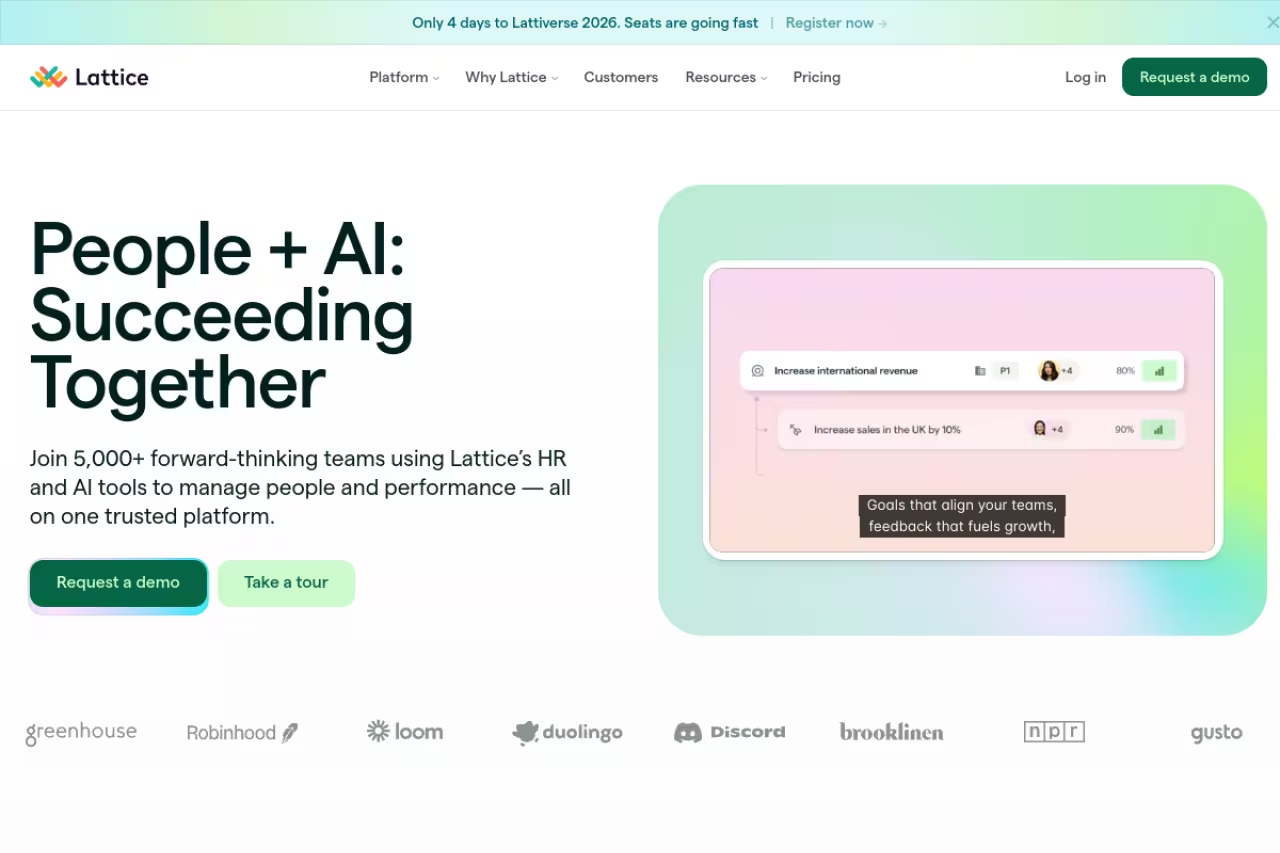
Lattice is the platform I'd hand to most growing companies, and the reason is simple: engagement data is useless if it lives in a vacuum. Lattice puts pulse surveys, eNPS, and onboarding/exit surveys right next to performance reviews, 1:1s, and goals. When a survey flags a disengaged team, the manager is already in the tool where they run check-ins, so there's a path to actually do something about it.
Who it's best for: companies of roughly 50 to 1,000 people that want one system for engagement and performance instead of stitching two together. HR teams that care about follow-through will get the most out of it.
The one to hand growing companies of roughly 50 to 1,000 people that want engagement and performance in one system, with AI survey analysis and Mercer benchmarks. Modular pricing creeps toward $16 per user, and the $4,000 annual minimum is a poor fit under about 30 people.
Pricing is modular. The Engagement module runs about $4 per user per month, while the performance bundle starts around $11 per user per month, billed annually, with a $4,000 annual minimum. The Lattice Engagement page details the survey and benchmark features but, like most enterprise HR tools, hides exact pricing behind a demo.
The standout is the AI analysis on survey results. It surfaces the top drivers and suggested next steps in seconds instead of leaving you to read open-text comments line by line. Benchmarks pull from Mercer data, so you can see whether your scores are actually low or just normal for your size.
The catch: the modular pricing adds up fast. Engagement alone is cheap, but once you add performance, goals, and grow modules, you're closer to $16 per user, and the annual minimum makes it a poor fit for teams under about 30 people. It's also more platform than a 15-person startup needs.

Culture Amp: best for enterprise depth and benchmarks
Culture Amp is the platform people-science teams ask for by name. It has been doing engagement surveys longer than almost anyone, and it shows in the depth: lifecycle surveys, action planning, granular sub-group analysis, and the largest benchmark dataset in the category. If you want to compare your engagement against thousands of other companies by industry and stage, this is the strongest option.
Who it's best for: organizations of 500-plus employees with a dedicated People or HR analytics function. The reporting rewards someone who knows how to slice it.
The choice for organizations of 500-plus employees with a dedicated People analytics function, thanks to unmatched benchmarks and action planning. It is quote-only, costly and complex, so a 100-person company would pay for depth it will not touch.
Pricing is quote-only. Culture Amp publishes nothing, which is a real annoyance. Based on consistent market data, the engagement module lands roughly in the $5 to $9 per employee per month range, with combined engagement-and-performance suites running higher, and enterprise contracts for 1,000-plus employees commonly hitting $36,000 to $45,000 a year. Multi-year deals typically shave 15 to 25% off. Independent pricing breakdowns like PeopleOpsClub's guide line up with those numbers.
The standout is benchmarking. No competitor has a comparable dataset, and the action-planning tools nudge managers toward concrete steps rather than leaving them with a score and a shrug.
Where it falls short: cost and complexity. For a 100-person company, Culture Amp is overkill and overpriced. The quote-only model also means you can't sanity-check the price without sitting through a sales process. If you don't have someone who lives in the analytics, you're paying for depth you won't touch.

15Five: best for transparent, mid-market pricing
15Five is the rare engagement vendor that puts its prices on the website, and that alone earns it a spot. The Engage plan is $4 per user per month, Perform is $11, and the Total Platform is $16, all billed annually. You can read 15Five's pricing page and know exactly what you'll pay, which is refreshing in a category built on "request a demo."
Who it's best for: mid-market companies, roughly 100 to 500 employees, that want engagement plus weekly check-ins and want to compare costs without a sales call.
The engagement side covers surveys, targeted assessments, action planning, heat maps, and benchmarking. The weekly check-in format (the namesake "15 minutes to write, 5 to read") is the differentiator. It keeps a steady drip of manager-employee conversation going between formal surveys, which is where most engagement actually moves.
The standout is the combination of price transparency and the check-in cadence. You always know the cost, and the product is built around a habit rather than a once-a-year event.
The catch: the engagement analytics aren't as deep as Culture Amp's, and the benchmark dataset is smaller. If your whole reason for buying is heavy people-analytics, 15Five will feel light. It's a strong generalist, not a specialist.
Pick it if you want engagement plus weekly check-ins at published prices, for roughly 100 to 500 employees. The Engage plan is $4 per user per month, but analytics and benchmarks are lighter than Culture Amp's, so it is a strong generalist, not a specialist.
If you're building out the rest of your stack, our roundup of the best AI tools for HR covers the recruiting and onboarding side that sits next to engagement.

Bonusly: best for recognition-led culture
Bonusly takes a different angle. Instead of starting with surveys, it starts with recognition: small peer-to-peer bonuses that employees give each other, redeemable for real rewards. It sounds gimmicky until you watch adoption. Recognition feeds get used daily, while surveys get used twice a year, and daily beats annual for keeping a pulse on culture.
Who it's best for: teams of any size that want to build a recognition habit. It's especially good for distributed and remote teams where casual appreciation otherwise disappears.
There's a genuinely useful free plan for up to 8 users. The paid Team plan with the Bizy AI assistant is $5 per user per month (or $3 without the AI add-on), per Bonusly's pricing page, with the Organization tier moving to custom pricing for SSO, awards, and a dedicated CSM.
The standout is that recognition actually drives engagement signal. Bonusly added pulse analytics so you get sentiment data out of the activity rather than running a separate survey program. Slack and Teams integrations mean it lives where people already work.
Where it falls short: it's recognition first and survey second. If you need rigorous engagement measurement, lifecycle surveys, and benchmark comparisons, this isn't that tool. It's the culture layer, not the analytics layer.
Go with it to build a recognition habit, especially on distributed teams, with a free plan for up to 8 users. It is the culture layer, not the analytics layer, so look elsewhere for rigorous surveys and benchmark comparisons.
Workleap Officevibe: best for small teams that want it simple
Workleap Officevibe is the one I'd point a 30-person company to if they've never run an engagement program before. Setup is genuinely low-friction. Pulse surveys, anonymous feedback, eNPS, and peer recognition through "Good Vibes" all work out of the box, and it tracks 10 core engagement metrics without you configuring anything.
Who it's best for: SMBs and first-time buyers who want results in a week, not a quarter.
There's a free tier for a single team, and paid plans land around $5 per user per month on annual billing with a 10-user minimum. You can read more in our Workleap review. For a company that just wants to know how people feel and act on it quickly, the price-to-value is hard to beat.
The standout is simplicity. The weekly pulse cadence and plain-language reporting mean a non-HR manager can run the whole thing.
The catch: simplicity has a ceiling. As you grow past a few hundred people, you'll want the deeper segmentation and benchmarks that Culture Amp or Lattice offer. Officevibe gets you started; it doesn't always scale with you.
The simple starting point for SMBs and first-time buyers who want results in a week, at around $5 per user per month. Simplicity has a ceiling, though: past a few hundred people you will want the deeper segmentation and benchmarks of Culture Amp or Lattice.
If your team is fully remote, pair it with the right collaboration stack. Our guide to the best communication tools for remote teams is a good companion read.

Nectar: best for recognition with built-in rewards
Nectar sits in the same recognition lane as Bonusly but leans harder into the rewards side. It ships with a swag store, reward cards, and an automated way to handle birthdays and work anniversaries, so the appreciation runs itself instead of relying on a manager remembering.
Who it's best for: companies that want recognition plus a real rewards catalog without building one themselves, especially distributed teams that can't do in-office perks.
The Plus plan is $5 per employee per month billed annually, and Premium is $6, which adds a nominations program, swag store, and multi-language support. Note the $4,000 annual minimum and that Nectar dropped its free tier, though a free trial is still available.
The standout is the rewards depth. Between gift cards, charitable donations, company swag, and Amazon redemptions, employees rarely run out of things they actually want.
Where it falls short: like Bonusly, it's a recognition tool, not a survey platform. The engagement insights are a byproduct of recognition activity, not a dedicated measurement suite. And the $4,000 floor makes it pricey per-seat for very small teams.
Choose it for recognition with a real rewards catalog, swag store and automated anniversaries, especially for distributed teams. It is not a survey platform, and the $4,000 annual minimum makes it pricey per seat for very small teams.
Connecteam: best for frontline and deskless teams
Connecteam solves a problem the other tools on this list mostly ignore: most engagement software assumes everyone sits at a laptop. If your workforce is construction crews, retail staff, restaurant teams, or field technicians, surveys-by-email is a non-starter. Connecteam is mobile-first and built for people who don't have a company inbox.
Who it's best for: deskless and frontline operations. This is the only tool here designed for staff who live on their phones, not in Slack.
The free plan covers up to 10 users, which is unusually generous. Paid plans use hub-based pricing starting around $29 per month flat for the first 30 users on the Basic Operations hub, scaling up through Advanced and Expert tiers. Our Connecteam review goes deeper on the bundles.
The standout is fit. It rolls communication, scheduling, time tracking, recognition, and surveys into one app that frontline workers actually open, because they're already using it to see their shifts.
The catch: it's a workforce-management app first and an engagement tool second. The survey and recognition features are solid but lighter than a dedicated platform. If you have a desk-based team, this is the wrong category entirely.
The only tool here built for deskless and frontline staff who live on their phones, with a free plan for up to 10 users. It is a workforce app first, so surveys and recognition are lighter, and a desk-based team should look elsewhere.

WorkTango: best for unified enterprise recognition and surveys
WorkTango (formerly Kazoo) tries to do what most vendors split into two products: recognition and engagement surveys in one platform. For enterprises that don't want to run Bonusly for recognition and Culture Amp for surveys, that consolidation is the pitch.
Who it's best for: larger organizations that want recognition, rewards, surveys, and goals from a single vendor with one contract and one login.
A fit for larger organizations that want recognition, rewards, surveys and goals under one contract and one login. It is quote-only and enterprise-priced, so a company under a few hundred people is better served by Bonusly or Officevibe.
Pricing is quote-only and scales with employee count and which modules you turn on (Recognition & Rewards, Surveys & Insights, Goals & Feedback). Expect enterprise-tier pricing rather than the per-seat self-serve rates of the smaller tools.
The standout is the unified data. Because recognition and survey signals live together, you get a fuller picture of engagement than a survey-only tool, and recognition behavior becomes a leading indicator you can actually watch.
Where it falls short: it's an enterprise buy. There's no quick self-serve path, and for a company under a few hundred people, you're better served by Bonusly or Officevibe at a fraction of the cost and setup.
Before you commit to any of these, it's worth keeping your broader stack in mind. You can browse our top tools directory to see how engagement software fits alongside the rest of your team's workflow.
How to choose
Don't start with the feature list. Start with two questions.
First, what's your actual goal? If you want to measure engagement and act on it with analytics, you're shopping for a survey platform: Lattice, Culture Amp, or 15Five. If you want to build a recognition culture day to day, you're shopping for recognition tools: Bonusly, Nectar, or WorkTango. Buying a survey tool when you wanted recognition (or the reverse) is the most expensive mistake here.
Second, where do your people work? Desk-based teams have a dozen good options. Frontline and deskless teams really have one: Connecteam. Don't force an email-survey tool on people without an inbox.
From there, size decides the rest. Under 50 people: Officevibe or Bonusly, both have free tiers and near-zero setup. 50 to 500: Lattice or 15Five, with 15Five winning if price transparency matters and Lattice winning if you want performance management too. 500-plus with a real analytics function: Culture Amp. The deeper you go, the more the benchmark quality and segmentation justify the cost.
One more thing. Whatever you pick will only work if managers act on it. Budget time for that, not just license fees. A cheap tool people use beats an expensive one they ignore.
If you want to keep up with how AI is reshaping HR and the rest of the workplace, Dupple X is our membership for operators who'd rather skim a sharp briefing than read 40 vendor blogs.
FAQ
What is the best employee engagement software in 2026?
For most companies, Lattice is the best overall because it combines engagement surveys with performance management and goals in one tool, so survey data actually leads to action. Culture Amp is the strongest choice for large enterprises that need deep benchmarks, and Bonusly is best if your priority is building a recognition culture rather than running formal surveys.
How much does employee engagement software cost?
It ranges from free to enterprise. Engagement-only modules typically run $4 to $9 per employee per month. Bonusly and Connecteam offer free plans (up to 8 and 10 users respectively). Full platforms that bundle engagement and performance run $11 to $16 per user. Enterprise contracts with Culture Amp or WorkTango can reach $36,000 to $45,000 a year for 1,000-plus employees.
What's the difference between engagement software and recognition software?
Engagement software (Lattice, Culture Amp, 15Five) measures how employees feel through surveys, eNPS, and analytics. Recognition software (Bonusly, Nectar) builds culture through peer-to-peer appreciation and rewards. Many companies run both, since recognition activity generates daily signal while surveys give you structured measurement a few times a year.
Is there free employee engagement software?
Yes. Bonusly is free for up to 8 users, Connecteam is free for up to 10 users, and Workleap Officevibe has a free tier for a single team. These are real free plans, not trials, and they're enough for a small team to start a recognition or pulse-survey habit before paying anything.
What's the best engagement tool for frontline and deskless workers?
Connecteam, by a wide margin. It's mobile-first and built for staff who don't have a company email or laptop, such as retail, restaurant, construction, and field teams. Most engagement platforms assume desk-based employees and rely on email surveys, which frontline workers rarely see.
Do I need a separate tool for performance reviews?
Not necessarily. Lattice and 15Five include performance management in their higher tiers, so you can run engagement and reviews from one platform. If you want a dedicated solution instead, see our guide to the best AI performance review tools for options that focus specifically on reviews and feedback.
Related guides
Some offers on this page may be paid placements or contain affiliate links.
Across our whole catalogue the median is $24 a month and 33% of tools advertise a free tier. Figures are the lowest recurring monthly price quoted in our own review of each tool, read on 2026-08-19. Full method and every category.
