
Best Employee Benefits Software (2026): I Compared 8 Platforms

Key facts8 tools compared: Gusto, Rippling, Justworks, Deel, BambooHR, Forma, Compt, Benepass
- 8 tools compared: Gusto, Rippling, Justworks, Deel, BambooHR, Forma, Compt, Benepass
- Gusto (best for: US SMBs wanting payroll + benefits in one): From $49/mo + $6/employee
- Rippling (best for: Companies wanting HR + IT + benefits unified): Core ~$8/employee, benefits add-on ~$6
- Justworks (best for: Small teams wanting big-company health plans): $59-$109/employee/mo (PEO)
- Deel (best for: Global and remote teams): EOR quote-based, 150+ countries
Benefits are where good companies quietly lose people. The health plan looks fine on paper, then open enrollment turns into a three-week email chain, a spreadsheet nobody trusts, and a new hire in another state who can't figure out how to add a dependent. The software you pick decides whether that whole thing runs itself or eats a week of someone's month every year.
I spent the last few weeks in pricing pages, vendor quotes, and benchmark reports to figure out what actually holds up in 2026. The short version: if you're a US small or mid-size company that wants payroll and benefits in one clean system, Gusto is the one I'd start with. If you want HR, IT, and benefits welded together with deep automation, Rippling wins. If your problem is perks and stipends rather than health insurance, you need a completely different category of tool.
This guide is for founders, HR leads, and operators picking a platform for a team of roughly 5 to 500 people. I've split it by what you're actually trying to solve, because "benefits software" means at least three different products depending on who you ask.
Quick comparison
| Tool | Best for | Price (2026) | Standout |
|---|---|---|---|
| Gusto | US SMBs wanting payroll + benefits in one | From $49/mo + $6/employee | No-markup brokerage, clean UX |
| Rippling | Companies wanting HR + IT + benefits unified | Core ~$8/employee, benefits add-on ~$6 | Automation depth, carrier sync |
| Justworks | Small teams wanting big-company health plans | $59-$109/employee/mo (PEO) | Fortune 500 group rates for 2+ people |
| Deel | Global and remote teams | EOR quote-based, 150+ countries | In-country benefits and compliance |
| BambooHR | HR-first teams adding a benefits module | From $10/employee + ~$5 benefits add-on | Self-service employee experience |
| Forma | Flexible lifestyle and wellness benefits | ~$3-5/employee/mo platform fee | Visa card + store + reimbursement |
| Compt | Reimbursement-based stipends and LSAs | Fixed annual tiered pricing based on headcount | Open spending, no merchant lock-in |
| Benepass | LSAs for smaller teams | ~$2.40/employee/mo platform fee | Card-based, affordable entry point |

Gusto: the default for US small businesses
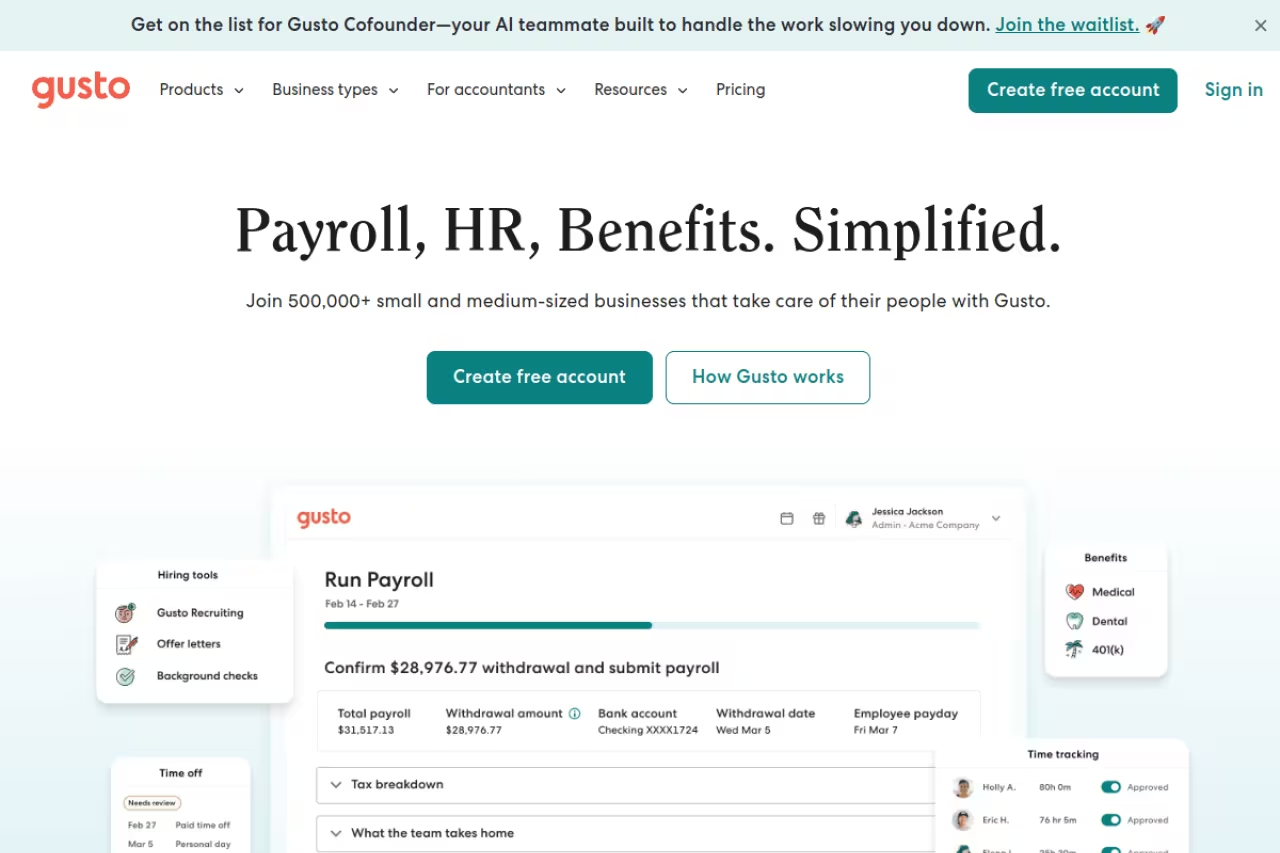
Gusto started as payroll and grew into a full people platform, and benefits admin is one of the parts it does without making you suffer. You can run health, dental, and vision, plus 401(k), commuter benefits, FSA, and HSA, all tied to the same payroll engine so deductions just work.
The default for US companies under ~200 employees that want one system for paying and insuring people, with a guided enrollment flow a non-specialist HR person can run. The catch is a 23% Simple base fee jump in April 2026 and US-only coverage.
Pricing is published, which is rarer than it should be. The Simple plan runs $49/month plus $6 per person, Plus is $80/month plus $12 per person, and Premium is $180/month plus $22 per person, per Gusto's pricing. The part I like most: buy insurance through Gusto's own brokerage and there's no extra platform fee for benefits administration. You pay carrier premiums and that's it.
The standout is the UX. Employees self-enroll during a guided flow, the system flags compliance items, and new-hire onboarding pulls everything into one place. For a non-specialist HR person, that beats any feature checklist.
The catch: Gusto raised the Simple base fee from $40 to $49 in April 2026, a 23% jump, and if you bring your own broker instead of theirs, you'll pay $6 per eligible employee per month on the lower tiers. It's also US-only. The moment you hire abroad, you've outgrown it.
Rippling: benefits as one module in a bigger machine
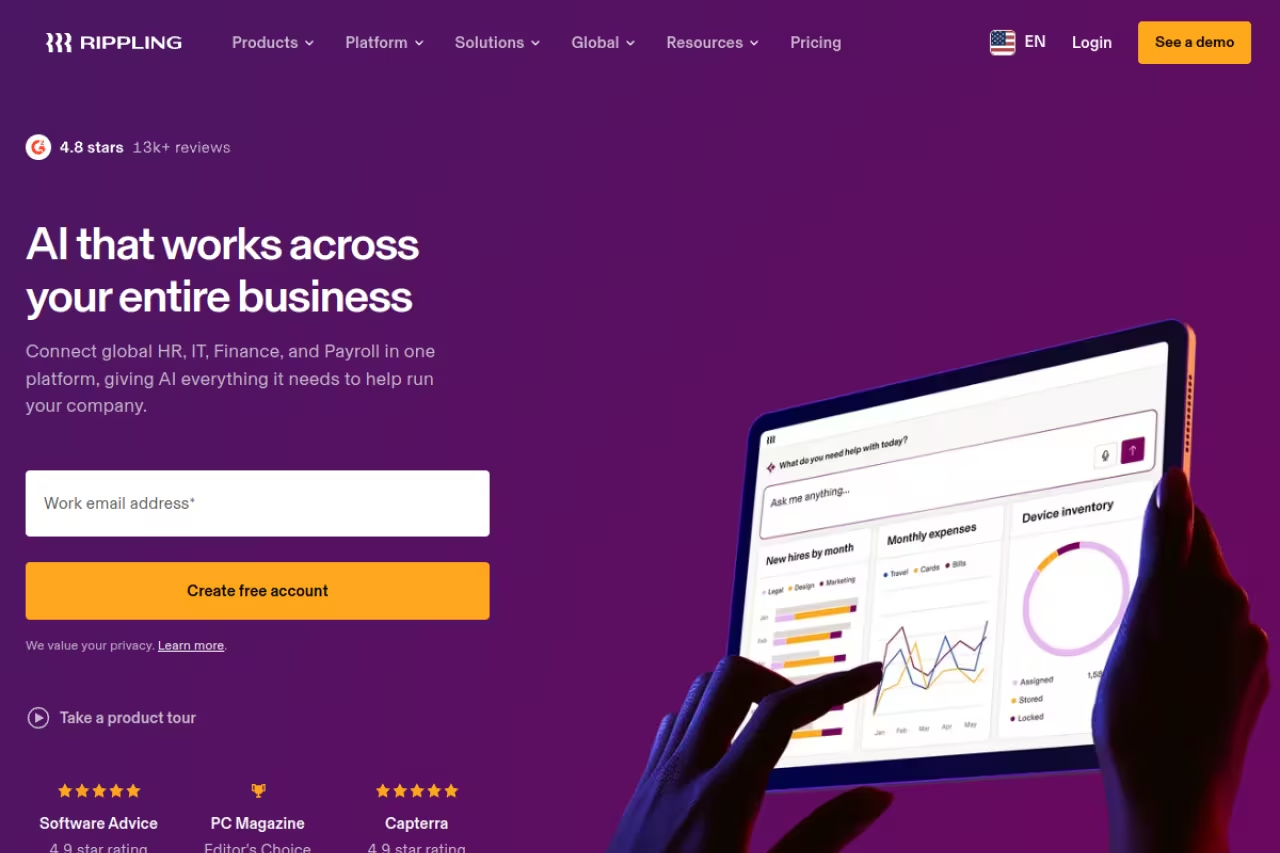
Rippling's pitch is that HR, IT, and finance shouldn't live in separate tools. Benefits administration is a module that plugs into the same employee record that handles payroll, devices, and app access. Onboard someone once and their health enrollment, laptop, and Slack account all spin up together.
Strong for companies of 50 to 500 employees tired of stitching five systems together, with deep carrier integrations and near hands-off open enrollment. Skip it if you are a 10-person startup: quote-based pricing and annual contracts make it overkill.
This shines around 50 to 500 employees.
Pricing is modular and quote-based, the trade-off for the flexibility. The Core platform starts around $8 per employee per month, and the benefits module typically adds about $6 PEPM, with a full HR + payroll + benefits + time stack landing roughly in the $22 to $30 per employee range, per Rippling pricing analyses. Carrier integrations for health, dental, vision, and 401(k) are deep, and open enrollment is close to hands-off.
Where it falls short: you can't see real numbers without talking to sales, annual contracts are mandatory, and implementation fees reportedly range from $1,500 to $20,000 by size. For a 10-person startup that just needs health insurance, Rippling is overkill and the contract structure will annoy you.

Justworks: small-team health plans at big-company rates
Justworks is a PEO, which means it co-employs your team and pools them with thousands of other small companies to negotiate health insurance. That's the entire reason to use it: a 5-person startup gets access to plans normally reserved for large employers.
Choose it if the quality of the health plans matters more than the software. As a PEO it pools small US businesses into group rates, even teams as small as two, but co-employment adds complexity and lock-in and costs more than standalone payroll.
It's a Certified PEO with access to medical, dental, vision, life, disability, FSA, HSA, commuter benefits, and 401(k) from major carriers like Aetna and UnitedHealthcare. The PEO Basic plan runs about $59 per employee per month, dropping to $49 after 50 employees. PEO Plus, which adds full medical/dental/vision administration, runs roughly $99 to $109 and drops to $89 past 50 people. Teams as small as two can get group coverage.
The standout is access. Cross-checking business.com's review against Justworks' own pages, the consistent theme is that the group rates are the product. Software is the wrapper.
The catch: the PEO model isn't for everyone. Co-employing adds complexity and lock-in, and per-employee costs run higher than a standalone payroll tool. If you already have a great broker, you may not need the pooled-rate advantage you're paying for.

Deel: benefits for teams that cross borders
If your team is spread across countries, US-centric tools fall apart fast. Deel is built for exactly this. Through its Employer of Record service, it offers locally compliant benefits in 150+ countries without you setting up a legal entity in each one.
The pick for remote-first and global companies hiring across borders, with benefits in 150+ countries backed by 110+ directly-owned entities. EOR seats are the expensive part, and a fully domestic US team would pay for breadth it will not use.
Deel handles health insurance, equity, statutory benefits, currency conversion, and local tax compliance from one platform, backed by 200+ in-house legal experts and 110+ directly-owned entities rather than a loose partner network. That ownership is the difference between consistent compliance and a vendor shrugging when a local rule changes.
Pricing is quote-based and depends on whether you're using EOR, payroll, or contractor management. EOR seats are the expensive part, but against the alternative (incorporating abroad), it's cheap.
Where it falls short: it's not the tool for a fully domestic US team. The depth is in international coverage, and you'd be paying for breadth you don't use. For US-only payroll, Gusto or Rippling cost less and feel lighter.

BambooHR: HR-first, benefits bolted on well
BambooHR comes at this from the HR side. It's a well-loved HRIS with a benefits module you add on, rather than a benefits engine with HR features. If your team already lives in BambooHR for time off, performance, and employee records, adding benefits keeps everything in one login.
Go with it if you already want an HRIS and prize a clean employee self-service experience. Benefits is an add-on with weaker carrier depth than Gusto, and stacked fees mean the real number only shows after a sales conversation.
Per BambooHR's pricing, Core runs $10 per employee per month, Pro is $17, and Elite is $25, with companies of 25 or fewer paying a flat rate starting at $250/month. Benefits administration adds roughly $4 to $6 per employee on top, and bundling payroll and benefits together gets you a 15% discount.
The standout is the employee experience. Self-service enrollment, mobile access, and clean reporting make it feel less like enterprise software and more like a consumer app.
The catch: benefits is an add-on, not the core, so carrier integrations and depth aren't as strong as a payroll-native tool like Gusto. You're also stacking fees: base plan plus payroll plus benefits adds up, and the real number only shows after a sales conversation.
A quick aside on building your stack
Picking benefits software is one decision inside a bigger one: which tools your team runs on day to day. If you're auditing your whole stack, our top tools directory, the best AI tools for HR guide, and the best AI recruiting tools roundup pair well with this list. And if you want the weekly signal on what operators are actually adopting, Dupple X is where I keep up.
Forma: flexible lifestyle benefits people actually use
Traditional benefits cover health. Forma covers everything else people care about: fitness, learning, family, wellness, food. Forma runs Lifestyle Spending Accounts, HSAs, FSAs, and HRAs on one platform, with three ways to spend: the Forma Store, a Forma Visa card, or reimbursement.
A good fit for companies layering differentiated perks on top of core health benefits, with a reported 85% budget utilization. It is an add-on, not a replacement, and the platform fee plus stipend is a real budget commitment, with card declines at unrecognized merchants.
The numbers are good. Per Forma's 2026 benchmark report, drawn from nearly a million employees across 300 companies, all-inclusive LSAs hit 85% budget utilization. Forma reports 98% retention and a 75 NPS, with clients like Stripe and Lululemon. Platform fees land around $3 to $5 per employee per month, separate from the stipend budget you fund.
The catch: this is an add-on, not a replacement for health insurance. The platform fee plus the stipend money means real budget commitment, and the card-based model can hit declined transactions when a merchant isn't recognized.
Compt: reimbursement-first stipends without the lock-in
Compt attacks the same problem as Forma from the opposite direction. Instead of a card and a closed store, it's reimbursement-first: you set spending rules and categories, employees buy what they want anywhere, and Compt handles receipts, tax treatment, and payroll sync.
Pick it if you want maximum employee flexibility and hate dictating where people can spend. The open reimbursement model avoids card declines, but pricing needs a sales call and employees front the money and wait to be repaid.
The open model is the standout. No merchant network decides what counts, which kills the "my transaction got declined" friction card-based tools create. Compt reports an average 93% participation rate and says admins spend around 30 minutes a month on it.
The catch: pricing is fixed annual tiered pricing based on headcount with no public number, so you'll need a sales call. Reimbursement also means employees front the money and wait, which some teams dislike versus a preloaded card.
Benepass: the affordable LSA entry point
Benepass is the budget-friendly option in the lifestyle benefits space, especially for smaller teams. It's card-based, positions itself as a market leader in LSAs, and tends to win on price for companies under ~200 employees.
The affordable on-ramp for smaller teams launching an LSA or perks program, with a platform fee around $2.40 per employee per month. It is card-based like Forma, so declines apply, and sub-100-employee quotes reportedly start near $15K, so negotiate.
Per Vendr's marketplace data, the platform fee runs around $2.40 per employee per month, the lowest of the dedicated perks tools here. You fund the stipend on top of that.
The catch: like Forma, it's card-based, so the same declined-transaction friction applies, and reported quotes for sub-100-employee teams have started around $15K before the stipend budget. Negotiate. These vendors routinely come down 15% to 30% on multi-year deals.
How to choose
Don't start with the tool. Start with the problem you actually have.
If your problem is "I need to run payroll and offer health insurance," you want a payroll-native platform. Gusto if you're US-based and want simplicity and published pricing. Rippling if you're bigger and want automation across HR and IT. Justworks if your team is small and you specifically want pooled, big-company health rates.
If your problem is "my team is global," none of those fully solve it. Go straight to Deel, or pair an HRIS like BambooHR with an EOR for your international staff.
If your problem is "my health benefits are fine but my perks are boring," you're in a different aisle entirely. Forma for a polished card-and-store experience, Compt if you want open reimbursement with no merchant restrictions, Benepass if you're small and price-sensitive.
One rule that saves money: never accept the first quote on the perks tools. The 15% to 30% multi-year discount is real and expected. And always run the math on your actual headcount, since per-employee pricing changes shape fast between 10, 50, and 200 people. To scan adjacent categories before you commit, Dupple X covers new tooling weekly.
FAQ
What is the best employee benefits software for small businesses?
For most US small businesses, Gusto is the best starting point because it combines payroll and benefits administration in one system with published pricing from $49/month plus $6 per person. If you specifically want access to large-employer health insurance rates for a team of fewer than 10, Justworks' PEO model is worth the higher per-employee cost.
How much does employee benefits software cost in 2026?
It depends on the type. Payroll-plus-benefits platforms run roughly $6 to $30 per employee per month all-in. Dedicated lifestyle benefits tools charge a smaller platform fee, around $2.40 to $5 per employee per month, plus the actual stipend money you fund. PEOs like Justworks sit higher at $59 to $109 per employee because they include pooled health insurance.
What's the difference between benefits administration and lifestyle benefits software?
Benefits administration software (Gusto, Rippling, BambooHR) manages core insurance like health, dental, vision, and 401(k), including enrollment and compliance. Lifestyle benefits software (Forma, Compt, Benepass) manages flexible stipends and Lifestyle Spending Accounts for things like fitness, learning, and wellness. Many companies run one of each.
Do I need a PEO for employee benefits?
Not necessarily. A PEO like Justworks pools your team with others to negotiate better health insurance rates, which helps small companies that couldn't get good plans alone. But it adds co-employment complexity and costs more per head. If you already have a strong broker relationship or enough headcount to negotiate directly, a standalone platform like Gusto is often cheaper and simpler.
Which benefits software works best for global or remote teams?
Deel is the strongest choice for global teams, offering locally compliant benefits in 150+ countries through its Employer of Record service, without requiring you to open a legal entity in each country. For mixed teams, many companies pair a US HRIS like BambooHR with Deel for their international hires.
Can lifestyle benefits replace health insurance?
No. Lifestyle Spending Accounts and perks platforms like Forma, Compt, and Benepass are designed to complement core health benefits, not replace them. They cover discretionary categories like wellness, fitness, and learning. You still need a medical plan through a payroll platform, PEO, or broker.
Related guides
Some offers on this page may be paid placements or contain affiliate links.
