
Best AI Performance Review Tools (2026)

Key facts8 tools compared: Lattice, 15Five, Leapsome, Workleap Performance, Culture Amp, PerformYard…
- 8 tools compared: Lattice, 15Five, Leapsome, Workleap Performance, Culture Amp, PerformYard, Peoplebox, ChatGPT
- Lattice (best for: Most teams wanting reviews + goals + growth): From $8/seat/mo
- 15Five (best for: Continuous feedback and weekly check-ins): ~$11/user/mo (Perform)
- Leapsome (best for: All-in-one talent and HR suite): From $199/mo
- Workleap Performance (best for: Small teams wanting simplicity): $5/user/mo
Performance review season is the one part of management almost nobody enjoys. You sit down with a blank box, try to remember what someone did eight months ago, and turn it into feedback that is fair, specific, and not accidentally biased. Most managers spend hours on it and still produce something generic.
That is the gap AI is filling right now. The good tools pull from check-ins, peer feedback, and goal data you already have, then draft a review you can actually edit instead of writing from scratch. The bad ones just bolt a chatbot onto an old HR suite and call it "AI." After comparing the main players for this guide, my top pick for most teams is Lattice: it ties reviews to goals and growth, the AI drafts from real data, and it starts at a price small teams can stomach.
This guide is for managers, HR leads, and founders who run review cycles and want to cut the busywork without handing judgment over to a model. Below is a quick comparison, then eight tools reviewed honestly, including where each one falls down.
Quick comparison
| Tool | Best for | Price | Standout |
|---|---|---|---|
| Lattice | Most teams wanting reviews + goals + growth | From $8/seat/mo | AI drafts from real performance data |
| 15Five | Continuous feedback and weekly check-ins | ~$11/user/mo (Perform) | Reviews built from a year of check-ins |
| Leapsome | All-in-one talent and HR suite | From $199/mo | Widest module range in one platform |
| Workleap Performance | Small teams wanting simplicity | $5/user/mo | Cheapest serious option, AI included |
| Culture Amp | Sentiment and theme analysis at scale | ~$4,500/yr min | Groups open-text feedback into themes |
| PerformYard | Flexible, custom review cycles | ~$5-10/user/mo | Review Assist writes inside the form |
| Peoplebox | OKR-driven companies in Slack | From $7/user/mo | Reviews pull straight from OKRs |
| ChatGPT | DIY drafting with no platform | Free or $20/mo | Total flexibility, zero integration |

Lattice
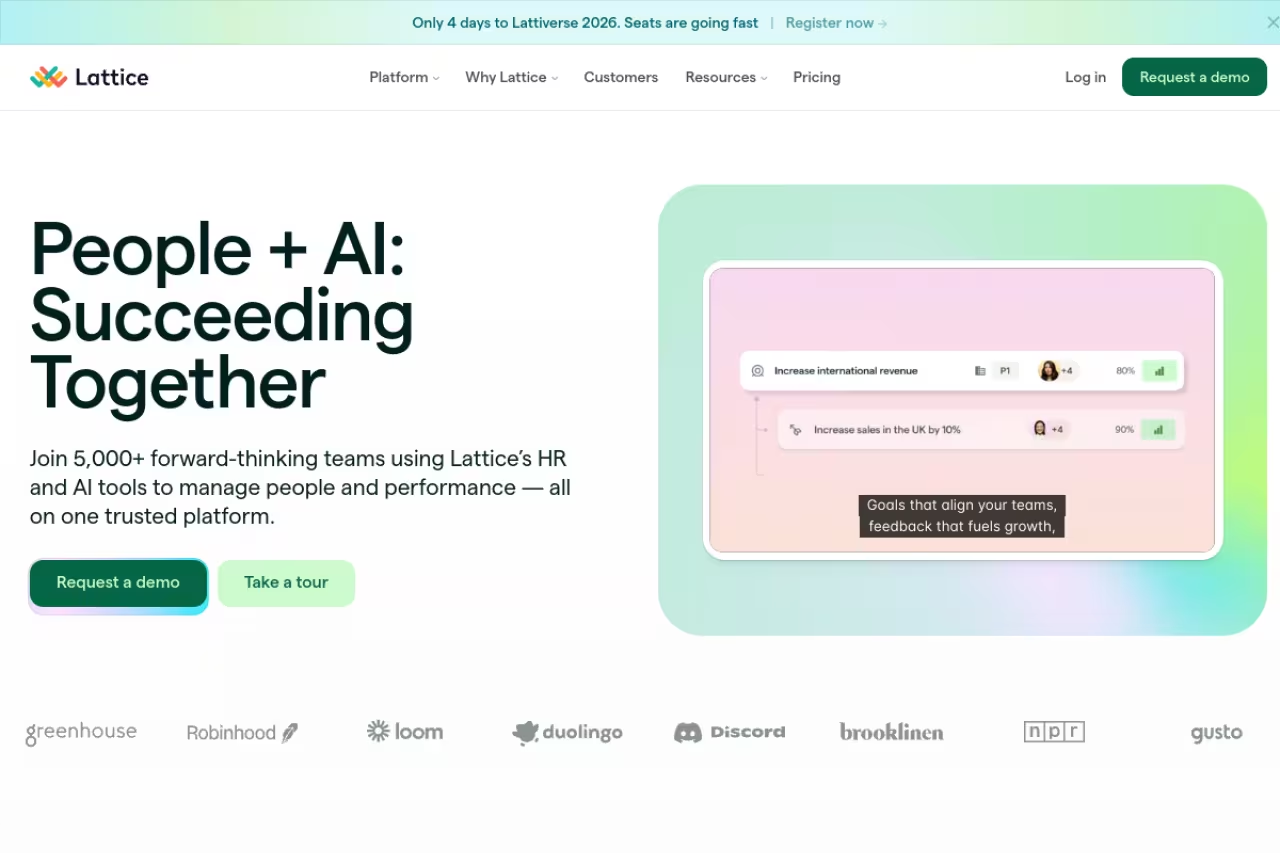
Lattice is the tool I point most teams to first. It is a full performance platform: reviews, goals and OKRs, 1:1s, feedback, and engagement surveys, with AI threaded through each piece rather than parked in a separate "AI" tab.
For reviews specifically, the AI helps managers write balanced summaries, condenses peer feedback into a readable digest, and flags where wording might be unclear or one-sided. Because it sits on top of your goal data and weekly updates, the drafts reference what someone actually shipped, not vague platitudes. That context is what separates a usable draft from a generic one.
The tool I point most teams to first. Lattice ties AI-drafted reviews to goals and weekly updates, so drafts reflect what people actually shipped. It suits teams wanting reviews connected to growth in one system, from 50 people up.
The Performance product is $8 per seat per month, billed annually, and includes reviews, calibration, succession planning, and PIPs. Goals & OKRs is another $8, Engagement is $4, and the Grow add-on (with AI-powered growth areas) is $4. Per the Lattice pricing page, there is a $4,000 minimum annual spend.
The standout: AI that drafts from your real performance history. Calibration tools also help managers normalize ratings across a team so one tough grader does not sink someone's review.
The catch: That $4,000 minimum prices out very small teams, and the cost climbs fast once you stack modules. A 60-person company running Performance, Goals, and Grow is paying real money. Lattice is also sunsetting its HRIS and payroll products by mid-2026 to focus on performance, so if you wanted it as your system of record, that plan is off the table.

15Five
15Five built its name on weekly check-ins, and that is still its core advantage. The whole philosophy is that a good review should be the natural summary of a year of small conversations, not a once-a-year scramble. The AI leans on that history.
When a review cycle opens, 15Five pulls from accumulated check-ins, 1:1 notes, goal progress, and peer recognition (its "High Fives" feature) to give managers a running record to write from. It also includes a 9-box talent matrix and 360-degree feedback, so you get a structured view of where people sit on performance and potential.
A strong choice for managers who want continuous feedback baked into the weekly rhythm, not a heavy annual event. Its AI draws on a year of check-ins, 1:1 notes and recognition.
The Perform plan runs about $11 per user per month and covers reviews, check-ins, and OKRs. Engage (engagement only) is around $4, and Total Platform is roughly $16. There is an AI meeting-notes add-on at $2 per user per month and a Kona AI coaching add-on at $29 per manager per month, per 15Five's pricing documentation.
The standout: Reviews assembled from a real year of check-in data. If your team already does weekly updates, the AI has a lot to work with.
Where it falls short: The model only works if people actually fill out check-ins every week. Teams that adopt 15Five but skip the weekly habit get the same blank-box problem AI was supposed to solve. The add-on pricing for the better AI features also adds up quietly.

Leapsome
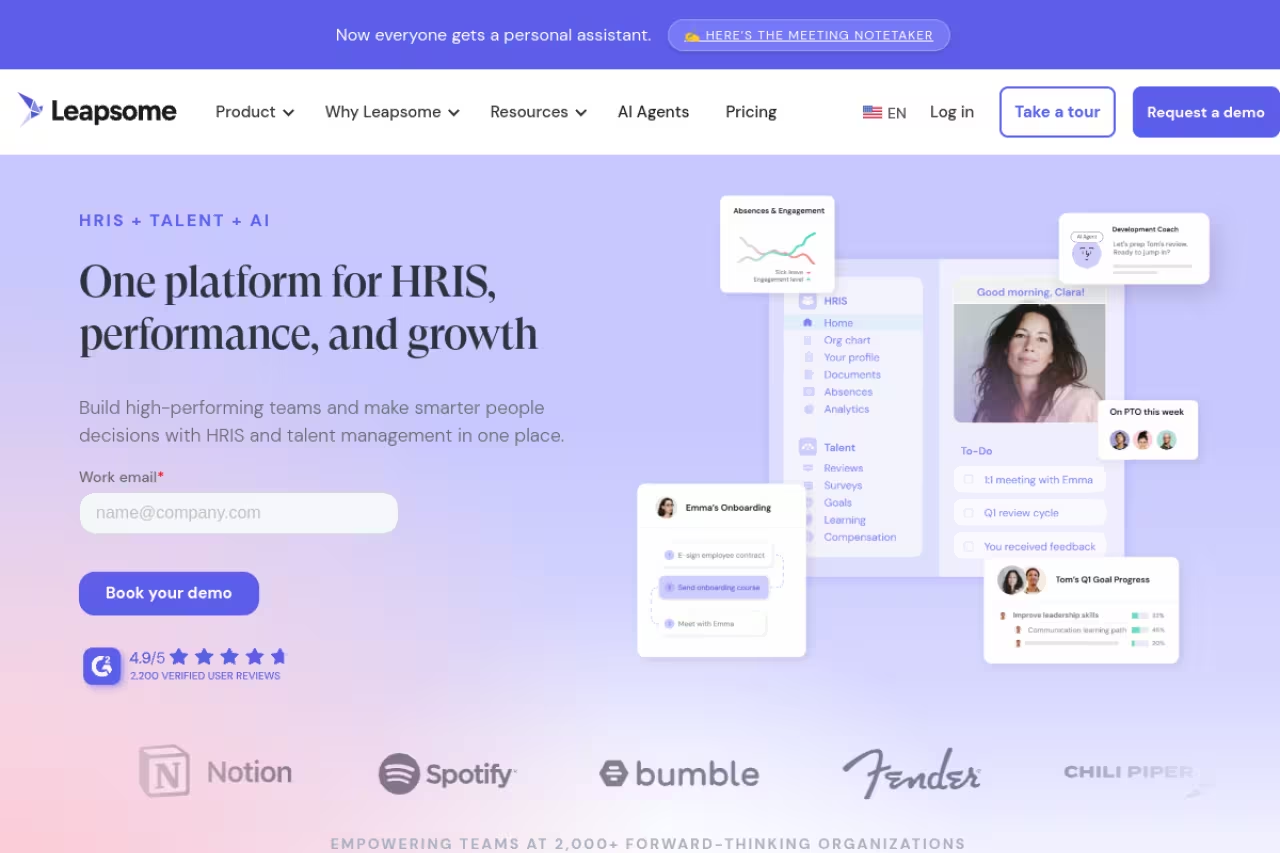
Leapsome is the broadest platform here. It covers performance reviews, engagement surveys, goals, learning, compensation, and a growing HRIS layer, with AI agents included across the board rather than sold as an upsell.
For reviews, Leapsome's competency frameworks are a strong point. You define what "good" looks like for each role and level, and reviews map back to those competencies, which keeps feedback consistent across managers. The AI helps draft and refine, and the multi-language support is genuinely useful for distributed teams running reviews in several countries.
The broadest platform here, covering reviews, engagement, goals, learning and compensation, with AI included. A fit for mid-size and larger companies, but Leapsome no longer publishes simple per-seat tiers.
Leapsome no longer publishes simple per-seat tiers. The pricing page lists a starting point of $199 per month and runs on custom quotes based on modules and headcount, with multi-module and volume discounts. AI agents, workflows, analytics, and instant feedback come standard.
The standout: The widest module range of any tool on this list, with AI included rather than gated behind an add-on. Competency-based reviews keep things consistent at scale.
The catch: Breadth is also the downside. For a team that only wants to run reviews, Leapsome is more platform than you need, and the custom-quote model means you cannot just check a price and sign up. Expect a sales call.
If your goal is less "buy an HR platform" and more "get your team using AI well day to day," that is a different problem. Dupple X bundles the major AI models and tools into one subscription so your people can draft, summarize, and analyze without juggling ten logins.
Workleap Performance
Workleap Performance is the value pick. It does the core job well: a review cycle builder, 360 feedback, AI-guided writing, and analytics, without the enterprise weight or the enterprise price.
The AI is included with the product, not sold separately, which is refreshing. It surfaces trends across reviews and surveys, highlights potential issues, and generates recommendations managers can act on. The interface is clean enough that managers who hate review software tend to complain less.
The value pick for small and mid-size teams that want a real performance tool without a four-figure floor. AI is included, though there is a 10-user minimum.
Workleap Performance is $5 per user per month on annual billing (or $6.25 monthly), with a 10-user minimum, and standard AI is included. There is an optional Manager Agent add-on at $99 per manager per month for proactive insights and review drafting. Note that Workleap also lists packaged annual plans (Standard at $4,999/yr, Pro at $11,999/yr) on its main pricing page, so confirm which structure applies to your headcount.
The standout: The cheapest credible option here, with AI bundled in. For a 30-person team, the math is hard to beat.
Where it falls short: It is lighter on the deep talent-management features (succession planning, detailed calibration, compensation) that bigger orgs eventually want. The Manager Agent, where a lot of the better AI lives, is a steep $99 per manager.

Culture Amp
Culture Amp started in engagement surveys and grew into performance, and it shows in where its AI is strongest: making sense of large volumes of text feedback. If you run 360s or engagement surveys across hundreds of people, Culture Amp's AI groups open-text responses into themes and drafts executive-ready summaries so you are not reading every comment by hand.
Its Perform module handles reviews, goals, and development, with sentiment tracking and comment comparison layered on top. For people-analytics teams, the data depth is the draw.
Pick Culture Amp if you run large 360s or engagement surveys and need AI to make sense of open-text feedback. It suits larger organizations, but prices are unpublished and start high.
Culture Amp does not publish prices. Multiple resellers put the floor around $4,500 per year, with per-employee costs roughly $9 to $14 per month depending on modules. The Perform module is quoted separately. There is no free plan.
The standout: Turning thousands of free-text comments into readable themes and summaries. That is a genuinely hard problem and Culture Amp does it well.
The catch: It is built for scale, so small teams will find it heavy and expensive for what they need. Pricing opacity means budgeting requires a sales conversation, and the performance side has historically been less mature than the engagement side it grew from.

PerformYard
PerformYard takes the opposite approach to the all-in-one platforms: it is deliberately flexible. You can configure almost any review cadence, format, or workflow, which suits companies whose process does not fit a template.
Its AI shows up as Review Assist, which gives real-time writing suggestions inside the review form, and Review Summary, which pulls instant highlights of strengths and growth areas. Rather than generating a whole review unprompted, it supplements the manager who is already writing, which some HR teams prefer for keeping a human firmly in the loop.
The flexible option for teams whose review process does not fit a template. Its AI supplements the manager who is already writing, which keeps a human in the loop, but AI is priced as an add-on.
PerformYard starts around $5 to $10 per person per month for core performance management, with engagement and AI features priced as add-ons. The final number is custom-quoted, so expect a call.
The standout: Configurability. If you have a multi-stage, multi-rater process that other tools choke on, PerformYard usually handles it.
Where it falls short: The AI is more assistant than author. If you wanted the tool to generate full drafts from your performance data the way Lattice or 15Five do, PerformYard's help is lighter. The custom-quote pricing also makes quick comparison annoying.

Peoplebox
Peoplebox is the pick for OKR-driven companies, especially ones that live in Slack. It connects reviews directly to goals and OKRs, so feedback is anchored to measurable outcomes rather than impressions. The AI drafts reviews, summarizes feedback, and runs continuous performance nudges.
The Slack-native experience matters more than it sounds. When check-ins, feedback requests, and review reminders happen where people already work, completion rates go up, which is half the battle with any review tool.
The pick for OKR-driven companies that live in Slack, tying reviews directly to goals. Slack-native nudges help completion rates, and pricing starts lower than the big suites.
Peoplebox starts around $7 per person per month for talent management and $8 for the OKR platform, with a full Professional suite around $12 per person, billed annually.
The standout: Reviews that pull straight from OKR progress, so the conversation is about results, not vibes. Strong fit for companies that already take OKRs seriously.
The catch: If your company does not run on OKRs, a chunk of the value evaporates, and you are paying for a goal engine you barely use. Implementation and setup can also run into real money for larger rollouts.

ChatGPT (the DIY route)
Not every team needs a platform. If you run reviews in a doc or spreadsheet and just want help writing them, ChatGPT is the cheapest, most flexible option. Paste in your notes, a few bullet points on what someone did, and the competencies you are rating against, and it will produce a structured draft in seconds.
The trade-off is that it knows nothing about your people unless you tell it. There is no integration, no calibration, no audit trail, and you are responsible for stripping out anything generic or off-base. But for a founder doing reviews for eight people, that is often fine, and a good prompt beats a blank page every time. For broader ideas on using it at work, our guide on how to use ChatGPT for work digs deeper.
The cheapest, most flexible route for small teams and solo managers who run reviews in a doc. It knows nothing about your people unless you tell it, with no integration, calibration or audit trail.
Free on the basic tier, $20 per month for Plus. No per-seat HR cost at all.
The standout: Total flexibility and near-zero cost. You control the prompt, the tone, and the structure.
Where it falls short: Everything a platform gives you, it does not: no data integration, no bias-flagging tuned to HR, no record-keeping, and a real risk of pasting sensitive employee data into a general tool. Treat it as a writing aid, not a system.
How to choose
Start with one question: do you need a system, or just a drafting tool?
If you run reviews for fewer than ten people and already have your notes, skip the platforms. ChatGPT plus a shared doc will save you the most time for the least money.
If you need a system, sort by what you already do. Run weekly check-ins? 15Five turns that habit into reviews. Live and die by OKRs? Peoplebox anchors feedback to them. Want one tool for performance, learning, and HR? Leapsome is the broadest. Watching budget on a small-to-mid team? Workleap at $5 a seat is the value play. Need engagement and sentiment analysis across hundreds of people? Culture Amp.
For most teams that want a strong all-rounder where AI drafts from real data, Lattice is the safe default. The one trap to avoid: do not buy a platform for its AI demo. The AI is only as good as the check-in, goal, and feedback data feeding it, so the tool that fits your existing habits will always beat the one with the flashiest model. If your wider goal is getting the whole team fluent in AI tools, browse our top AI tools roundup and the best AI tools for HR for adjacent picks.
FAQ
What is the best AI tool for writing performance reviews?
For most teams, Lattice is the best all-around choice because its AI drafts from real goal and feedback data, not a blank prompt. If you only want a writing aid and run reviews in a doc, ChatGPT is the cheapest option. For continuous-feedback teams, 15Five pulls reviews from a year of weekly check-ins.
Can AI write a full performance review by itself?
It can produce a solid draft, but you should never ship it unedited. AI tools draft strengths, suggest development goals, and flag biased language, yet they cannot judge context or weigh trade-offs the way a manager can. The fastest workflow is to let AI write the first pass, then spend your time refining the parts that need human judgment.
How much do AI performance review tools cost?
Entry-level dedicated tools start around $5 per user per month (Workleap, PerformYard). Mid-tier platforms like Lattice and 15Five run roughly $8 to $16 per seat once you add the modules you need, often with a $4,000-plus annual minimum. Enterprise tools like Culture Amp and Leapsome use custom quotes that typically start near $4,500 a year. ChatGPT, at $20 a month flat, undercuts all of them if you do not need integration.
Is it safe to put employee data into AI review tools?
Dedicated HR platforms like Lattice and 15Five are built for it, with access controls and data handling designed for sensitive performance data. The risk comes from general tools: pasting names, salaries, or detailed feedback into a consumer ChatGPT account is a privacy and compliance concern. Many organizations involve legal and HR before adopting AI in reviews, since it touches employment law and anti-discrimination rules.
Do AI performance reviews reduce bias?
They can help by flagging loaded or one-sided language and by normalizing ratings through calibration, which several platforms offer. But AI can also reproduce bias baked into its training or your historical data, so it is not a fix on its own. Use it to catch obvious problems, and keep a human reviewing every output.
Ready to get your team using AI the right way across reviews and everything else? Try Dupple X for one subscription that covers the major models and tools, no per-app juggling.
Related guides
Some offers on this page may be paid placements or contain affiliate links.
Across our whole catalogue the median is $24 a month and 33% of tools advertise a free tier. Figures are the lowest recurring monthly price quoted in our own review of each tool, read on 2026-08-19. Full method and every category.
