
The Best CRM for Ecommerce in 2026: 8 Tools I'd Actually Trust With Your Customer Data

Key facts8 tools compared: Klaviyo, HubSpot, Drip, Omnisend, Gorgias, Brevo, Zoho Bigin, Salesforce
- 8 tools compared: Klaviyo, HubSpot, Drip, Omnisend, Gorgias, Brevo, Zoho Bigin, Salesforce
- Klaviyo (best for: Shopify retention & email/SMS): Free up to 250 profiles; ~$20/mo at 500
- HubSpot (best for: All-in-one sales + marketing + service): $20/seat/mo (promo $7-10)
- Drip (best for: DTC brands focused on automation): $39/mo for 500 contacts
- Omnisend (best for: Best value for small/mid stores): Free; $16/mo paid
Most "ecommerce CRM" lists are written by people who have never reconciled a Shopify order export against a customer profile at 2am. They list 15 tools, slap a star rating on each, and call it a day. That doesn't help you decide anything.
So I'm going to do the opposite. I advise online stores, and I've compared most of these platforms on pricing, integrations, and public reviews. The honest truth is that "CRM" means three different things in ecommerce: the retention engine that emails and texts your buyers (Klaviyo, Drip, Omnisend), the sales-and-service hub that tracks every contact and deal (HubSpot, Zoho, Salesforce), and the support inbox that turns tickets into revenue (Gorgias). Most stores need one of the first three, not all of them.
If you sell on Shopify and care about repeat purchases, my top pick is Klaviyo. It owns the retention category for a reason. But it's not the cheapest, and it's overkill for some stores, so read on before you sign up for anything. This is for founders and operators running real stores, not enterprises with a six-figure software budget.
Quick comparison
| Tool | Best for | Starting price | Standout |
|---|---|---|---|
| Klaviyo | Shopify retention & email/SMS | Free up to 250 profiles; ~$20/mo at 500 | Sub-200ms Shopify data sync |
| HubSpot | All-in-one sales + marketing + service | $20/seat/mo (promo $7-10) | One record for the whole customer journey |
| Drip | DTC brands focused on automation | $39/mo for 500 contacts | Every feature on every plan |
| Omnisend | Best value for small/mid stores | Free; $16/mo paid | Email + SMS + push in one flow |
| Gorgias | Support-driven stores | $10/mo Starter | Edit Shopify orders inside tickets |
| Brevo | Budget multichannel | Free (300 emails/day); ~$9/mo | Pay by sends, not contact count |
| Zoho Bigin | Cheap, simple sales pipeline | Free; $7/user/mo | Real CRM at email-tool prices |
| Salesforce | Enterprise & complex orgs | Custom (high) | Scales past anything else here |

Klaviyo: the default for Shopify stores
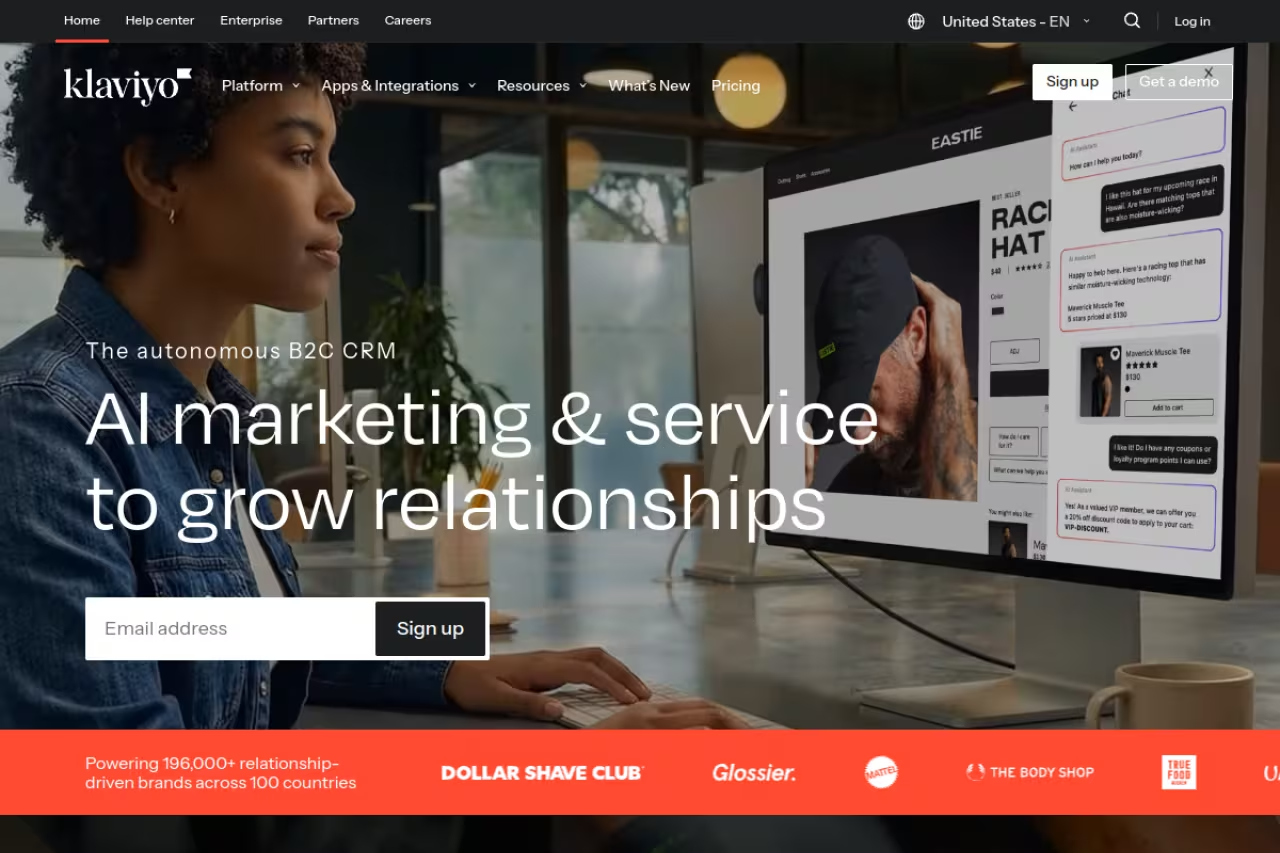
Klaviyo is a customer data platform with email and SMS bolted to the front of it, and it was effectively built for Shopify. It's been Shopify's CRM partner for over a decade, and according to Digital Commerce 360, more than 117,000 brands now run both together, with commerce data flowing in under 200 milliseconds. That speed matters: an abandoned-cart flow that fires instantly converts better than one that lags by a minute.
Who it's best for: Shopify and WooCommerce stores where repeat purchases drive the business. If your growth depends on getting the second, third, and fourth order out of a customer, this is the tool.
The default for Shopify and WooCommerce stores where repeat purchases drive growth, thanks to predictions of next order date and lifetime value. The catch is active-profile billing, which lets unemailed subscribers inflate your bill unless you keep your list clean.
The free plan covers 250 active profiles and 500 emails a month. Per Klaviyo's own pricing page, the Email plan runs about $20/month at 500 contacts, roughly $30 at 1,000, and around $100 at 5,000. SMS is billed separately through credits.
The standout: Predictive analytics that actually move money. Klaviyo predicts each customer's next order date and lifetime value, then lets you build flows around those predictions. Nothing else on this list does it as cleanly.
The catch: In 2025 Klaviyo switched billing to "active profiles," which means inactive subscribers you never email still count toward your bill. If you don't run list hygiene, costs creep. It's rated 4.6/5 across 1,178 G2 reviews, but the pricing complaints in there are real. Budget for the climb as your list grows.
HubSpot: when you need more than email
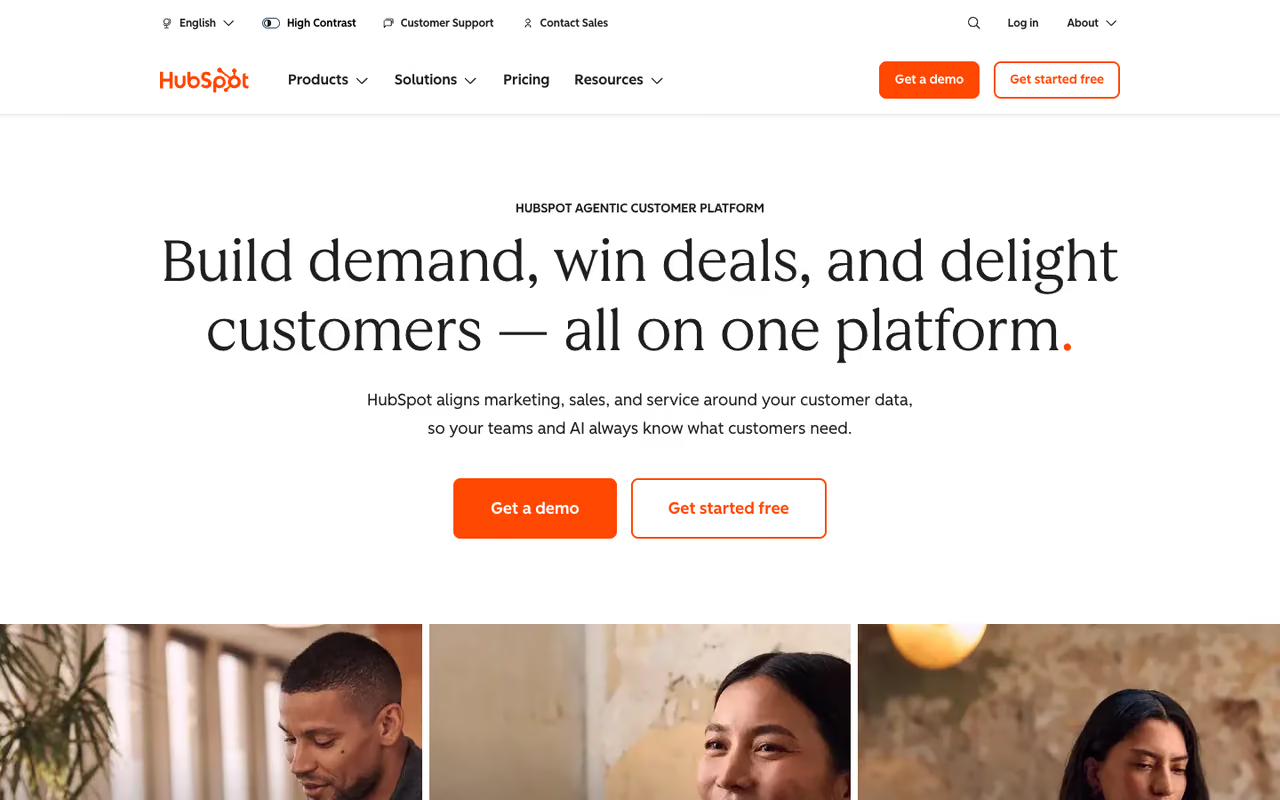
HubSpot is a true CRM in the classic sense: one record per contact that tracks marketing, sales, and support activity together. It syncs natively with Shopify for customers, orders, and products, and it's the right call when your business has a sales motion (wholesale, high-ticket, B2B) on top of the storefront.
Who it's best for: Stores with a sales team, a wholesale arm, or a service operation that needs deal stages and pipelines, not just broadcast emails.
Pick HubSpot when your store also has a wholesale, high-ticket or service sales motion that needs real deal stages. As a pure store-email tool it is the wrong shape, since its ecommerce automation trails Klaviyo and costs jump past Starter.
The Starter Customer Platform is $20/seat/month and bundles starter-level marketing, sales, and service. New customers get a promo of $7/month (annual) or $10/month (monthly) per seat, confirmed right on HubSpot's Starter page. The free tier is genuinely usable for tracking contacts.
The standout: Visibility across the whole customer journey. When support, sales, and marketing all read from one timeline, you stop guessing why a customer churned.
Where it falls short: Ecommerce automation is weaker than the dedicated retention tools. HubSpot's flows can't match Klaviyo's product-feed personalization, and costs jump hard when you move from Starter to Professional. As a pure store-email tool, it's the wrong shape.

Drip: the DTC retention specialist
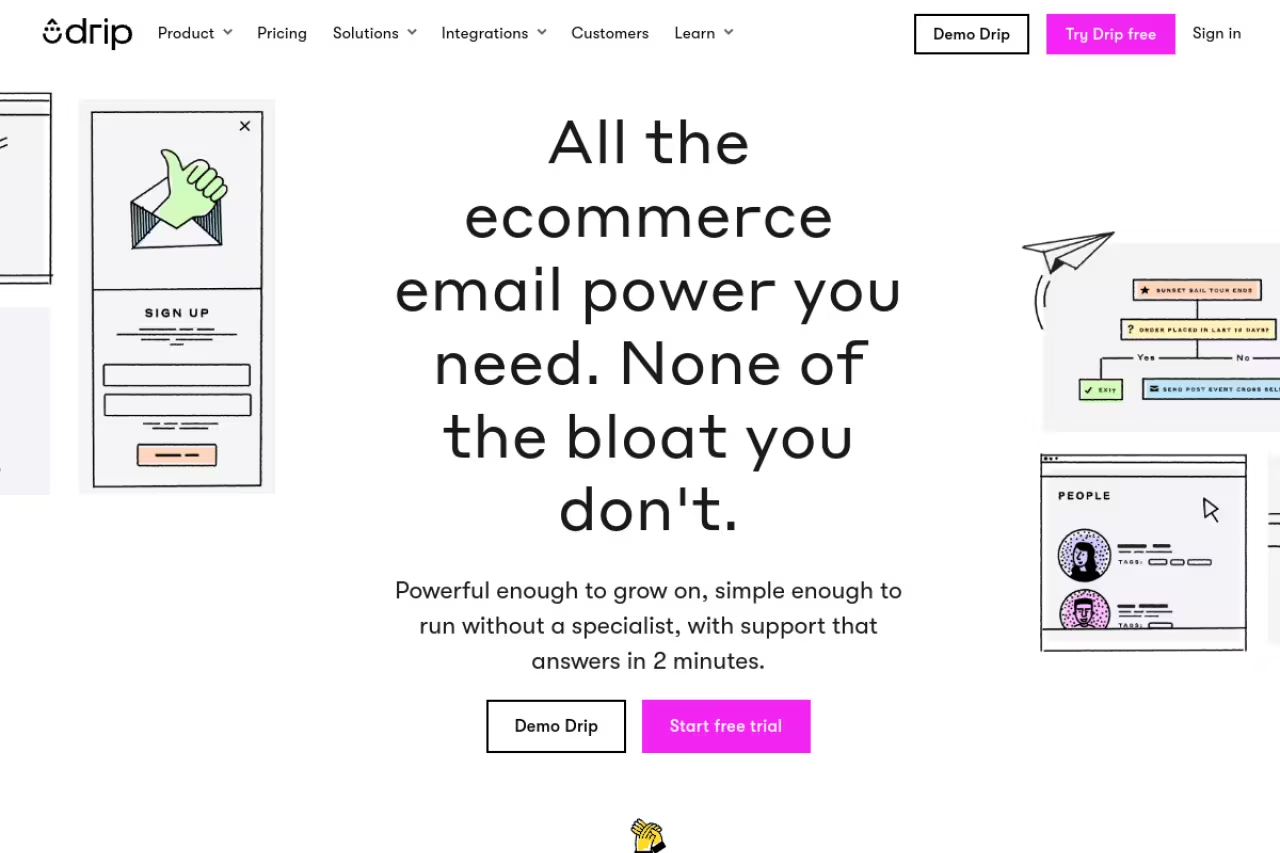
Drip is a customer-centric marketing automation platform aimed squarely at direct-to-consumer brands. It sits in the same lane as Klaviyo but with a flatter pricing model and a reputation for cleaner automation building.
Who it's best for: DTC brands that live and die by lifecycle automation: welcome series, browse abandonment, post-purchase, win-back. It has 200+ ecommerce integrations and segments that update themselves as customers behave.
A DTC retention specialist with every feature on every plan, so small stores get the full automation toolkit. There is no free plan, the entry price is higher than Omnisend or Brevo, and templates trail Klaviyo.
Drip starts at $39/month for up to 500 contacts, scaling with your subscriber count. There's a 14-day free trial but no free-forever plan. The headline feature is that every plan includes every feature, so you're not locked out of automation because you're on a lower tier.
The standout: No feature gating. On Drip, a tiny store gets the same automation toolkit as a big one. That's rare, and it removes the "do I need to upgrade just for this one workflow" tax.
The catch: No free plan and a higher entry price than Omnisend or Brevo, so it stings for very small stores. The deliverability and template library also feel a step behind Klaviyo's. You're paying for automation depth, not polish.

Omnisend: the best value for most stores
Omnisend packs email, SMS, and web push into one workflow builder, with prebuilt automations tuned for Shopify and WooCommerce. For most small and mid-sized stores, it delivers 80% of Klaviyo for a meaningfully lower price.
Who it's best for: Budget-conscious Shopify and WooCommerce stores that want serious automation without Klaviyo's bill.
The value pick for budget-conscious Shopify and WooCommerce stores that want serious multichannel automation without Klaviyo's bill. Predictive analytics and segmentation are shallower, and very large senders will eventually outgrow it.
The free plan reaches 250 contacts, 500 emails, and 60 trial SMS a month. The Standard plan starts at $16/month, and Pro at $59/month for 2,500 contacts with unlimited email. Note a 2026 change: per Omnisend's pricing docs, SMS on new Pro subscriptions is now a volume-based add-on starting at $0.007 per message rather than bundled credits.
The standout: Multichannel in a single flow. Adding an SMS step or a push notification to an existing automation takes a click, not a separate tool.
Where it falls short: The predictive analytics and segmentation depth don't reach Klaviyo's level, and very large senders eventually outgrow it. For the price, though, it's the value pick.
If you're still mapping out your retention stack and want a wider survey of automation platforms, our guide to the best AI marketing tools pairs well with this one.

Gorgias: the CRM that lives in your support inbox
Gorgias is a different animal: a helpdesk that doubles as a customer view. It pulls email, chat, SMS, and social into tickets, and its Shopify sync is the deepest of any support tool. Agents can edit orders, issue refunds, and manage subscriptions without leaving the ticket.
Who it's best for: Stores where support volume is high and tickets are sales opportunities. If your customers ask "where's my order" 200 times a week, this turns that into structured, revenue-aware conversation.
A strong fit when support volume is high and tickets are sales opportunities, since agents can edit orders and issue refunds inside the ticket. Watch the AI Agent, which is double-billed and can quietly inflate costs during a traffic spike.
Plans run from $10/month (Starter) up to $900/month (Advanced), with unlimited agent seats on every paid plan. Billing is based on ticket volume, not seats.
The standout: Order actions inside the ticket. Your agent never tabs over to Shopify admin, which is a real time saver at scale.
The catch: The AI Agent is double-billed. Each AI resolution costs roughly $0.90 to $1.00 and also counts as a helpdesk ticket, so a traffic spike can quietly double your bill. Watch the ticket meter.

Brevo: pay for sends, not contacts
Brevo (formerly Sendinblue) bills on email volume rather than contact count, which flips the usual ecommerce CRM math. You can store up to 100,000 contacts on the free plan and only pay as your sends grow.
Who it's best for: Small to mid stores with big lists but modest send volume, or anyone burned by per-contact pricing on Klaviyo.
Choose Brevo if you have a big list with modest send volume, or got burned by per-contact pricing. The model is a relief, but it is a generalist with thinner ecommerce personalization and a CRM that feels bolted on.
Free covers 300 emails a day with unlimited contacts. Paid plans start around $9/month (Starter) and $18/month (Business) for unlimited automation. The CRM and live-chat modules cost extra: about $12/user for Sales and $15/user for Conversations.
The standout: The pricing model. Inactive contacts don't inflate your bill, which is a genuine relief if your list has a long tail.
Where it falls short: It's a generalist. The ecommerce-specific personalization is thinner than Klaviyo or Drip, and the CRM features feel bolted on rather than core. Good multichannel value, average ecommerce depth.
Zoho Bigin: a real pipeline at an email-tool price
Zoho Bigin is the pick when you want an actual sales CRM (pipelines, deals, contact records) without HubSpot's complexity or cost. It's built for small teams and priced like one.
Who it's best for: Stores with a wholesale or B2B sales pipeline who need to track deals, not just email blasts.
A real sales pipeline at an email-tool price, suited to stores with a wholesale or B2B arm tracking deals. It is not a retention engine, so expect to pair it with a dedicated email tool and run two systems.
Bigin runs $0, $7, $12, and $18 per user per month billed annually (Free, Express, Premier, Bigin 360). The Express plan already handles unlimited contacts and deals with basic reporting.
The standout: It's a genuine CRM at marketing-tool prices. For a small store closing wholesale deals, $7/user is hard to argue with.
The catch: It's not an ecommerce retention engine. There's no native Shopify abandoned-cart flow, no product-feed emails. Pair it with a dedicated email tool if you need both, and accept that you're running two systems.

Salesforce: only if you've outgrown everything else
Salesforce is the enterprise endpoint. If you're running multiple brands, complex B2B and B2C motions, and a data team, it scales past anything else here. For everyone else, it's too much tool.
Who it's best for: Large or fast-scaling orgs with dedicated admins and real budget. Commerce Cloud plus Marketing Cloud can run your entire customer operation.
Only worth it for large or fast-scaling orgs with multiple brands, a data team, dedicated admins and real budget. For almost every other store it is too much tool, and adopting it early is a classic way to burn money.
Custom and high. Realistically you're talking thousands per month plus implementation, and you'll likely need a consultant. There's no honest "starting at $X" for ecommerce here.
Where it falls short: Complexity and cost. Most stores reading this will never need it, and adopting it early is a classic way to burn money on software you can't fully use.
How to choose without overthinking it
Match the tool to the job, not the hype.
- You sell on Shopify and want more repeat orders: Klaviyo. If the bill scares you, Omnisend gets you most of the way for less.
- You're a DTC brand obsessed with automation: Drip, for the no-gating feature model.
- You have a sales or wholesale motion on top of the store: HubSpot if budget allows, Zoho Bigin if it doesn't.
- Support volume is your bottleneck: Gorgias.
- You have a huge list but send rarely: Brevo's send-based pricing wins.
- You're a true enterprise: Salesforce, and you already have people to run it.
One rule I'd push hard: start cheaper than you think you need. Every tool here lets you migrate up. Almost nobody regrets starting on Omnisend's free plan and graduating to Klaviyo. Plenty of people regret signing a HubSpot Professional contract before they had the volume to use it. If you want a broader shortlist of platforms across categories, our top tools directory is a good next stop.
Most of these tools now ship AI features too, from predictive sends to AI support agents. If you want to go deeper on that side, our roundup of the best AI tools for small business covers the wider stack. And if your week disappears into manual customer ops, Dupple X helps you put the repetitive work on autopilot.
FAQ
What is the best CRM for a small ecommerce business?
For most small Shopify or WooCommerce stores, Omnisend offers the best value: a free plan that reaches 250 contacts and paid plans from $16/month, with email, SMS, and push in one flow. If retention is your whole strategy and budget allows, Klaviyo is the stronger long-term pick. For a store that needs a sales pipeline instead of email automation, Zoho Bigin at $7/user is the cheapest real CRM.
Is Klaviyo a CRM or an email marketing tool?
Both. Klaviyo is built on a customer data platform that stores rich profiles and behavioral history, which is the CRM part, with email and SMS marketing layered on top. It's not a sales CRM with deal pipelines like HubSpot, so if you need to track quotes and wholesale deals, pair Klaviyo with a sales CRM or use HubSpot instead.
How much does an ecommerce CRM cost in 2026?
It ranges widely. Free plans exist on Klaviyo, Omnisend, Brevo, and Zoho Bigin. Realistic paid entry points are around $16/month for Omnisend, $20/month for Klaviyo and HubSpot at 500 contacts, and $39/month for Drip. Watch for usage-based billing: Klaviyo charges by active profiles, Gorgias by ticket volume, and Brevo by send volume, so your real cost depends on how you operate.
Do I need a CRM if I already use Shopify?
Shopify stores customer and order data, but it doesn't run lifecycle marketing, predictive segmentation, or multichannel automation on its own. A dedicated CRM or retention platform is where abandoned-cart flows, win-back campaigns, and customer lifetime value tracking actually live. For most stores, adding Klaviyo or Omnisend to Shopify is the single highest-use marketing move.
Which ecommerce CRM has the best Shopify integration?
Klaviyo has the deepest native retention sync, with Shopify data flowing in under 200 milliseconds, which is why over 117,000 brands run them together. For support specifically, Gorgias offers the deepest bi-directional Shopify sync, letting agents edit orders and issue refunds inside a ticket. The "best" integration depends on whether you're optimizing for marketing or service.
Related guides
Some offers on this page may be paid placements or contain affiliate links.
Across our whole catalogue the median is $24 a month and 33% of tools advertise a free tier. Figures are the lowest recurring monthly price quoted in our own review of each tool, read on 2026-08-19. Full method and every category.
