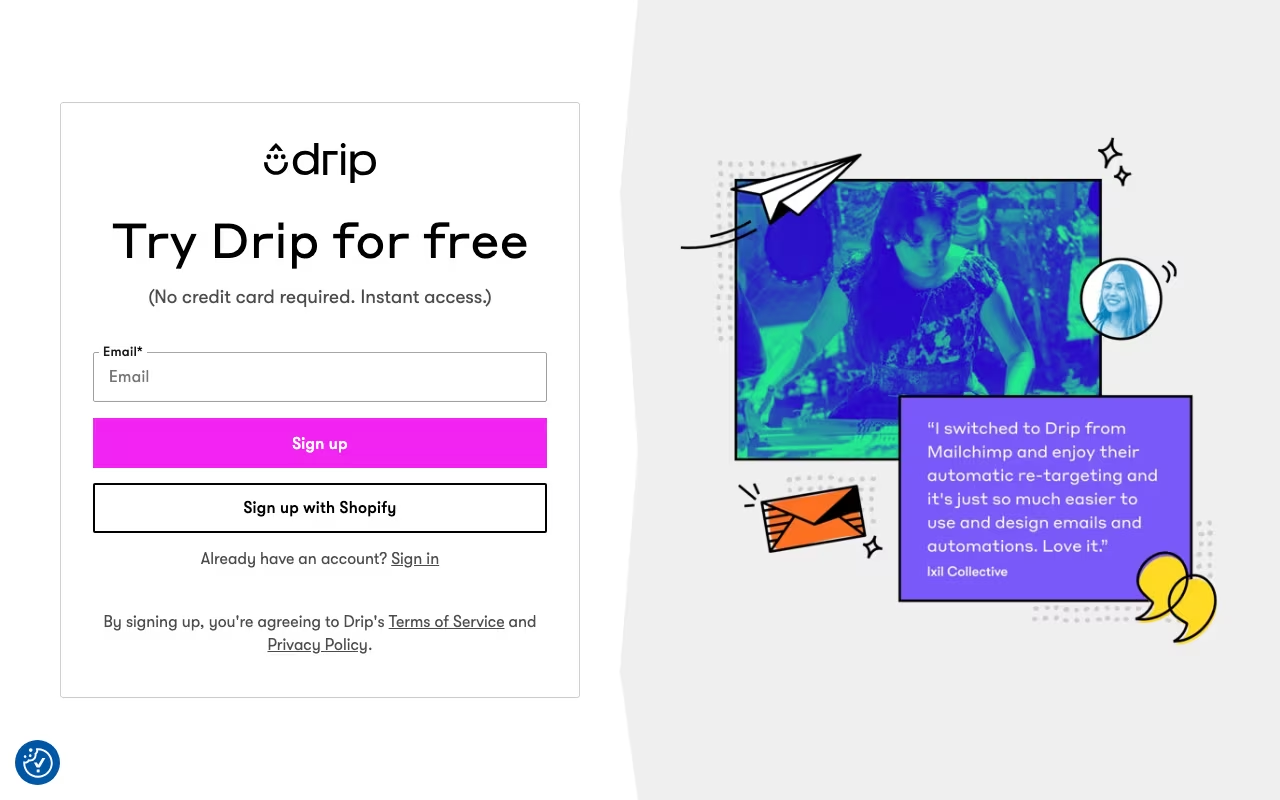
What Is Drip?
Drip is the email marketing and automation platform built specifically for e-commerce brands. Founded in 2013, Drip serves over 30,000 stores with email and SMS workflows, segmentation, and revenue attribution designed for online retail rather than general marketing use cases.
The pitch is e-commerce-native automation. While Mailchimp and ActiveCampaign serve any business, Drip optimizes for Shopify, BigCommerce, WooCommerce, and Magento workflows: abandoned cart, browse abandonment, post-purchase nurture, win-back campaigns, and revenue per email tracking. The platform treats every contact as a potential customer with a buying lifecycle, not just a subscriber.
The product competes directly with Klaviyo and Omnisend in the e-commerce email space. Drip differentiates on automation depth and event-driven workflows.
Try Drip Free Get started →How Drip Works
Connect your e-commerce store. Drip pulls order history, product catalog, customer data, and browsing behavior. The platform tracks every customer's lifecycle: first visit, abandoned cart, first purchase, repeat purchase, lapsed.
Build automation workflows for each lifecycle stage. Welcome series greets new subscribers; abandoned cart sequences recover lost orders; post-purchase nurture drives repeat business; win-back campaigns re-engage lapsed customers. Each workflow can include email, SMS, and tag updates based on contact behavior.
Segmentation lets you target precise audiences. Customers who bought product A but not B; subscribers who opened the last 5 emails; abandoned cart contacts above $100 cart value. Combine criteria for targeted sends.
Revenue tracking ties email engagement to actual purchases. The dashboard shows revenue per email, lifetime value by segment, and ROI per campaign. Marketing teams justify spend with concrete numbers.
Visual workflow builder handles multi-step sequences with conditional logic. Forms and pop-ups capture subscribers; product blocks pull live catalog data into emails.
Drip Pricing in 2026
Pricing based on contact count.
- 2,500 contacts: $39/month
- 5,000 contacts: $89/month
- 10,000 contacts: $154/month
- 25,000 contacts: $349/month
- 100,000+ contacts: Custom pricing
All plans include unlimited emails, automations, and integrations. SMS available as add-on.
Compared to Klaviyo at similar contact tiers, Drip is competitive. Compared to Mailchimp E-commerce, Drip offers more automation depth at similar prices.
See Drip Plans See plans →Where Drip Wins
- E-commerce-native: built for online retail workflows.
- Strong automation depth: multi-condition workflows that match how customers actually buy.
- Revenue attribution: clear ROI per email and campaign.
- Pre-built workflows: abandoned cart, post-purchase, win-back templates ready to deploy.
- Visual segmentation: build precise customer segments without code.
Where It Falls Short
- E-commerce only: not designed for service businesses or B2B.
- Smaller brand than Klaviyo: less recognition in Shopify ecosystem.
- Less polished than Klaviyo's newer features: AI and predictive features less mature.
- SMS as add-on: not bundled into base pricing.
Drip vs Klaviyo vs Omnisend vs Mailchimp E-commerce
Marketing tools, published pricing
| Tool | Pricing | Model |
|---|---|---|
| Drip | From $39/mo (2,500 contacts), scales with list size | Subscription |
| TheTop | $99/mo (lowest published recurring price) | Subscription |
| Hopp for Business | $9/mo (lowest published recurring price) | Subscription |
| POWR | $9.99/mo (lowest published recurring price) | Subscription |
| Roster | $500/mo (lowest published recurring price) | Subscription |
| Recomaze AI | $99/mo (lowest published recurring price) | Subscription |
Klaviyo dominates Shopify email marketing with brand recognition and deepest e-commerce features. More expensive.
Omnisend is the budget e-commerce email alternative. Cheaper, less automation depth.
Mailchimp E-commerce targets crossover between marketing email and e-commerce. Less specialized.
Sendlane targets similar e-commerce niche with strong segmentation.
Who Should Use Drip
Shopify stores moving past Mailchimp: real e-commerce email automation.
DTC brands with established product catalogs: revenue attribution matters.
Stores running serious lifecycle marketing: welcome, cart abandonment, post-purchase, win-back.
Skip it if: you sell only B2B services (use ActiveCampaign), need the absolute brand-leader e-commerce platform (Klaviyo wins), or operate at very small scale (Mailchimp's free tier is enough).
How Drip works
Drip is an email marketing and automation platform aimed at B2C and ecommerce: physical goods, digital products, courses, events and bookings. It bundles an email designer, behaviour-based dynamic segmentation, a visual automation workflow builder, embedded signup forms, onsite pop-ups and reporting. The positioning is explicitly "Klaviyo or Mailchimp without the bloat": enough power for real lifecycle marketing, run by a small team with no dedicated email specialist.
You connect your store first. Shopify, Shopify Plus, WooCommerce and BigCommerce are supported directly, and custom stores connect through the Shopper Activity API. Import your list, then start from one of 20+ prebuilt ecommerce workflow templates: welcome series, abandoned cart, abandoned browse, post-purchase, win-back. Workflows are assembled point-and-click in a visual builder and can act across email, onsite pop-ups and Facebook or Instagram custom audiences using store data as the trigger.
Segments are dynamic and rebuild themselves from purchase, browse and spend behaviour, then feed personalisation tokens into 50+ ecommerce email templates. For simple one-trigger-one-action cases you use Rules instead of a full workflow, which keeps the workflow count down. There is smart A/B testing, an open API, unlimited sub-accounts (useful for agencies), and integrations with tools like LoyaltyLion, Smile.io, Judge.me, Junip, Stripe, Typeform, Sleeknote and Zapier.
Pricing is a single feature set metered by list size and send volume, starting at $39/mo for 1 to 2,500 people with unlimited email sends. There is a 14-day free trial and no card required. Migration of lists, flows, templates and segments from your old platform is done for you at no cost, with 90 days of personalised onboarding for lists above 17,500 people. Drip publishes support numbers it holds itself to: 97.3% CSAT, under 2 minutes to live chat, under 1.6 hours by email.
Where Drip wins
- One feature set at every price. Dynamic segments, onsite campaigns, the open API, unlimited sub-accounts and free migration are all included at the $39 entry point rather than gated behind higher tiers.
- Unlimited email sends on the base plan. You are billed on list size and volume, not charged per send from a credit balance.
- The templates are genuinely ecommerce-native. Abandoned cart, abandoned browse, post-purchase and win-back ship prebuilt, and store data works as a workflow trigger, so lifecycle flows are not built from a blank canvas.
- Free hands-on migration of lists, flows, templates and segments from your previous platform, plus 90 days of personalised onboarding once your list is above 17,500.
- Published support SLAs rather than vague promises: 97.3% CSAT, under 2 minutes to live chat, under 1.6 hours by email.
- Multi-channel without extra tools. Onsite pop-ups, embedded forms and Facebook Custom Audience sync are part of the platform, not add-ons.
Where it falls short
- No SMS channel at all. It appears nowhere in the product nav, the automation page or the FAQ. If you want email and SMS in one platform, this is not it.
- A hard cap of 50 active workflows per account. Drip states this is a deliberate performance limit, not a restriction you can buy your way out of with an upgrade.
- Live chat is for $99/mo+ customers only. Below that you get email support, Monday to Friday.
- Free migration and personalised onboarding are reserved for lists over 17,500 people, so smaller stores switching in are doing the move themselves.
- Integration count is modest and inconsistently stated: the FAQ says 50+ ecommerce integrations while the automation page claims 200+, and either way the catalogue is narrower than the big ecommerce ESPs.
- It is squarely a B2C tool. There is no sales CRM, lead scoring or B2B pipeline, so the shape is wrong for B2B lifecycle marketing.
Who should use Drip
Drip fits small-to-mid ecommerce and B2C teams on Shopify, WooCommerce or BigCommerce, plus course, event and booking sellers, who want serious segmentation and lifecycle automation without a Klaviyo-sized bill or a specialist to run it. The flat feature set means a 2,500-contact store gets the same capabilities as a large one, which is unusual in this category. Agencies get particular value from unlimited sub-accounts at no extra charge.
Skip it if SMS is part of your channel mix, if your program needs more than 50 active workflows, or if you need CRM and lead scoring for a B2B motion.
Frequently Asked Questions
Does Drip integrate with Shopify?
Yes natively. Deep two-way sync.
Can I run SMS campaigns?
Yes via add-on. Combined email + SMS workflows.
Does it support multi-store setups?
Yes on higher tiers. Manage multiple Shopify stores under one account.
What about revenue attribution accuracy?
Click-based attribution within configurable lookback window (default 7 days).
Can I migrate from Mailchimp?
Yes. Drip's migration tools handle subscriber lists and active workflows.