
The Best CRM for Retail in 2026: 8 Tools I'd Actually Trust With My Customer List

Key facts8 tools compared: Endear, HubSpot, Lightspeed Retail, Square, Zoho CRM, Salesforce, Marsello…
- 8 tools compared: Endear, HubSpot, Lightspeed Retail, Square, Zoho CRM, Salesforce, Marsello, Klaviyo
- Endear (best for: Omnichannel brands doing clienteling): $350/mo per location
- HubSpot (best for: Retailers who want CRM + marketing in one): $15/seat/mo
- Lightspeed Retail (best for: Stores that need POS + CRM together): $89/mo
- Square (best for: Small shops on a budget): Free
Most "retail CRM" lists are written by people who have never stood behind a counter. They rank generic sales pipelines that were built for software demos, not for a store associate trying to remember that the customer in front of them bought a $400 coat in March and likes to be texted, not emailed.
Retail is a different beast. You're not nurturing a 6-month B2B deal. You're capturing thousands of fast, low-context transactions, tying them back to real people, and then giving your floor staff a reason to reach out before the next visit. The right tool sits where the sale happens (the POS, the Shopify checkout, the WhatsApp thread) and turns that data into a follow-up. The wrong one becomes an expensive contact database nobody updates.
If you run a modern brand with stores and an online shop and you want associates actually clienteling, Endear is my top pick. If you're a small shop that just needs the basics tied to your register, Square covers it for free. Below are the eight I'd trust, who each is for, and where each one annoyed me.
Quick comparison
| Tool | Best for | Price (from) | Standout |
|---|---|---|---|
| Endear | Omnichannel brands doing clienteling | $350/mo per location | AI tells associates who to text and when |
| HubSpot | Retailers who want CRM + marketing in one | $15/seat/mo | Free tier, then one connected stack |
| Lightspeed Retail | Stores that need POS + CRM together | $89/mo | Loyalty and CRM baked into the register |
| Square | Small shops on a budget | Free | Real CRM bundled with payments |
| Zoho CRM | Multi-location chains that want control | $14/user/mo | Deep customization, low price |
| Salesforce | Enterprise retail groups | $25/user/mo | Scales to anything, integrates with all |
| Marsello | Loyalty-first retail marketing | $60/mo | Points, tiers, and campaigns in one app |
| Klaviyo | Ecommerce-heavy retail | Free to 250 contacts | Best-in-class segmentation and email/SMS |
Endear: the clienteling CRM built for store teams
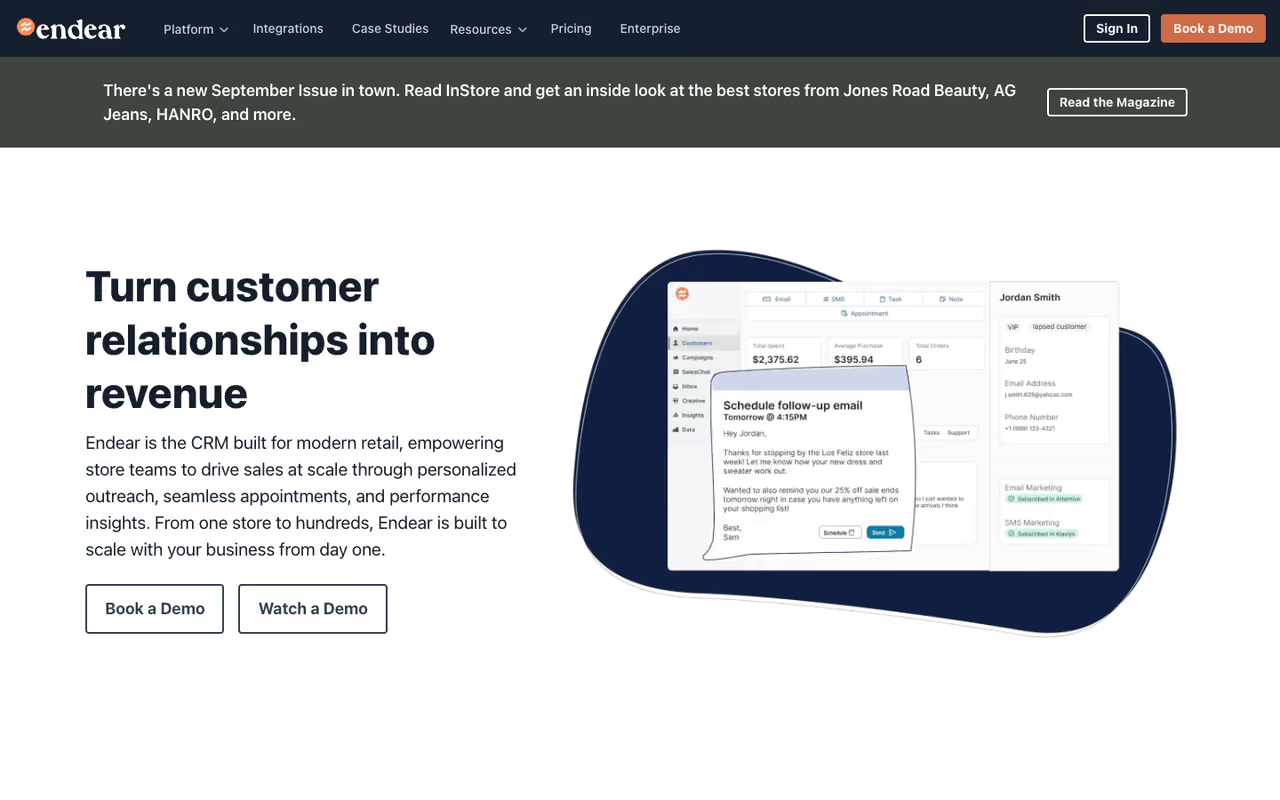
Endear is the one I keep recommending to brands that have a physical footprint and an online store and are tired of their two systems not talking. It's a retail-native CRM that unifies customer, order, and product data, then hands your associates the tools to reach out over email, SMS, and WhatsApp from a single profile. According to Endear, the platform powers more than 2,000 stores and over $1 billion in attributed sales, with customers like GANNI, Rebag and Glossier.
Who it's for: mid-sized omnichannel brands where store associates are expected to build relationships, not just ring people up. If "clienteling" is a word your team uses, this is your shortlist.
The pick for mid-sized omnichannel brands whose store associates are expected to build relationships through clienteling. Per-location pricing adds up fast across many boutiques, and it is overkill if your staff will not do proactive outreach.
starts at $350/month per store location, billed by location rather than per seat, so your whole floor team can use it without per-head charges. There's a 14-day free trial. Extra texts and emails beyond your plan allowance cost more.
The standout: the AI Opportunity Engine, launched in May 2026, surfaces which customers an associate should contact, when, and roughly what to say, based on purchase patterns. Endear reported it grew associate-led outreach 6x in six weeks in early deployments. There's also an AI Notetaker that captures customer details and auto-generates follow-up tasks.
The catch: the per-location pricing adds up fast if you run 20 boutiques, and it's overkill for a single shop that doesn't have associates doing proactive outreach. It also assumes you have a real clienteling motion. If your staff won't text customers, you're paying for a feature you won't use.

HubSpot: CRM plus the entire marketing stack
HubSpot isn't retail-specific, but it's the tool I'd hand a growing retailer who wants their customer database, email marketing, automation, and reporting in one place instead of five subscriptions. The free CRM is genuinely usable, and you grow into the paid Hubs as you need them.
Who it's for: retailers who see themselves as marketers as much as merchants. Brands running content, email flows, and paid acquisition alongside their stores.
A good choice for retailers who are marketers as much as merchants and want CRM, email and automation in one place. There is no native POS, and the price cliff from Starter to Professional is steep.
the CRM core is free for unlimited users. Starter plans begin at $15/seat/month on annual billing ($20 month-to-month), per HubSpot's pricing page. Marketing Hub Professional jumps to $890/month including three seats, with extra seats at $50. That gap between Starter and Pro is the real cost decision.
The standout: once you're in, everything connects. A purchase triggers an email flow, which feeds a report, which informs a segment, without you wiring up three tools. The workflow automation is the best in this list for non-technical teams, and it overlaps heavily with the platforms in my best AI marketing automation roundup.
Where it falls short: there's no native POS, so you'll need an integration (Shopify, Square, or middleware) to pull in-store sales. And the price cliff from Starter to Professional is steep. Plenty of retailers get stuck on Starter wanting Pro features they can't justify. If you want a CRM purely for ecommerce, see my best CRM for ecommerce breakdown.
Lightspeed Retail: the CRM that lives in your register
Lightspeed Retail approaches this from the opposite direction: it's a POS first, with CRM and loyalty built in. For a lot of stores that's the right call, because the customer record updates automatically every time someone checks out. No syncing, no integration to maintain.
Who it's for: brick-and-mortar stores that want one system for inventory, checkout, and customer data instead of bolting a CRM onto a separate register.
A fit for brick-and-mortar stores that want inventory, checkout and customer data in one system, with every sale enriching the profile automatically. The CRM is good but not deep, so advanced segmentation will need an add-on.
Basic is $89/month on annual billing, Core is $149/month, and Plus is $289/month, per Lightspeed's tiers. Loyalty and marketing show up at the Core tier. Payment processing runs 2.6% plus 10 cents per in-person transaction.
The standout: the customer profile is fed directly by sales. Every transaction enriches the record without anyone lifting a finger, so your segments are always current. The loyalty program ties into the same data.
The catch: the CRM is good, not deep. If you want advanced segmentation, multi-channel campaigns, or AI-driven outreach, you'll feel the ceiling and end up adding something like Marsello on top. You're also locked into Lightspeed's processing rates unless you negotiate.
Square: a real CRM for free
Square gives small retailers something rare: an actual CRM (the Customer Directory) bundled free with its payment tools. It tracks contact info, purchase history, and visit frequency, and it talks to Square Marketing and Square Loyalty when you're ready to spend.
Who it's for: independent shops, pop-ups, and small chains that want customer data without a software bill. If you're already taking payments on Square, you have a CRM and may not know it.
The easy choice for independent shops, pop-ups and small chains that want customer data without a software bill, since it is live the moment you take a payment. It is basic by design, and you will migrate as marketing needs grow.
the Customer Directory is free. Square Loyalty adds $45/month per location, and Square Marketing is usage-based, priced on the number of reachable customer profiles you message.
The standout: zero setup friction. The CRM is live the moment you take your first payment, and the data is clean because it comes straight from the register. For a small operation, that's hard to beat.
Where it falls short: it's basic by design. Segmentation is shallow, there's no clienteling workflow, and once your marketing needs grow you'll hit limits and start paying per contact. It scales with you only up to a point, then you migrate.
Zoho CRM: control and low cost for chains
Zoho CRM is the value pick for multi-location retailers who want to customize how they track customers without paying enterprise prices. It's a general CRM, but it bends to retail workflows well and the price-to-feature ratio is excellent.
Who it's for: growing chains and franchise operators who have specific processes and want a tool they can shape, plus an IT-minded person to set it up.
The value pick for growing chains and franchise operators who want to shape their own processes cheaply, and have someone to set it up. Out of the box it is a blank-ish slate, and smaller shops will find it more tool than they need.
Standard is $14/user/month, Professional $23, Enterprise $40, and Ultimate $52, all on annual billing per Zoho's pricing. There's a free edition for up to three users. Monthly billing costs roughly 20% more.
The standout: customization at this price is genuinely good. Custom modules, workflows, and the broader Zoho ecosystem (Books, Inventory, Marketing) mean you can build a retail stack for a fraction of what Salesforce costs.
The catch: the flip side of flexibility is setup work. Out of the box it's a blank-ish slate, and the retail-specific features you'd want (POS sync, in-store clienteling) require integrations or the wider Zoho suite. Smaller shops will find it more tool than they need.

Salesforce: the enterprise option that scales to anything
Salesforce is where large retail groups end up when they've outgrown everything else. It's the most powerful CRM here, it integrates with every system you already run, and it scales from regional chain to global brand. It's also the most expensive and the most demanding to run.
Who it's for: enterprise retailers with dedicated ops or RevOps teams, complex data across many channels, and a budget for implementation.
Where large retail groups land once they outgrow everything else, with a ceiling that scales across hundreds of stores. Cost and complexity are the price, so most independent and mid-sized retailers need far less.
the Starter Suite is $25/user/month, Professional $80, Enterprise $165, and Unlimited $330, per Salesforce's pricing. Commerce Cloud is custom-quoted, often benchmarked around 1-2% of gross merchandise value. Einstein AI features are add-ons, frequently $50 to $150+ per user.
The standout: ceiling. There is almost nothing you can't build, automate, or integrate. For a retail group unifying data across hundreds of stores and an ecommerce site, that headroom matters.
Where it falls short: cost and complexity. Real spend after add-ons and implementation runs far above list price, and you need expertise (in-house or a consultant) to make it work. For most independent and mid-sized retailers, this is more than you need. If you'd rather browse alternatives by category, our top tools directory is a faster way to shortlist.
Marsello: loyalty-first retail marketing
Marsello flips the priority. Instead of a CRM with loyalty bolted on, it's a loyalty and marketing platform that doubles as your customer hub, with points, tiers, email, and SMS in one app. It plugs into Shopify and Lightspeed and pulls in your POS and online data automatically.
Who it's for: retailers whose growth lever is repeat purchases and loyalty, especially Shopify or Lightspeed stores that already have a POS and want the marketing layer on top.
A loyalty-first engine for Shopify or Lightspeed stores whose growth lever is repeat purchases, with points and VIP tiers that launch quickly. It is not a full sales CRM, so skip it if you need pipelines, wholesale tracking or clienteling.
plans are Loyalty Launch, Loyalty Accelerate, and Enterprise. Shopify pricing starts from $60/month. If you use Lightspeed's bundled Loyalty & Marketing, Marsello billing is rolled into your Lightspeed subscription.
The standout: the loyalty mechanics are deep and quick to launch. Customizable points, VIP tiers, points expiry, and behavior-driven campaigns work out of the box, then customize as far as you want. For a brand that lives on repeat customers, that focus pays off.
The catch: it's not a full sales CRM. If you need pipeline management, B2B wholesale tracking, or associate-level clienteling, Marsello won't cover it. If wholesale is a big part of your business, look at a dedicated best CRM for B2B instead. Marsello is a marketing and loyalty engine, and you should treat it as one.
Klaviyo: the segmentation engine for ecommerce-heavy retail
Klaviyo is technically a marketing platform, but its customer data and segmentation are good enough that ecommerce-leaning retailers often run it as their de facto CRM. If most of your sales happen online and email/SMS is your main channel, this is the strongest pick on the list.
Who it's for: DTC and ecommerce-first retailers where the website outsells the store, and where personalized email and SMS drive most of the revenue.
The strongest pick for DTC and ecommerce-first retailers where email and SMS drive most revenue, thanks to sharp segmentation and predictive features. It is weak in-store, and costs climb steeply as your list grows.
free up to 250 contacts and 500 email sends. Paid email plans scale by contact count, and SMS is billed separately by usage. The free tier is a real way to start, not a teaser.
The standout: segmentation. Klaviyo's behavioral data and predictive features (like predicted lifetime value and next-order date) are sharper than anything else here for online retail. The flows are excellent.
Where it falls short: it's weak in-store. There's no native POS clienteling, and the cost climbs steeply as your list grows. For a store-heavy brand it's the wrong center of gravity. Pair it with a POS-native tool, or pick something else.
How to choose without overthinking it
Start with where your sales actually happen, then match the tool to that.
Mostly in-store, small budget: start with Square's free directory. It's already in your register, and you can add loyalty later for $45/month.
Stores plus online, associates who clientele: Endear. The per-location price is worth it only if your team will actually text customers. If they won't, you're paying for nothing.
You want POS and CRM as one system: Lightspeed Retail. Less syncing, fewer moving parts, good enough CRM for most stores.
Marketing is your growth engine: HubSpot if you want one connected stack, Klaviyo if you're ecommerce-first, Marsello if loyalty is the lever.
Multi-location chain that wants control on a budget: Zoho. Enterprise group with a dedicated ops team and real budget: Salesforce. If a chunk of your revenue is wholesale rather than walk-in, weigh a dedicated best CRM for B2B against these retail picks.
The honest test: pick the tool that sits closest to where money changes hands and that your staff will open every day. A cheaper CRM your team uses beats an expensive one they ignore. If you want to keep up with the AI features reshaping these tools, our Techpresso newsletter breaks down what's actually worth adopting each week.
FAQ
What is the best CRM for a small retail store?
For most small stores, Square's Customer Directory is the best starting point because it's free, built into the payment tools you already use, and tracks purchase history automatically. When you outgrow it, Lightspeed Retail (POS plus CRM) or Endear (for clienteling) are the natural next steps.
How much does a retail CRM cost in 2026?
It ranges widely. Square's CRM is free, Zoho starts at $14/user/month, Lightspeed Retail starts at $89/month, and Endear starts at $350/month per location. Enterprise platforms like Salesforce run from $25/user/month to several hundred once you add AI and implementation. Budget for integration and setup costs on top of the sticker price.
What is clienteling and which CRM does it best?
Clienteling is when store associates build ongoing one-to-one relationships with customers through personalized outreach, usually based on past purchases. Endear is the strongest dedicated clienteling CRM in 2026, with AI that tells associates who to contact and when. BSPK is another option aimed at luxury and specialty retail.
Do I need a retail-specific CRM or will a general one work?
If your sales happen in physical stores, a retail-specific or POS-native CRM (Endear, Lightspeed, Square) saves you from building fragile integrations, because customer data updates straight from the register. If you sell mostly online or run heavy marketing, a general CRM like HubSpot or a marketing-led tool like Klaviyo can work better.
Can a retail CRM connect to my POS and online store?
Yes, and this should be a top requirement. POS-native tools (Lightspeed, Square) handle in-store data automatically. Endear, Marsello, and Klaviyo connect directly to Shopify and major POS systems. General CRMs like HubSpot and Salesforce connect through integrations, which work but add a layer to maintain. Always confirm your exact POS is supported before buying.
Which retail CRM has the best AI features in 2026?
Endear's AI Opportunity Engine, which tells associates exactly who to reach out to and when, is the most useful retail-specific AI on this list. Salesforce Einstein is the most powerful overall but costs extra and needs setup. Klaviyo's predictive analytics (lifetime value, next-order date) are excellent for online retail. For a wider look, see our roundup of the best AI sales tools.
Related guides
Some offers on this page may be paid placements or contain affiliate links.
Across our whole catalogue the median is $24 a month and 33% of tools advertise a free tier. Figures are the lowest recurring monthly price quoted in our own review of each tool, read on 2026-08-19. Full method and every category.
