
Best Customer Feedback Tools in 2026: 8 Platforms Compared

Key facts8 tools compared: Sprig, Survicate, Hotjar (Contentsquare), Typeform, Refiner, Canny…
- 8 tools compared: Sprig, Survicate, Hotjar (Contentsquare), Typeform, Refiner, Canny, Enterpret, Qualtrics
- Sprig (best for: Product teams, in-product research): Free, then $175/mo
- Survicate (best for: Multi-channel feedback collection): Free, then $114/mo
- Hotjar (Contentsquare) (best for: Feedback + behavior together): Free, then ~$49/mo
- Typeform (best for: Conversational surveys, marketing): Free, then $39/mo
Most feedback tools sell you a survey builder and call it a day. You ship an NPS popup, collect a thousand responses, then stare at a spreadsheet wondering what any of it means. The collecting was never the hard part. The reading is.
That gap is what changed in 2026. The better tools now tag themes, score sentiment, and tell you what 800 open-text answers are actually saying before you've finished your coffee. The catch is that "feedback tool" now covers wildly different products: in-app survey widgets, conversational form builders, feature-request boards, and enterprise voice-of-customer suites that cost more than a junior hire. Picking the wrong lane wastes months.
I compared eight of them across the lanes that matter for a SaaS or product team. If you want one answer: Sprig is my top pick for product teams who want in-context surveys plus AI that does the analysis, with a usable free tier to start. If you need to collect feedback across email, web, and link in one place, Survicate is the better generalist. Here's the breakdown.
Quick comparison
| Tool | Best for | Price | Standout |
|---|---|---|---|
| Sprig | Product teams, in-product research | Free, then $175/mo | AI agents analyze responses for you |
| Survicate | Multi-channel feedback collection | Free, then $114/mo | Survey anywhere, one repository |
| Hotjar (Contentsquare) | Feedback + behavior together | Free, then ~$49/mo | Pair surveys with heatmaps and recordings |
| Typeform | Conversational surveys, marketing | Free, then $39/mo | Highest completion rates of any builder |
| Refiner | SaaS micro-surveys tied to lifecycle | Custom (from ~$79/mo) | Event-triggered targeting by user trait |
| Canny | Feature requests and roadmaps | Free, then $79/mo | Public board that closes the loop |
| Enterpret | AI analysis of all feedback channels | From ~$30k/yr | Unifies every source into one taxonomy |
| Qualtrics | Enterprise voice-of-customer | Custom (~$15k+/yr) | The full XM program, end to end |

Sprig: the one I'd start with for product teams
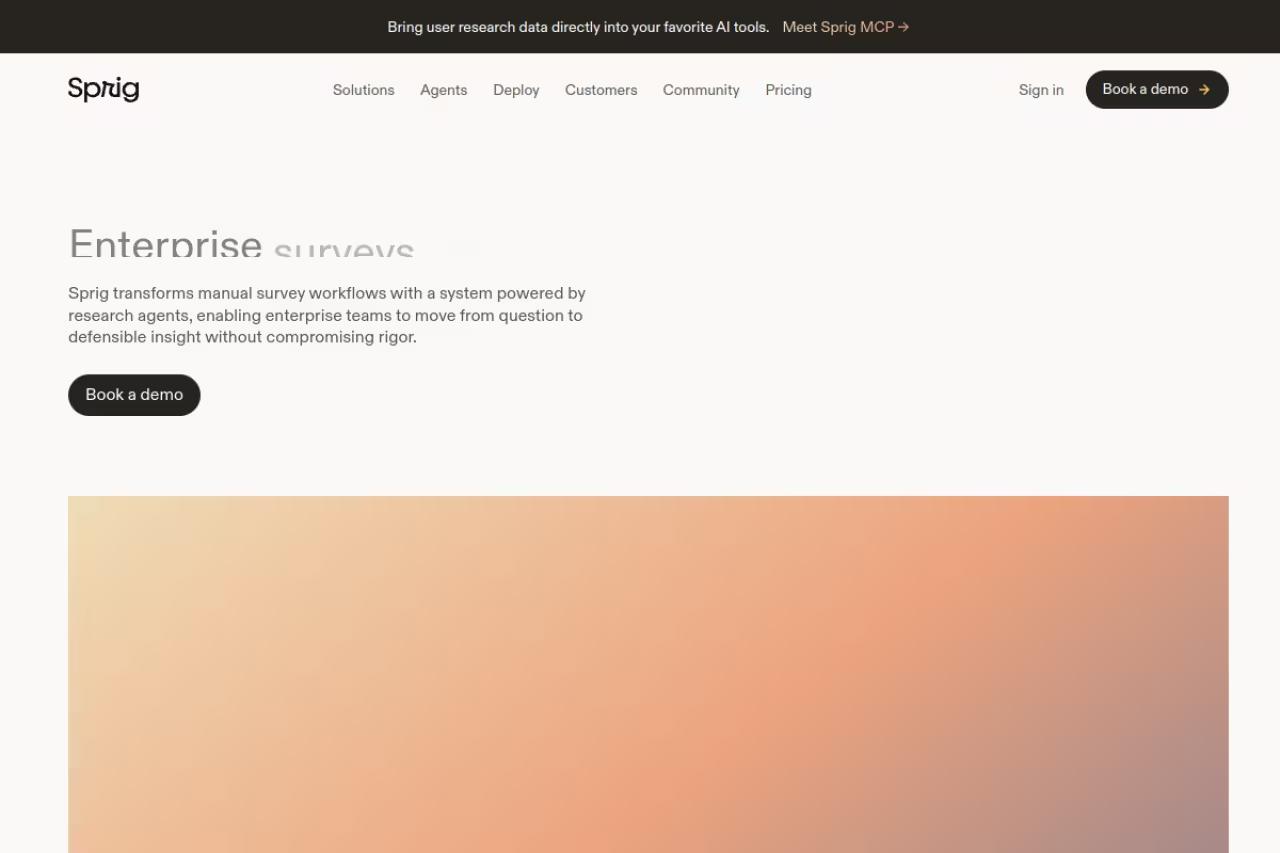
Sprig is built for collecting feedback inside your product at the exact moment a user does something interesting. You fire a two-question survey after someone abandons onboarding, or right when they hit a new feature, and the responses land tagged and summarized by AI.
Start here if you're a product, UX or growth team that wants to know why users behave the way they do. The AI summaries are a real shift, but it has pushed upmarket and is overkill for a cheap NPS widget.
The AI agents are the real shift this year. Instead of you reading 400 open-text answers, Sprig clusters them, surfaces the recurring complaint, and writes the summary. Figma, DoorDash, and HelloFresh use it for exactly this.
Pricing: there's a genuine free plan with one in-product survey or replay per month for up to 5,000 monthly users. The Starter plan runs $175/month billed annually with 25,000 monthly tracked users and unlimited link surveys. Enterprise is custom.
The catch: Sprig has spent the last year pushing upmarket, rebranding around "enterprise surveys powered by agents." That means the self-serve tiers feel like an afterthought now, and the jump from free to a useful paid plan is steep if your team is tiny. If you just want a cheap NPS widget, this is overkill.

Survicate: the best all-rounder
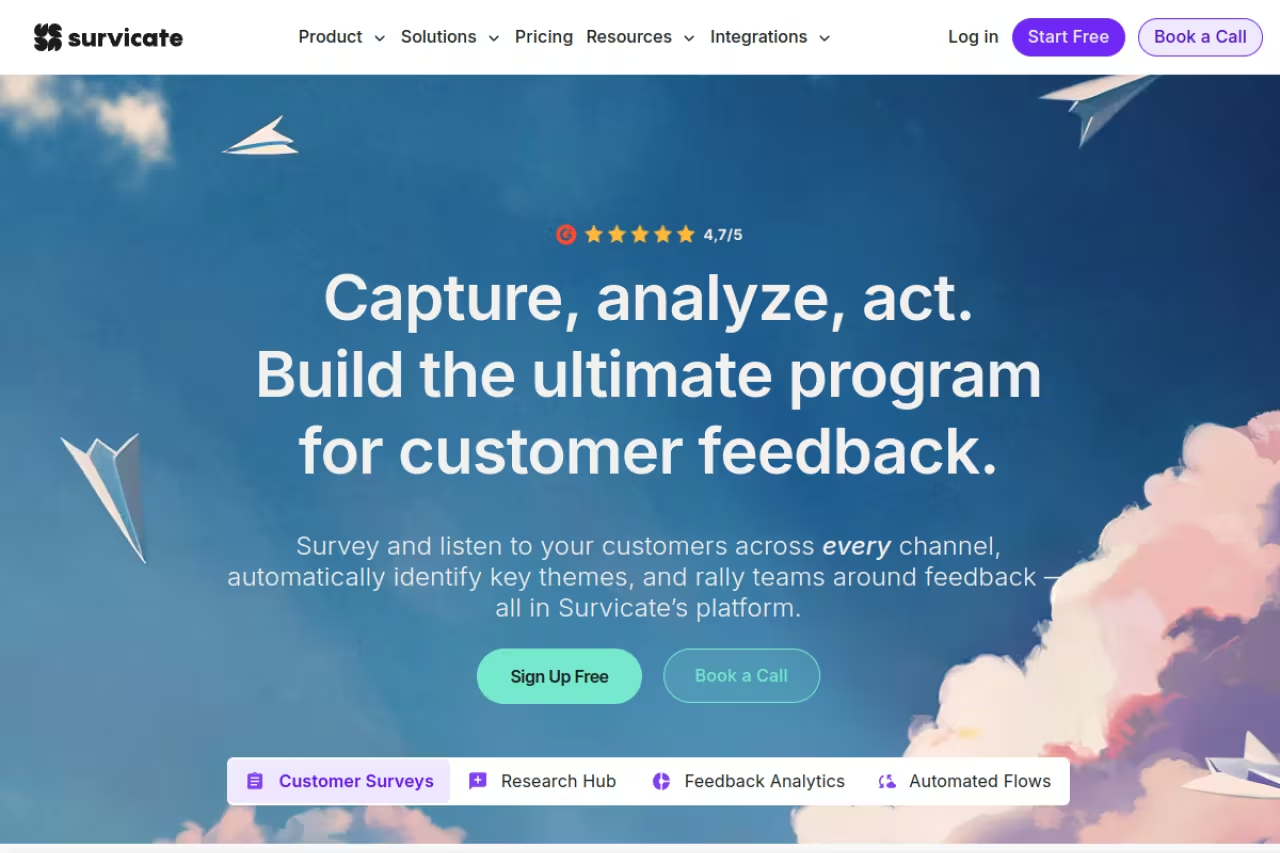
Survicate is what I recommend when you don't want to commit to one channel. It runs surveys in-app, over email, on your website, through a link, and inside tools like Intercom, then dumps every response into a single AI-powered feedback repository.
A solid all-rounder for cross-functional teams that want email, in-app, website and link surveys feeding one AI-powered repository. Response caps bite fast, since 250 a month on Growth disappears quickly and the next tier nearly triples the price.
The AI Research Assistant pulls themes out of your collected feedback without you tagging anything by hand.
Pricing: a free plan covers 25 responses a month with one active survey. The Growth plan starts at $114/month billed annually for 250 responses, unlimited active surveys, and the AI assistant. Pro is $349/month, Enterprise $569/month, both with custom response pools.
The catch: response caps bite fast. 250 a month on Growth disappears quickly if you're surveying a real user base, and the next tier nearly triples the price. Watch your volume before you commit, because overage math can flip Survicate from cheap to expensive in a hurry.

Hotjar: feedback plus the behavior behind it

Hotjar earns its spot because it answers a question a survey alone can't: not just what users say, but what they actually did right before they said it. Pair a feedback widget with a session recording and a heatmap, and a vague "the checkout is confusing" complaint becomes a video of someone rage-clicking a broken button.
It's best for teams who want qualitative feedback glued to behavioral data without buying two products. Hotjar merged into Contentsquare in 2025, and the tools now live inside that platform, with new sign-ups going through a unified plan structure.
Hotjar suits teams that want qualitative feedback tied to session recordings and heatmaps without buying two products. The Contentsquare migration has been messy, so budget time to work out which plan you're on.
Pricing: there's still a free Basic tier (the Ask side gives you 20 survey responses a month). On the new unified pricing, Growth starts around $49/month for up to 7,000 sessions, with Business near $99/month and Scale around $213/month.
The catch: the Contentsquare migration has been messy. Legacy customers are still being moved through 2026, pricing pages contradict each other depending on where you land, and the clean Hotjar simplicity is getting absorbed into a heavier enterprise product. Budget time to figure out which plan you're on.
If you're already deep in behavioral analytics, our roundup of AI customer insights tools covers the platforms that go a layer deeper than Hotjar.

Typeform: when completion rate is the whole game
Typeform makes surveys people actually finish. One question at a time, clean transitions, conversational tone. For any feedback you're sending to customers by email or link, completion rate is the metric that decides whether your data is worth anything, and Typeform wins it.
Typeform is the choice when completion rate decides whether your data is worth anything, for marketing teams, onboarding surveys and feedback outside the product. Response limits are stingy, and it collects beautifully but barely analyzes.
The form-building experience is the best in the category, full stop.
Pricing: the free plan caps you at 100 responses a month. Basic is $39/month (still 100 responses), Plus $79/month for 1,000, and Business $129/month for 10,000. Annual billing knocks roughly 30% off.
The catch: those response limits are stingy and they're the real cost driver. Paying $39/month and still being capped at 100 responses feels rough, and Typeform isn't built for in-app micro-surveys or feedback analysis. It collects beautifully and analyzes barely. You'll need something else for the reading.

Refiner: surveys wired into your product lifecycle
Refiner is the SaaS specialist. It fires micro-surveys based on user traits and behavior, so you survey the user who just upgraded, or the one who's been inactive for 14 days, instead of blasting everyone. Targeting is the whole pitch, and it's good at it.
It's best for product-led SaaS teams who want feedback tied to lifecycle events and revenue, not random sampling. Branching logic, personalization tokens, and event-based triggers all come standard.
The SaaS specialist for product-led teams that want feedback tied to lifecycle events and revenue instead of random sampling. Targeting is excellent, but demo-only pricing is annoying and scaling by MAU can get expensive.
Pricing: Refiner moved to custom quotes that scale by monthly active users rather than responses (responses stay unlimited), with paid plans reportedly starting around $79/month. There's a 30-day free trial and a small perpetual free plan at 25 responses a month.
The catch: the move to "book a demo" pricing is annoying if you just want to see a number and start. Scaling by MAU also means a high-traffic free product can get expensive even with light survey usage. It's purpose-built for SaaS, so if you're not SaaS, look elsewhere.
If you're building a product-led motion, Dupple X puts the lifecycle and growth context next to tools like this.

Canny: the feature-request engine
Canny solves a different problem than surveys: capturing, organizing, and closing the loop on feature requests. Users post ideas on a public board, vote, and watch your roadmap move. It turns the chaos of "can you add X" support tickets into a ranked, deduplicated list.
Canny is the feature-request engine for product teams drowning in scattered asks who want one ranked source of truth. The free board is great for testing, but tracked-user billing climbs fast once your community engages.
Pricing: the free plan covers 25 tracked users with one board, one roadmap, and Autopilot AI to auto-capture feedback. The Pro plan starts at $79/month billed yearly. In May 2025 Canny switched from per-admin to tracked-user billing, so a "tracked user" is anyone who posts, votes, or comments.
The catch: that tracked-user model surprises people. Core starts around $19/month but climbs fast: roughly $175/month at 500 tracked users and around $275/month at 1,000. The free board is great for testing and you'll outgrow it the moment your community engages. Read the pricing carefully before you invite users.

Enterpret: AI that reads everything for you
Enterpret doesn't collect feedback, it makes sense of the feedback you already have. It ingests support tickets, reviews, survey responses, sales calls, and social mentions, then builds one adaptive taxonomy so you can ask "what are enterprise customers complaining about this quarter" and get a real answer.
Enterpret is for larger product and CX teams whose feedback is spread across ten tools and nobody sees the whole picture. It's an analysis layer, not a starter tool, with estimated contracts of $30,000 to $100,000+ per year.
The Customer Context Graph ties every piece of feedback back to an individual account, which is genuinely useful for prioritization.
Pricing: no public numbers. Industry estimates put contracts at $30,000 to $100,000+ per year depending on data volume, and you'll talk to sales.
The catch: this is an analysis layer, not a starter tool. You need existing feedback volume across multiple channels to justify it, and the price puts it out of reach for most small teams. If you're collecting your first 500 responses, you don't need Enterpret yet. For a closer look at this category, see our guide to AI sentiment analysis tools.
Qualtrics: the enterprise standard
Qualtrics is the heavyweight. CustomerXM runs full voice-of-customer programs: surveys, NPS, CSAT, closed-loop workflows, statistical analysis, and predictive models, all under one roof. If your CX program needs to satisfy a board and integrate with everything, this is the default.
The enterprise standard for large companies running formal, multi-team experience programs where rigor and scale beat nimbleness. It's right for a 5,000-person company and wrong for a 20-person startup, with long contracts and a steep learning curve.
Pricing: custom only. CustomerXM typically starts around $15,000 per year and scales hard from there based on users and response volume, with enterprise deployments averaging well into six figures.
The catch: it's powerful and it's heavy. The learning curve is real, the contracts are long, and the cost is brutal below enterprise scale. Qualtrics is the right answer for a 5,000-person company and the wrong one for a 20-person startup.
How to choose
Stop comparing feature lists and answer three questions instead.
Where does your feedback need to happen? If it's inside your product at specific moments, you want Sprig or Refiner. If it's spread across email, web, and link, Survicate. If completion rate on external surveys is your bottleneck, Typeform. If it's feature requests piling up in support, Canny.
Do you have a collection problem or a reading problem? If you can't get enough responses, buy a collection tool (Sprig, Survicate, Typeform). If you're drowning in responses you can't process, buy an analysis layer (Enterpret, or the AI features inside Sprig and Survicate).
What's your real budget and scale? Under 50 people, start free or on a sub-$120/month plan and grow into it. Don't let a sales rep talk you into Qualtrics before you've validated that you'll actually act on the feedback. The most expensive tool is the one you buy and never use.
For most product teams in 2026, the honest move is to start with a free Sprig or Survicate tier, prove you'll act on what you learn, then upgrade. Pair whatever you pick with the broader stack in our top tools directory, and lean on AI customer support tools to catch feedback that arrives as tickets rather than surveys.
If you're assembling a full growth and product stack, Dupple X gives you a yearly trial to test the workflow end to end before you commit.
FAQ
What is the best customer feedback tool in 2026?
For most product teams, Sprig is the best all-around pick because it collects feedback in-product and uses AI agents to analyze responses automatically. If you need to gather feedback across multiple channels like email and web, Survicate is the stronger generalist. Enterprises running formal voice-of-customer programs default to Qualtrics.
Are there good free customer feedback tools?
Yes. Sprig, Survicate, Hotjar, Typeform, and Canny all offer real free plans. The limits vary: Survicate and Canny cap at 25 responses or tracked users a month, Typeform at 100 responses, and Hotjar at 20 survey responses. Free tiers are fine for validating that your team will actually act on feedback before you pay.
Which customer feedback tool is best for SaaS products?
Refiner and Sprig are built specifically for SaaS. Both fire in-app micro-surveys triggered by user behavior and lifecycle events, so you can survey users at upgrade, churn risk, or feature adoption moments rather than sampling randomly. Refiner scales pricing by monthly active users; Sprig by tracked users with a free tier to start.
How much do customer feedback tools cost?
Entry pricing runs from free to around $120/month for tools like Typeform ($39), Hotjar (~$49), Canny ($79), and Survicate ($114). Mid-market tools like Sprig start near $175/month. Enterprise platforms jump dramatically: Enterpret runs $30,000+ per year and Qualtrics starts around $15,000 per year, both custom-quoted.
Related guides
Some offers on this page may be paid placements or contain affiliate links.
Across our whole catalogue the median is $24 a month and 33% of tools advertise a free tier. Figures are the lowest recurring monthly price quoted in our own review of each tool, read on 2026-08-19. Full method and every category.
