
Best CRM for Insurance Agents (2026): 8 Tools I'd Actually Trust With Renewals

Key facts8 tools compared: AgencyBloc, HubSpot, Radiusbob, Zoho CRM, NowCerts (Momentum), Better…
- 8 tools compared: AgencyBloc, HubSpot, Radiusbob, Zoho CRM, NowCerts (Momentum), Better Agency, Ringy, GoHighLevel
- AgencyBloc (best for: Life & health agencies): $109/user/mo
- HubSpot (best for: Agents who want free + polish): Free, then $20/seat/mo
- Radiusbob (best for: Budget-minded L&H agents): $43/mo (CRM only)
- Zoho CRM (best for: Customization on a budget): Free (3 users), then $14/user/mo
Most CRMs were built for SaaS sales teams chasing one-time deals. Insurance is the opposite. You sell once and then service that policy for a decade: renewals, endorsements, carrier changes, the annual enrollment scramble, the E&O paperwork. A generic pipeline tool ignores all of that, which is why so many agents end up running their book out of spreadsheets and sticky notes.
The tension is real. A horizontal CRM like HubSpot is cheap, polished, and flexible, but it has no idea what a "policy" or a "renewal date" is until you build it yourself. A purpose-built insurance AMS knows all of that out of the box, but costs three to five times more and feels clunky next to modern software. You're picking your poison.
This guide is for working agents and small agencies (1 to 20 producers) who want their renewals tracked, their commissions reconciled, and their leads followed up on without hiring an admin to babysit the system. If you only read one line: for a life and health agency that wants insurance-specific everything, AgencyBloc is the safest pick. If you'd rather start free and customize, Zoho CRM gives you the most for $0.
Quick comparison
| Tool | Best for | Price | Standout |
|---|---|---|---|
| AgencyBloc | Life & health agencies | $109/user/mo | Policy + commission tracking built in |
| HubSpot | Agents who want free + polish | Free, then $20/seat/mo | Best free tier, easiest to use |
| Radiusbob | Budget-minded L&H agents | $43/mo (CRM only) | Cheapest insurance-native option |
| Zoho CRM | Customization on a budget | Free (3 users), then $14/user/mo | Most flexible per dollar |
| NowCerts (Momentum) | Independent P&C agencies | $99/user/mo | Full AMS with policy lifecycle |
| Better Agency | P&C automation lovers | Custom quote | 100+ prebuilt insurance campaigns |
| Ringy | High-volume phone sales | $119/mo + dialer | Built-in power dialer |
| GoHighLevel | Marketing-heavy agencies | $97/mo | Funnels, SMS, and CRM in one |
AgencyBloc: the default for life and health
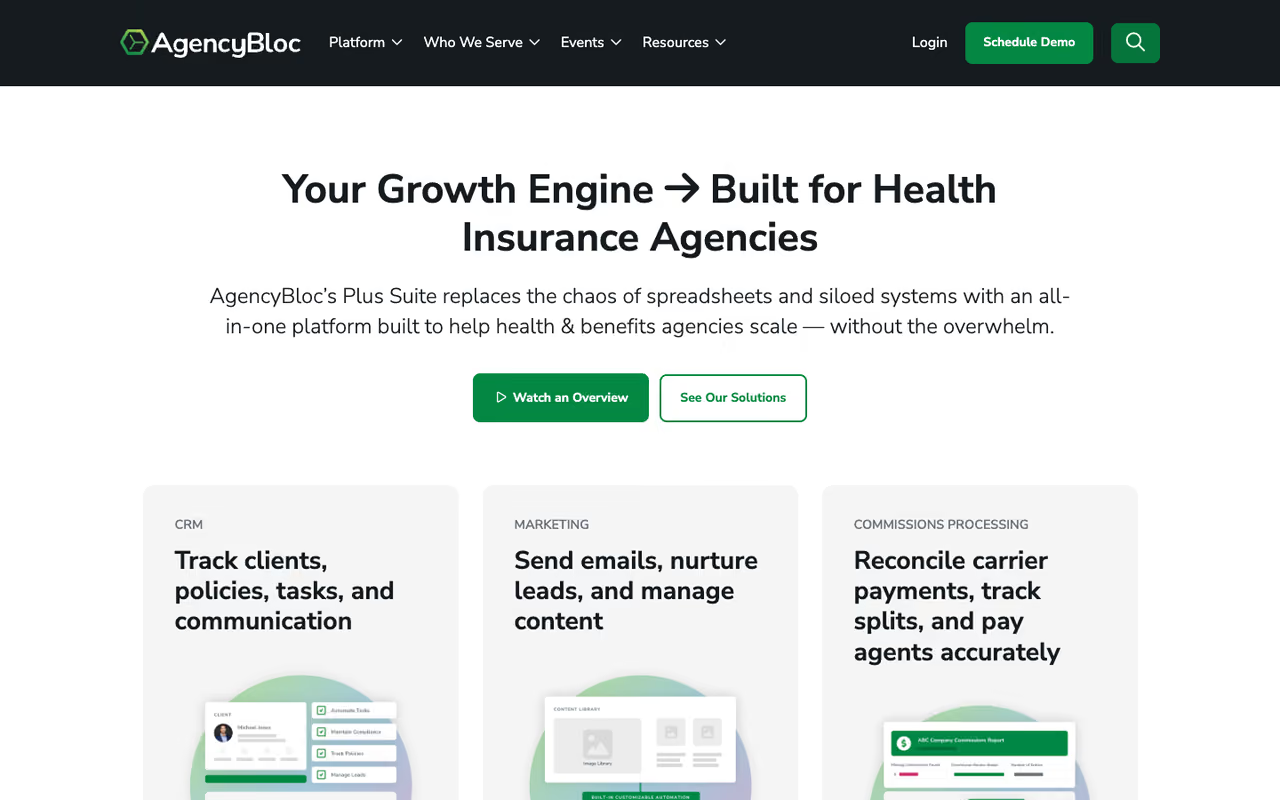
AgencyBloc's AMS+ is the one most life, health, and Medicare agencies land on, and it's earned that. It's not a CRM with insurance features bolted on. It's an agency management system where policies, carriers, commissions, and clients are first-class objects. You can issue quotes, track a policy from application to active, automate 90-60-30 day renewal reminders, and log compliance notes without inventing your own data model.
The default for independent life and health agencies and FMOs that live on renewals and commission accuracy, with Commissions+ automating carrier matching. Pricing climbs with seats and modules, and solo agents with few policies will find it overkill.
Pricing: the AMS+ Grow tier runs $109 per user per month, which includes CRM, automation, reporting, and marketing. Add-ons stack on top: Commissions+ is volume-based, Quote+ is priced by groups quoted, and email campaigns cost $0.02 per send. Higher Accelerate and Elevate tiers are custom-quoted.
The standout is commission tracking. Reconciling carrier statements by hand is the single most painful task in a health agency, and AgencyBloc's Commissions+ automates the matching. That alone pays for the software at most shops.
The catch: pricing climbs fast once you add seats and modules, and the interface feels dated next to a modern SaaS tool. Solo agents selling a handful of policies a month will find it overkill. It shines at five-plus producers with real renewal volume.

HubSpot: the best free starting point
HubSpot isn't built for insurance, and that's exactly why it works for a certain kind of agent. The free CRM is genuinely free for unlimited users with up to a million contacts, no trial clock. You get pipelines, email tracking, tasks, and a clean mobile app. For a new producer who needs to stop losing leads in their inbox, it's hard to beat $0.
A free, easy starting point for newer agents and P&C generalists willing to build custom fields for policy data. It knows nothing about insurance, so renewals, commissions and carrier downloads are on you, and the jump to Professional is steep.
Pricing: free forever for the core CRM. Sales Hub Starter is $15 per seat per month billed annually (about $20 monthly), which unlocks automation and better reporting. The jump to Professional is steep, with a base around $1,600 a month, so most small agencies stay on free or Starter.
The standout is sheer usability. HubSpot's onboarding, templates, and email sequences are best-in-class, and you'll be productive in an afternoon instead of a week of training calls.
Where it falls short: it knows nothing about insurance. No native renewal tracking, no commission reconciliation, no carrier downloads. You rebuild all of that with custom properties and workflows, and you'll never get IVANS policy downloads feeding it automatically. Great for sales, weak for servicing a book.
Zoho CRM: most flexibility per dollar
Zoho CRM is the customization king of this list. It gives you a 360-degree client view across email, phone, chat, and social from one dashboard, and you can mold its custom modules to model policies, claims, and renewals surprisingly well. If you like tinkering and want to own your setup, this is the one.
Best for: small teams that want insurance-shaped fields and automations without paying insurance-software prices.
Zoho suits small teams that want insurance-shaped fields and automations without insurance-software prices, and it is the most flexible option per dollar. Flexibility means work, since someone must design the insurance logic, and there are no native carrier integrations.
Pricing: the free plan covers up to 3 users forever. Paid plans run $14 (Standard), $23 (Professional), $40 (Enterprise), and $52 (Ultimate) per user per month on annual billing. Even the Enterprise tier costs less than half of a dedicated insurance AMS.
The standout is the price-to-flexibility ratio. You can build renewal-date automations, lead scoring, and multi-stage pipelines on the Standard plan for the price of a few coffees per agent.
The catch: flexibility means work. Zoho hands you a blank-ish canvas, and someone on your team has to design the insurance logic. There's a learning curve, and the sprawling Zoho ecosystem (40-plus apps) can feel like a maze. No native carrier integrations either.
If you're weighing a flexible horizontal CRM against a workflow-heavy setup, our roundup of the best AI workflow automation tools pairs well with a Zoho or HubSpot base.
Radiusbob: the budget insurance-native option
Radiusbob has been around since 2010 and built specifically for life and health insurance agents. It bundles lead management, CRM, and a built-in VoIP dialer, with E&O license tracking, commissions, and email marketing included. AgencyBloc acquired it in 2023, so it now sits in the same family as the premium option above.
The budget insurance-native option for solo agents and small life and health shops wanting insurance-specific features at the lowest price. It is a workhorse with a dated interface, and you will outgrow it if you need sophisticated commission reconciliation.
Pricing: after fifteen years without an increase, the Basic CRM plan moved from $34 to $43 per month. VoIP-enabled plans start at $78 a month with 3,000 outbound and 1,000 inbound minutes. There's a 14-day free trial.
The standout is value. You get unlimited leads and clients, commissions tracking, and a dialer for less than a fifth of what AgencyBloc costs.
Where it falls short: the interface looks its age, and the feature depth doesn't match the premium AMS tools. It's a workhorse, not a showpiece. If you need sophisticated commission reconciliation or polished automation, you'll outgrow it.

NowCerts (Momentum): independent P&C agencies
NowCerts, now rebranded as Momentum AMP, is a cloud-based agency management system aimed at independent property and casualty agencies. It covers the full policy lifecycle, document storage, ACORD forms, certificates of insurance, and commission tracking, which is the stuff P&C agents actually need day to day.
A real AMS for small independent P&C agencies that need more than a sales CRM, with COIs, ACORD forms and e-signatures. Reviewers report unpredictable price changes, and the UI is functional rather than delightful.
Pricing: the Essentials plan starts at $99 per user per month, with additional users at $45 each. There's a 30-day free trial, and notably no feature restrictions tied to tiers.
The standout is that you get genuine AMS depth (policy management, COIs, e-signatures) at a price that undercuts legacy enterprise systems like Applied Epic, which can carry $10,000-plus setup fees.
The catch: reviewers report frequent and sometimes unpredictable price changes, which makes budgeting annoying. The UI is functional rather than delightful, and like most full AMS tools, there's a setup period before it earns its keep.
Better Agency: automation-first for P&C
Better Agency (acquired by GloveBox in late 2024 and now folded into GloveBoxCRM) calls itself the only sales-driven insurance AMS for P&C agents. Its hook is automation: more than 100 prebuilt SMS, email, and task campaigns for sales, service, claims, and renewals, triggered by your IVANS policy downloads.
Best for: P&C agencies that want marketing automation and follow-up handled without building campaigns from scratch.
Strong for P&C agencies that want marketing automation and follow-up without building campaigns from scratch, thanks to IVANS-triggered sequences. Pricing is quote-only, the roadmap is in transition after the acquisition, and it loses value without IVANS downloads.
Pricing: Better Agency uses custom quotes rather than public pricing, so you'll need a demo to get a number. Expect it to land in the typical AMS range of roughly $85 to $200 per user per month based on market comparisons.
The standout is the prebuilt campaign library. Those IVANS-triggered automations mean a new lead or a pending renewal kicks off the right text and email sequence automatically, which is where most agencies leak revenue.
Where it falls short: the lack of transparent pricing is a turn-off, and the GloveBox acquisition means the roadmap and branding are in transition. If you're not a P&C agent using IVANS downloads, much of its value disappears.
If you're leaning hard into automated outreach, it's worth reading our guide to the best AI sales tools before you commit to one platform's campaign engine.
Ringy: built for phone-heavy sales
Ringy is a CRM aimed squarely at high-velocity sales agents, including a lot of insurance producers who live on the phone. The draw is the built-in dialer and SMS automation, so your CRM and your calling tool are the same product instead of two subscriptions duct-taped together.
Made for agents who buy leads and dial fast in final expense, Medicare and life telesales, with the dialer built in. It is not an AMS, so there is no policy servicing, and add-ons plus minutes push costs up.
Pricing: the base plan is $119 per month (often discounted to $99 for the first six months), including 1,000 minutes and 1,000 texts. The Power Dialer add-on is $70, AI tools $10, and call scripting $10. A serious caller stacking add-ons lands around $209 a month before usage overages of about a penny per minute or text.
The standout is the power dialer integration. For a lead-buying telesales operation, working leads the instant they come in is the whole game, and Ringy is built for that motion.
The catch: it's a sales-velocity tool, not an AMS. There's no real policy servicing, renewal lifecycle, or commission reconciliation. Costs also balloon once you add the dialer and heavy minutes, so model your real usage before signing up.
GoHighLevel: all-in-one for marketing-heavy agencies
GoHighLevel isn't insurance-specific, but a lot of agencies and agency-marketing consultants run on it because it combines a CRM, funnel and website builder, email and SMS marketing, calendars, and automations in one place. If your bottleneck is lead generation and nurture more than policy servicing, it's compelling.
Consider it if your bottleneck is lead generation and nurture, and you want funnels, landing pages and follow-up under one bill. It is complex, knows nothing about policies or commissions, and usage-based add-ons make the true cost fuzzy.
Pricing: the Starter plan is $97 per month with unlimited contacts and users. Agency Unlimited at $297 unlocks unlimited sub-accounts and white-labeling. Note that SMS, calls, email sends, and AI features are billed separately on usage.
The standout is the breadth. You replace three or four tools (CRM, email platform, landing page builder, scheduler) with one bill, which is genuinely useful for a small team.
Where it falls short: it's complex, with a real learning curve, and it knows nothing about insurance policies or commissions. Usage-based add-ons make the true cost fuzzy. It's a marketing machine first and a servicing tool not at all.
How to choose
Skip the feature-checklist paralysis and answer three questions.
First, what do you sell? Life, health, and Medicare agents should start with AgencyBloc or Radiusbob, because commission reconciliation and renewal tracking are the whole job. P&C agents want a true AMS like NowCerts or Better Agency that ingests IVANS downloads.
Second, is your bottleneck selling or servicing? If you're drowning in new leads and need to dial and close, Ringy or GoHighLevel earn their keep. If you're losing money on missed renewals and messy commissions, buy the insurance-native AMS and accept the higher price.
Third, what's your budget and tolerance for setup? Tight budget and willing to build it yourself: Zoho CRM free or HubSpot free. Want it to work out of the box and willing to pay: a dedicated AMS. The cheapest tool you never configure properly costs more than the expensive one you actually use.
Whichever you pick, the system only pays off if your team logs everything in it. If you want to go deeper on automating the busywork around your stack, the Dupple X toolkit and our top tools directory are good next stops.
Try Dupple X free for a year and pair your CRM with the AI tools that actually move the needle.
FAQ
What is the best CRM for insurance agents in 2026?
There's no single winner, it depends on what you sell. For life and health agencies, AgencyBloc is the strongest all-in-one pick because of its commission and renewal tracking. For P&C agents, NowCerts or Better Agency fit better. For agents who want to start free and customize, Zoho CRM and HubSpot are the value leaders.
What's the difference between a CRM and an AMS for insurance?
A CRM manages contacts, leads, and sales pipelines. An agency management system (AMS) does all of that plus the insurance-specific work: policy lifecycle, carrier downloads, commission reconciliation, ACORD forms, and certificates of insurance. AgencyBloc, NowCerts, and Better Agency are AMS platforms. HubSpot, Zoho, and Ringy are CRMs you'd extend with custom fields.
Is there a free CRM for insurance agents?
Yes. HubSpot's core CRM is free for unlimited users, and Zoho CRM is free for up to 3 users forever. Neither is insurance-specific, so you'll build custom fields for policy type, carrier, and renewal date yourself. They're a smart starting point for solo agents and new producers on a tight budget.
How much does insurance CRM software cost per month?
It ranges widely. Budget insurance-native tools like Radiusbob start around $43 a month. Mid-tier AMS platforms like NowCerts and AgencyBloc run roughly $99 to $109 per user per month. Generic CRMs start free (HubSpot, Zoho) and scale to $14 to $52 per user. Add dialers, commissions modules, and SMS, and the real bill climbs from there.
Do I need an insurance-specific CRM or will a general one work?
If you mostly sell and your servicing is light, a general CRM like HubSpot or Zoho with custom fields works fine and saves money. If renewals, commissions, and carrier downloads are central to your book, an insurance-specific AMS pays for itself by automating the reconciliation and compliance work a generic tool can't touch.
Related guides
Some offers on this page may be paid placements or contain affiliate links.
