
Best AI Compliance Tools (2026): 8 Platforms I'd Actually Trust

Key facts8 tools compared: Vanta, Scytale, Comp AI, Drata, Sprinto, Credo AI, Holistic AI, OneTrust
- 8 tools compared: Vanta, Scytale, Comp AI, Drata, Sprinto, Credo AI, Holistic AI, OneTrust
- Vanta (best for: Most teams getting SOC 2 / ISO 27001): From ~$10K/yr
- Scytale (best for: Value seekers wanting experts + AI): From ~$7.5K/yr
- Comp AI (best for: Startups, technical teams, tight budgets): From $199/mo
- Drata (best for: Scaling companies, many frameworks): From ~$7.5K/yr
Compliance used to be a quarter of someone's job. Now it's two jobs at once: the old security audits (SOC 2, ISO 27001, GDPR) that customers demand before they sign, plus a brand new category nobody had on their roadmap two years ago, governing the AI systems you ship. The EU AI Act's high-risk provisions hit full force in August 2026, and the questionnaires from enterprise buyers now ask about model risk, not just encryption.
The good news: the tools got dramatically better. Most of them have AI agents that draft your policies, answer security questionnaires, and flag failing controls before an auditor ever sees them. The bad news: the category split. Some platforms automate your security certifications, others govern your AI models, and a few try to do both. Buying the wrong one means paying for a feature set you'll never touch.
If you want the short answer: Vanta is still the platform I'd hand most teams, because it does the security compliance everyone needs and its AI agent is genuinely useful. But the right pick depends on whether your problem is "I need a SOC 2 to close deals" or "I need to govern the AI we deploy." This guide covers both. Here's what I'd actually trust with an audit on the line.
Quick comparison
| Tool | Best for | Price | Standout |
|---|---|---|---|
| Vanta | Most teams getting SOC 2 / ISO 27001 | From ~$10K/yr | AI agent with 95% answer acceptance |
| Scytale | Value seekers wanting experts + AI | From ~$7.5K/yr | Multi-agent suite + human GRC team |
| Comp AI | Startups, technical teams, tight budgets | From $199/mo | Open source, self-hostable |
| Drata | Scaling companies, many frameworks | From ~$7.5K/yr | Flat fee, no per-seat charges |
| Sprinto | Sub-25-person startups | From ~$7K/yr | Lowest credible entry point |
| Credo AI | Enterprises governing AI models | Custom | EU AI Act + NIST AI RMF policy packs |
| Holistic AI | Teams auditing AI for bias/risk | Custom | 100+ automated model tests |
| OneTrust | Large orgs needing privacy + AI | From ~$10K/yr | Runtime AI agent oversight |

Vanta: the default choice for security compliance
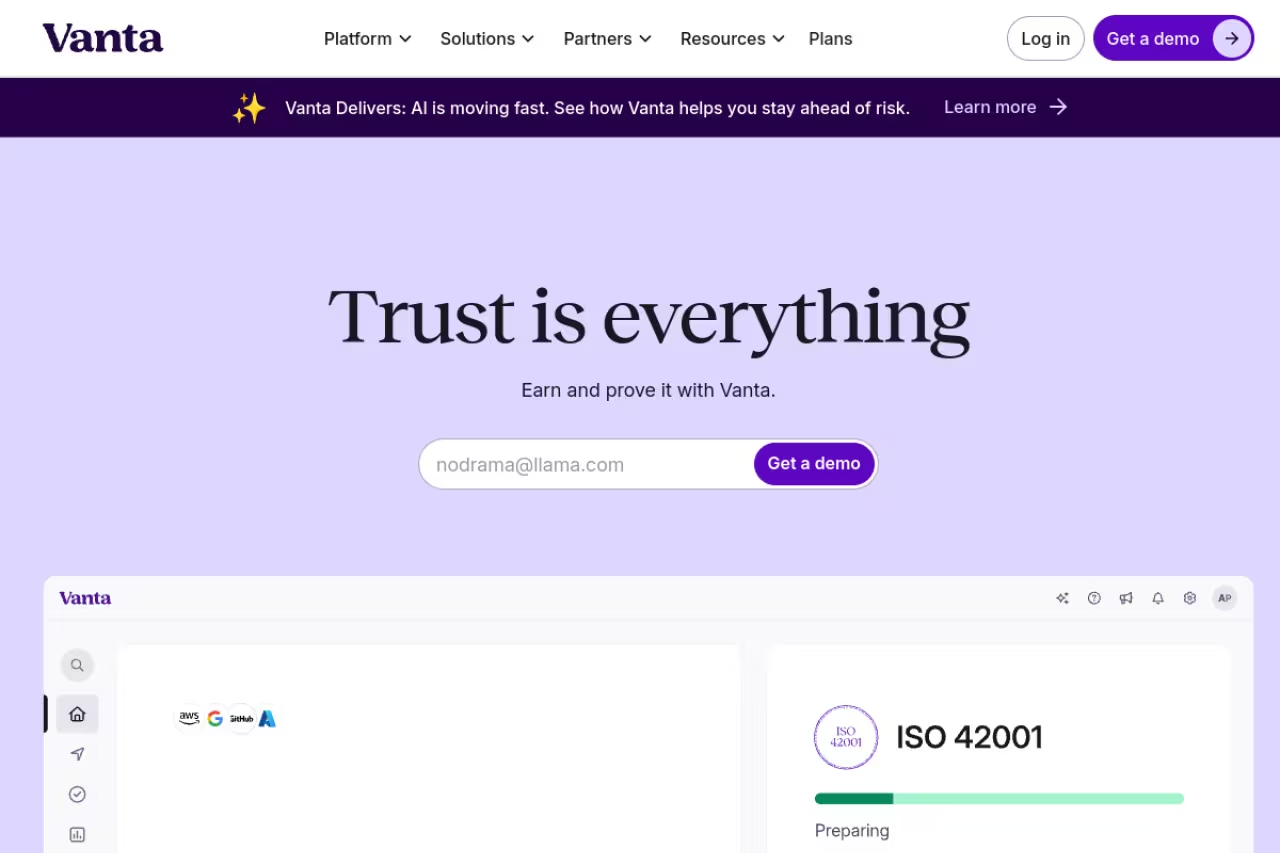
Vanta is what most people mean when they say "compliance automation." You connect it to your cloud (AWS, GCP, Azure), your HR system, your code repos, and it continuously checks your security controls against the framework you're chasing, then collects the evidence an auditor needs.
What pushed it ahead this year is the Vanta Agent. In January 2026 the company shipped its Agentic Trust Platform, and the agent now drafts policies, scores vendor risk automatically, and answers inbound security questionnaires from your own evidence library. Vanta reports a 95% acceptance rate on the answers it suggests, which matches what I saw: it pulls exact matches when they exist and writes plausible new responses when they don't. That questionnaire feature alone justifies the cost for any team that loses days to enterprise security reviews.
The default for B2B SaaS companies that need SOC 2 or ISO 27001 to close deals with minimal friction, and its agent that answers security questionnaires from your evidence library is worth the cost alone. Quotes are custom and exclude the auditor, so negotiate.
Pricing: Vanta doesn't publish list prices. Real-world quotes start around $10,000 to $12,000 per year for a startup under 50 people on a single framework, climbing to $25,000+ with add-ons and more frameworks. The audit itself is separate and runs $10,000 to $50,000.
The catch: every quote is custom, so you negotiate blind, and the headline price never includes the auditor. Buyers who show they're evaluating Drata or Sprinto routinely get 15 to 30% off. Don't take the first number.

Scytale: AI automation with humans in the loop
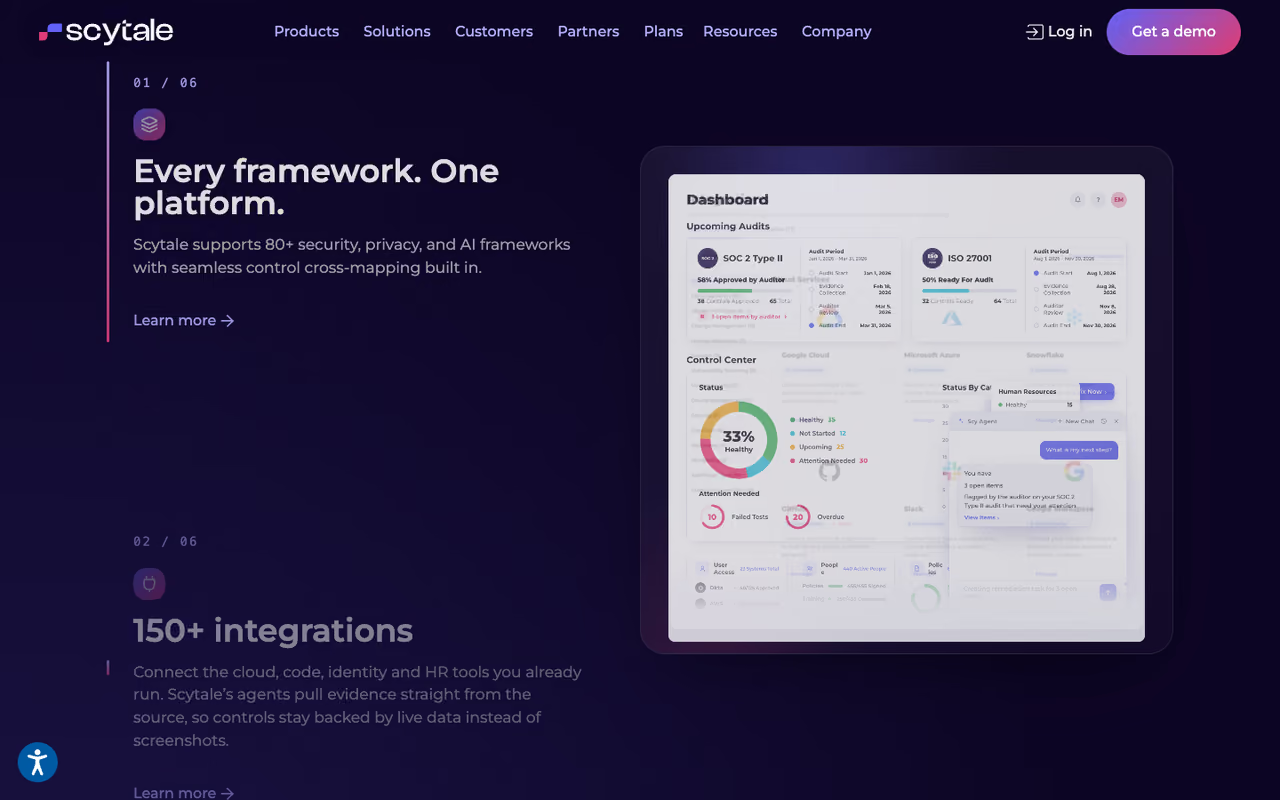
Scytale is the one I point smaller teams to when they want help, not just software. It pairs an AI multi-agent suite with an assigned team of human GRC experts, so you're not staring at a dashboard wondering what "control SC-7 failed" actually means. The platform covers 80+ frameworks including SOC 2, ISO 27001, ISO 42001 (the AI management standard), GDPR, HIPAA, and SOX ITGC.
The AI side is real, not a chatbot bolted on. ScyAgent answers GRC questions about your specific environment with confidence scoring, and a set of specialist agents handle gap scanning, evidence review, and vendor intelligence in the background. Scytale won a 2026 G2 Best Software Award in the GRC category, and the reviews lean heavily on the human support being responsive.
The one for first-time SOC 2 teams that want expert hand-holding bundled in, and anyone who also needs ISO 42001 for AI governance. Entry pricing looks good against Vanta, but you depend on your assigned team's bandwidth.
Pricing: starts around $7,500 per year, scaling with company size and the number of frameworks. The advisory bundle is included, which is the part that makes the entry price look good against Vanta.
The catch: the human-expert model is the selling point and the constraint. You're somewhat dependent on your assigned team's bandwidth, and the deepest automation still trails what a pure-software platform like Drata gives a team that doesn't need the hand-holding.
Comp AI: the open-source disruptor
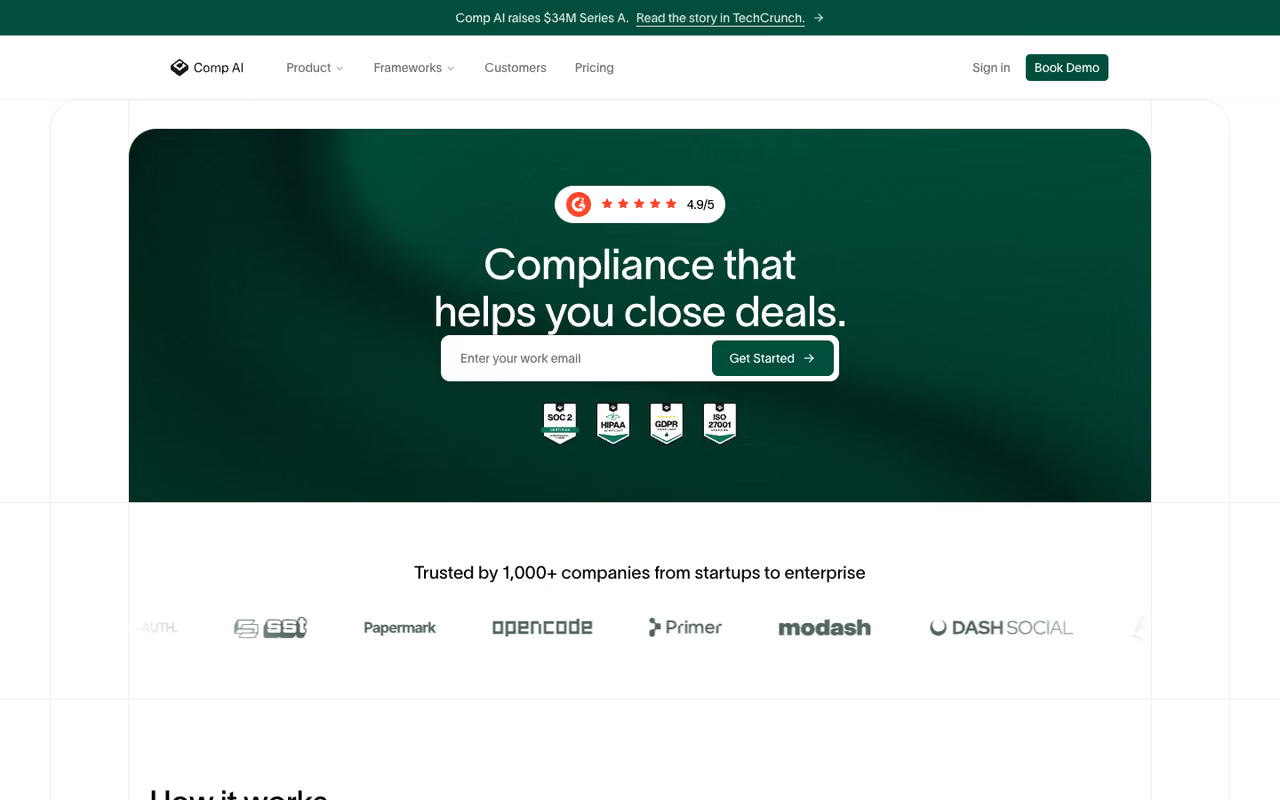
Comp AI is the most interesting new entrant, and the only one on this list you can read the source code of. The core platform is open source under AGPLv3, so you can inspect every agent, every check, every integration on GitHub, or self-host the whole thing if you don't want a vendor holding your compliance posture hostage. For technical founders who instinctively distrust black boxes, that's a real argument.
It covers SOC 2, ISO 27001, HIPAA, GDPR, and 25+ frameworks total, with 580+ integrations for automated evidence collection. The trust center is live-monitored: only published policies and verified controls show up, and anything that fails or reverts to draft drops off automatically. As of early 2026 it claimed thousands of companies using it, impressive for a platform founded in 2025.
Best for: startups and engineering-led teams that want compliance automation without enterprise pricing, and anyone who values being able to audit the auditor.
The most interesting new entrant for startups and engineering-led teams that want to inspect the source or self-host. The managed Starter plan is $199 per month, but it is young and fewer auditors have seen its evidence format.
Pricing: the managed cloud Starter plan is $199 per month, Pro is $997 per month and includes a third-party audit, and a done-for-you concierge package starts at $3,000 one-time. Self-hosting the open-source core is free.
The catch: it's young. The integration count is high but the platform hasn't survived as many audit cycles as Vanta or Drata, and you'll find fewer auditors who've seen its evidence format. The trade-off for the price is being slightly earlier on the maturity curve.
If you're a small team trying to move fast on both AI adoption and the compliance that comes with it, our Dupple X membership tracks tools like these as they ship so you don't have to audit the whole market yourself.

Drata: built to scale across frameworks
Drata competes head to head with Vanta and wins on a specific axis: it scales without punishing you for headcount. Drata doesn't charge per seat, so a 200-person company pays the same platform fee as a 50-person company on the same tier. If you're growing fast or running several frameworks at once, the math favors Drata.
It automates evidence collection and control monitoring across SOC 2, ISO 27001, GDPR, HIPAA, and dozens of other frameworks, with continuous testing that catches drift before it becomes an audit finding.
Pick Drata if you expect to add frameworks and don't want pricing tied to headcount, since there is no per-seat charge. It is overkill for a five-person startup that needs one SOC 2 report, where Sprinto or Comp AI fit better.
Pricing: the Foundation tier runs $7,500 to $15,000 per year for one framework, Advanced sits at $15,000 to $25,000, and Enterprise starts at $25,000 and climbs past $100,000. Implementation and the external audit are extra.
Where it falls short: it's powerful enough to be overkill for a five-person startup that just needs one SOC 2 report. The advanced tiers and the implementation cost mean Drata earns its keep at scale, not at the very bottom of the market, where Sprinto or Comp AI fit better.

Sprinto: the cheapest credible entry
Sprinto owns the bottom of the market. It's consistently the lowest credible entry point in SOC 2 automation and dominates among sub-25-employee startups. It connects to 200+ tools, maps and monitors controls automatically, and claims to automate up to 80% of the audit-prep work.
Its AI layer interprets regulations into structured requirements that map to your existing setup, and when a regulation changes it realigns your controls to prevent drift. For a tiny team that just needs to pass one audit, that's the whole job.
The cheapest credible entry for early-stage startups getting a first SOC 2 or ISO 27001 on a tight budget, with Starter around $7,000 to $8,000 per year. Prices aren't published, and bigger orgs with complex needs outgrow it.
Pricing: the Starter tier lands around $7,000 to $8,000 per year for a single framework. Multi-framework setups run $9,000 to $15,000, and four-plus frameworks can pass $20,000.
The catch: prices aren't published, so you only learn the tiers after a sales call, and the cheapest tier is genuinely starter-grade. Bigger orgs with complex multi-entity needs outgrow it, at which point Drata or Vanta make more sense.

Credo AI: governance for the models you ship
This is where the list pivots from security compliance to AI compliance. Credo AI governs the AI systems your company deploys rather than your cloud infrastructure. It maintains a model inventory, runs impact assessments, and produces audit-ready documentation against the frameworks regulators care about.
Its policy library covers the EU AI Act, NIST AI RMF, ISO 42001, SOC 2, and US-specific rules like NYC Local Law 144 for hiring algorithms. If you ship AI that touches credit, hiring, healthcare, or anything the EU classifies as high-risk, this is the category of tool you need, and Vanta-style platforms won't cover it.
The choice when the obligation is AI governance, covering model inventory, impact assessments and the EU AI Act for enterprises shipping high-risk AI. It is not a SOC 2 tool, so you are overbuying if you just want a security cert.
Pricing: custom, quoted per engagement. There's no published tier, which tells you it's aimed at enterprise budgets.
Where it falls short: it's not a SOC 2 tool. You can generate SOC 2 evidence from it, but if your actual problem is closing deals with a security cert, you're overbuying. Credo earns its price only when AI governance is a real, board-level obligation.

Holistic AI: testing models, not just documenting them
Holistic AI approaches AI compliance from the technical end. It started as an algorithmic-auditing and bias-detection specialist and grew into a full-lifecycle governance platform. The differentiator is that it actually tests your models: 100+ automated checks including red teaming, jailbreak attempts, hallucination detection, and fairness assessments for employment or lending systems.
It pairs that testing with a visual policy builder carrying templates for the EU AI Act, NIST, and ISO 42001, plus violation tracking and audit-ready evidence. In 2026 it added Guardian Agents that observe models continuously and intervene in real time, the kind of runtime enforcement the EU AI Act effectively requires for high-risk systems.
Go with Holistic AI if you need to prove your models are fair and safe through 100+ automated checks, not just document a policy, especially in hiring or lending. The methodology depth is more than most teams need outside regulated domains.
Pricing: custom. Aimed at enterprises with a genuine model-risk function.
The catch: the methodology depth is the point, and it's more than most teams need. If you're not deploying models in a regulated domain, the bias-audit machinery is firepower you won't use.

OneTrust: the enterprise privacy incumbent that added AI
OneTrust is the established privacy and data-governance platform, used by 14,000+ organizations across 300+ jurisdictions, and it has bolted AI governance onto an already-deep privacy stack. In 2026 it added real-time AI governance: AI agent discovery, a policy library, and runtime guardrail enforcement that inspects models continuously instead of at a single checkpoint.
A natural fit for large organizations already running privacy programs (GDPR, CCPA, consent management) that want AI governance under one roof. It carries enterprise pricing, with a minimum annual contract of roughly $10,000.
Pricing: OneTrust raised its minimum annual contract to roughly $10,000 across tiers in early 2026, and real enterprise deployments run well beyond that.
Where it falls short: it's heavy. OneTrust is built for big privacy operations, and a startup that just needs a SOC 2 will drown in modules it doesn't need. The AI features are strong but they're an add-on to a privacy platform, not the core.
How to choose
Start with what's actually forcing your hand, because the categories don't overlap as much as the marketing suggests.
If a customer is blocking a deal until you have a security cert, you need security compliance automation: Vanta, Scytale, Drata, Sprinto, or Comp AI. Pick by stage. Under 25 people and budget-conscious, start with Sprinto or Comp AI. Want experts bundled in, go Scytale. Scaling and adding frameworks, go Drata. Want the safest default and the best questionnaire automation, go Vanta.
If a regulator (or your own legal team reading the EU AI Act) is forcing your hand on the AI you deploy, you need AI governance: Credo AI for policy and documentation, Holistic AI if you need to test models for bias and safety, OneTrust if you already live in its privacy ecosystem. These don't replace a SOC 2 tool, they sit alongside it.
The mistake I see most: buying an enterprise AI-governance platform because "AI" is in the name, when the real need was a $7K SOC 2. Match the tool to the obligation, not the buzzword. For more on the broader stack, see our guides to the top AI tools and the best AI agents shaping how teams work in 2026.
FAQ
What are AI compliance tools?
AI compliance tools fall into two groups. The first automates traditional security and privacy certifications (SOC 2, ISO 27001, GDPR, HIPAA) using AI agents that collect evidence, monitor controls, and answer questionnaires. Vanta, Drata, and Sprinto fit here. The second governs the AI systems a company deploys, checking them against frameworks like the EU AI Act and NIST AI RMF. Credo AI and Holistic AI fit there.
Which AI compliance tool is best for a startup?
For most startups chasing their first SOC 2, Sprinto and Comp AI are the cheapest credible options, starting around $7,000 per year and $199 per month respectively. Scytale is worth the slightly higher entry if you want human GRC experts included. Vanta is the safest default once you have budget, mainly for its questionnaire automation.
How much do AI compliance platforms cost in 2026?
Security compliance automation runs from roughly $7,000 to $25,000 per year for startups and small teams, climbing past $100,000 for large enterprises on multiple frameworks. Comp AI is the outlier with a $199-per-month managed plan and a free self-hosted option. AI governance platforms like Credo AI and Holistic AI quote custom enterprise pricing. None of these include the external audit, which is a separate $10,000 to $50,000.
Do I need an AI governance tool for the EU AI Act?
If you build or deploy AI that the EU classifies as high-risk (credit scoring, hiring, medical, critical infrastructure), then yes, you'll need governance capabilities for the obligations taking effect in August 2026: risk management, technical documentation, event logging, and human oversight. A standard SOC 2 platform won't cover these. If your AI use is low-risk, the obligations are far lighter and you may not need a dedicated platform.
Can one platform handle both security and AI compliance?
A few try. Scytale covers 80+ frameworks including ISO 42001, the AI management standard, alongside SOC 2. OneTrust pairs deep privacy compliance with AI governance. But the AI-act-specific governance (model testing, bias audits, high-risk documentation) is still best served by specialists like Credo AI or Holistic AI. Most teams that need both end up running one security tool and one AI-governance tool.
Is open-source compliance software like Comp AI safe to use?
Open source is arguably more transparent, not less. With Comp AI you can inspect every agent and check on GitHub, which is more than you get from closed platforms. The trade-off is maturity: it's a 2025-founded product, so it has fewer audit cycles behind it and fewer auditors familiar with its evidence format than Vanta or Drata. For most startups that's an acceptable trade for the price and the transparency.
Related guides
Some offers on this page may be paid placements or contain affiliate links.
