
The 8 Best Community Platforms in 2026 (Compared and Ranked)

Key facts8 tools compared: Skool, Circle, Mighty Networks, Whop, Discord, Kajabi, Heartbeat, Geneva
- 8 tools compared: Skool, Circle, Mighty Networks, Whop, Discord, Kajabi, Heartbeat, Geneva
- Skool (best for: Paid communities that want simplicity): $99/mo (Pro)
- Circle (best for: Creators who want depth and polish): $89/mo
- Mighty Networks (best for: Course-led communities): $79/mo
- Whop (best for: Early-stage creators, zero monthly cost): Free + ~3% fee
Picking a community platform feels low-stakes until you've moved 800 members off the wrong one. I've done that migration. It's miserable, it costs you churn, and it's entirely avoidable if you spend an afternoon thinking about what you actually need before you swipe a card.
The problem is that every tool in this category sells itself as the all-in-one home for your audience, and most of them are lying by omission. Some are built for course creators who treat the community as an afterthought. Some are chat apps wearing a membership-site costume. A few are genuinely great but priced for people already making real money. The gap between "looks good on the pricing page" and "still works at 2,000 members" is where people get burned.
This is for founders, creators, and operators who want a paid or engaged community and don't want to redo this decision in six months. If you want the short answer: Skool is the best default for most paid communities because of its flat pricing and gamification, Circle is the pick if you want depth and polish, and Discord is still unbeatable for free, real-time chat. The rest of this covers when each of the eight makes sense.
Quick comparison
| Tool | Best for | Starting price | Standout |
|---|---|---|---|
| Skool | Paid communities that want simplicity | $99/mo (Pro) | Gamification + discovery directory |
| Circle | Creators who want depth and polish | $89/mo | Most features, fastest shipping |
| Mighty Networks | Course-led communities | $79/mo | Native mobile apps + AI matchmaking |
| Whop | Early-stage creators, zero monthly cost | Free + ~3% fee | Pay nothing until you sell |
| Discord | Free, real-time chat communities | Free | Voice, presence, massive reach |
| Kajabi | Course businesses needing one stack | $89/mo | Courses, email, checkout in one |
| Heartbeat | Small course communities on a budget | $49/mo | Cheap entry with course tools |
| Geneva | Casual, group-chat-style groups | Free | Discord simplicity, friendlier UX |

Skool: the best default for paid communities
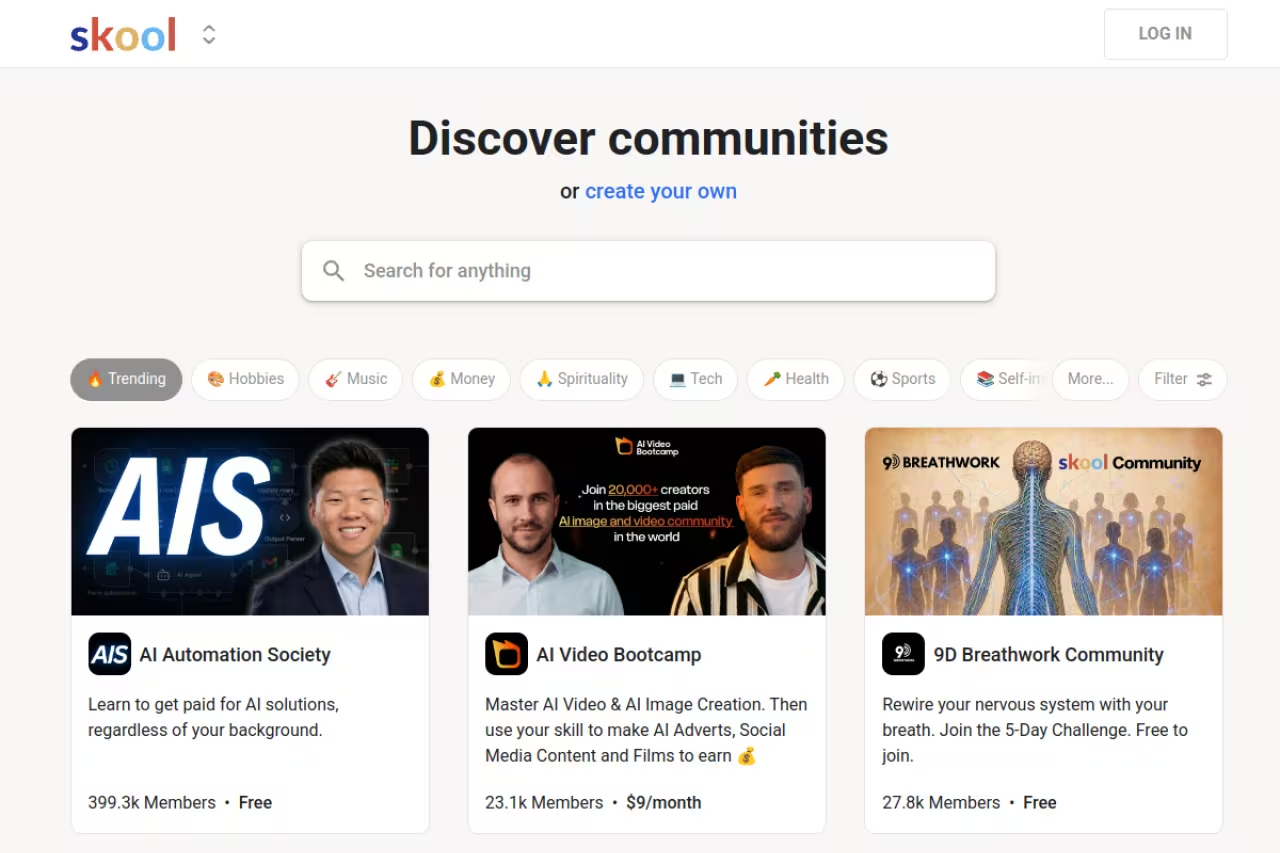
Skool won the creator-community fight over the last two years, and it did it by being almost aggressively simple. There are no nested settings menus or 40 toggles. You get a discussion feed, courses (they call them classrooms), a calendar, and a leaderboard. That's it. The constraint is the feature.
The gamification is the part people underestimate. Members earn points for engagement, climb levels, and unlock content as they level up. It sounds gimmicky until you watch your daily active numbers and realize people are showing up to keep a streak alive. For a paid community where retention is the whole game, that loop does real work.
The pick for coaches and creators who want one clean space for discussion and courses, with gamification that keeps members showing up. Simplicity has a ceiling: no real automation, thin email, and customization limited to logo and colors.
Skool now runs a $9/month Hobby plan with a steep 10% transaction fee, and a $99/month Pro plan that drops the fee to 2.9% (per Skool's pricing page). Most serious communities go Pro. Annual billing gets you two months free.
The standout: The discovery directory. Public Skool communities can be found and joined through Skool's own marketplace, which sends you members you didn't have to pay to acquire. No other platform here does organic discovery this well.
The catch: The simplicity has a ceiling. There's no real automation engine, native email is thin, and customization is limited to your logo and colors. If you want branded mobile apps or deep workflows, Skool will frustrate you fast.

Circle: the most capable platform for serious builders
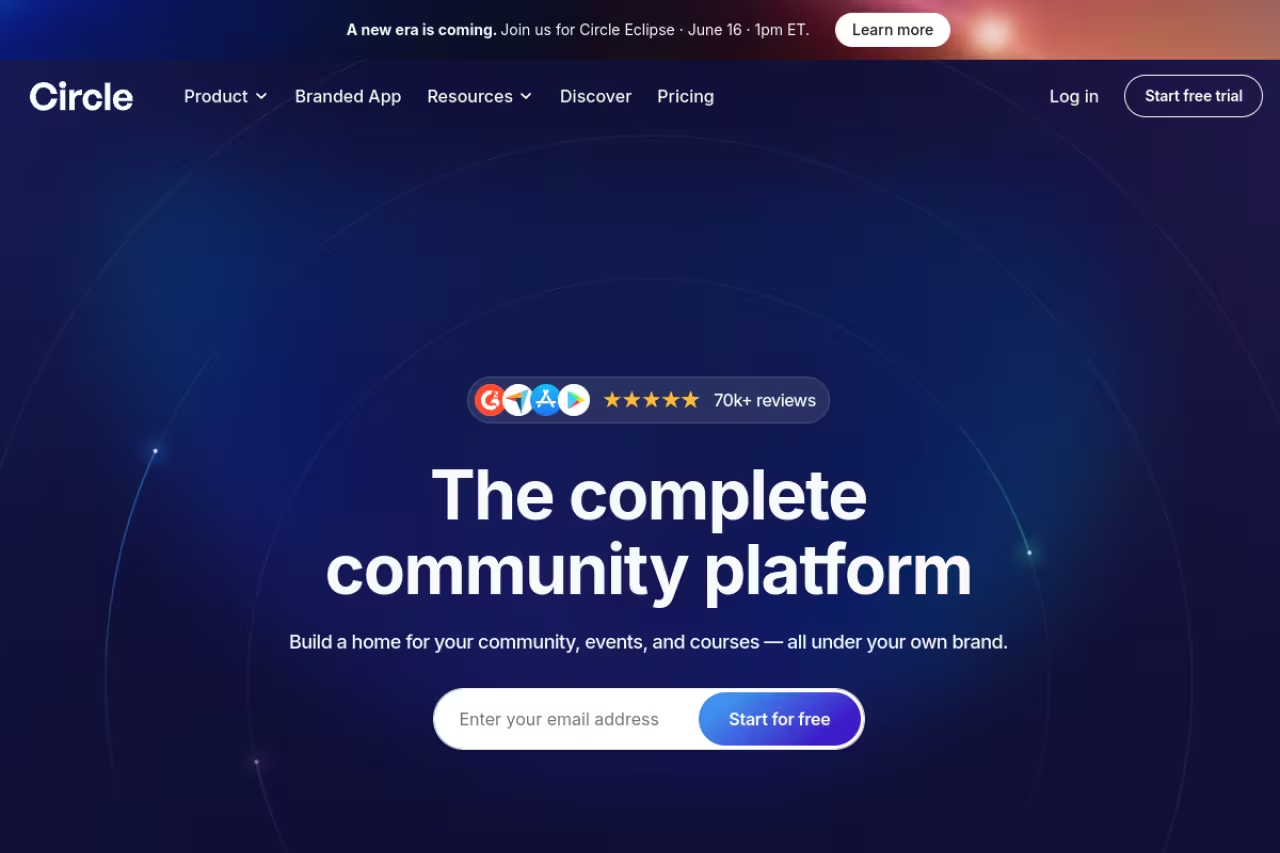
Circle is what you reach for when Skool feels too small. It ships features faster than anyone in the category (the team publicly tracks shipping hundreds of updates a year), and it shows. You get discussion spaces, courses, live streams, events, member directories, paid memberships, and a workflow builder that actually automates onboarding and engagement.
Looking through what Circle actually ships, it rarely seems to hit a wall. Need a private space for paying members? Done. Want to drip a course and gate it behind a tier? Done. The polish shows in the feature set, and user reviews rarely describe it as clunky.
Choose Circle for a premium, branded space with courses, live streams, and automations, if you can handle more settings. Fees stack on Stripe's cut, so the entry plan's real take rate is closer to 5% than 2%.
The Professional plan is $89/month with 2% transaction fees. Business is $199/month at 1% fees, and Circle Plus is custom-priced at 0.5% fees with AI agents and optional branded mobile apps (Circle's pricing). There's a 14-day free trial and a 30-day money-back guarantee.
The standout: Breadth without bloat. Few platforms give you live streaming, courses, automations, and a real API at this price, and fewer still keep it usable.
The catch: Transaction fees stack on top of Stripe's cut, so your real take rate on the entry plan is closer to 5% than 2%. Branded mobile apps live behind the custom-priced top tier, which prices out a lot of solo creators who want their own app.

Mighty Networks: best for course-led communities
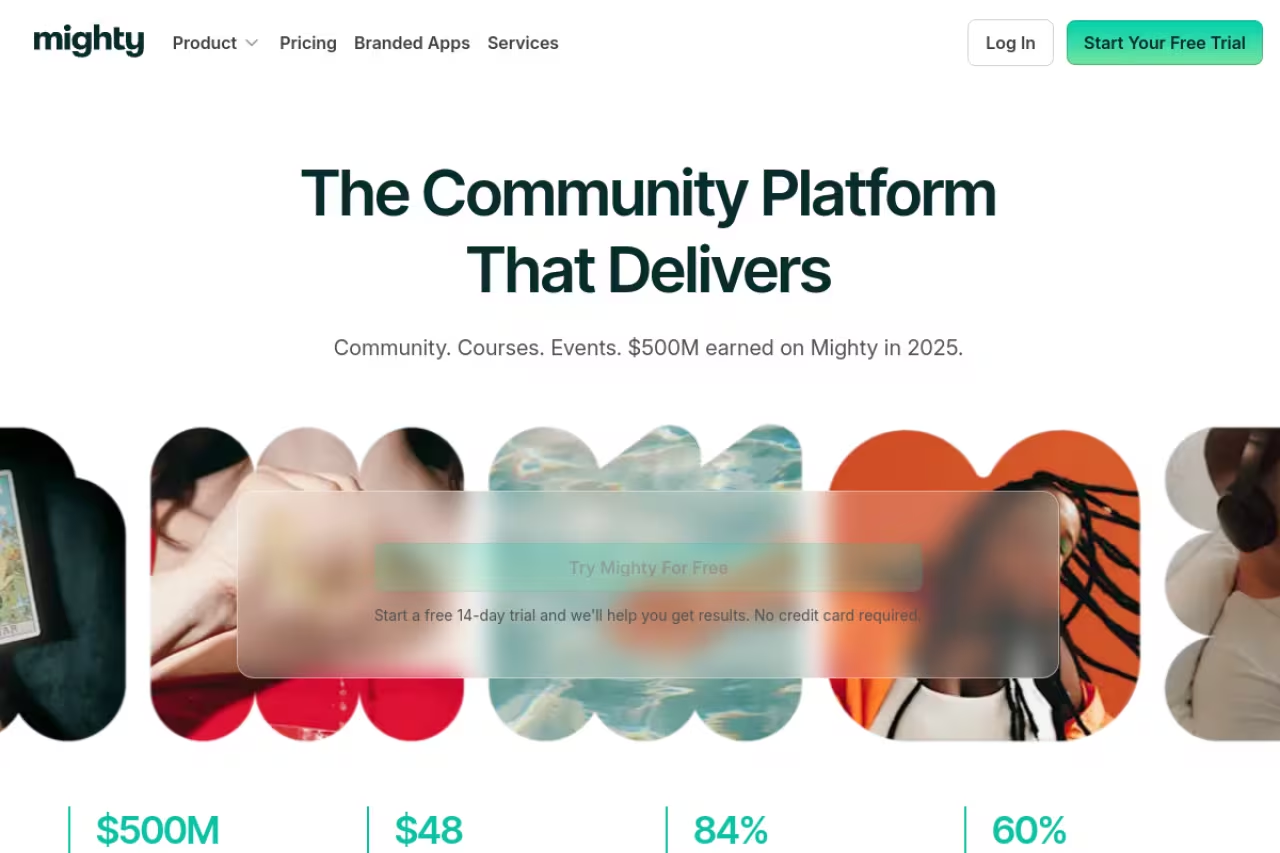
Mighty Networks has leaned hard into the "people magic" angle: AI that helps match members to each other and surface relevant conversations. Underneath the marketing, it's a strong all-in-one with courses, events, paid memberships, and native iOS and Android apps included on every plan, not just the enterprise tier.
That last point matters. If your members live on their phones and you want a real app experience without a five-figure custom build, Mighty does it cheaper than almost anyone. The AI conversation starters and matchmaking are genuinely useful for larger groups where new members would otherwise lurk and leave.
A strong fit for course-led communities with a mobile-first audience, since native iOS and Android apps come on every plan. The interface has more surface area than Skool, and your community lives in Mighty's branded app unless you upgrade.
The Launch plan is $79/month (or $950/year) with 2% fees. Scale runs $179/month at 1% fees, and Mighty Pro is custom-priced at 0.5% with a fully branded app (Mighty Networks pricing). Every plan includes the shared iOS and Android apps.
The standout: Native mobile apps on the entry plan plus AI matchmaking. That combination is rare under $100/month.
The catch: The interface has more surface area than Skool, and new members sometimes feel lost. The AI features are good but not magic, and the shared app means your community lives inside Mighty's branded app unless you pay for Mighty Pro.
If you're still weighing whether a course belongs inside your community at all, our guide to the best online course platforms breaks down the standalone options.
Whop: start free, pay only when you sell
Whop flipped the model: no monthly fee, you only pay when you make money. It started as a marketplace for digital products and grew into a full community-and-monetization platform. For an early-stage creator with no audience yet, paying $0/month instead of $99 is the difference between testing an idea and not.
The fees are where it gets real. Whop is free to start, but takes roughly 3% on automated sales on top of the standard 2.7% + $0.30 card processing, and adds payout charges, so your true cost can land near 5% to 7% depending on the transaction (Whop fee breakdown). It dropped its old 30% marketplace commission in 2025, which made it far more attractive.
Go with Whop for the lowest-risk launch when you are pre-revenue and want no fixed monthly bill. The all-in fee is higher than it looks, and at scale a flat $99/month plan with 2% fees beats it.
Free to start. Fees scale with your sales rather than a flat subscription.
The standout: Zero monthly cost plus a built-in marketplace that can send you buyers. It's the lowest-risk way to launch a paid community in this list.
The catch: The all-in fee is higher than it looks once you account for platform, processing, and payout charges. At scale, a flat $99/month plan with 2% fees beats Whop's percentage model. It's a great on-ramp, not always a great forever home.

Discord: still the king of free real-time chat
Discord isn't a membership platform, and pretending otherwise is how people end up disappointed. It's the best free real-time community tool on the planet, with voice channels, screen sharing, and a presence model that makes a space feel alive in a way feed-based tools never do.
For free communities, fan groups, dev communities, and anything that thrives on synchronous chat, nothing beats it. Discord also added Server Subscriptions, letting owners charge for premium tiers while Discord takes a 10% cut, which is lower than most competitors (how Discord makes money). With 150 million-plus monthly active users, your audience is probably already there.
Unbeatable for free communities and real-time chat, with voice and presence that async tools can't match. It has no structure and no courses, so as a paid home it falls short of purpose-built tools.
Free. Nitro is optional for members at $9.99/month, and Server Subscriptions let you monetize at a 10% platform cut.
The standout: Voice and presence. The "who's online right now" energy drives engagement that async platforms struggle to match.
The catch: No structure. Threads sprawl, courses don't exist, search is weak, and monetization is bolted on rather than native. As a paid product home, it falls short of purpose-built tools. Plenty of creators run a free Discord plus a paid Skool or Circle, and that combo works well.

Kajabi: for course businesses that want one stack
Kajabi isn't a community platform first. It's a course-and-marketing platform that includes a community space. If you're already selling courses and want email marketing, sales funnels, checkout, and a community under one login, Kajabi is the consolidation play.
The community feature has improved a lot and now stands on its own for most creators, but you're buying Kajabi for the whole stack, not the community alone.
The consolidation play for established course creators who want email, funnels, checkout, and community under one login. It is expensive if you only want community, and the Starter plan's one-product limit is tight.
Starter is $89/month (or $71/month annual) and includes one community plus one course. Plans run up to $499/month for Pro (Kajabi pricing). Kajabi charges no platform transaction fee on its own payments beyond standard processing.
The standout: True all-in-one. Courses, email, funnels, checkout, and community in a single system, which kills a pile of monthly subscriptions.
The catch: It's expensive if you only want community, and the community module is good-not-great compared to dedicated tools. The Starter plan's one-product limit is tight for anyone with a real catalog.

Heartbeat: cheap entry with real course tools
Heartbeat is the budget pick that still includes courses and events. Its Build plan starts at $49/month, the lowest real entry point here for a platform with classroom features, capped at 350 members (Heartbeat pricing).
It blends a Discord-style channel layout with course and event tools, which makes it feel familiar to anyone coming from chat apps but with more structure.
A budget entry for small communities under a few hundred members who want courses without Circle or Mighty prices, from $49/month. The 5% fee is steep and the 350-member cap arrives fast.
Build is $49/month (350 members, 5% fee), Grow is $149/month (5,000 members, 2.5% fee), and Scale is $849/month with a branded app. Fees sit on top of Stripe's processing.
The standout: The cheapest entry into a course-capable community platform, with a channel-based layout that feels modern.
The catch: The 5% fee on the entry plan is steep, the 350-member cap arrives fast if you grow, and the jump to Grow at $149/month is a big step. Brand recognition is also thinner than the bigger names.
Geneva: casual groups without the chaos
Geneva is the friendlier, less intimidating answer to Discord. It mixes chat, rooms, broadcasts, and events into one tidy app, and it's free. For communities that want the warmth of group chat without Discord's gamer aesthetic and steep learning curve, Geneva fits.
A friendlier, free alternative to Discord for casual interest groups and local communities that want lightweight chat. Monetization and course tools are thin to nonexistent, so it is a chat layer, not a home for a paid product.
Free to use, which makes it an easy zero-risk start.
The standout: Discord-level simplicity with a cleaner, more welcoming interface that non-technical members actually enjoy.
The catch: Monetization and course tools are thin to nonexistent, so it's not a home for a paid product. It's a chat layer, not a business platform.
How to choose
Strip away the marketing and this comes down to three questions.
What's the core activity? If it's real-time chat, use Discord or Geneva. If it's structured learning plus discussion, use Skool, Circle, or Mighty Networks. If it's a course business with community attached, use Kajabi. Match the tool to the behavior you want, not the feature list.
Where are you on revenue? Pre-revenue or testing, start on Whop or Discord and pay nothing. Once you're past roughly $2,000/month in community income, a flat subscription with a low transaction fee (Skool, Circle) almost always beats a percentage model. Do the math on your actual sales volume.
How much complexity can you stomach? Skool and Geneva win on simplicity. Circle, Mighty, and Kajabi win on depth but demand more setup. If you're a solo operator who'd rather create than configure, lean simple. A platform you actually use beats a powerful one you fight.
My honest default for most paid communities is Skool: flat price, strong retention loop, and a discovery channel you don't get elsewhere. Reach for Circle when you want depth, and keep Discord around for free, real-time energy regardless of where the paid product lives.
If a thriving community is part of a larger creator stack you're assembling, Dupple X bundles the tools and playbooks growing creators reach for, and our top tools directory is a good next stop for everything else in the workflow.
Building an audience around your product? Try Dupple X free for a year and get the tools to turn community into revenue.
FAQ
What is the best community platform in 2026?
For most paid communities, Skool is the best all-around choice thanks to its flat $99/month pricing, strong gamification, and a discovery directory that brings in new members organically. Circle is the better pick if you want more features and customization, and Discord remains the top free option for real-time chat communities.
What is the cheapest way to start a paid community?
Whop is the cheapest entry because it has no monthly fee. You only pay a transaction fee (roughly 3% plus processing) when you actually make a sale. Discord is also free if you don't need built-in course tools. Once you cross a few thousand dollars in monthly revenue, a flat-rate plan like Skool usually costs less overall.
Skool vs Circle: which is better?
Skool is simpler, charges a flat fee, and has built-in gamification and a discovery marketplace, which makes it ideal for creators who want engagement without complexity. Circle has far more features (live streams, automations, an API, branded apps) and more customization, which suits teams that want a premium, fully branded space. Pick Skool for simplicity, Circle for depth.
Can I make money with a Discord community?
Yes. Discord offers Server Subscriptions that let you charge members for premium tiers and roles, and Discord takes a 10% cut, which is lower than most platforms. That said, Discord lacks native courses and structured monetization, so many creators run a free Discord alongside a paid Skool or Circle community for products.
Do community platforms charge transaction fees?
Most do, and they stack on top of Stripe's standard processing (about 2.9% + $0.30). Skool Pro charges 2.9%, Circle starts at 2%, Mighty Networks at 2%, and Whop runs around 3% plus payout fees. Kajabi is one of the few that adds no platform fee beyond payment processing. Always calculate your all-in rate, not just the headline percentage.
Which community platform has a mobile app?
Mighty Networks includes native iOS and Android apps on every plan, which is rare under $100/month. Circle, Skool, and Heartbeat offer branded mobile apps only on their higher or custom-priced tiers. If a dedicated app matters and your budget is tight, Mighty Networks is the strongest value.
Related guides
Some offers on this page may be paid placements or contain affiliate links.
