
The Best Carbon Accounting Software in 2026

Key facts8 tools compared: Persefoni, Watershed, Sweep, Greenly, Normative, SINAI, Climatiq…
- 8 tools compared: Persefoni, Watershed, Sweep, Greenly, Normative, SINAI, Climatiq, ClimatePartner
- Persefoni (best for: Starting free with audit-grade data): Free (Pro); Advanced custom
- Watershed (best for: Large enterprise programs): ~$50k-$250k+/yr
- Sweep (best for: Cross-team ESG + carbon): Custom
- Greenly (best for: European SMBs wanting support): From ~$1,950/yr
Carbon accounting used to be a spreadsheet nobody wanted to own. In 2026 it sits on the CFO's desk. The EU's CSRD is pulling thousands of companies into mandatory disclosure, the ISSB's IFRS S1 and S2 standards have moved emissions into financial reporting, and buyers now ask suppliers for footprint data before they sign. The tooling has caught up, but it has split into very different products for very different buyers.
If you want one answer: Persefoni is the place to start, because its Pro tier is genuinely free and produces an auditable Scope 1, 2, and 3 inventory without a sales call. For larger companies with a real sustainability team, Watershed and Sweep are the two I'd shortlist. For European SMBs that want a human guiding them, Greenly is the friendliest entry point.
I compared these platforms' pricing pages, read their methodology docs, and checked pricing against multiple sources. This guide is for founders, sustainability leads, and finance teams who need to measure emissions properly and report them without getting fined or laughed out of an audit. Here is what each tool does, who it fits, and where it falls short.
Quick comparison
| Tool | Best for | Price | Standout |
|---|---|---|---|
| Persefoni | Starting free with audit-grade data | Free (Pro); Advanced custom | Real free tier with all 15 Scope 3 categories |
| Watershed | Large enterprise programs | ~$50k-$250k+/yr | Verdantix-rated calculation engine |
| Sweep | Cross-team ESG + carbon | Custom | Assigns emissions ownership across teams |
| Greenly | European SMBs wanting support | From ~$1,950/yr | Dedicated climate expert included |
| Normative | Science-led enterprise + free SME calc | Custom; free calculator | UN-backed free Business Carbon Calculator |
| SINAI | Decarbonization planning | Custom | ROI-positive abatement modeling |
| Climatiq | Developers building carbon features | Free; Data Pro €2,000/yr | 944k+ emission factors via API |
| ClimatePartner | Calculate, reduce, communicate | Custom | Bundles footprint with reduction projects |

Persefoni
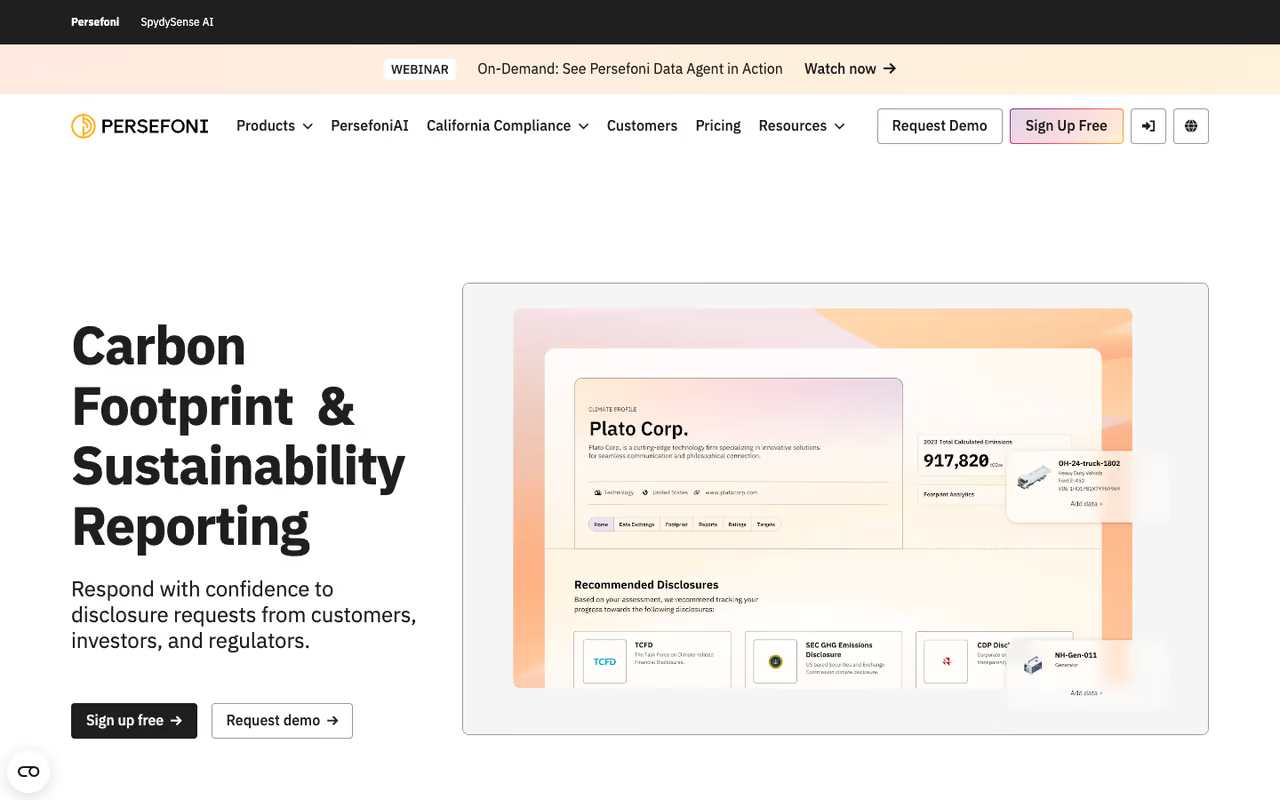
Persefoni is the rare enterprise platform that gives away a serious free product. The free tier, Persefoni Pro, covers Scope 1, 2, and all 15 categories of Scope 3, includes a report builder for CSRD, ISSB, and CDP, and ships with an AI copilot. No trial clock, no credit card. For a company doing its first footprint, that combination is hard to beat.
Who it's best for: SMBs and mid-market teams that want investor-grade numbers without a procurement cycle, plus financial institutions that need PCAF-aligned portfolio accounting.
Hard to beat for a first footprint: the free Pro tier covers Scope 1, 2 and all 15 Scope 3 categories with CSRD, ISSB and CDP reporting. It is single-user, so collaboration lives behind the quote-based Advanced tier, where the price jumps hard.
Pro is free, confirmed on Persefoni's pricing page. The paid Advanced tier (multi-user, SOC 2, scenario modeling, a dedicated success manager) is quote-based, and independent reviews put it in the $55,000-per-year range.
The standout: Methodology is strictly aligned to the GHG Protocol and PCAF, so the output holds up to an auditor. The free plan alone replaces a lot of consultant hours.
The catch: the free tier is single-user, so collaboration and the heavier analytics live behind Advanced. Once you outgrow Pro, you are talking to sales and the price jumps hard.

Watershed
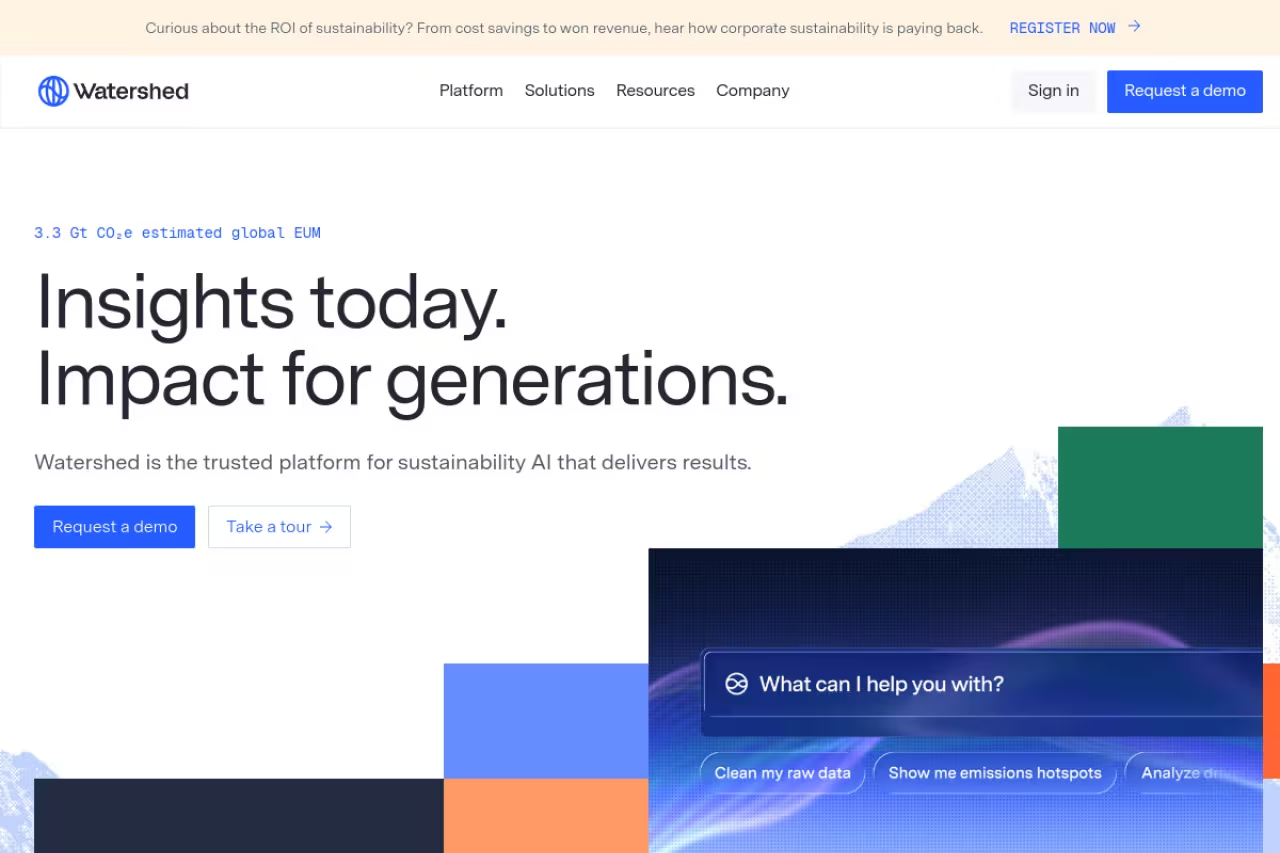
Watershed is built for companies running real climate programs, not first footprints. It combines emissions measurement, regulatory reporting, and decarbonization planning, with carbon, water, and waste modules under one roof. It was named a leader in the 2026 Verdantix Green Quadrant for enterprise carbon management, scoring well on data quality and calculation methodology.
Who it's best for: Large enterprises with mature data infrastructure and a sustainability team that can feed the platform. If you have board-level climate targets and dozens of subsidiaries, this is the weight class.
The weight class for large enterprises with board-level climate targets, mature data and a sustainability team to feed it. Pricing is custom and runs six figures, so it is overkill for small teams without internal headcount.
Custom and not published. Based on marketplace and reseller listings, expect roughly $50,000 to $250,000+ per year depending on entity count, integrations, and advisory level.
The standout: The calculation engine, and the way it ties measurement directly to reduction opportunities. The data acquisition tooling pulls from messy enterprise systems without much hand-cleaning.
Where it falls short: it is overkill for small teams. Without internal sustainability headcount, you will not get value from six figures of software, and the pricing assumes a buyer who can absorb that.

Sweep
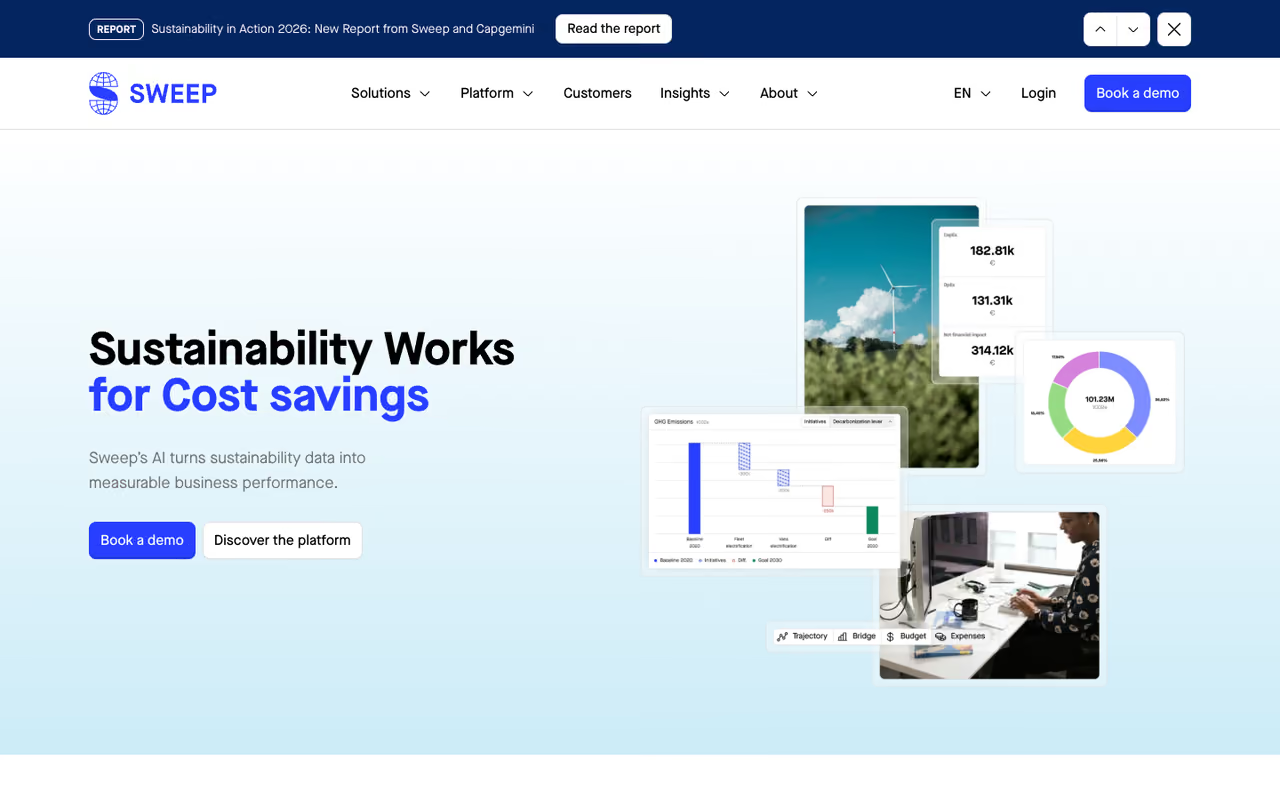
Sweep treats carbon as a team sport. Instead of one analyst owning the number, it assigns emissions ownership across business units, which is a smart fix for the real failure mode of carbon accounting: nobody updates the data after the first report. It covers CSRD, GRI, ISSB, TCFD, SFDR, and the GHG Protocol from a single dataset, so you map data once and reuse it across disclosures.
Who it's best for: Organizations that want carbon and full ESG in one system, with finance, HR, procurement, and operations all feeding the same source of truth.
Pick Sweep if you want carbon and full ESG in one system, with ownership spread across finance, HR, procurement and operations. It is quote-based with no free tier, and the breadth makes onboarding heavier than a single-purpose tool.
Custom, quote-based. Sweep targets mid-market and enterprise buyers rather than self-serve SMBs.
The standout: Sweep was named a Leader in the 2025 IDC MarketScape for sustainability management platforms, and the audit trail is thorough: every data point is traceable through sources, changes, and approvals.
The catch: no public pricing and no free tier, so evaluation means a demo. The breadth that makes it powerful also makes onboarding heavier than a single-purpose carbon tool.
Greenly
Greenly is the most approachable name on this list, especially for European companies. It pairs automated carbon assessment with a dedicated climate expert, so you are not staring at a blank dashboard wondering what a Scope 3 category 11 even is. The suite now stretches into life cycle analysis, supplier engagement, and CSRD compliance, with an AI copilot called EcoPilot.
Who it's best for: SMBs and European mid-market teams that want hand-holding through their first few reporting cycles. Greenly cites 3,500+ clients.
The approachable choice for SMBs and European mid-market teams that want a climate expert guiding their first reporting cycles. The expert support is the product, but self-serve is thinner than Persefoni's free tier and pricing can climb as you grow.
Annual, scaled to company size. Reviews report entry plans from around $1,950/yr for very small companies, with packages that include 1:1 expert support starting above $10,000/yr. You will get a custom quote based on headcount and industry.
The standout: The expert support is the product. For teams without a sustainability hire, that guidance is worth more than another chart.
Where it falls short: the heavy reliance on experts means the self-serve experience is thinner than Persefoni's free tier, and per-employee pricing can climb fast as you grow.
If you're assembling a wider compliance stack around this, our roundup of the best AI compliance tools pairs well with whichever carbon platform you choose.
Normative
Normative is the science-first option, with a Stockholm pedigree and a focus on the hardest part of any footprint: spend-based and supplier Scope 3 data. It offers a unified platform for capturing, modeling, and reporting carbon, plus a Carbon Network feature for engaging suppliers.
Who it's best for: Enterprises that want scientifically validated data and expert climate strategy, and small businesses who just need a free starting estimate.
A buy-for-rigor choice for enterprises that want scientifically validated Scope 3 data, with a free SME calculator as an on-ramp for small businesses. That calculator is an estimate, not an audit-ready inventory, and the full platform is custom-quoted.
The full platform is custom-quoted. Separately, Normative runs a free Business Carbon Calculator through the UN-backed SME Climate Hub, optimized for businesses under 50 employees and €10M revenue.
The standout: The free SME calculator is a legitimately useful on-ramp, and the paid platform's depth on Scope 3 modeling is well regarded.
The catch: the free calculator is an estimate, not an audit-ready inventory, and the enterprise platform sits at the higher end of effort and cost. This is a buy-for-rigor choice, not a buy-for-speed one.
SINAI Technologies
SINAI flips the usual emphasis. Most tools obsess over measurement, then bolt on reduction. SINAI is built around decarbonization planning: model abatement scenarios, find the ROI-positive moves, and build a net-zero roadmap on top of audit-grade Scope 1-3 accounting. Its Utility Automation feature turns raw utility bills into audit-ready emissions data.
Who it's best for: Enterprises that already know roughly where their emissions are and need a defensible plan to cut them, especially heavy industry and complex supply chains.
Go with SINAI if you already know roughly where your emissions are and need a defensible plan to cut them, especially in heavy industry. It is enterprise-priced and not for a 20-person startup doing a first footprint.
Custom, enterprise-focused. No public tier.
The standout: The scenario and marginal-abatement modeling is more serious than what most accounting-first tools offer, which is why it shows up in deals with large banks and industrial groups.
Where it falls short: this is not for a 20-person startup doing a first footprint. The planning power assumes you have real operational data and a budget to act on. If supply chain is your hotspot, our guide to the best AI supply chain tools pairs well here.
Climatiq
Climatiq is the odd one out, and that is the point. It is not a dashboard, it is a carbon calculation API with 944k+ emission factors. If you are building emissions tracking into your own product, your ERP, or a logistics tool, Climatiq gives you programmatic CO2e calculations instead of a UI you have to live inside.
Who it's best for: Developers and product teams embedding carbon math into software, plus data teams automating factor mapping at scale.
Wrong audience if you want a dashboard, right if you are a developer embedding carbon math into your own product through an API. It is infrastructure, so you still build the experience and disclosures yourself, from €250 a month commercially.
A free Starter plan (non-commercial, no card required) lets you search and browse factors. Data Pro is €2,000/yr or €250/month for commercial use with full Core dataset access. Enterprise adds custom volumes, premium datasets like ecoinvent, and spreadsheet add-ins.
The standout: Breadth and quality of emission factors, exposed cleanly through an API. For engineering teams it removes the worst part of carbon work: sourcing and maintaining factors.
The catch: this is infrastructure, not a reporting product. You still have to build the experience and the disclosures around it. Wrong audience if you wanted a turnkey CSRD report. If your team is weighing build-versus-buy here, the broader Dupple top tools directory is a good place to scan adjacent options.
ClimatePartner
ClimatePartner rounds out the list for companies that want measurement and action in one motion. The ClimatePartner Hub calculates your corporate footprint, surfaces hotspots, and generates reports compatible with CSRD, CDP, and TCFD, then connects you to climate projects for reduction and offsetting.
Who it's best for: Consumer-facing brands that want to calculate, reduce, and communicate progress, especially those that care about product labeling and customer claims.
Suits consumer-facing brands that want to calculate, reduce and credibly communicate progress in one motion, including product labeling. The tight coupling with offset projects is not for teams that prefer pure measurement and separate claims.
Custom and project-dependent, since the offset side is bundled with the software.
The standout: Bundling accounting with real reduction projects and communication tools shortens the path from "we measured it" to "we can talk about it credibly."
Where it falls short: the tight coupling with offset projects is not for everyone. Plenty of teams want pure measurement and prefer to handle claims separately, given the scrutiny around offset quality.
How to choose
Start with your trigger. The reason you are buying changes the answer more than any feature list.
You need a first footprint, fast and free. Persefoni Pro, or Normative's free SME calculator if you are under 50 people. Get a number, find your hotspots, then decide.
You are under CSRD or ISSB obligation. You need full Scope 3 across all 15 categories, a mapped multi-framework dataset, and an audit trail. Sweep, Watershed, and Persefoni Advanced are the shortlist. Budget five to six figures.
You want a human, not a dashboard. Greenly's expert-led model is the path of least resistance, particularly in Europe.
Measurement is solved, reduction is the gap. SINAI for serious abatement modeling, ClimatePartner if you also want to communicate and offset.
You are building, not reporting. Climatiq's API. Skip the dashboards entirely.
One rule cuts across all of these: pick for your Scope 3 reality. Scopes 1 and 2 are the easy 20%. Supply chain and spend-based Scope 3 is where 80% of most footprints and all of the pain lives, so weight your evaluation toward supplier data and factor quality.
If a tighter ops and reporting stack is part of the same project, Dupple X helps founders and operators move faster on the workflow side while your carbon platform handles the numbers. Start a Dupple X trial here.
FAQ
What is the best free carbon accounting software?
Persefoni Pro is the strongest free option in 2026 because it covers Scope 1, 2, and all 15 Scope 3 categories with no trial limit and includes a CSRD and ISSB report builder. Normative's Business Carbon Calculator is a good free estimate for businesses under 50 employees, and Climatiq's Starter API plan is free for non-commercial use.
How much does carbon accounting software cost?
It ranges enormously. Free tiers exist (Persefoni Pro, Normative's SME calculator). SMB plans with expert support, like Greenly's, run from roughly $1,950 to $10,000+ per year. Enterprise platforms like Watershed are custom-quoted and commonly land between $50,000 and $250,000+ annually depending on entity count and integrations.
What's the difference between Scope 1, 2, and 3 emissions?
Scope 1 is direct emissions from sources you own, like company vehicles and on-site fuel. Scope 2 is indirect emissions from purchased electricity, heat, and steam. Scope 3 is everything else in your value chain: purchased goods, business travel, and the use of your products. Scope 3 is usually the largest and hardest to measure, which is why factor quality and supplier tooling matter most.
Do I need carbon accounting software for CSRD compliance?
For most companies, yes. CSRD requires detailed, auditable emissions data across all scopes mapped to ESRS standards, which is impractical in spreadsheets at scale. Tools like Sweep, Watershed, and Persefoni map a single dataset to CSRD, ISSB, and other frameworks, giving you the audit trail an assurance provider will demand.
Which carbon accounting software is best for small businesses?
For free, Persefoni Pro. For guided support, Greenly's entry plans start around $1,950 per year and include a climate expert. If you are very small and just want an estimate, Normative's free Business Carbon Calculator through the SME Climate Hub is built exactly for companies under 50 employees.
Can developers add carbon calculations to their own apps?
Yes. Climatiq exposes 944k+ emission factors through a REST API, with a free Starter tier for non-commercial use and a Data Pro plan at €2,000 per year for commercial access. It is the standard choice for embedding CO2e calculations into ERPs, logistics tools, or your own product rather than buying a separate dashboard.
Related guides
Some offers on this page may be paid placements or contain affiliate links.
