
The Best Accounting Software for Real Estate (2026)

Key facts8 tools compared: Stessa, Baselane, Buildium, AppFolio, QuickBooks Online, REI Hub, Xero…
- 8 tools compared: Stessa, Baselane, Buildium, AppFolio, QuickBooks Online, REI Hub, Xero, Landlord Studio
- Stessa (best for: Self-managing investors): Free; Pro $28/mo annual
- Baselane (best for: Landlords who want banking + books in one): Free; Smart $20/mo
- Buildium (best for: Residential property managers): From $62/mo
- AppFolio (best for: Mid-to-large portfolios (150+ units)): $1.49/unit, $298 min
Real estate accounting breaks generic bookkeeping tools in a specific way: you don't have one business, you have one entity per property, plus security deposits you can't legally commingle, plus a Schedule E that wants income and expenses sorted by property and by IRS category. QuickBooks can technically do all of this. It just won't do it without a lot of manual classing.
So the real question isn't "what's the best accounting software." It's "how many doors do you have, and do you also need to collect rent and pay vendors from the same place." A landlord with four single-family rentals and a 200-unit property manager are shopping for completely different software, even though they'd both type the same thing into Google.
I compared most of these platforms in depth. If you're a self-managing investor with a handful of properties and you want the answer up front: start with Stessa, which is free and built for exactly this. If you're a property manager billing other people's portfolios, the answer is Buildium or AppFolio. Below is the full breakdown, who each one is actually for, and where each one falls short.
Quick comparison
| Tool | Best for | Price | Standout |
|---|---|---|---|
| Stessa | Self-managing investors | Free; Pro $28/mo annual | Auto Schedule E, real bank feeds, $0 entry |
| Baselane | Landlords who want banking + books in one | Free; Smart $20/mo | Built-in business banking and rent collection |
| Buildium | Residential property managers | From $62/mo | Full PM accounting with trust/escrow handling |
| AppFolio | Mid-to-large portfolios (150+ units) | $1.49/unit, $298 min | AI-assisted bookkeeping at scale |
| QuickBooks Online | Brokerages and mixed entities | $38 to $275/mo | Accountant-standard double-entry ledger |
| REI Hub | Investors who want strict double-entry | From $9/mo | Real estate chart of accounts done right |
| Xero | Multi-entity investors who hate per-seat fees | $25 to $90/mo | Unlimited users on every plan |
| Landlord Studio | Mobile-first small landlords | Free; Pro $12/mo annual | Best phone app for logging expenses |

Stessa, the easiest free pick for investors
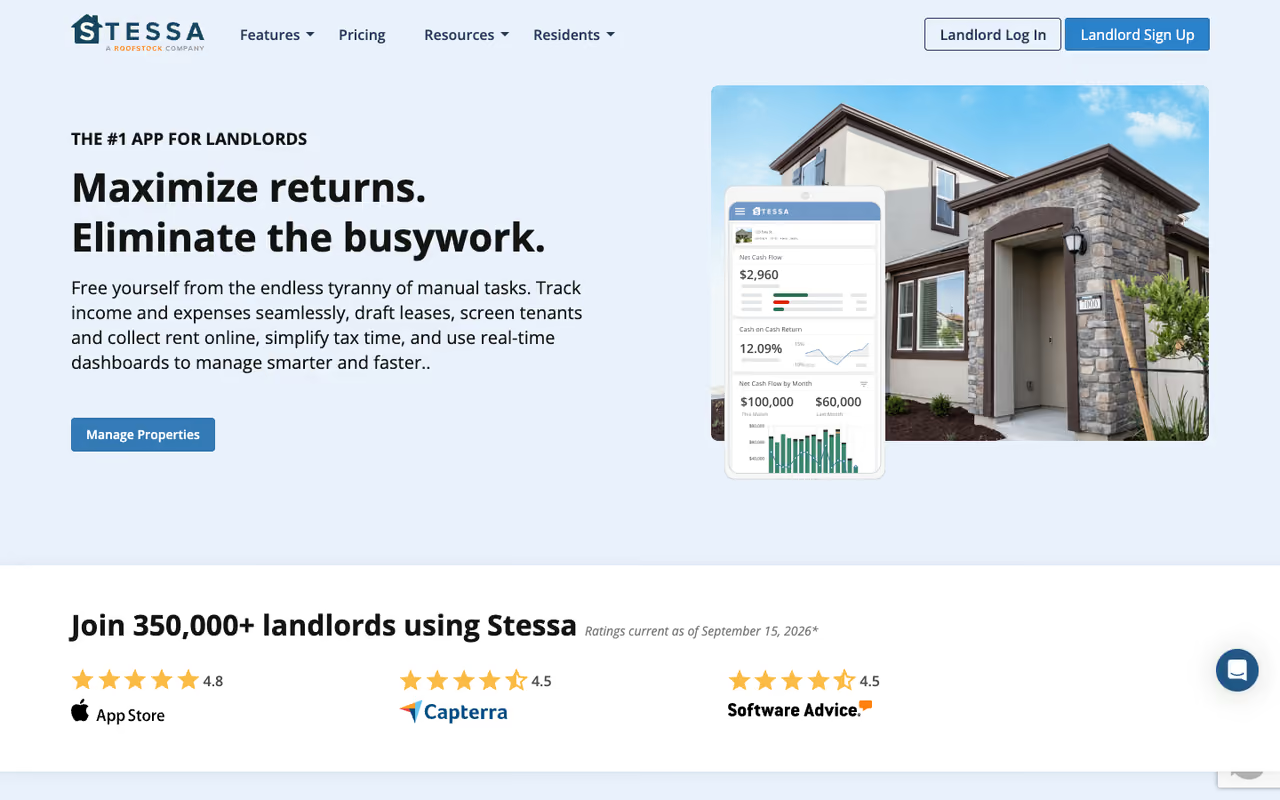
Stessa is what I recommend to most landlords who own rather than manage. It's free, it connects to your actual bank and mortgage accounts, and it automatically sorts transactions into the categories that map to a Schedule E. At tax time you export one report instead of reconstructing a year of Venmo and Home Depot receipts.
Who it's best for: investors with anywhere from one to a few dozen properties who self-manage and mostly need clean books and tax reports, not a full property management suite.
The easiest recommendation for landlords who own rather than manage, with clean Schedule E reports and almost no setup. The trade-off is simplified cash-basis tracking, so a CPA who wants a true general ledger will push you elsewhere.
Pricing: the Essentials plan is genuinely free with unlimited properties. Stessa's pricing adds Manage at $12/month (billed annually) and Pro at $28/month annually, which unlocks unlimited receipt scanning, all advanced reports, and a higher APY on cash held in the Stessa account.
The standout is how little setup it asks for. You link accounts, it learns your categories, and the dashboard shows net cash flow per property without you building a single formula.
The catch: Stessa uses simplified cash-basis tracking, not true double-entry accounting. For most landlords that's fine, even preferable. But if your CPA wants a proper general ledger with balanced debits and credits, or you're running development projects with complex financing, you'll outgrow it.

Baselane, banking and books in the same account

Baselane took a different angle: instead of importing transactions from your bank, it is the bank. You open business checking accounts (one per property if you want), collect rent into them, and the bookkeeping happens automatically because the money is already inside the system.
Who it's best for: landlords who are tired of juggling a separate bank, a separate rent-collection app, and a separate spreadsheet. If you want one login for the whole money flow, this is the cleanest version of that.
Choose Baselane if you want one login for banking, rent collection and books. You only get the full benefit by moving your banking over, and it is US-only, so otherwise it is a thinner version of Stessa.
Pricing: the Core plan is free, including ACH rent collection and the bookkeeping engine. Per Baselane's own breakdown, the Smart plan runs $20/month (billed annually) for the heavier reporting and automation. There are no monthly account fees on the banking side.
The standout is auto-tagging income and expenses to the right property and the right Schedule E line as money moves, plus unlimited property-specific accounts so deposits and operating cash never mix.
Where it falls short: you have to actually move your banking to Baselane to get the full benefit, and it's US-only. If you're committed to your existing business bank, you lose the main advantage and it becomes a thinner version of Stessa.

Buildium, the property manager's accounting backbone
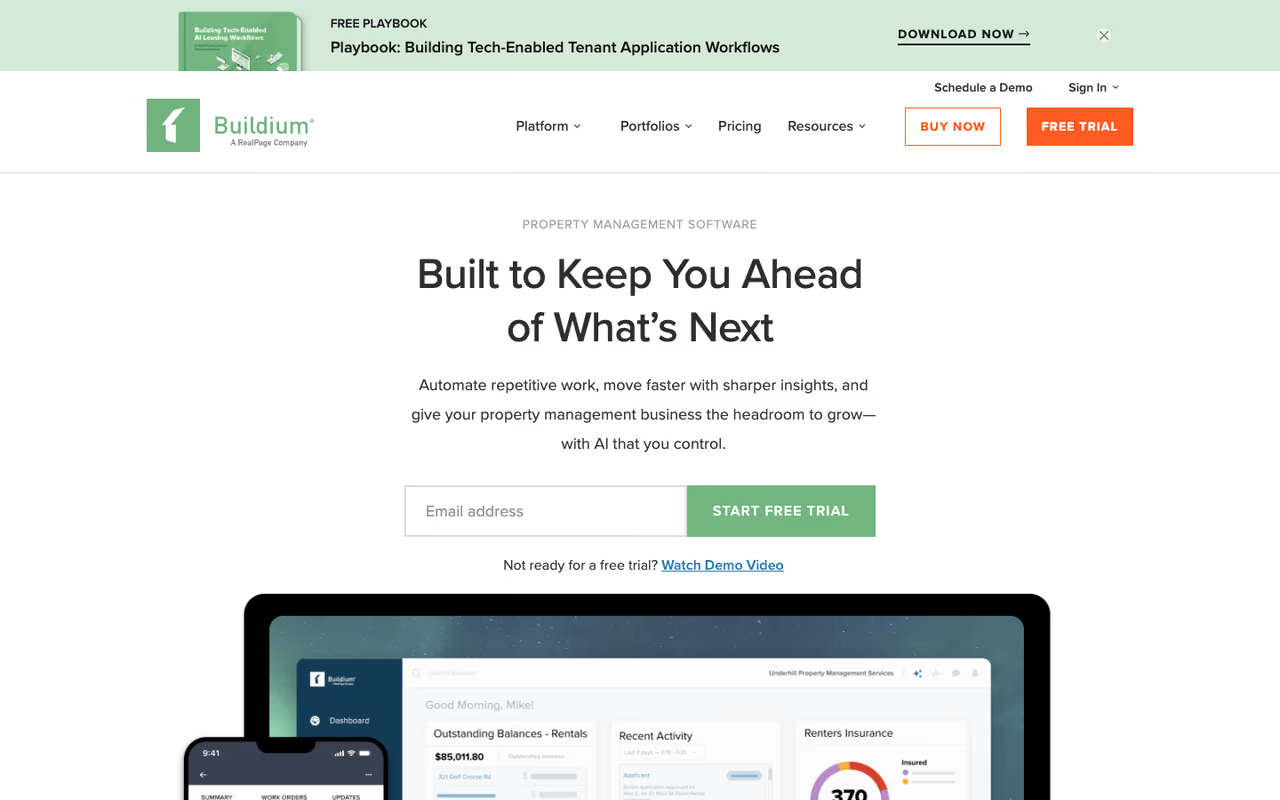
Once you're managing property for other people, the rules change. You need trust accounting, owner statements, 1099s, and the ability to keep dozens of owners' money correctly separated. Buildium is built around exactly that.
Who it's best for: residential property management companies handling roughly 50 to a few thousand units across multiple owners. It's also a reasonable fit for HOA and community association management.
The accounting backbone for residential property managers handling roughly 50 to a few thousand units, plus HOA work. Trust accounting and owner statements are built in, but the entry price is steep for a small investor.
Pricing: Buildium's plans start at $62/month for Essential, $192/month for Growth, and $400/month for Premium, with feature depth (and the number of included bank accounts) rising at each tier. Custom pricing kicks in above 5,000 units.
The standout is the accounting being purpose-built for the property management workflow: full double-entry ledgers, automated owner draws, escrow handling, and reports your owners expect to see every month without you assembling them by hand.
The catch: the entry price is high if you only manage a handful of units, so it's overkill for a small investor. And Buildium's QuickBooks integration pushes journal entries rather than line-item detail, so your QBO ledger won't show individual tenant transactions without manual mapping.
AppFolio, for portfolios that have outgrown everything else
AppFolio competes head-to-head with Buildium but leans toward larger, scaling operators. The accounting is strong, and recent releases push AI into the bookkeeping itself: invoice coding, bank-feed matching, and anomaly flags that save real hours at scale.
Who it's best for: mid-to-large property managers, ideally 150 units and up, where the per-unit math starts to make sense.
Built for mid-to-large property managers, ideally 150 units and up, where AI-assisted coding and volume performance justify the premium. The monthly minimums make it a poor deal for small landlords, and onboarding is a real commitment.
Pricing: AppFolio charges per unit per month with monthly minimums. Multiple 2026 breakdowns put the Core plan at about $1.49 per unit with a $298 minimum, Plus around $3.20 per unit ($960 minimum), and Max at roughly $5 per unit. That structure is why analysts warn that operators with fewer than 150 units often pay well above the headline rate.
The standout is how it holds up at volume. Bulk operations, AI-assisted coding, and reporting that doesn't slow down across thousands of units are the reasons big operators pay the premium.
Where it falls short: that $298 minimum makes it a bad deal for small landlords, and the platform's depth means a real onboarding period. This is software you commit to, not something you try for a weekend.
If your own back office is what's drowning, not just your books, a single AI workspace can absorb a surprising amount of the lease summaries, owner emails, and listing copy that eat your week. That's the bet behind Dupple X: one subscription, every major AI model. You can start a yearly trial here if that's the bottleneck.
QuickBooks Online, the accountant's default
Plenty of real estate businesses run on QuickBooks Online for one simple reason: every accountant already knows it. If you have a bookkeeper or CPA, handing them a QuickBooks file is the path of least resistance.
Who it's best for: brokerages, agents tracking commissions, and investors with mixed entities (some rentals, some flips, maybe an operating business) who want one accountant-standard ledger.
The accountant's default and a solid ledger for brokerages, agents and mixed-entity investors. It has no native concept of property or unit and no tenant tools, so you build that structure yourself with classes.
Pricing: as of 2026, QuickBooks Online runs $38/month for Simple Start, $75 for Essentials, $115 for Plus, and $275 for Advanced. You'll want Plus for the class and location tracking that lets you separate properties.
The standout is the ecosystem. Every bank connects, every app integrates, and any accountant on earth can pick up the file.
The catch: QuickBooks has no native concept of "property" or "unit." You build that yourself with classes and locations, and you maintain it manually. There's no rent collection, no tenant portal, and no owner statements. It's a great ledger and a poor property management tool.
REI Hub, double-entry built for real estate
REI Hub is the answer for investors who want the rigor of QuickBooks but the real estate awareness of Stessa. It's true double-entry accounting with a chart of accounts designed around properties, loans, and fixed assets from day one.
Who it's best for: investors who care about an audit-ready general ledger, track loan amortization and capital improvements, and want tax-ready reports without forcing a generic tool into shape.
Pick REI Hub if you want an audit-ready double-entry ledger designed around properties, loans and fixed assets. You trade the auto-magic of Stessa for accounting correctness, with no banking or rent collection and a steeper learning curve.
Pricing: REI Hub starts at $9/month (annual) for up to 3 units, scaling to $15 for 10 units, $27 for 20 units, and $48/month for unlimited. There's a 14-day trial with no card required.
The standout is the balance-sheet discipline. Where Stessa simplifies, REI Hub gives you proper ledgers, so your books actually reconcile and a CPA can sign off without re-doing them.
Where it falls short: there's no banking or rent collection, and the double-entry model means a slightly steeper learning curve than the auto-magic of Stessa or Baselane. You're trading convenience for accounting correctness.
Xero, the multi-entity favorite
Xero is the strongest QuickBooks alternative for real estate, and its killer feature is one that matters specifically to investors: unlimited users on every plan. If you run several LLCs and want your partner, bookkeeper, and CPA all in the books, you're not paying per seat.
Who it's best for: investors and small firms juggling multiple entities who want clean double-entry accounting and hate per-user pricing.
The strongest QuickBooks alternative for investors juggling multiple LLCs, thanks to unlimited users on every plan. It is not real-estate-native, and the Early plan caps invoices at 20 a month, so expect add-ons for property workflows.
Pricing: Xero runs $25/month for Early, $55 for Growing, and $90 for Established in the US. You'll likely need Growing for unlimited transactions, and Established if you want project tracking to model rehabs.
The standout is the combination of a clean modern interface, unlimited users, and strong multi-entity support through Xero's app ecosystem.
The catch: like QuickBooks, Xero isn't real-estate-native. The Early plan caps you at 20 invoices a month, which is tight if you're billing many tenants, and you'll lean on add-ons for property-specific workflows.

Landlord Studio, the best app for logging on the go
Landlord Studio earns its place on the strength of its mobile app. If your accounting problem is really "I keep losing receipts and forgetting expenses," snapping a photo at the hardware store and having it categorized is the fix.
Who it's best for: small, hands-on landlords who manage from their phone and want income, expenses, and rent tracking in one mobile-first tool.
The fix for hands-on landlords whose real problem is lost receipts, with a mobile app that handles scanning, mileage and rent reminders well. The accounting is solid but not deep, so growing commercial operators will want more.
Pricing: the GO plan is free for up to 3 units. Landlord Studio's Pro is $12/month (billed annually) covering the first few units, then about $1 per additional unit, with a Pro Plus tier above it.
The standout is genuinely the app. Receipt scanning, mileage tracking, and rent reminders all work well from a phone, which most desktop-first competitors do poorly.
Where it falls short: the accounting is solid but not deep. It's expense and income tracking with good tax reports, not a full general ledger, so growing commercial operators will eventually want more.
How to choose
Skip the feature checklists and answer three questions.
First, do you manage your own properties or other people's? If you manage for owners, you need trust accounting and owner statements, which means Buildium or AppFolio. Everything else on this list is built for owners, not managers.
Second, if you're an owner, how much do you care about accounting correctness versus convenience? If you just want clean books and a Schedule E with zero effort, Stessa or Baselane. If your CPA wants a real double-entry ledger, REI Hub or Xero.
Third, do you want banking and rent collection in the same tool? If yes, Baselane is the only one here that does all three natively. If you're happy keeping your bank separate, the import-based tools give you more accounting depth.
For most self-managing investors reading this, the honest answer is: start free with Stessa, and only move up when you hit a wall. Don't pay for property management software to run four rentals. For more tool breakdowns across categories, our /top-tools roundup and the guides on AI for accounting and expense tracking tools cover adjacent ground.
FAQ
What is the best accounting software for real estate investors?
For self-managing investors, Stessa is the best starting point because it's free, connects to your real bank accounts, and auto-categorizes everything for a Schedule E. If you need strict double-entry accounting, REI Hub is the better fit. Property managers handling other owners' portfolios should look at Buildium or AppFolio instead.
Can I just use QuickBooks for rental properties?
Yes, but with effort. QuickBooks Online has no built-in concept of a property or unit, so you separate them using classes and locations and maintain that structure manually. It gives you an accountant-standard ledger but no rent collection, tenant portal, or owner statements. Real-estate-native tools like Stessa or REI Hub handle the property layer automatically.
Is there free accounting software for landlords?
Yes. Stessa's Essentials plan is free with unlimited properties, and Baselane's Core plan is free including rent collection and banking. Landlord Studio's GO plan is free for up to 3 units. These cover most small landlords without any subscription.
What's the difference between property management software and real estate accounting software?
Accounting software (Stessa, REI Hub, QuickBooks) focuses on tracking income, expenses, and producing tax reports for properties you own. Property management software (Buildium, AppFolio) adds trust accounting, owner statements, tenant screening, maintenance workflows, and the ability to manage portfolios on behalf of other owners. Managers need the second category; most owners only need the first.
How much should I expect to pay?
A self-managing investor can run on $0 with Stessa or Baselane, or roughly $9 to $28 a month for a paid investor tool. Property managers pay more: Buildium starts at $62/month, and AppFolio charges per unit with a $298 monthly minimum, so it only makes sense above roughly 150 units.
Does this software handle Schedule E and taxes?
The real-estate-specific tools do. Stessa, Baselane, REI Hub, and Landlord Studio all categorize transactions to Schedule E lines and export tax-ready reports. Generic tools like QuickBooks and Xero can produce the same reports, but you have to set up the categories and property tracking yourself first.
Ready to clear the rest of your back-office work the same way? Dupple X puts every major AI model behind one login. Start a yearly trial.
Related guides
Some offers on this page may be paid placements or contain affiliate links.
Across our whole catalogue the median is $24 a month and 33% of tools advertise a free tier. Figures are the lowest recurring monthly price quoted in our own review of each tool, read on 2026-08-19. Full method and every category.
