
Best AI Supply Chain Tools (2026): 9 Platforms I'd Actually Trust

Key facts9 tools compared: Kinaxis Maestro, o9 Solutions, Blue Yonder, SAP IBP, Flowlity, GMDH…
- 9 tools compared: Kinaxis Maestro, o9 Solutions, Blue Yonder, SAP IBP, Flowlity, GMDH Streamline, project44, Altana, Prediko
- Kinaxis Maestro (best for: Large enterprises needing concurrent planning): ~$250k-$1M+/yr
- o9 Solutions (best for: Cross-functional integrated business planning): Enterprise custom
- Blue Yonder (best for: Complex optimization at retail/CPG scale): Enterprise custom
- SAP IBP (best for: Companies already running SAP): Enterprise custom
Most "AI supply chain" pitches fall apart the moment you ask what the AI actually does. Half the time it's a forecasting model wearing a buzzword, and the other half it's a chatbot bolted onto a dashboard nobody opens. After a few weeks digging through demos, pricing pages, and analyst reviews, I wanted to separate the platforms that change how planners work from the ones that just sound good in a board deck.
The honest answer is that there's no single best tool, because a $400M manufacturer and a Shopify brand doing $2M live in different universes. So I split this by who you are. If you're a large enterprise that wants real-time scenario planning across demand, supply, and finance, Kinaxis Maestro is my top pick. If you're a mid-market team that doesn't have a data science department, Flowlity is the one I'd start with. And if you run inventory on Shopify, Prediko does more for $49 a month than most enterprise suites do at $400k.
This guide is for operators, founders, and supply chain leads who are tired of vague claims and want to know what these tools cost, what they actually do, and where each one falls short.
Quick comparison
| Tool | Best for | Price | Standout |
|---|---|---|---|
| Kinaxis Maestro | Large enterprises needing concurrent planning | ~$250k-$1M+/yr | Real-time scenario modeling across the whole chain |
| o9 Solutions | Cross-functional integrated business planning | Enterprise custom | Connects supply, demand, and P&L in one model |
| Blue Yonder | Complex optimization at retail/CPG scale | Enterprise custom | Patented solvers + generative AI orchestration |
| SAP IBP | Companies already running SAP | Enterprise custom | Joule copilot for natural-language planning |
| Flowlity | Mid-market without data science teams | Custom (mid-market) | Probabilistic forecasting, fast deployment |
| GMDH Streamline | SMBs and growing distributors | From ~$100-$500/mo | Affordable forecasting + replenishment |
| project44 | Transportation visibility and ETAs | Enterprise custom | Real-time tracking, predictive ETAs |
| Altana | Multi-tier risk and trade compliance | Enterprise custom | Maps suppliers beyond tier 1 |
| Prediko | Shopify ecommerce brands | From $49/mo | SKU-level demand plans built for DTC |
Kinaxis Maestro: the concurrent planning benchmark
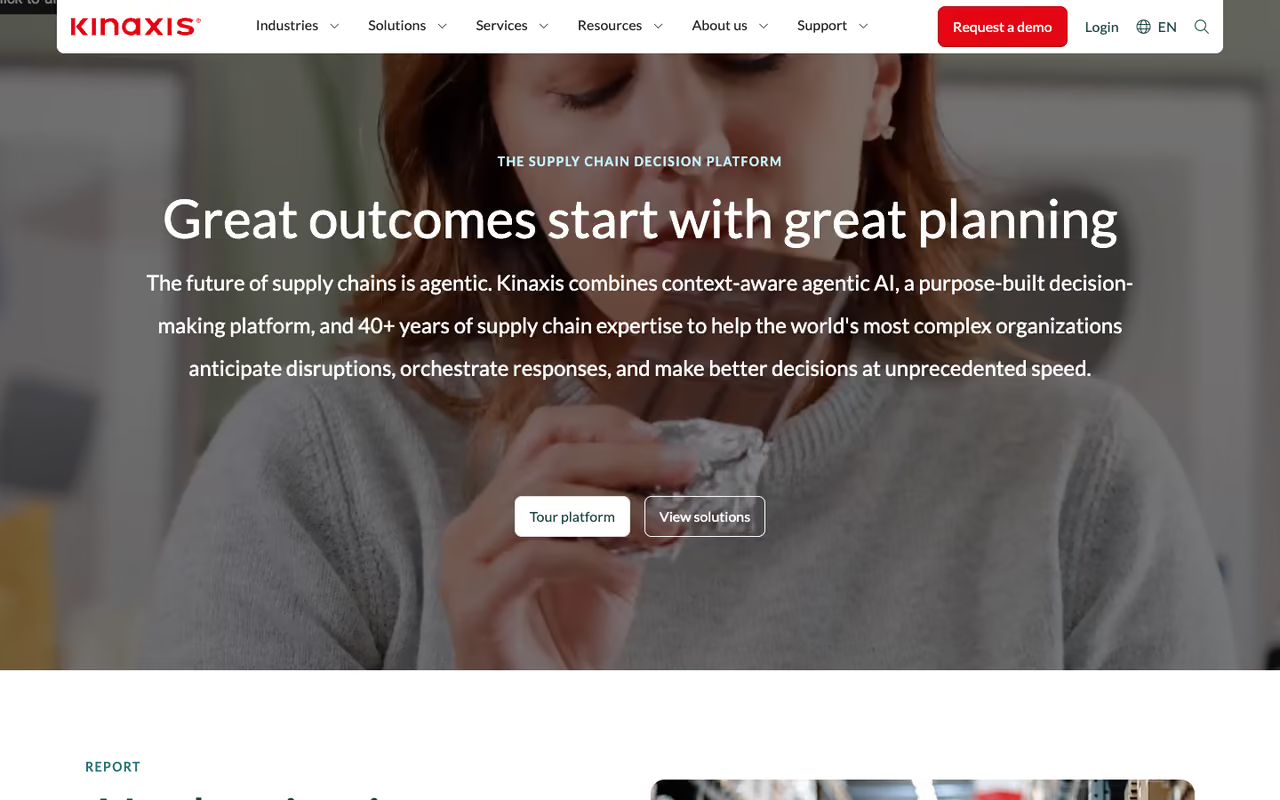
Kinaxis rebranded its flagship RapidResponse platform to Maestro in 2024, and it remains the gold standard for what the industry calls concurrent planning. Instead of running demand, supply, and capacity in separate weekly cycles, Maestro models them all at once, so when you change one input you see the downstream impact across the entire chain in seconds.
The concurrent planning benchmark for large manufacturers in automotive, electronics and life sciences that run constant what-if analysis. It is enterprise-grade in cost and rollout time, and overkill without a dedicated planning team and clean master data.
The AI layer matters here. Maestro pairs a supply chain data fabric with Planning.AI, which blends heuristics and machine learning for faster disruption response, plus a generative AI interface that helps planners build scenarios and dashboards in plain language. That last part is genuinely useful for getting non-experts into the system.
Pricing is the wall most teams hit. Independent estimates put a Kinaxis license between $250k and over $1M annually, with mid-market versions around $20k a month, and implementation fees adding another 15-40% on top.
The catch: this is enterprise-grade in every sense, including the cost and the implementation timeline. If you don't have a dedicated planning team and clean master data, you'll spend a year fighting the rollout before you see value. Overkill for anyone under a few hundred million in revenue.

o9 Solutions: one model for supply, demand, and money
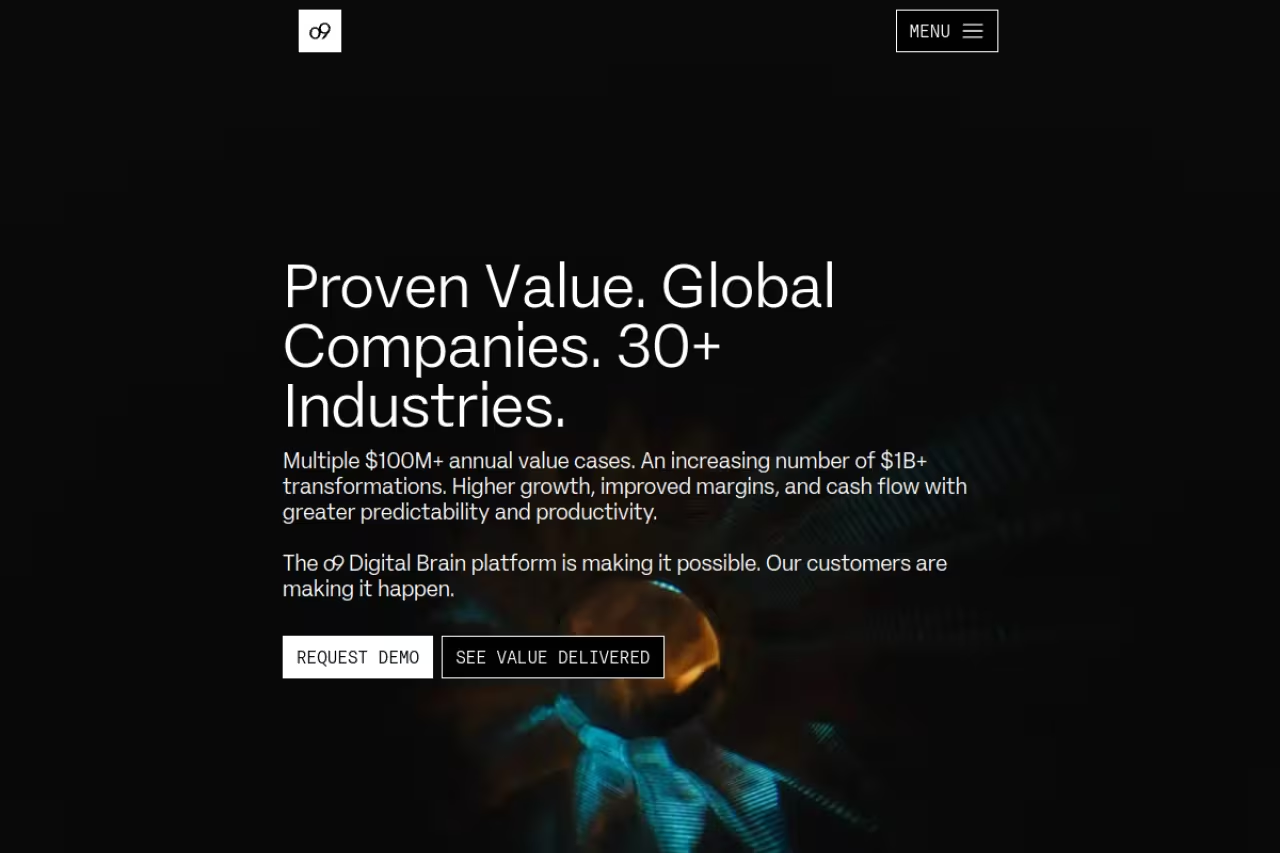
o9 Solutions built its reputation on what it calls the Enterprise Knowledge Graph, a digital twin of your business that ties commercial, supply, and financial planning into a single model. The pitch I keep hearing from users is that o9 lets you see the P&L impact of a supply decision at the same moment you make it, which is rare.
Pick o9 if sales, operations and finance should work off one model instead of arguing over spreadsheets, especially in consumer goods and retail. It is powerful but heavy, with custom pricing and a long, multi-year implementation.
Where o9 stands out is breaking down the silos between teams. You can model a demand spike and immediately see what it does to capacity, inventory, and margin together. For consumer goods and retail brands juggling promotions and constrained supply, that unified view is the whole point.
The catch: o9 uses enterprise custom pricing, and multiple G2 reviewers describe the cost as prohibitive for smaller organizations. The platform is powerful but heavy, and several users mention a steep learning curve and long implementation. This is a strategic, multi-year commitment, not a tool you trial next quarter.
Flowlity: AI planning for teams without data scientists
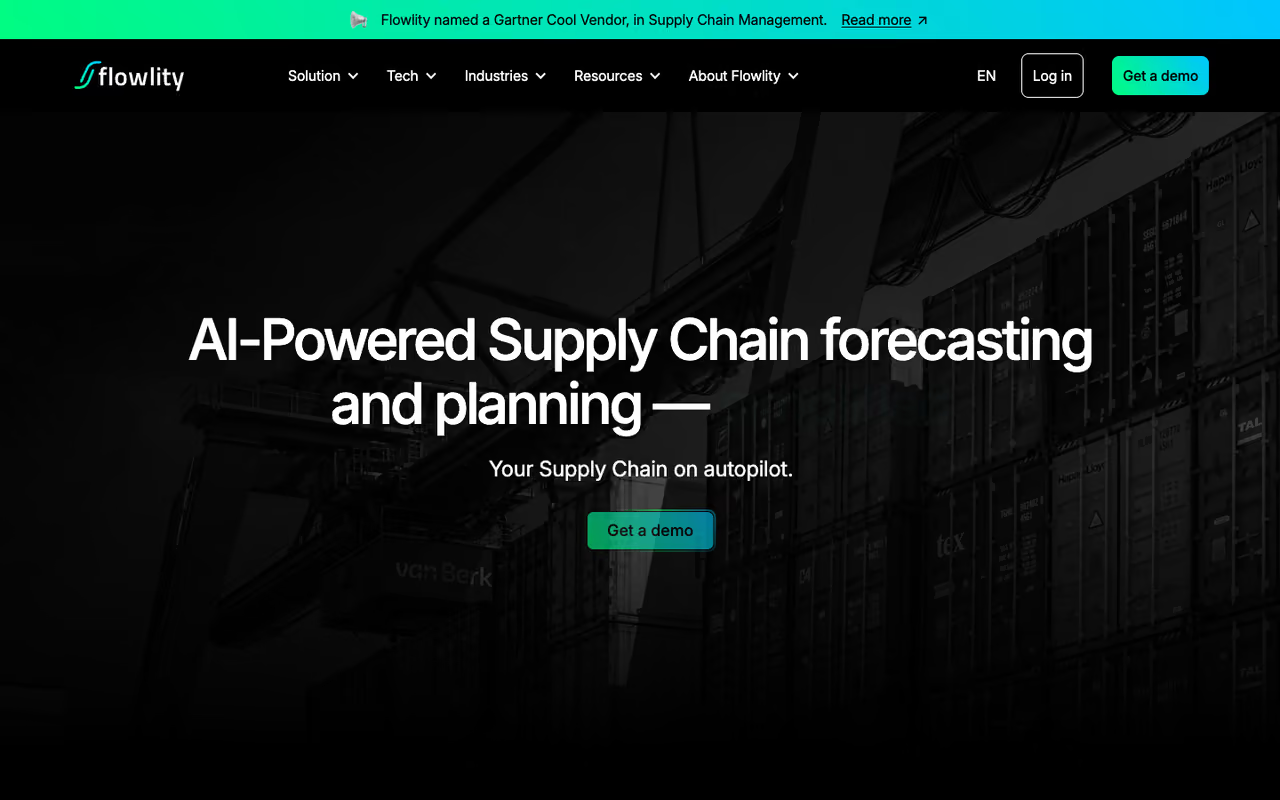
Flowlity is the one I'd recommend to most mid-market companies, and it's the platform that made me rethink how accessible this category has become. It's cloud-based, deploys fast, and is built specifically to replace the spreadsheet planning that most SMBs and mid-market manufacturers still run on.
Best for: supply chain teams between roughly $20M and $500M in revenue who want real AI forecasting without hiring a data science team.
The standout is its probabilistic approach. Rather than spitting out one number and pretending it's certain, Flowlity forecasts a range and recommends inventory targets that account for uncertainty. The company claims it automates up to 95% of planning activities while keeping planners in control, with inventory reductions of up to 60% and higher service rates. Even if you halve those numbers, the direction is right.
Go with it if you are a mid-market team that wants real AI forecasting without hiring data scientists. The probabilistic forecasts and quick deployment are the draw, but pricing is quote-based and the partner ecosystem is smaller than the giants.
Pricing is custom and quote-based, which is the one knock against it. You won't find a public price, so you have to book a call. But the deployment is quick by enterprise standards, and you're not locked into a year of implementation before you see a forecast.
The catch: no transparent pricing and a smaller partner ecosystem than the SAP or Blue Yonder giants. If your supply chain is genuinely massive and global with thousands of nodes, Flowlity may not have the depth of the enterprise incumbents.
If you're piecing together your own AI stack to run leaner, the same logic applies to the rest of your tooling. Our team uses Dupple X to get every major AI model in one subscription instead of paying for five separate seats.

Blue Yonder: optimization muscle for the big leagues
Blue Yonder is the platform retail and CPG giants reach for when the math gets genuinely hard. Its strength is the patented solvers that handle multi-objective optimization, the kind of problem where you're balancing service levels, cost, capacity, and a dozen constraints at once. The Blue Yonder Orchestrator now layers generative AI on top for faster orchestration across planning and execution.
The optimization muscle for large retailers, distributors and consumer goods companies with complex networks and a team to run it. You are buying solver horsepower, not ease of use, with opaque pricing and a heavy implementation.
The catch: Blue Yonder is enterprise software with enterprise complexity, and pricing is custom and opaque. Reviews consistently flag a heavy implementation and a UI that feels dated in places. You're buying optimization horsepower, not ease of use.
SAP IBP: the obvious move if you already run SAP
If your ERP is SAP, SAP Integrated Business Planning is the path of least resistance. It covers demand planning, inventory optimization, and S&OP, and the data already lives in your ecosystem, which removes the integration headache that kills a lot of supply chain projects.
The obvious move for companies committed to SAP, since planning talks natively to the rest of your stack. Outside the SAP ecosystem it loses most of its appeal, and you are buying convenience, not best-in-class planning intelligence.
The AI hook is Joule, SAP's copilot, which by 2026 has grown from a generative assistant into an agentic layer that lets planners query analytics in natural language. The Joule Studio agent builder is now generally available, so teams can build their own planning agents.
The catch: outside the SAP ecosystem, IBP loses a lot of its appeal, and the experience can feel bureaucratic. You're buying convenience and integration, not best-in-class planning intelligence. If you're not already an SAP shop, look elsewhere first.
GMDH Streamline: the affordable forecasting workhorse
GMDH Streamline is what I'd point a growing distributor or small manufacturer toward when the enterprise suites are out of budget. It handles demand forecasting, inventory optimization, and production planning, and it integrates with most ERPs, WMS, and accounting systems.
A practical choice for SMBs and mid-market distributors that have outgrown spreadsheets but cannot justify a six-figure platform. It is less slick and less agentic than the enterprise suites, but classic forecasting that works beats fancy AI that needs a team.
Pricing actually starts in a reachable range, roughly $100 to $500 depending on tier, with enterprise customization available on request. For a tool that does real forecasting and replenishment, that's a fraction of what the big names charge.
The catch: it's not as slick or as deep as the enterprise platforms, and the AI is more classic forecasting than the agentic, conversational tooling the leaders are pushing. For most growing businesses, though, classic forecasting that actually works beats fancy AI that needs a team to operate.

project44: knowing where your freight actually is
Planning is useless if you can't see your shipments, which is where project44 comes in. It's a decision intelligence platform built around real-time transportation visibility, connecting shippers, carriers, and 3PLs through one data layer for live tracking, predictive ETAs, and AI exception management.
Choose it for accurate multimodal freight visibility across ocean, road, rail and air. It solves visibility, not planning, so expect enterprise custom pricing and to run it alongside one of the planning tools above.
project44 and FourKites consistently rank at the top of Gartner's transportation visibility evaluations, and project44's context-based AI is built to turn scattered tracking data into actual decisions, not just dots on a map.
The catch: this solves visibility, not planning. It's a complement to a forecasting platform, not a replacement, and pricing is enterprise and custom. You'll likely run it alongside one of the planning tools above.

Altana: seeing past your tier-1 suppliers
Most companies have no idea who supplies their suppliers, and that blind spot is exactly what Altana attacks. Its Atlas platform builds an AI-powered map of the global supply chain, covering an estimated 50% of global trade and 600M+ companies, so you can trace dependencies several tiers deep and spot risk before it hits you.
The pick for multi-tier visibility into risk, resilience and trade compliance, including forced-labor due diligence. It is a risk platform, not a planning tool, so layer it on top of your core stack rather than instead of it.
The standout is the federated machine learning model: Altana brings its intelligence to your data rather than pulling your data into a shared pool, which keeps things private. Customers like Maersk, Boston Scientific, and U.S. Customs use it, which tells you the depth of the data.
The catch: this is a risk and compliance platform, not a planning or forecasting tool. It answers "where am I exposed," not "how much should I order." Pricing is enterprise and you'll want it on top of, not instead of, your core planning stack.
Prediko: the Shopify brand's secret weapon
Prediko is the easiest recommendation on this list because the value-to-price ratio is so clear. Built specifically for Shopify, it's trained on over 25 million SKUs across 25+ industries and generates a 12-month, SKU-level demand plan that catches seasonality and sales spikes automatically.
The easiest recommendation for DTC and ecommerce brands on Shopify that want real forecasting without an enterprise contract. Value is strong from $49 a month, but it is Shopify-first and will not replace a full planning suite for a complex manufacturer.
Pricing starts at $49 a month on the Starter plan with unlimited users, SKUs, and purchase orders, plus a 14-day free trial. There's a $20/month raw materials and BOM add-on if you manufacture. For a brand losing money to stockouts and overstock, that pays for itself almost immediately.
The catch: it's Shopify-first, so if you're not on Shopify it isn't for you. It also won't replace a full planning suite for a complex manufacturer. But for its target buyer, nothing else comes close on value.
How to choose
Skip the feature matrices and answer three questions instead.
What's your size and budget? Under $10M in revenue or running on Shopify, start with Prediko or GMDH Streamline. Between $20M and $500M without a data team, Flowlity is your sweet spot. Enterprise with a planning department and complex global operations, you're looking at Kinaxis, o9, or Blue Yonder.
What problem are you actually solving? Forecasting and inventory point you to Flowlity, GMDH, or Prediko. End-to-end integrated planning means o9 or Kinaxis. Visibility means project44. Multi-tier risk means Altana. Don't buy a planning suite to fix a visibility problem.
What's your existing stack? Already on SAP? IBP removes a brutal integration project, even if it isn't the smartest planner. On Shopify? Prediko plugs in natively. The cost of forcing a misaligned tool into your stack usually outweighs its feature advantages.
One more thing: don't let an AI demo do your evaluation for you. Run a pilot with your own messy data, because the gap between a polished sales demo and your real SKUs is where most of these projects quietly fail. If you're building a broader operations stack, our guides on the best AI agents and best AI tools for data analysis pair well with whichever planning tool you land on, and you can browse more options in our top AI tools directory.
Frequently asked questions
What is the best AI tool for supply chain management?
There isn't one winner for everyone. For large enterprises, Kinaxis Maestro and o9 Solutions lead on concurrent and integrated planning. For mid-market teams, Flowlity offers real AI forecasting without a data science requirement. For Shopify ecommerce brands, Prediko delivers SKU-level demand planning starting at $49 a month. Match the tool to your size, your core problem, and your existing systems.
How much do AI supply chain platforms cost?
It ranges enormously. Enterprise platforms like Kinaxis can run from $250k to over $1M a year before implementation fees, and o9 and Blue Yonder use similar custom enterprise pricing. Mid-market tools like Flowlity quote based on your needs, while SMB options like GMDH Streamline start around $100 to $500 a month. Shopify-focused Prediko starts at $49 a month with a free trial.
Does AI actually improve demand forecasting accuracy?
Yes, when it's done well. Machine learning models pick up seasonality, promotions, and nonlinear patterns that classic statistical methods miss. Vendors report inventory reductions and stockout drops in the 30-50% range, and Flowlity claims service-rate gains alongside inventory cuts of up to 60%. Results depend heavily on data quality, so clean inputs matter more than the algorithm.
What's the difference between supply chain planning and visibility tools?
Planning tools like Kinaxis, o9, and Flowlity decide what to make, buy, and stock based on forecasted demand. Visibility tools like project44 and FourKites track where your shipments physically are and predict arrival times. Risk platforms like Altana map who your suppliers' suppliers are. Most mature operations run a planning tool plus a visibility tool, because they answer different questions.
Can small businesses use AI supply chain software?
Absolutely, and the options have gotten much better. GMDH Streamline starts around $100 a month for SMB forecasting and replenishment, Prediko serves Shopify brands from $49 a month, and Flowlity is designed for mid-market teams without data scientists. You no longer need an enterprise budget to get real AI-driven planning.
Once you've picked your planning platform, the fastest way to keep up with everything else moving in AI is to get every top model under one roof. Dupple X gives you access to the leading AI models in a single subscription, which is how we test and compare tools like the ones above without juggling a dozen logins.
Related guides
Some offers on this page may be paid placements or contain affiliate links.
