
The Best AI Voice Agents in 2026: 9 Platforms Compared

Key facts9 tools compared: ElevenAgents, Retell AI, Murf, Vapi, Bland AI, Synthflow, PolyAI, Cognigy…
- 9 tools compared: ElevenAgents, Retell AI, Murf, Vapi, Bland AI, Synthflow, PolyAI, Cognigy, OpenAI Realtime API
- ElevenAgents (best for: Human-sounding customer-facing agents): Usage-based, per minute
- Retell AI (best for: Production apps, most teams): $0.07-$0.31/min, $10 free credit
- Murf (best for: Cost-conscious, multilingual voice agents): $0.08/min flat
- Vapi (best for: Developers who want full control): $0.05/min fee + model costs
A year ago, an AI on a phone call still gave itself away inside the first sentence. The stilted cadence, the half-second pause before every reply, the way it talked over you. That tell is mostly gone now. In 2026 a well-built voice agent answers in under a second, hears you interrupt, and books a meeting without ever sounding like it's reading a script.
The problem is that "voice agent" now covers two very different things. One camp is developer infrastructure you wire together yourself. The other is a no-code builder where you click a flow and point it at your calendar. Pick wrong and you either ship nothing because the tooling assumed an engineering team you don't have, or you outgrow a closed platform the week you start scaling. The price gap between those two worlds is real, and the "$0.05/min" numbers on the homepages almost never match the bill.
If you want the short answer: ElevenAgents is the pick when voice quality is the priority, since it pairs the most natural-sounding voices in the category with real deployment infrastructure. Retell AI is the platform I'd start with for most teams shipping a real product: the cleanest mix of usage-based pricing, low latency, and enough flexibility that you won't hit a wall. The rest of this list is for the cases where neither is the right fit, and there are several. This list compares all nine against the same yardstick: how fast they respond, what they actually cost at volume, and where each one breaks.
Quick comparison
| Tool | Best for | Price | Standout |
|---|---|---|---|
| ElevenAgents | Human-sounding customer-facing agents | Usage-based, per minute | Best-in-class voice, telephony, 70+ languages |
| Retell AI | Production apps, most teams | $0.07-$0.31/min, $10 free credit | Predictable all-in pricing |
| Murf | Cost-conscious, multilingual voice agents | $0.08/min flat | Own Falcon model, 35+ languages, ~800ms latency |
| Vapi | Developers who want full control | $0.05/min fee + model costs | Bring-your-own everything |
| Bland AI | High-volume outbound campaigns | $0.09/min connected | Self-hosted model stack |
| Synthflow | No-code, non-technical operators | $29-$449/mo by call slots | 50+ native integrations |
| PolyAI | Enterprise inbound at scale | Custom (quote) | Up to 80% call containment |
| Cognigy | Contact centers on Genesys/Avaya | Custom (quote) | Plugs into existing CCaaS |
| OpenAI Realtime API | Builders who want raw access | ~$0.06-$0.24/min audio tokens | Native speech-to-speech model |
ElevenAgents
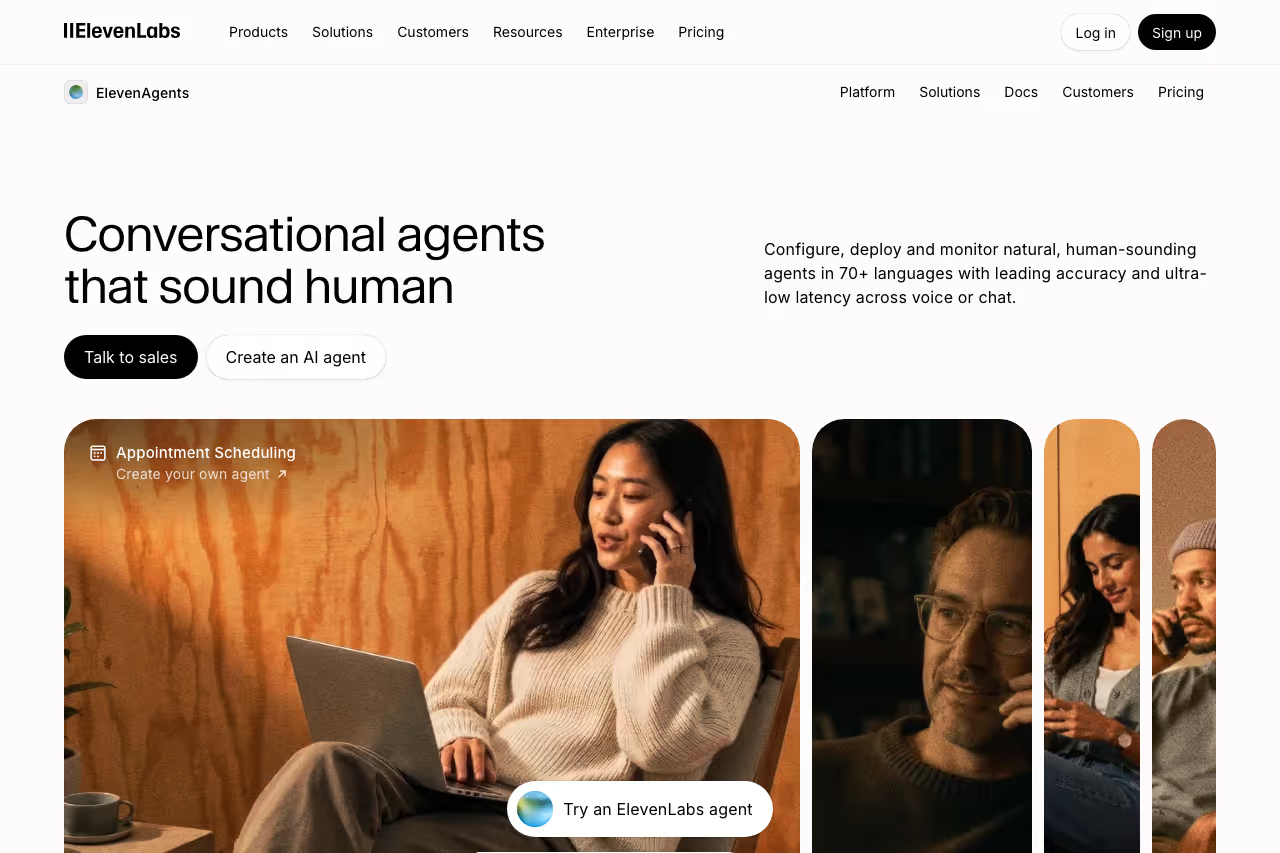
ElevenAgents is ElevenLabs' platform for building production voice agents. It pairs the most natural-sounding voices in the category with the infrastructure to deploy them: telephony, tool calling, knowledge bases, and multilingual support in 70+ languages. You choose the LLM, define the agent's behavior, and ship it to phone, web, or your own stack.
Who it's best for: teams that want their voice agent to actually sound human. Customer-facing use cases where voice quality is the difference between callers engaging or hanging up.
Choose ElevenAgents when voice quality decides whether callers engage or hang up, with telephony, tool calling and 70+ languages behind it. It is a platform, not a turnkey product, so budget setup time for prompts, tools and testing.
Pricing is usage-based (billed per minute of conversation) on top of ElevenLabs' plans, so you scale with real usage instead of committing to seats. It's the same infrastructure ElevenLabs runs its own Reception.ai product on, which is a meaningful production credential.
The catch: it's a platform, not a turnkey product. Expect to invest setup time in prompts, tools, and testing. If you want a ready-made receptionist out of the box, that's what Reception.ai is for.

Retell AI: the default pick for shipping voice products
Retell AI is voice infrastructure that doesn't make you assemble the whole stack yourself but still gives you API access when you need it. You build agents in a no-code flow or in code, and Retell handles the orchestration between speech-to-text, the language model, and the voice.
The default for teams that want production-grade reliability without juggling five vendor accounts, sitting between Vapi's raw kit and Synthflow's closed builder. Per-minute costs run up to $0.31 if you pair the priciest voice with a heavy model.
It sits in the sweet spot between Vapi's raw kit and Synthflow's closed builder.
Pricing is usage-based at $0.07 to $0.31 per minute depending on the voice and model you pick, with no mandatory subscription. You get $10 in free credit at signup and 20 concurrent calls included, then $8/month per extra concurrent line. The base voice infrastructure runs $0.055/min and you layer LLM and TTS on top, which is where the range comes from.
The standout is that the all-in number stays close to the headline. Independent cost breakdowns put a production-grade Retell setup near $2,800/month at 10,000 minutes, which is the kind of figure you can actually put in a budget.
The catch: the flexibility cuts both ways. If you want a true drag-and-drop experience with zero config, Synthflow is gentler. And the per-minute ceiling of $0.31 is real if you pair the priciest voice with a heavy model, so watch your component choices.

Murf AI: Fast, human-like voice for cost-conscious teams
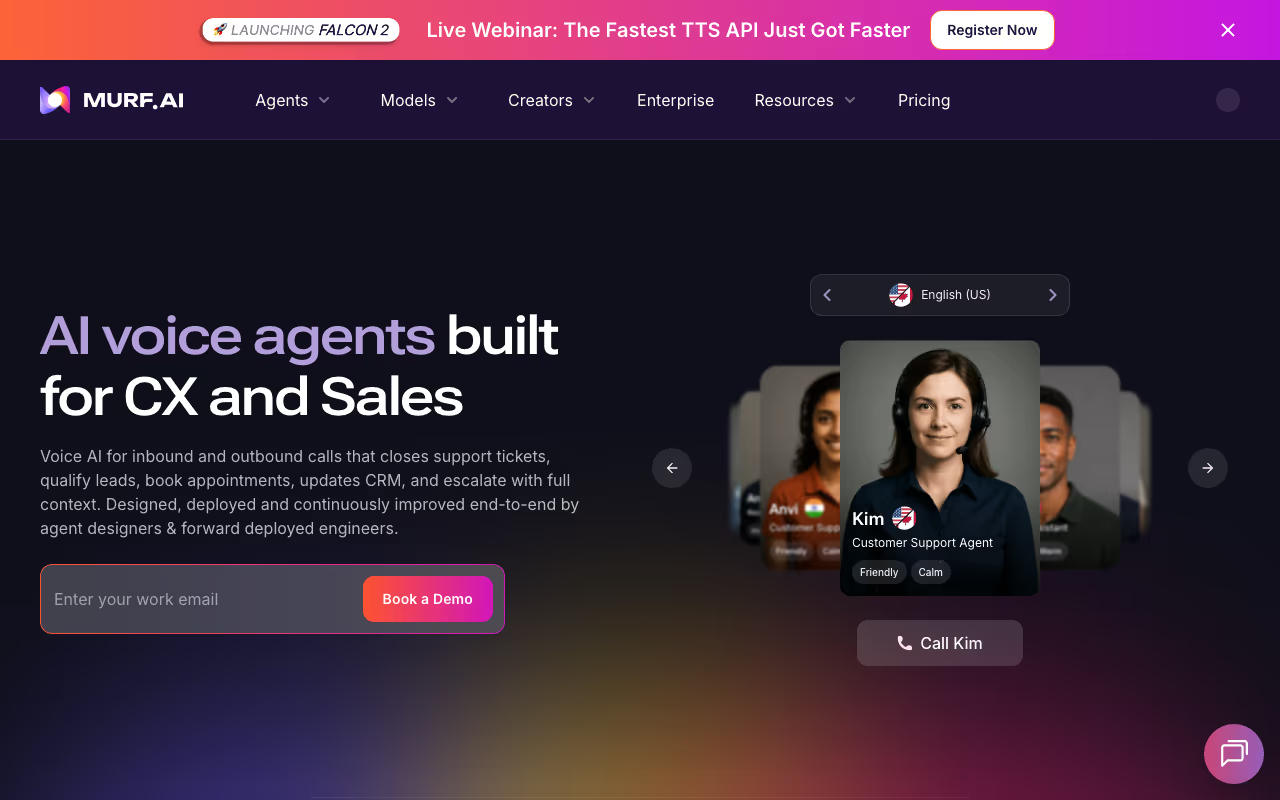
Murf is a voice AI platform that builds its own speech models rather than licensing someone else's, and uses that stack to deploy purpose-built voice agents for enterprises. Because Murf owns the text-to-speech layer end to end, it controls latency and voice quality more tightly than platforms stitching together third-party APIs.
A cost-conscious enterprise option, with a flat $0.08 per minute, roughly 800ms latency and 35+ languages on its own speech models. There is no public self-serve builder, so access runs through a guided pilot and Retell or Synthflow start faster.
Pricing is a flat $0.08 per minute, with no separate platform fee or markup on individual components. That undercuts most usage-based competitors on this list once STT, LLM, and TTS costs are added up separately, and Murf pairs it with a free proof-of-concept and a fully managed pilot.
The standout is the combination of speed and language coverage. Built on Murf's proprietary Falcon model, agents run at roughly 800ms end-to-end latency and support 35+ languages with mid-sentence switching, scaling to 10,000 concurrent calls without a drop in performance. SOC 2, HIPAA, ISO 27001, and GDPR come standard, along with on-premise deployment and Azure data residency.
The catch: there's no public self-serve agent builder yet. Access runs through a guided pilot with Murf's team, so if you want to spin up an agent solo in an afternoon, Retell or Synthflow will get you there faster. Murf trades that instant self-serve speed for a managed setup and free custom engineering support.

Vapi: maximum control for developers
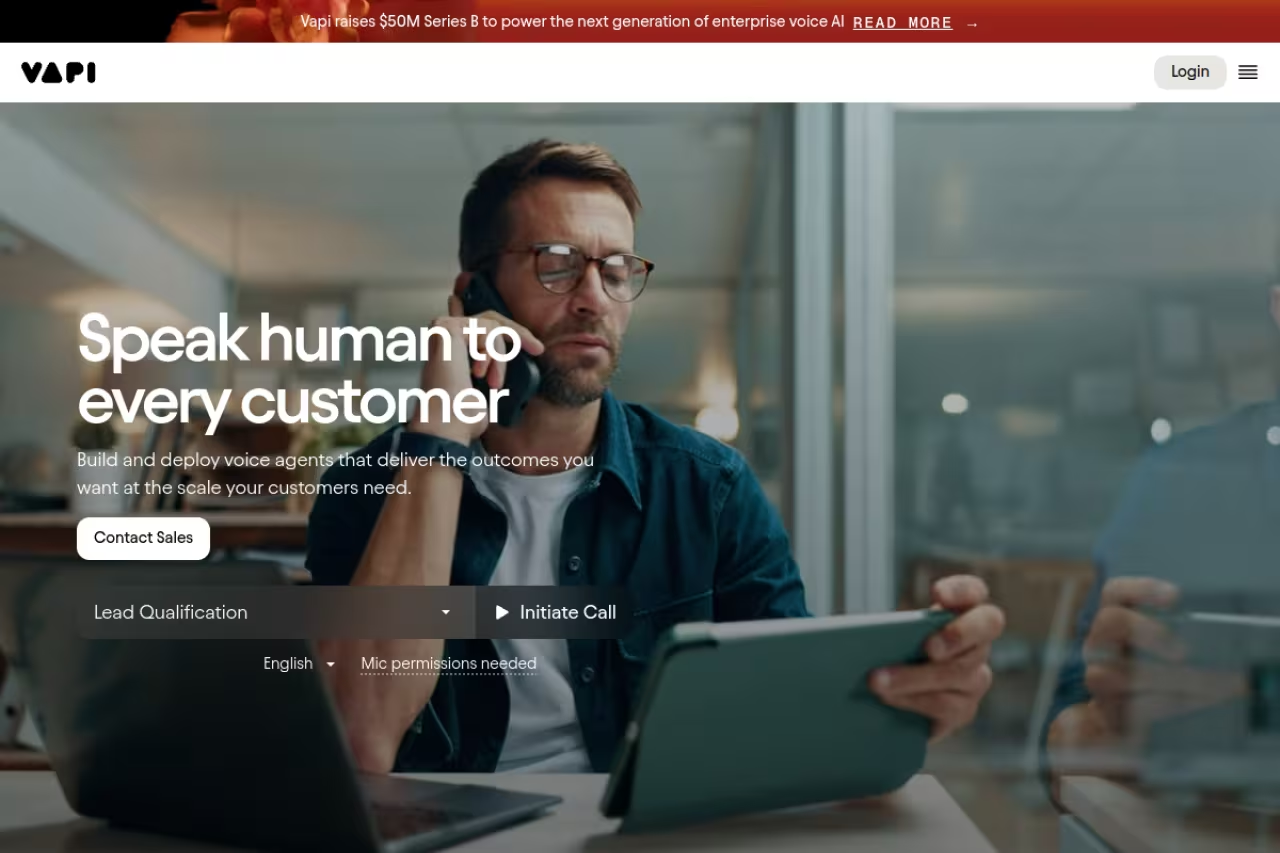
Vapi is the platform for engineers who want to own every layer. You bring your own keys for speech-to-text, the LLM, and text-to-speech, and Vapi handles the real-time orchestration and telephony. It's the closest thing to a Lego kit in this category.
Vapi is for developer teams with the appetite to tune their own stack and the volume to justify it, since nothing locks you into a voice or model. The headline $0.05 per minute is misleading, and real stacks cost far more in money and engineering time.
The platform fee is $0.05 per minute on the Build plan, with 10 concurrent lines included and then $10 per line per month. Model costs pass through at cost, or hit zero if you supply your own API keys. Vapi targets sub-500ms latency under load, which is competitive with anything here.
The standout is control. Nobody locks you into a voice or model. If a better TTS provider launches next month, you swap it in.
The catch: that headline $0.05 is misleading on its own. Add STT, LLM, TTS, and telephony, and real-world stacks land around $10,000 to $13,200/month at 10,000 minutes per independent testing, more than triple Retell at the same volume. Vapi is the most expensive of the big three unless your engineers aggressively optimize. You are paying in engineering time for the control.

Bland AI: built for outbound at volume
Bland AI runs its own self-hosted model stack end to end, which is unusual. Most platforms stitch together third-party STT, LLM, and TTS. Bland controls the whole pipeline, which it pitches as more reliable for high-volume calling.
Built for outbound campaigns dialing thousands of numbers, where a self-hosted stack keeps latency and voice consistent. You cannot swap in a third-party voice, and the monthly plan fee makes it expensive at low volume.
The base rate is $0.09 per minute for connected calls, with $0.015 charged for outbound attempts under 10 seconds. Bland moved to plan-based pricing in late 2025, so there's a monthly fee on top, and enterprise pricing is custom. At 10,000 minutes the Scale tier lands near $4,899/month, between Retell and Vapi.
The standout is the controlled stack. Because Bland owns every layer, latency and voice stay consistent at scale, and there's no juggling multiple vendor bills.
The catch: the closed stack means less flexibility. You can't swap in a third-party voice you prefer, and the monthly plan fee makes Bland expensive at low volume. It only makes financial sense once you're running serious call counts.
Synthflow: the no-code option that actually ships
Synthflow is the platform I'd hand to a non-technical operator. The drag-and-drop Flow Designer lets you build inbound and outbound agents, book meetings, qualify leads, and route calls without writing a line of code.
The platform I'd hand to a non-technical operator, with a drag-and-drop designer, 50+ native integrations and live call monitoring. It costs more per minute than Retell and you will outgrow it if you have engineers who want deep customization.
Pricing is subscription-based by concurrent call slots rather than per minute: roughly $29/month at the entry tier up to $449/month on Growth, with bundled minutes that work out to roughly $0.45 to $0.58 per minute effective. That's pricier per minute than Retell, but you pay zero engineering time.
The standout is the integration list: 50+ native connections including GoHighLevel, ServiceTitan, HubSpot, and Salesforce, plus live call monitoring with whisper and barge-in controls. Synthflow also added HIPAA support in early 2026.
The catch: the effective per-minute cost is two to six times higher than a tuned developer stack, and you trade away deep customization for the convenience. If you have engineers, you'll outgrow it. If you don't, it's the fastest path to a live agent.

PolyAI: enterprise inbound that holds the line
PolyAI is built for large companies fielding huge volumes of inbound calls. It ships pre-trained industry assistants, speaks 40+ languages, and plugs into existing CRMs and contact center stacks.
PolyAI fits enterprises with strict compliance needs and call volumes that would bury a smaller platform, with a reported 80% of calls resolved before escalation. Expect quote-based pricing and a real sales cycle, which is overkill for a startup prototyping an idea.
Pricing is custom and quote-based, which is standard at this tier. You're buying a managed solution, not a self-serve account.
The standout is containment. PolyAI reports resolving up to 80% of calls before any escalation to a human, which is the number that actually moves a contact center's cost structure.
The catch: there's no free tier, no instant signup, and a real sales cycle to get started. This is overkill for a startup testing an idea. It earns its keep when you're replacing a call center, not prototyping.
Cognigy: for contact centers already on Genesys or Avaya
Cognigy targets the same enterprise market as PolyAI but with a different bet: deep integration into the CCaaS platforms you already run. If your stack is Genesys, Avaya, or Amazon Connect, Cognigy slots in rather than replacing everything.
Established contact centers on Genesys, Avaya or Amazon Connect should look here, since Cognigy slots into the stack instead of replacing it. Without one of those platforms its main advantage disappears, and the enterprise sales motion offers no quick start.
Pricing is custom and quote-based.
The standout is the AI Agent Manager, a visual builder that lets ops teams design multi-step conversation flows with agentic reasoning, all wired into your current telephony.
The catch: same as PolyAI. Enterprise sales motion, no quick start, and real implementation work. The value is in the integration depth, so if you're not already on one of those platforms, the main reason to choose Cognigy disappears.
OpenAI Realtime API: the raw foundation
OpenAI's Realtime API isn't a packaged voice agent. It's the native speech-to-speech model that many of the platforms above could sit on top of. You get direct access, and you build the rest.
Best for: builders who want the lowest-level access and are comfortable handling orchestration, telephony, and state themselves.
The newer GPT-Realtime-2 model runs about $0.06 per minute on audio input and roughly $0.24 per minute on audio output in typical use, though prompt caching can cut the effective rate to $0.05 to $0.10/min if you wire it correctly.
The standout is that you're talking to the model with nothing in between, plus native speech-to-speech that avoids the lag of chaining separate STT and TTS steps.
The catch: this is a foundation, not a product. No call flow builder, no analytics, no telephony out of the box. Most teams should build on Retell or Vapi instead of reinventing that layer. Pick the raw API only if you have a specific reason the platforms can't meet.
The raw foundation for builders who want the lowest-level access and will handle orchestration, telephony and state themselves, with native speech-to-speech and no lag from chained steps. Most teams should build on Retell or Vapi instead.
If you're building voice into a broader stack of AI tools, it's worth keeping an eye on the wider agent market too. Our roundup of the best AI agents and the best AI agent platforms covers the text-and-action side that often pairs with voice. And if you just want to stay current on which of these tools is winning, Dupple X tracks the AI tooling space so you don't have to read ten pricing pages a week.
How to choose
Skip the feature checklist and answer three questions in order.
First, do you have engineers? If no, go straight to Synthflow. The no-code builder and 50+ integrations get you live without a developer, and the higher per-minute cost is cheaper than hiring. If yes, keep going.
Second, what's your volume and budget shape? For a real product at moderate scale, Retell AI gives the best all-in cost with the least babysitting. For maximum control and the willingness to optimize a stack, Vapi pays off at high volume. For outbound campaigns specifically, Bland's controlled stack and $0.09/min connected rate fit.
Third, are you an enterprise replacing a contact center? Then it's PolyAI for raw inbound containment, or Cognigy if you're already on Genesys or Avaya.
Most teams reading this should start with Retell, prototype in a weekend, and only graduate to Vapi or an enterprise platform when a specific limit forces the move.
FAQ
What is the best AI voice agent platform in 2026?
When voice quality is the deciding factor, ElevenAgents leads because it pairs the most natural-sounding voices in the category with real deployment infrastructure. For most teams shipping a real product, Retell AI is still an excellent starting point because it balances usage-based pricing, low latency, and flexibility without forcing you to assemble the entire stack. Vapi wins if you want full developer control, Synthflow if you have no engineers, and PolyAI or Cognigy for enterprise contact centers.
How much do AI voice agents cost per minute?
Real per-minute costs in 2026 range from about $0.07 (Retell AI) to $0.31 at the high end, with no-code platforms like Synthflow landing around $0.45 to $0.58 effective once you account for bundled minutes. Vapi's $0.05 platform fee looks cheapest but climbs past $10,000 a month at 10,000 minutes once you add STT, LLM, TTS, and telephony.
Can AI voice agents handle outbound sales calls?
Yes. Bland AI is purpose-built for high-volume outbound at $0.09/min for connected calls, and Synthflow handles outbound dialing with lead qualification and CRM sync. For pairing voice with the rest of a sales motion, our guide to the best AI tools for sales prospecting covers the workflow side.
Do I need to code to build an AI voice agent?
No. Synthflow's drag-and-drop Flow Designer and Retell AI's no-code builder both let non-technical users ship working agents. Coding gives you more control with platforms like Vapi or the OpenAI Realtime API, but it isn't required to get a live agent answering calls.
How is voice quality different from voice cloning?
Voice quality for agents is about real-time naturalness during a live call, while cloning is about replicating a specific person's voice. If you're trying to build or replicate a custom voice rather than deploy a phone agent, see our walkthrough on how to create an AI voice.
Related guides
Some offers on this page may be paid placements or contain affiliate links.
Across our whole catalogue the median is $24 a month and 33% of tools advertise a free tier. Figures are the lowest recurring monthly price quoted in our own review of each tool, read on 2026-08-19. Full method and every category.
