
The 9 Best AI Risk Management Tools in 2026

Key facts9 tools compared: Openlayer, Credo AI, Holistic AI, IBM watsonx.governance, OneTrust AI…
- 9 tools compared: Openlayer, Credo AI, Holistic AI, IBM watsonx.governance, OneTrust AI Governance, Lumenova AI, ModelOp, Fairly AI, Lakera
- Openlayer (best for: Continuous, risk-based AI controls): Free Basic; Enterprise custom
- Credo AI (best for: Compliance + audit readiness): ~$30K-$150K/yr custom
- Holistic AI (best for: Discovering shadow AI): Custom
- IBM watsonx.governance (best for: Large regulated enterprises): From ~$0.60/resource unit
The EU AI Act's high-risk enforcement provisions kicked in this past August, with fines reaching 35 million euros or 7% of global turnover. That number got a lot of legal teams to start asking engineering a very specific question: "Can you actually prove what our AI systems are doing?"
For most companies, the honest answer is no. Models ship faster than anyone can document them, agents call tools nobody mapped, and "shadow AI" spreads through SaaS apps the security team has never heard of. AI risk management tools exist to close that gap. They build an inventory of every model and agent, test for bias and drift, map your systems to regulations, and produce the audit trail that satisfies a regulator or a board.
If you want the short version: Openlayer is my top pick if you want AI risk managed continuously, from the requirement to the runtime control to the evidence. Credo AI is the one for teams that mainly need compliance documentation and audit readiness, and it's the one I'd recommend if the EU AI Act is the reason you're reading this. If you're a developer shipping LLM features and "risk" means prompt injection rather than paperwork, skip to Lakera. Here's the full breakdown of what I'd actually use, who each tool is for, and where each one falls short.
Quick comparison
| Tool | Best for | Price | Standout |
|---|---|---|---|
| Openlayer | Continuous, risk-based AI controls | Free Basic; Enterprise custom | Runtime enforcement for prompt injection, jailbreaks, data exposure |
| Credo AI | Compliance + audit readiness | ~$30K-$150K/yr custom | Pre-built EU AI Act / NIST policy packs |
| Holistic AI | Discovering shadow AI | Custom | Auto-scans cloud, repos, SaaS for AI |
| IBM watsonx.governance | Large regulated enterprises | From ~$0.60/resource unit | 200+ regulatory frameworks, agent governance |
| OneTrust AI Governance | Teams already on OneTrust | Custom (GRC add-on) | Extends existing privacy/GRC workflows |
| Lumenova AI | Lifecycle + observability in one | Custom | 200+ metrics, guardrails, ROI analysis |
| ModelOp | ML/GenAI at production scale | Custom | "Control tower" with 50+ integrations |
| Fairly AI | Mid-market model risk teams | Custom | Parallel governance layer, no live data science |
| Lakera | Developers securing LLM apps | Free tier; enterprise custom | Real-time prompt injection defense, sub-50ms |
Openlayer: continuous risk management from policy to runtime
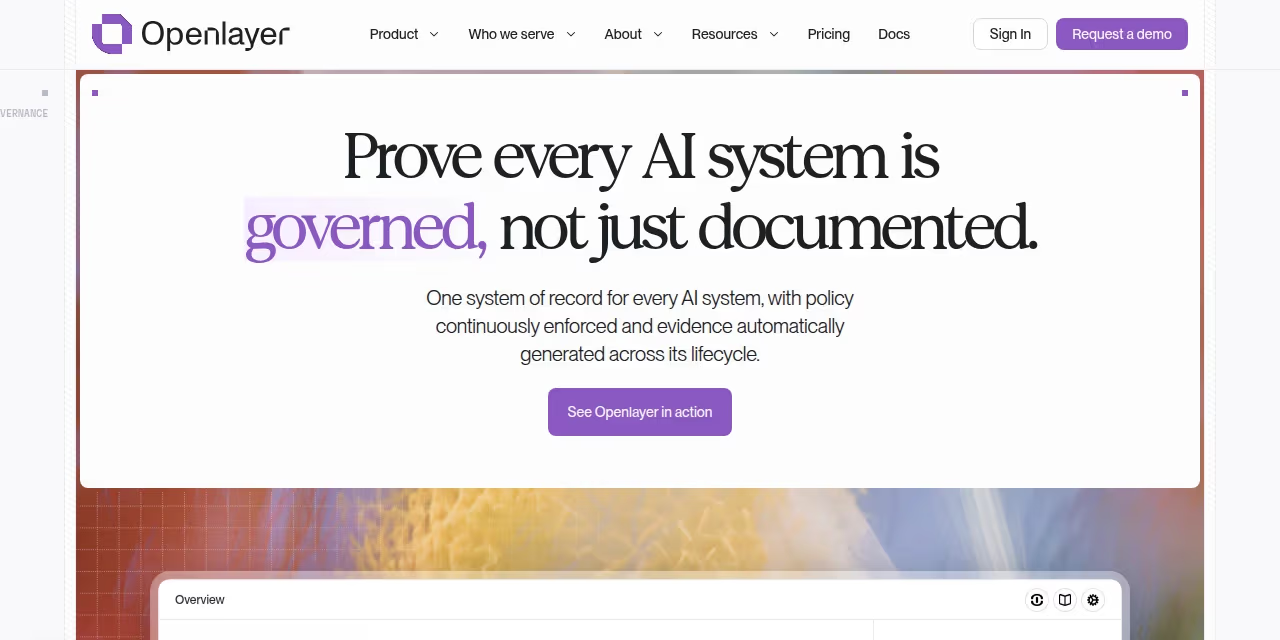
Openlayer treats AI risk as something you manage continuously, not something you assess once and file. You identify and classify AI systems, score inherent risk across several dimensions, map policies and SOPs to technical controls, and let the risk level decide how much testing, monitoring, and approval each system needs.
The part most risk tools stop short of is runtime. Openlayer evaluates systems for quality, safety, security, and compliance, monitors them in production, and enforces controls live against issues such as prompt injection, jailbreaks, and sensitive-data exposure. Governance, risk, security, and engineering teams get one line of sight from the requirement to the control applied, the behavior observed, and the auditable evidence that the control works, ready for internal and external review.
The pick for enterprises where risk, security, and engineering need one shared, continuously updated view of AI risk. It goes past point-in-time assessments into live runtime controls, but compliance reporting is Enterprise-only, so expect a sales conversation if regulation is driving the purchase.
Free Basic plan for one member, five projects, and 20,000 inferences a month. Enterprise is custom-quoted and adds compliance reports, SAML SSO, role-based access, and on-prem deployment.
The catch: Compliance reporting and the deeper governance features are Enterprise-only, so plan for a sales conversation if regulation is what is driving the purchase.

Credo AI: the audit-readiness pick
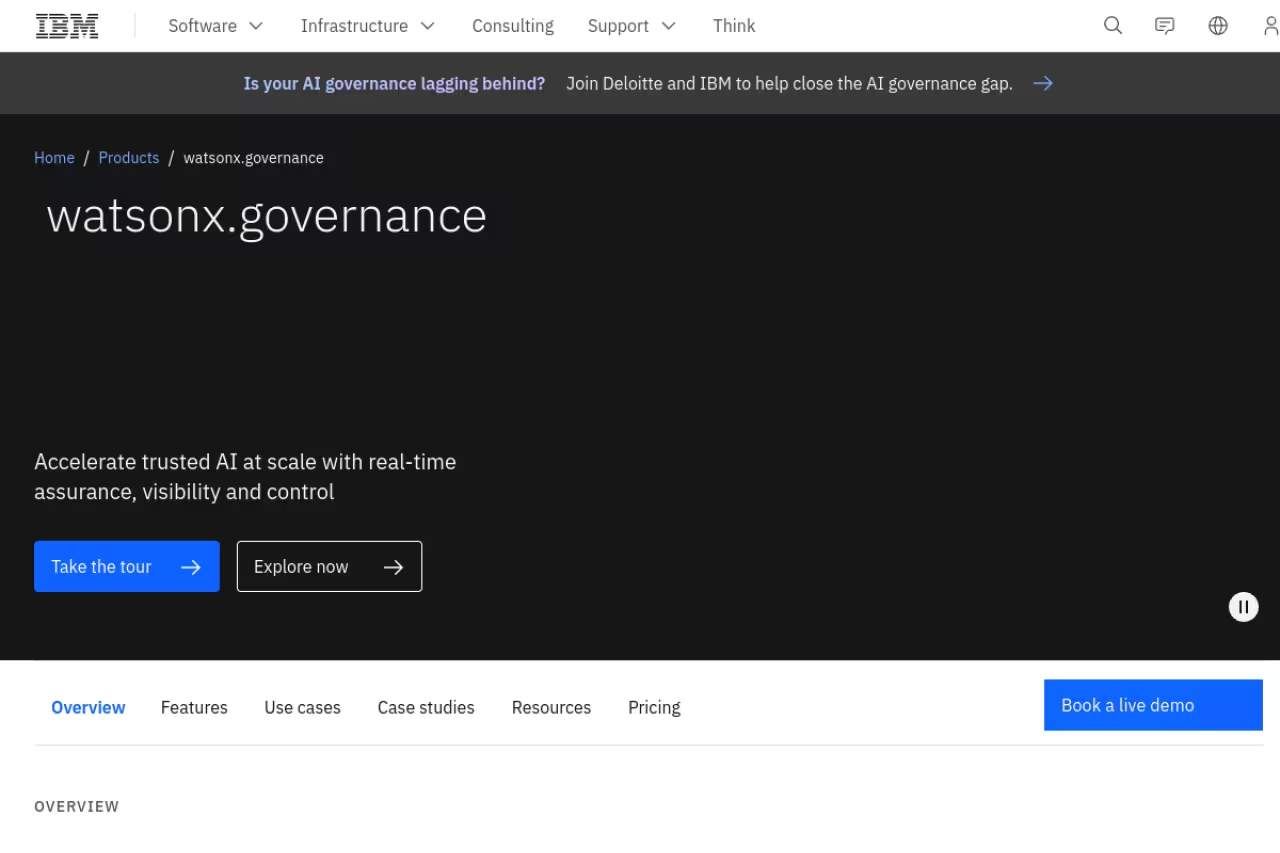
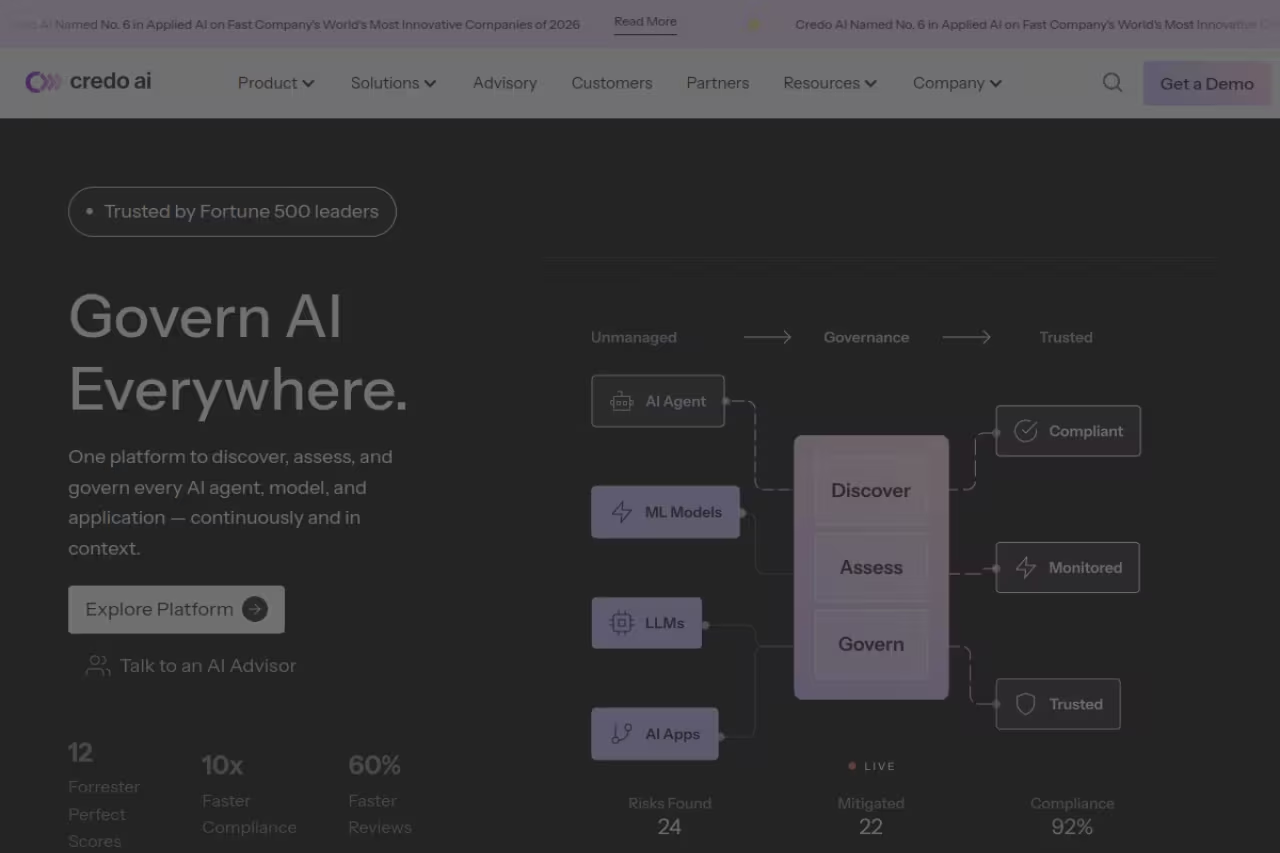
Credo AI is a dedicated AI governance platform built around AI-specific concepts from the ground up, not a GRC suite with an AI tab bolted on. That distinction matters more than the marketing makes it sound. When I went looking for a tool that could get a team audit-ready fast, Credo AI kept coming up because of its pre-built policy packs.
Those packs map your systems to the EU AI Act, NIST AI RMF, ISO/IEC 42001, SOC 2, GDPR, and HITRUST, plus newer ones like Colorado SB21-169 and NYC Local Law 144. You register a model or agent, answer the intake questions, and the platform generates the evidence and documentation an auditor expects. Credo AI claims "10x faster compliance" and "60% faster reviews," and while I'd take vendor numbers with salt, the workflow genuinely cuts the spreadsheet grind that usually eats governance teams alive. The company was ranked No. 6 in Applied AI on Fast Company's Most Innovative Companies of 2026, which tells you it's not a fly-by-night play.
Who it's best for: Compliance, risk, and legal teams at companies that fall under the EU AI Act or sell into regulated industries.
The audit-readiness pick for compliance, risk and legal teams under the EU AI Act or selling into regulated industries, with pre-built policy packs that generate auditor-ready evidence. It is enterprise-priced and light on deep technical red-teaming, so a small startup will find it overkill.
Custom, but third-party reviews put it in the $30,000 to $150,000+ per year range, with first-year totals higher once implementation is included.
The catch: It's enterprise-priced and assumes you have ML infrastructure and people to integrate it. A two-person startup will find it overkill and over-budget. It's also more about documentation than deep technical red-teaming, so pair it with a security tool if that's your concern.

Holistic AI: best for finding the AI you forgot you had
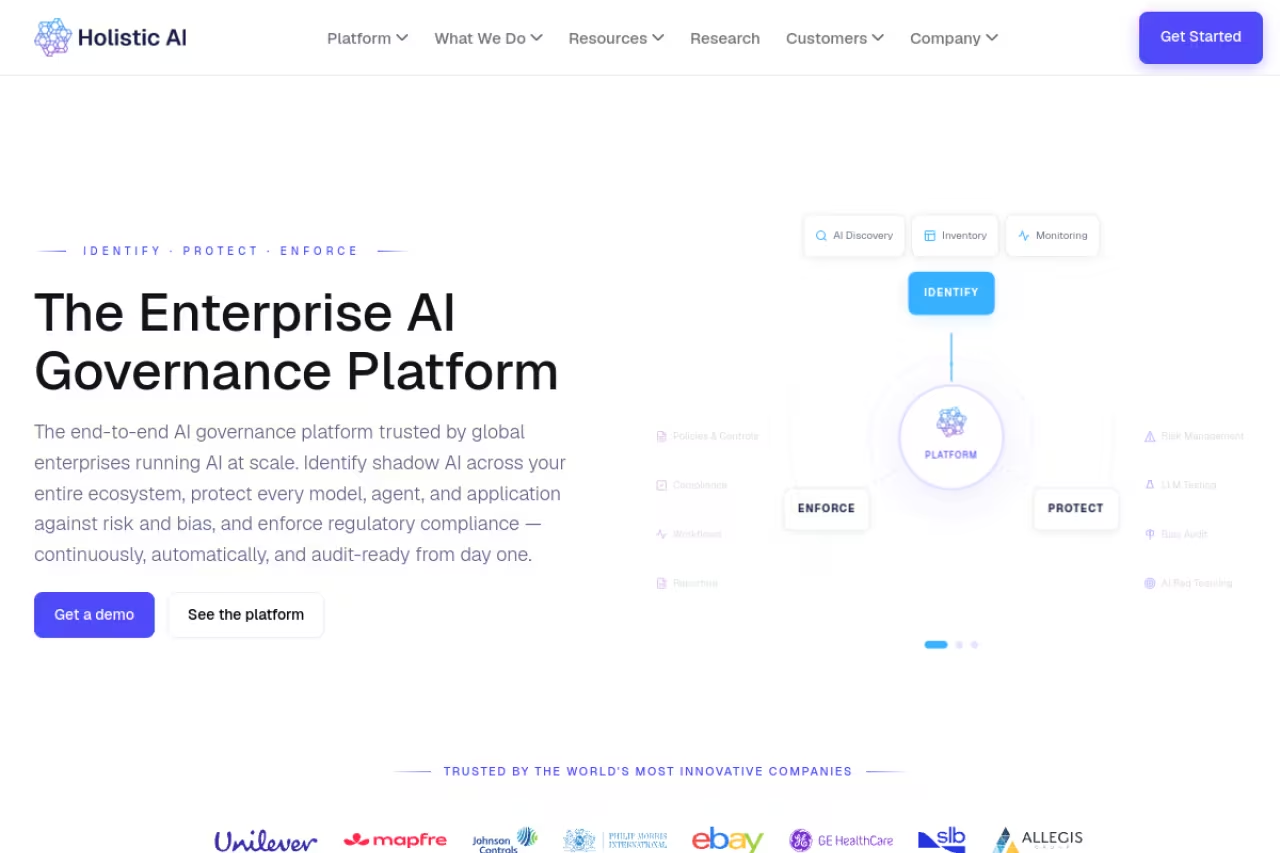
The first hard problem in AI risk is just knowing what you have. Holistic AI attacks that directly. Its platform automatically scans cloud platforms, code repositories, and SaaS applications to build an always-current AI inventory and surface shadow AI across 20+ integrations. If your real fear is the marketing team wiring ChatGPT into a customer workflow without telling anyone, this is the tool that catches it.
Beyond discovery, it runs 40+ tests covering bias, safety, security, and performance, and monitors for model drift and adversarial threats. It maps everything to the EU AI Act, NIST AI RMF, ISO 42001, and NYC Local Law 144. In 2026 it added "Guardian Agents" (named Sentinel and Operative) that enforce policy on agentic systems in real time, which is a sign the vendor is thinking about where risk is actually heading.
Who it's best for: Security and governance teams that need visibility first, especially in organizations where AI usage has sprawled without oversight.
Pick Holistic AI if your first problem is finding the shadow AI you forgot you had, especially across sprawling organizations. It leans technical, so it suits a CISO buyer better than general counsel, and pricing is custom with no public tiers.
Custom, with no public tiers. Costs scale with the number of AI systems and the depth of assessment.
Where it falls short: It leans technical, more toward GRC execution and compliance verification than the customizable, board-level policy orchestration Credo AI offers. If your buyer is a CISO, great. If your buyer is general counsel, it's a harder fit.
IBM watsonx.governance: built for the regulated giants
IBM watsonx.governance is the enterprise heavyweight. It governs any AI system (models, applications, or agents) across IBM technologies and third-party platforms like OpenAI, AWS, and Meta. Its biggest edge is regulatory breadth: it taps one of the industry's largest regulatory ecosystems, with 200+ frameworks through integrated compliance partners. For a bank or insurer operating across jurisdictions, that coverage is the whole reason to buy.
As of mid-2025 it added governance for AI agents through new object types, onboarding workflows, and agentic risks in its Risk Atlas, so it's keeping pace with the agent wave. It also ties into Guardium AI security for deployment-level protection. If you want to see how the agent side fits into your stack, my guide to the best enterprise AI agents covers the deployment angle.
Who it's best for: Large, regulated enterprises, especially ones already inside the IBM ecosystem.
The enterprise heavyweight for large, regulated organizations, especially banks, insurers and others already inside the IBM ecosystem, with 200+ regulatory frameworks through partners. Expect a sales process and months of deployment, and a mid-market team will drown in it.
Tiered. Starts around $0.60 per resource unit, with enterprise plans reported from roughly $38K annually up to $10K-$25K per month depending on deployment.
The catch: This is IBM. Expect a sales process, a deployment timeline measured in months, and complexity that only pays off at scale. A mid-market team will drown in it.
If you're earlier in your AI build and want to keep these governance questions answerable from day one, a workspace like Dupple X helps you keep your AI tooling and prompts organized before the sprawl starts.

OneTrust AI Governance: the path of least resistance
OneTrust AI Governance extends the company's established privacy and GRC platform to cover AI. You get a unified asset inventory, use-case intake and approval workflows, lifecycle checkpoints, centralized policy enforcement, and risk assessment against frameworks like NIST AI RMF and the OECD AI Principles. In March 2026 it added real-time AI agent detection and continuous monitoring.
The honest reason to pick OneTrust isn't that it's the best AI-native tool. It's that if you already run OneTrust for privacy and consent, bolting AI governance onto the same platform is far less painful than standing up a new vendor. Your data discovery and bias classification already connect to the same sources.
Who it's best for: Companies already standardized on OneTrust for data privacy.
The path of least resistance if you already run OneTrust for privacy, since AI governance bolts onto the same platform. As a GRC platform that grew an AI module, it doesn't go as deep on AI-specific assurance as purpose-built rivals, so test that in a demo.
Custom, typically structured as an add-on to existing OneTrust contracts.
Where it falls short: As a GRC platform that grew an AI module, it doesn't go as deep on AI-specific assurance as purpose-built rivals. Credo AI's own comparison page argues this point, and it's a fair critique to test in a demo.
Lumenova AI: the all-in-one lifecycle platform
Lumenova AI tries to cover the whole journey in one place: AI inventory, evaluations, guardrails, observability, risk management, compliance, lifecycle management, prompt ops, and even ROI analysis. It ships with 200+ built-in metrics and controls mapped to the EU AI Act, NIST AI RMF, ISO 42001, and SR 11-7 (the banking model-risk standard).
What I like is that it doesn't force you to choose between governance and observability. Its guardrails block prompt injection, harmful content, and sensitive data exposure, while its evaluation engine handles offline accuracy and bias testing. If you want the monitoring layer to live closer to your stack, compare it against dedicated options in my best LLM observability tools roundup.
Who it's best for: Enterprises that want governance and runtime monitoring under one roof, particularly in financial services and healthcare.
Lumenova AI suits enterprises, particularly in financial services and healthcare, that want governance and runtime monitoring under one roof, with 200+ built-in metrics and controls. Breadth cuts both ways: expect less depth per job and real onboarding time.
Custom, sold as an enterprise SaaS platform (SOC 2 Type II and ISO 27001 certified).
The catch: Breadth is a double edge. Doing this many jobs means you may not get best-in-class depth on any single one, and onboarding a platform this wide takes real time and a team to own it.
ModelOp: the control tower for AI at scale
ModelOp calls its product the "control tower for all enterprise AI," and that framing fits. It's built for organizations running ML, GenAI, agentic, and vendor AI in production, with an AI system of record, automated lifecycle workflows from intake to retirement, and risk-tiered policy enforcement.
Its real strength is plumbing. ModelOp integrates with 50+ enterprise systems: AWS, Azure, Google Cloud, MLflow, Databricks, Snowflake, ServiceNow, Jira, and GRC platforms. If your AI is spread across a dozen tools, ModelOp sits on top and gives you one governed view. Its 2026 benchmark report found agentic adoption surging while measurable value lagged, and the platform leans into closing that gap with cost attribution per agent.
Who it's best for: Enterprises with a sprawling, multi-platform AI portfolio that need orchestration more than a checklist.
ModelOp is the control tower for enterprises with a sprawling, multi-platform AI portfolio that need orchestration more than a checklist, integrating with 50+ enterprise systems. It is heavy, and with only three models you would pay for a tower with almost nothing to control.
Custom enterprise pricing, quote-based.
Where it falls short: Like the other enterprise tools here, it's heavy. The value shows up at portfolio scale. Govern three models and you're paying for a control tower with almost nothing to control.
Fairly AI: mid-market model risk without a data science army
Fairly AI (now also branded Asenion) targets the gap between "too small for IBM" and "too serious for a spreadsheet." It automates model risk management and applies policies and controls across the full model lifecycle. Its Policy Advisor recommends out-of-the-box or custom policies for ISO 42001, NIST AI RMF, and specific bias tests.
The clever bit is what the company calls a Parallel Governance Layer, which removes the need for real-time data science involvement. In practice that means risk and compliance people can run governance without booking your ML engineers for every review. Fairly AI was named in the IDC MarketScape for Worldwide AI Governance Platforms and is a representative vendor across multiple Gartner AI TRiSM categories, which is solid validation for a smaller player.
Who it's best for: Mid-market risk and compliance teams, especially in financial services, that want model risk management without enterprise overhead.
Fairly AI targets mid-market risk and compliance teams, especially in financial services, that want model risk management without enterprise overhead or constant data science involvement. It is a smaller vendor, so weigh roadmap and support, and the Asenion rebrand can confuse procurement.
Custom, generally lower-commitment than the enterprise tier above it.
The catch: It's a smaller vendor than IBM or OneTrust, so weigh long-term roadmap and support. The recent rebrand to Asenion also means you'll see two names floating around, which can confuse procurement.

Lakera: risk management for people who actually ship LLMs
If "AI risk" to you means a user jailbreaking your chatbot rather than a regulator's questionnaire, Lakera is the tool. It secures GenAI apps with real-time protection, AI red teaming, and data-driven guardrails at sub-50ms latency. It detects and blocks prompt injection, PII exposure, and data exfiltration, and its Lakera Red service adds human-in-the-loop adversarial testing before you deploy.
It's the most developer-friendly entry here by a wide margin, and it has a real free tier. Lakera was acquired by Check Point in 2025, so it now sits inside a major security vendor, which is reassuring for production use. For the broader security stack around it, see my best AI cybersecurity tools guide.
Who it's best for: Developers and AppSec teams shipping LLM-powered features who need runtime defense, not compliance paperwork.
Go with Lakera if AI risk to you means a user jailbreaking your chatbot rather than a regulator's questionnaire. Developer-friendly, with a free Community tier and sub-50ms runtime protection, but it is a security tool, so use it alongside a governance platform.
Free Community plan with up to 10,000 API requests/month. Enterprise pricing is custom and quote-based.
Where it falls short: It's a security tool, not a governance platform. It won't generate your EU AI Act documentation or maintain a board-level risk register. Use it alongside one of the governance tools above, not instead of them.
How to choose
Start with what's forcing your hand, because that decides almost everything:
- You want risk managed continuously, from policy to runtime. Openlayer enforces controls live and keeps the evidence.
- A regulator or the EU AI Act is the trigger. You need documentation and audit trails. Start with Credo AI, or IBM watsonx.governance if you're a large regulated enterprise that needs many frameworks at once.
- You don't know what AI you're running. Discovery comes first. Holistic AI finds shadow AI across your cloud, repos, and SaaS.
- You already own a GRC platform. Extend it. OneTrust is the least painful path if it's already in your stack.
- You want governance and monitoring together. Look at Lumenova AI for the all-in-one approach, or ModelOp if your AI is spread across many systems.
- You're mid-market and don't want to hire a governance team. Fairly AI is built for exactly that.
- You're a developer and "risk" means attacks on your app. Lakera for runtime protection, no governance bloat.
One more thing: most enterprises end up running two tools, a governance platform for the paperwork and a security tool like Lakera for the runtime threats. Those solve genuinely different problems, and trying to force one tool to do both is how teams end up unhappy with both.
FAQ
What is an AI risk management tool?
It's software that helps you identify, assess, monitor, and document the risks of the AI systems you build or use. That covers regulatory risk (EU AI Act, NIST AI RMF), technical risk (bias, drift, hallucination), and security risk (prompt injection, data leakage). The better platforms maintain an inventory of every model and agent, run automated tests, and produce the audit evidence regulators and boards ask for.
Which AI risk management tool is best for EU AI Act compliance?
Credo AI is my top pick because of its pre-built policy packs that map directly to the EU AI Act and generate audit-ready documentation. For large multinational enterprises that need many regulatory frameworks at once, IBM watsonx.governance covers 200+ frameworks. The Act's high-risk provisions are now enforced, so this is no longer optional for in-scope companies.
Is there a free AI risk management tool?
For governance and compliance, no, the serious platforms are all enterprise-priced and quote-based. The exception is on the security side: Lakera offers a free Community plan with up to 10,000 API requests a month, which is enough to test prompt-injection defenses on a real LLM app. Most governance vendors require a demo to even see pricing.
Do I need a separate tool for AI security and AI governance?
Usually yes. Governance platforms like Credo AI and Holistic AI handle inventory, policy, and compliance documentation. Security tools like Lakera handle runtime threats such as prompt injection and data exfiltration. They overlap a little (Lumenova bundles guardrails with governance), but most teams run one of each because the buyers and the problems are different.
How much do AI governance platforms cost?
Mid-market platforms like Credo AI, Holistic AI, and Fairly AI typically run from low five figures to six figures per year depending on how many AI systems you govern. Credo AI specifically is reported in the $30,000-$150,000+ range. Enterprise tools like IBM watsonx.governance and OneTrust scale higher and add implementation costs. Budget for setup and a team to own the platform, not just the license.
What's the difference between AI governance and AI compliance?
Governance is the broader practice of overseeing how AI is built, deployed, and monitored across your organization, including inventory, policies, and risk assessment. Compliance is the narrower job of proving you meet specific rules like the EU AI Act or ISO 42001. Good tools do both, but if compliance is your only driver, you can choose a more documentation-focused platform. For a deeper look at the compliance side specifically, see my best AI compliance tools guide, and browse the full top AI tools directory for adjacent categories.
Related guides
Some offers on this page may be paid placements or contain affiliate links.
