
Best LLM Observability Tools in 2026 (Compared and Ranked)

Key facts8 tools compared: Langfuse, LangSmith, Arize Phoenix, Braintrust, Comet Opik, W&B Weave…
- 8 tools compared: Langfuse, LangSmith, Arize Phoenix, Braintrust, Comet Opik, W&B Weave, Datadog LLM Obs, Helicone
- Langfuse (best for: Most teams, any framework): Free tier; $29/mo Core
- LangSmith (best for: LangChain / LangGraph stacks): Free (5k traces); $39/seat
- Arize Phoenix (best for: RAG eval and drift): Free OSS; $50/mo AX Pro
- Braintrust (best for: Eval-driven dev teams): Free tier; $249/mo Pro
The first time one of my AI agents quietly started hallucinating tool calls in production, I had no idea for nine days. No error logs. No 500s. Just a slow drip of confused users and a support inbox I couldn't explain. The model was "working." It was also wrong, and I was blind to it.
That is the gap LLM observability fills. Traditional monitoring tells you a request returned a 200. It does not tell you the agent looped four times, burned $1.40 in tokens, and returned a confidently wrong answer. To see that, you need trace-level visibility into every prompt, completion, retrieval step, and tool call, plus a way to score quality over time. That is the whole job.
If you want the short version: Langfuse is my default recommendation for most teams in 2026 because it is open source, framework-agnostic, and cheap to run. If your stack is built on LangChain or LangGraph, LangSmith is the more natural fit. And if you are doing serious RAG evaluation, Arize Phoenix is hard to beat. The rest of this is who should pick what, and where each one annoyed me.
Quick comparison
| Tool | Best for | Price | Standout |
|---|---|---|---|
| Langfuse | Most teams, any framework | Free tier; $29/mo Core | Open source with full self-host parity |
| LangSmith | LangChain / LangGraph stacks | Free (5k traces); $39/seat | Deepest agent-graph tracing |
| Arize Phoenix | RAG eval and drift | Free OSS; $50/mo AX Pro | OpenTelemetry, no lock-in |
| Braintrust | Eval-driven dev teams | Free tier; $249/mo Pro | Experiment + eval workflow |
| Comet Opik | Cost-conscious small teams | Free (25k spans); $19/mo | Cheapest hosted paid plan |
| W&B Weave | Teams already on W&B | Free (5k traces); $50/seat | Tight ML experiment integration |
| Datadog LLM Obs | Enterprises on Datadog | $8 / 10k requests | One pane with infra metrics |
| Helicone | Quick proxy-based logging | Free; maintenance mode | One-line proxy setup |

Langfuse: the default pick for most teams
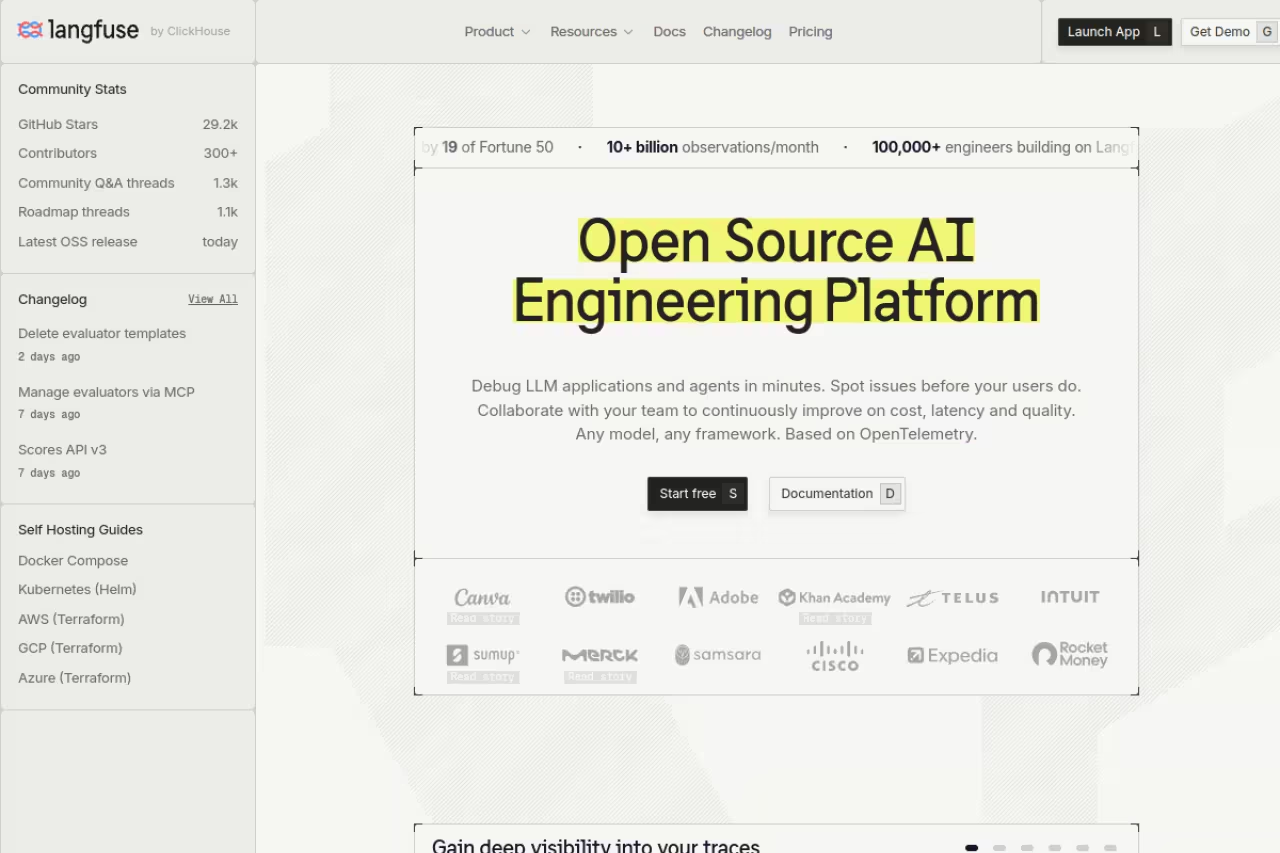
Langfuse is the tool I reach for first, and it is the one I recommend when a founder asks me where to start. It is an open source LLM engineering platform covering tracing, prompt versioning with a playground, evals, and datasets, and it integrates through OpenTelemetry, the OpenAI SDK, LangChain, and LiteLLM. It crossed 21,000 GitHub stars by early 2026, which tells you something about how widely it has been adopted.
The default for teams that want one framework-neutral tool with a genuinely free self-host option, since the open source version matches the cloud. Its integrations go broad rather than deep, so LangGraph-only shops will see less agent-step detail than in LangSmith.
the Hobby tier is free with 50k units per month and 30 days of data access. The Core plan is $29/month with 100k units included and additional usage at $8 per 100k. Pro is $199/month and adds three years of data retention plus SOC2 and HIPAA options. Self-hosting is genuinely free, and the open source version has feature parity with the cloud, which is rare.
The standout: the self-host story is real. A lot of "open source" tools cripple the free version to push you to cloud. Langfuse does not. You get the same product on your own infrastructure, which matters if you handle regulated data.
The catch: because Langfuse stays framework-neutral, its per-framework integrations go broad rather than deep. If you live entirely inside LangGraph, you will see less granular agent-step detail here than in LangSmith. It is a small price for the flexibility, but worth knowing.

LangSmith: built for LangChain and LangGraph
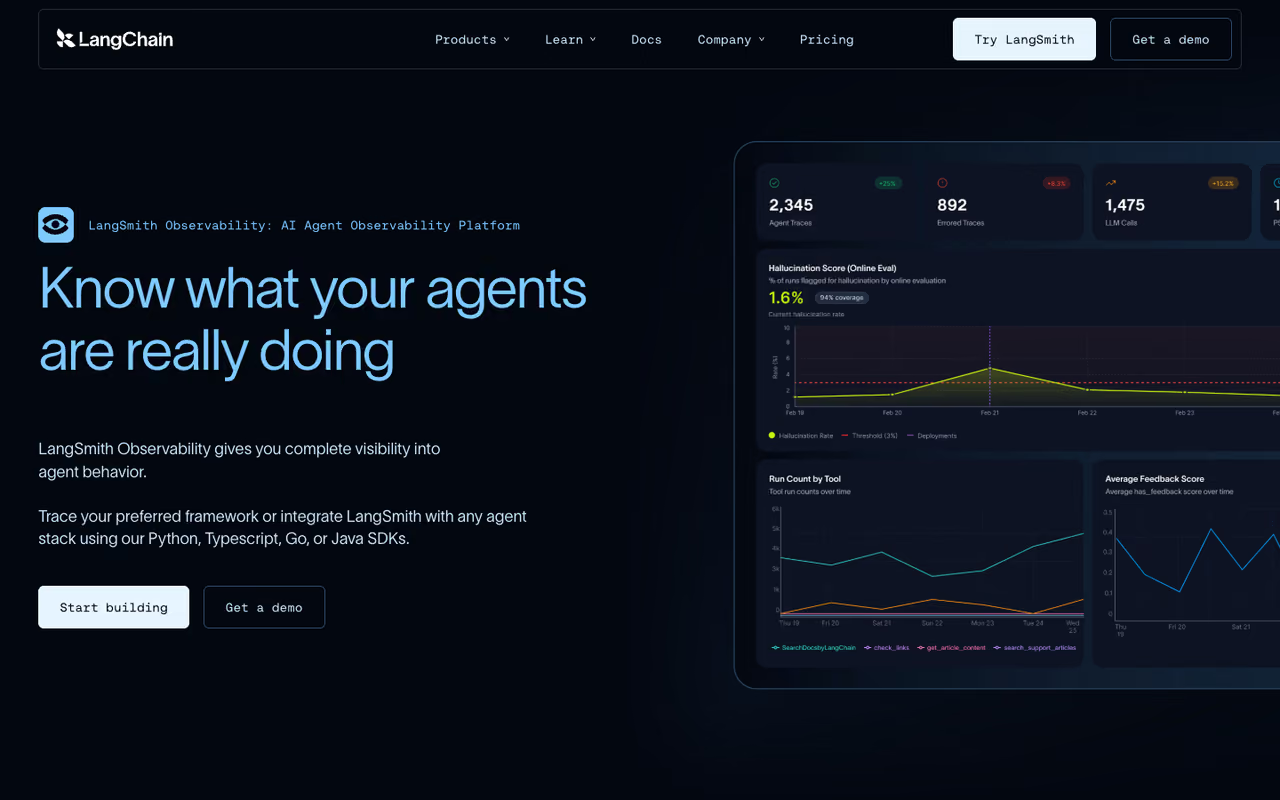
If your application is built on LangChain or its agent framework LangGraph, LangSmith is the path of least resistance. It comes from the same team, so tracing a multi-step agent graph requires almost no setup. You get high-fidelity traces, prompt management, annotation queues for human review, and online evaluations. For more on the underlying frameworks, see my guide to the best AI agent frameworks.
The path of least resistance for LangChain-native stacks, with deep LangGraph tracing and strong annotation queues. Per-trace overage adds up at scale, and the value drops sharply if you are on the raw OpenAI SDK or LlamaIndex.
The deep LangGraph tracing is the reason to choose it.
the Developer tier is free for one seat with up to 5,000 base traces per month, then pay-as-you-go. Plus is $39 per seat per month with 10k traces included. Overage runs $2.50 per 1,000 base traces, or $5.00 per 1,000 for extended 400-day retention. Enterprise is custom and adds self-hosting and SSO.
The standout: annotation queues. Being able to route specific traces to a human for structured scoring, then feed those judgments back into evals, closes the loop between "something looks off" and "we measured it and fixed it."
Where it falls short: the per-trace overage adds up faster than you expect at scale, and the value drops sharply if you are not on LangChain. I would not pick LangSmith for a stack built on the raw OpenAI SDK or LlamaIndex. You would be paying for integration depth you cannot use.
Arize Phoenix: the RAG evaluation specialist
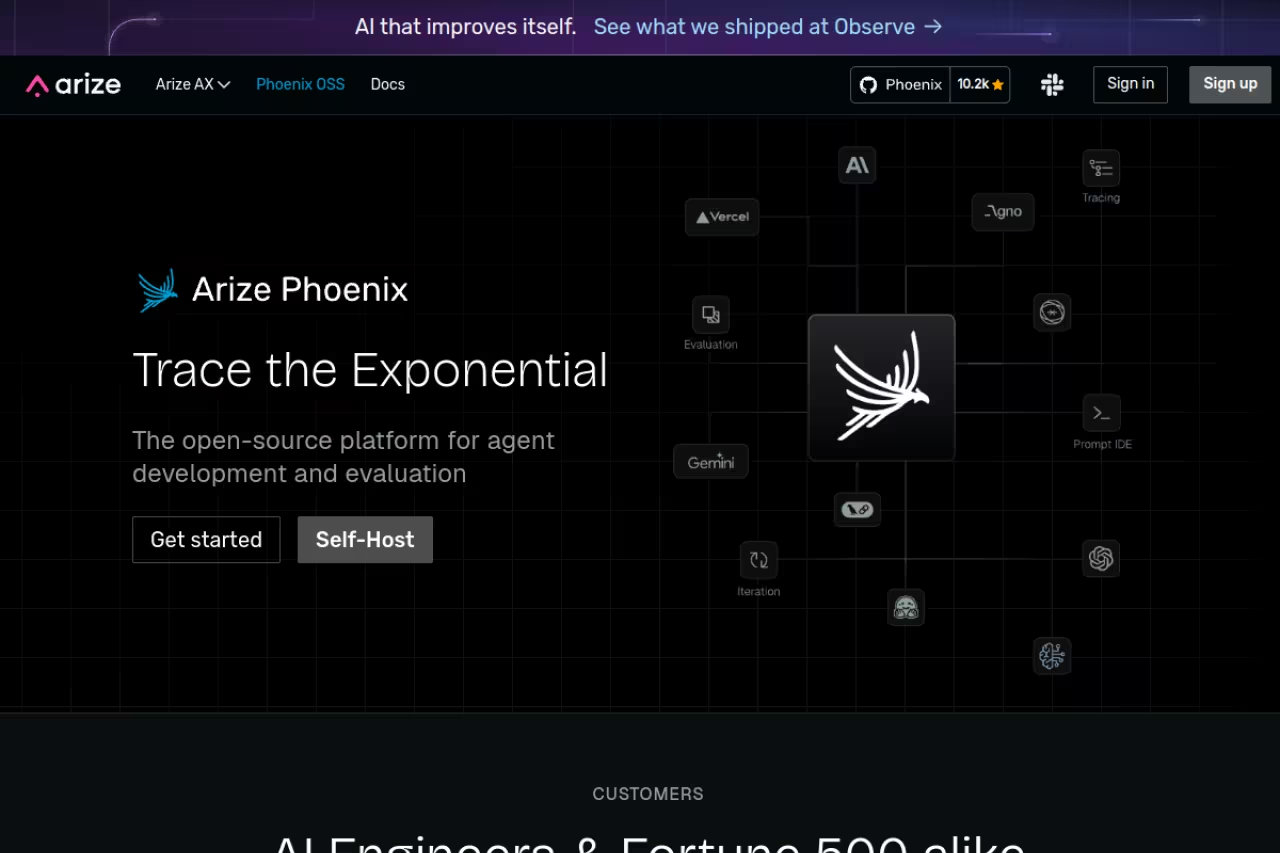
Arize Phoenix is the open source observability and evaluation tool from Arize AI, and it is my pick when retrieval quality is the thing keeping you up at night. It runs on OpenTelemetry through the OpenInference standard, so LlamaIndex, LangChain, Haystack, DSPy and the OpenAI Agents SDK all instrument without proprietary lock-in. You can self-host it with one command.
My pick when retrieval quality keeps you up at night, with span-level tracing, embedding clustering and drift detection for RAG teams. The split between free Phoenix and paid Arize AX confuses people, so check the boundary before committing.
Phoenix open source is $0 to self-host. The hosted commercial product, Arize AX, has a free tier (25k spans, 1GB, 15-day retention) and an AX Pro plan at $50/month with 50k spans, 10GB, and 30-day retention. Enterprise is a custom quote with alerts and online evals.
The standout: Phoenix evaluates one LLM with another, scoring relevance, toxicity, and hallucination across traces. For RAG, the embedding visualization that surfaces where retrieval drifts from your query intent is genuinely useful, not a gimmick.
The catch: the split between the free Phoenix project and the paid Arize AX platform confuses people constantly. Features you assume are included (alerting, online evals, dashboards) often live on the commercial side. Read the boundary carefully before you commit, or you will hit a wall mid-project.
If you are still choosing which models to instrument in the first place, my roundup of the best LLMs for coding and building is a useful companion read.
Braintrust: for eval-driven development
Braintrust treats evaluation as the center of gravity rather than an afterthought. It combines production monitoring, AI quality evals, and experimentation in one place, which suits teams who run structured experiments before every prompt change instead of shipping and hoping.
For AI-native teams that want eval-driven development as a daily habit, with a fast experiment workflow that is close to CI for prompts. The jump from free to $249/month Pro is steep, with nothing in between.
the Starter tier is free with $10 in monthly credits, 1GB of processed data, 10,000 scores, and 14-day retention. Pro is $249/month with $249 in credits, 5GB, 50,000 scores, and 30-day retention. Unlimited users on every plan is a nice touch.
The standout: the experiment workflow. Defining a dataset, running prompt variants against it, and diffing the scores side by side is fast and clean. It is the closest thing to a CI pipeline for prompts on this list.
Where it falls short: the jump from free to $249/month Pro is steep with nothing in between. Small teams that outgrow the Starter limits get sticker shock. The scores-based billing also takes a minute to reason about compared to simple trace counts.
Most of the teams I talk to do not need an enterprise platform on day one. They need to stop flying blind. If you are building an AI product and want a curated shortlist of tools that actually ship, Dupple X is the workspace I use to keep that stack tight, and you can start a yearly trial here.
Comet Opik: the budget hosted option
Comet Opik is the cheapest credible hosted paid plan in this roundup, and it is fully open source on top of that. It covers trace logging, prompt management, and evaluation scoring, with a familiar interface if your team already uses Comet for traditional ML experiment tracking.
The cheapest credible hosted option, ideal for small teams who want observability without Braintrust-level pricing, with Pro at $19/month. It is younger than Langfuse or Phoenix, so the ecosystem and community are thinner.
the Free cloud tier gives you up to 10 team members, 25k spans per month, and 60-day retention. Pro is $19/month with 100k spans and up to 50 members. Students and researchers get Pro free with academic verification. Self-hosting the open source version costs nothing.
The standout: $19/month is remarkably cheap for what you get, and the 60-day retention on the free tier beats most rivals' paid plans. For a side project or early-stage product, it is hard to argue with.
The catch: Opik is younger and smaller than Langfuse or Phoenix, so the integration ecosystem and community are thinner. You may hit edge cases where you are filing the GitHub issue rather than finding the answer already solved.
W&B Weave: best if you already use Weights & Biases
W&B Weave is the LLM tracing and evaluation product from Weights & Biases. It adds tracing with a single decorator, automatically logs calls to OpenAI and Anthropic, and captures inputs, outputs, token usage, and costs. If your ML team already lives in W&B for experiment tracking, Weave slots in without a new vendor relationship.
Worth it for teams already invested in Weights & Biases, where tracing slots in with a single decorator. If you are not a W&B shop, standalone tools are cheaper and more focused.
the free tier includes 5,000 traces per month. Teams is $50 per seat per month, with custom Enterprise pricing above that. Ingestion and storage are billed monthly in arrears based on usage.
The standout: the decorator-based instrumentation is about as low-friction as it gets. Wrap a function, and you are tracing. For research-style prompt iteration where you want experiments and traces in one history, the integration pays off.
Where it falls short: if you are not already a W&B shop, adopting Weave just for LLM observability is hard to justify when standalone tools are cheaper and more focused. The value is the ecosystem, and that value is near zero if you do not use the rest of it.

Datadog LLM Observability: for enterprises already on Datadog
If your company already pays Datadog for infrastructure monitoring, Datadog LLM Observability lets you watch model behavior in the same pane as your servers, databases, and APM traces. That correlation, seeing a latency spike in your LLM next to a database slowdown, is the real selling point.
Makes sense for enterprises with an existing Datadog contract who value one platform over a best-of-breed LLM tool. Costs can balloon, with teams reporting 40 to 200% bill increases, so it is a budget risk for startups.
LLM Observability is $8 per 10,000 monitored LLM requests per month, layered on top of APM. Be warned: each LLM request can generate multiple spans, and teams report 40 to 200% bill increases after turning it on.
The standout: correlation with the rest of your stack. No other tool here shows you LLM behavior alongside your full infrastructure telemetry out of the box.
The catch: cost. Datadog billing is famous for ballooning, and LLM observability is no exception. For a startup, this is overkill and a budget risk. It only makes sense if you are already locked into the platform and the alternative is yet another vendor.

Helicone: easy logging, but check the status first
Helicone earned a loyal following for its one-line proxy setup: change your base URL and you get instant request logging, cost tracking, and caching. I am including it with a clear caveat. Mintlify acquired Helicone in March 2026 and the product moved into maintenance mode. Security patches and new model support continue, but active feature development has stopped.
Dead-simple proxy logging for quick prototypes, but the roadmap has frozen in maintenance mode since Mintlify's March 2026 acquisition. Skip it for anything you plan to run for years and pick something actively developed.
there is still a free tier, and the open source code remains available to self-host.
The standout: the proxy approach. You do not instrument your code at all. You point at Helicone's gateway and it logs everything. For a quick prototype, nothing is faster to set up.
Where it falls short: maintenance mode is the headline. Against a fast-moving ecosystem, a frozen roadmap means provider API changes and new models may lag. I would not start a new long-term project on it in 2026. For anything you plan to run for years, pick something actively developed.
How to choose the right tool
Skip the feature-checklist paralysis. Answer three questions in order.
What framework are you on? If it is LangChain or LangGraph, start with LangSmith. If it is anything else (raw SDKs, LlamaIndex, a mix), start with Langfuse or Phoenix. Framework fit saves you more pain than any single feature.
Do you need to self-host? If regulated data or strict privacy rules apply, your shortlist is Langfuse, Phoenix, or Opik, all of which give you a real open source product to run yourself. Cross off the SaaS-only options now.
Is your main problem debugging or evaluation? If you mostly need to see what your agent did and why, any tracing tool works and you should optimize for price and integration. If your problem is measuring quality at scale, prioritize eval depth, which points you to Braintrust, Phoenix, or LangSmith's annotation queues.
My honest default for a team starting fresh in 2026: Langfuse on the free tier, upgrade to the $29 Core plan when you cross 50k units. It is open source, framework-agnostic, and cheap, and you can migrate later if you outgrow it. For a deeper look at building reliable AI systems, the best AI agent platforms guide pairs well with this one, and Dupple's top tools list keeps the wider stack current.
FAQ
What is LLM observability and why do I need it?
LLM observability is trace-level visibility into how your AI application behaves: every prompt, completion, retrieval step, tool call, token cost, and latency. Standard monitoring tells you a request succeeded. Observability tells you the agent looped four times and returned a wrong answer. You need it because LLMs fail silently, returning confident, plausible, incorrect output that never throws an error.
Which LLM observability tool is best for beginners?
Langfuse is the friendliest starting point for most teams. It has a free tier with 50k units per month, works with any framework through OpenTelemetry, and the documentation is strong. If your project is built on LangChain specifically, LangSmith's free Developer tier (5,000 traces per month) is the more natural first step because setup is nearly automatic.
Are there free and open source LLM observability tools?
Yes. Langfuse, Arize Phoenix, and Comet Opik are all open source and free to self-host, with the same core product as their hosted versions. Helicone is also open source but entered maintenance mode after its 2026 acquisition. Self-hosting is the right call when you handle regulated or private data and cannot send traces to a third-party cloud.
How much do LLM observability tools cost?
Pricing varies widely. Open source self-hosting is free aside from infrastructure. Hosted paid plans range from Comet Opik at $19/month to Langfuse Core at $29/month, LangSmith and W&B Weave around $39 to $50 per seat, and Braintrust Pro at $249/month. Datadog charges roughly $8 per 10,000 LLM requests, which can grow fast at scale.
Do I need a separate tool if I already use Datadog?
Not necessarily. Datadog has a built-in LLM Observability product at about $8 per 10,000 requests that correlates model behavior with your infrastructure metrics in one place. If you are already on Datadog and value that single pane, it can be enough. Just watch the cost: teams commonly see 40 to 200% bill increases after enabling it, so a focused tool like Langfuse may be cheaper.
Does LLM observability work with any AI framework?
Most modern tools do, thanks to OpenTelemetry. Langfuse and Arize Phoenix instrument LangChain, LlamaIndex, Haystack, DSPy, the OpenAI SDK, and more without lock-in. LangSmith is the exception worth noting: it works best with LangChain and LangGraph and offers less value outside that ecosystem. Match the tool to your framework before you compare features.
Related guides
Some offers on this page may be paid placements or contain affiliate links.
