
Best Sales Management Tools (2026): 8 Platforms Compared

Key facts8 tools compared: HubSpot Sales Hub, Pipedrive, Salesforce Sales Cloud, Close, Attio…
- 8 tools compared: HubSpot Sales Hub, Pipedrive, Salesforce Sales Cloud, Close, Attio, Apollo.io, Gong, Zoho CRM
- HubSpot Sales Hub (best for: Growing SMB / mid-market): Free, paid from $15/seat/mo
- Pipedrive (best for: Sales-led teams who want simple): $14/user/mo
- Salesforce Sales Cloud (best for: Enterprise, complex process): $25/user/mo (Starter)
- Close (best for: Inside sales / high-volume calling): $19/user/mo
Most sales teams do not have a tooling problem. They have a "we bought five things and use none of them properly" problem. Reps log deals in one system, run calls in another, forecast in a spreadsheet, and prospect in a tab nobody ever closes. The pipeline lives in everyone's head, which is the worst place for it to live.
A sales management tool fixes that: one place where deals move through stages, activity gets tracked, and a manager can answer "are we going to hit the number?" without a 40-minute pipeline review. The catch is that "sales management" now spans plain CRMs, AI-native ones, conversation intelligence, and prospecting engines, and they price wildly differently.
I compared the current versions of these platforms, checking what changed in 2026 and what the bills actually look like. Short answer: for most growing teams, HubSpot Sales Hub is still the best balance of power and not-needing-an-admin. Below is the full list, who each one is for, and where each one falls apart.
Quick comparison
| Tool | Best for | Starting price (annual) | Standout |
|---|---|---|---|
| HubSpot Sales Hub | Growing SMB / mid-market | Free, paid from $15/seat/mo | Free CRM that scales into a full suite |
| Pipedrive | Sales-led teams who want simple | $14/user/mo | Visual pipeline reps actually use |
| Salesforce Sales Cloud | Enterprise, complex process | $25/user/mo (Starter) | Endless customization and reporting |
| Close | Inside sales / high-volume calling | $19/user/mo | Built-in dialer and email in one screen |
| Attio | Startups, AI-native teams | Free, paid from $29/user/mo | Modern, flexible, fast data model |
| Apollo.io | Outbound prospecting + CRM | $49/user/mo | Database plus sequencing in one tool |
| Gong | Revenue intelligence at scale | Custom (platform fee + seats) | Call recording and deal risk signals |
| Zoho CRM | Budget-conscious full suite | $14/user/mo | Cheapest path to a real CRM |
HubSpot Sales Hub: the safe default that grew up
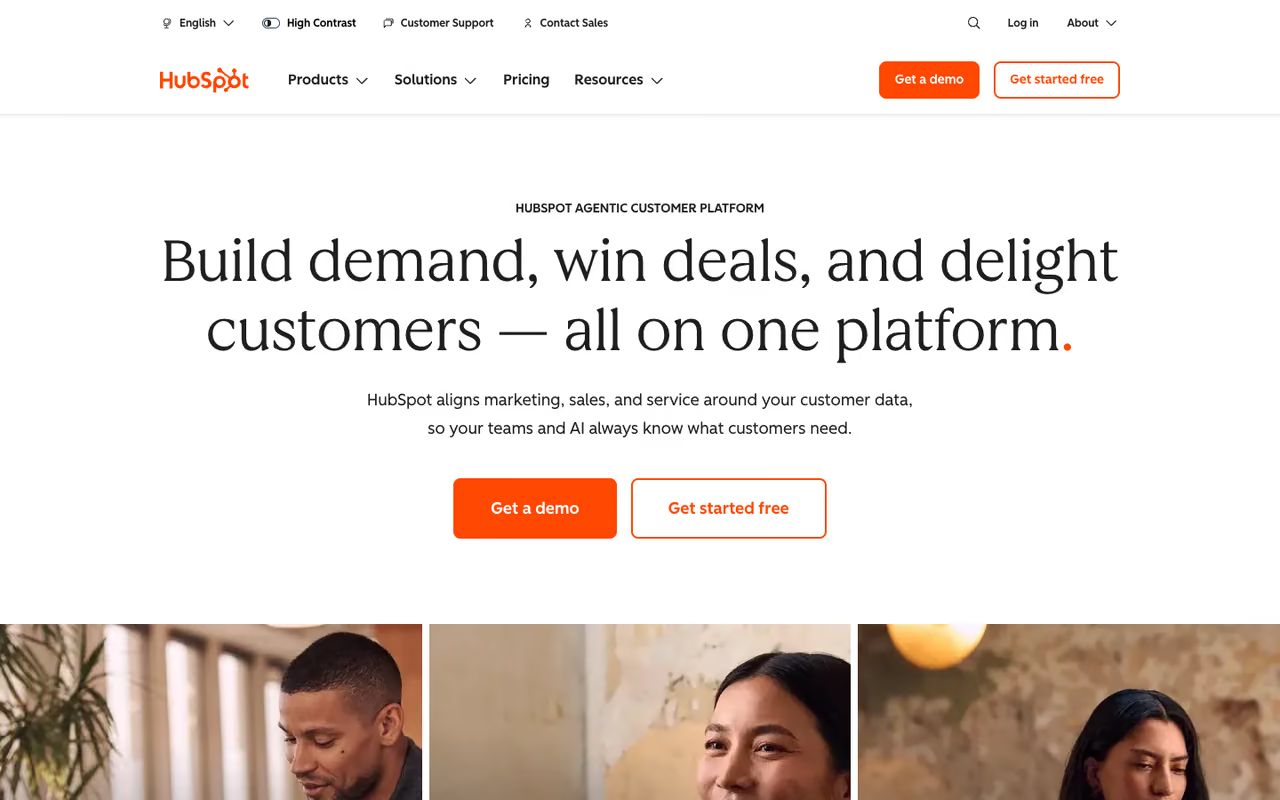
HubSpot Sales Hub is the tool I recommend first when a team has no idea where to start. It is a CRM, email tool, meeting scheduler, forecaster, and reporting layer in one, and the core CRM is free for unlimited users. You can run a real sales process on $0 longer than you would expect.
The safe default for SMB and mid-market teams that want sales and marketing under one roof without a Salesforce admin. The free CRM and clean interface make adoption easy, but the jump from $15 to $100 per seat for Professional is brutal.
The interface is the cleanest here, and reps stop fighting it within a day.
Pricing: the free tier covers basic deal tracking. Starter is $15/seat/month on an annual commitment ($20 month to month). Professional jumps to $100/seat/month for sequences, forecasting, and workflow automation, plus a one-time $1,500 onboarding fee. Enterprise runs $150/seat/month with predictive lead scoring and custom objects.
The standout: the on-ramp. You start free, add paid seats only for reps who need sequences, and never replatform. Everything connects to HubSpot's marketing side, so sales handoffs stop being a CSV export.
The catch: the jump from Starter to Professional is brutal. You go from $15 to $100 per seat the moment you need email sequences or proper forecasting, and the onboarding fee stings. A 10-rep team is at $12,000 a year before add-ons. Watch your seat math.

Pipedrive: the pipeline reps stop avoiding
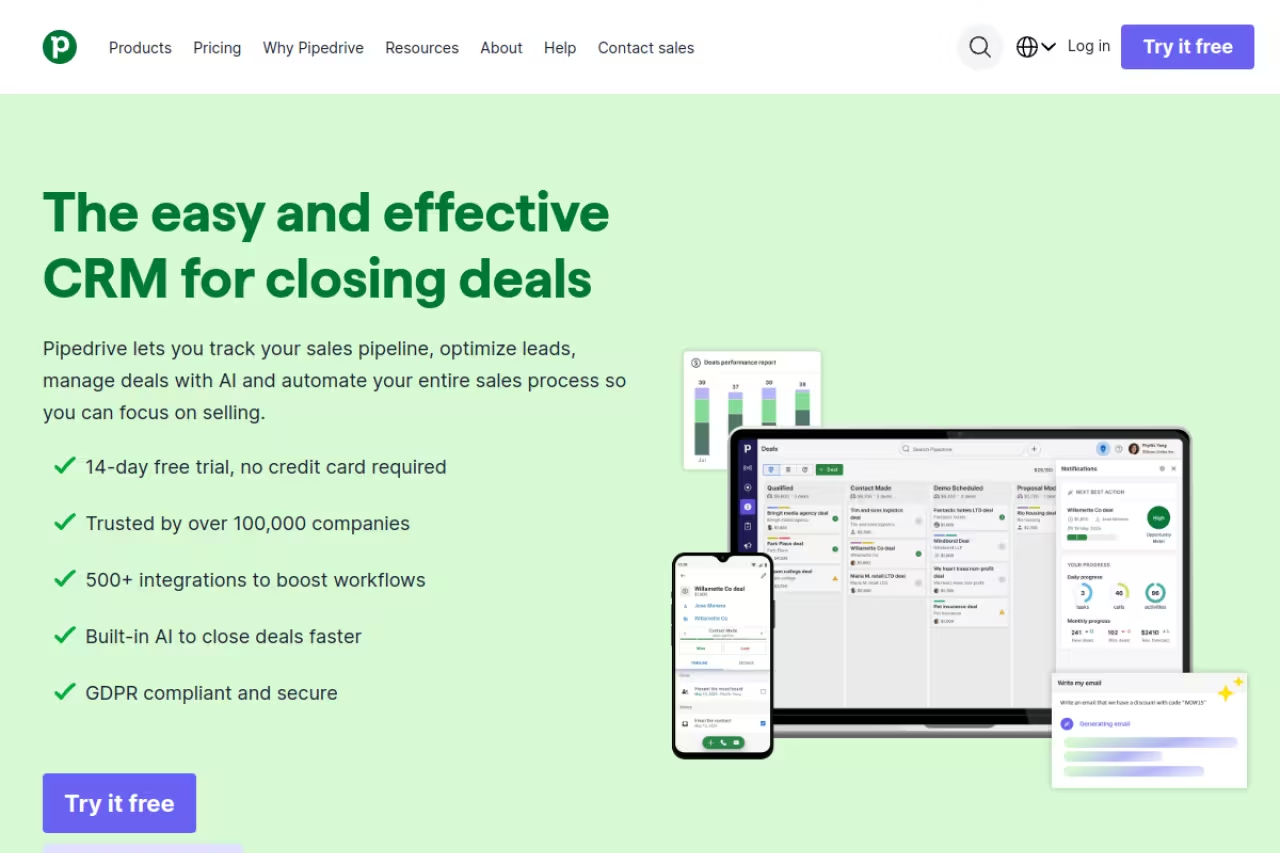
Pipedrive was built by salespeople tired of CRMs that punish you for selling. The whole product is organized around a drag-and-drop pipeline, and that single design choice is why adoption is so high. Reps see their deals, drag them forward, and the data gets logged as a side effect.
Pick Pipedrive if you run a sales-led SMB or outbound team and your last CRM died from nobody filling it in. Reps actually update the drag-and-drop pipeline, though reporting is shallow and you will outgrow it once you want marketing automation.
If your last CRM died from "nobody fills it in," Pipedrive is the antidote.
Pricing: four plans after the late-2025 rename. Lite is $14/user/month, Growth $24, Premium $49, and Ultimate $79, billed annually. Most teams land on Growth or Premium once they want email sync, automation, and the AI sales assistant.
The standout: speed to value. Import a contact list, build a pipeline, and have reps working in under an hour. No consultant required.
The catch: it is a sales CRM, not a platform. Reporting is decent but shallow next to Salesforce or HubSpot, and once you want marketing automation or deep customization, you outgrow it. Add-ons (LeadBooster, Campaigns, web visitors) also quietly inflate the bill.
Salesforce Sales Cloud: the enterprise standard, for better and worse
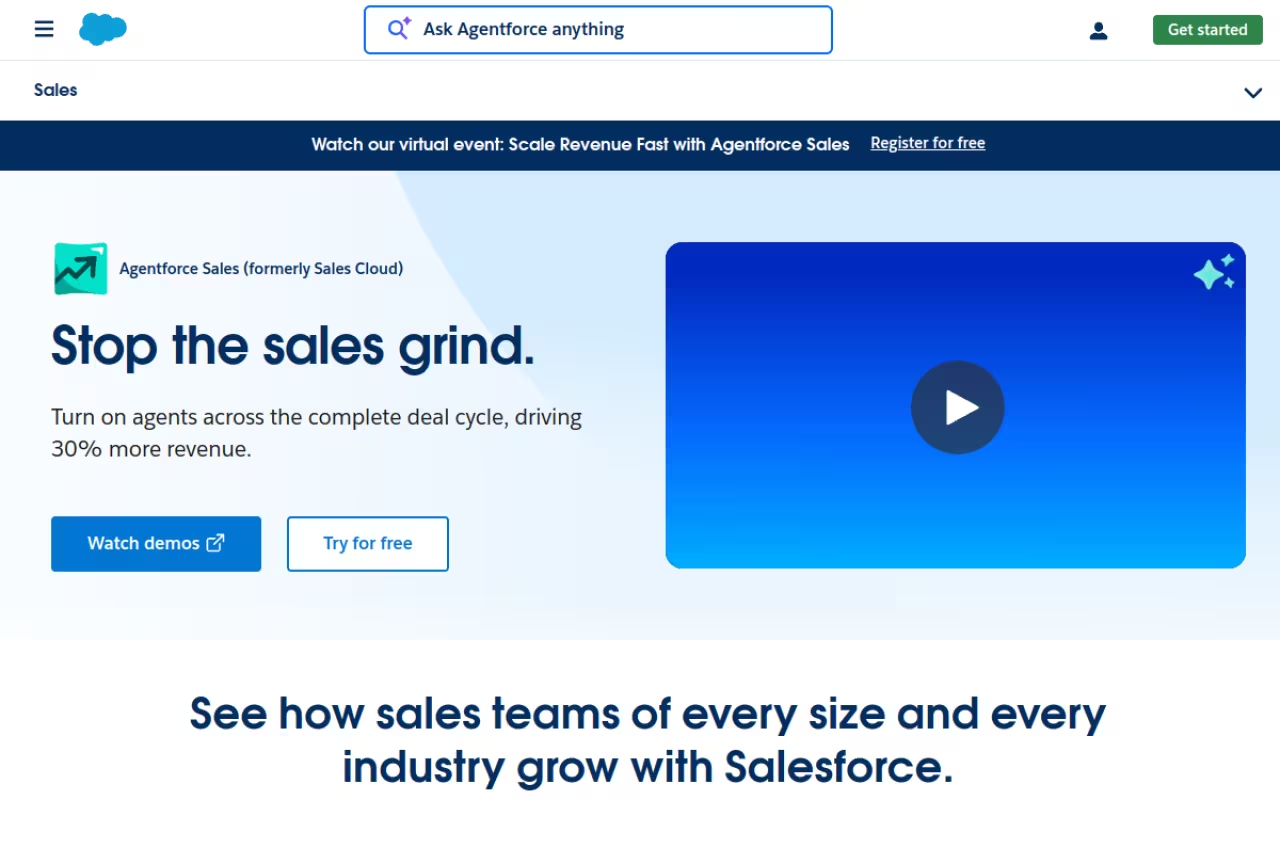
Salesforce Sales Cloud is the system of record big revenue orgs are built on. If your process has territories, complex approval rules, custom objects, and a RevOps team to maintain it, nothing else bends to your will the way Salesforce does. It can model almost any workflow you can describe.
The enterprise standard for orgs with over 50 reps, dedicated admins and a complex sales motion, and you will never outgrow it. Skip it if you are small: list price is only the start, and implementation can run from $50,000 into six figures.
Over 50 reps and a non-trivial sales motion, this is the safe long-term bet.
Pricing: five editions in 2026. Starter Suite is $25/user/month, Pro Suite $100, Enterprise $175, Unlimited $350, and the AI-forward Agentforce 1 Sales tier is $550, per user per month. Most growing orgs land on Enterprise at $175. Agentforce for Sales is also a $125/user/month add-on on lower editions.
The standout: ceiling. There is no scenario where you outgrow Salesforce. The AppExchange ecosystem and Agentforce agents mean almost any need has an answer.
The catch: it is overkill for small teams and expensive to run well. List price is the start, not the end. Implementation for a real org can run from $50,000 into six figures, and you will likely need an admin or partner on retainer. Buying Salesforce for a 5-person team is a classic mistake.

Close: built for teams that live on the phone
Close folds calling, email, SMS, and the CRM into one screen, which makes it the pick for inside-sales teams running high call volume. Instead of jumping between a dialer and your pipeline, a rep works a list, calls, logs, and moves on without switching tabs. That tight loop is the entire point.
Go with Close if your inside-sales or SDR team lives on the phone and runs volume outbound. The built-in power dialer can replace a separate tool, but it is narrow on purpose and real cost can climb past $150/rep/month.
Pricing: Solo is $19/user/month, Essentials $49, Growth $109, and Scale $149 per user, billed annually. Dialer minutes and Call Assistant are usage-based, so heavy callers should model the all-in number.
The standout: the power and predictive dialer. For a team smashing through call lists, the built-in calling alone can replace a separate phone tool, and the workflow is faster than a CRM bolted to a dialer.
The catch: it is narrow on purpose. If your motion is account-based, long-cycle enterprise selling rather than velocity calling, Close gives you less than HubSpot or Salesforce. Add the dialer tiers and premium phone lines and real cost can climb past $150/rep/month.
Attio: the CRM that finally feels modern
Attio is what a CRM looks like if you designed it in 2025 instead of 2005. It is AI-native, the data model is flexible like a spreadsheet-database hybrid, and it is genuinely fast. You shape objects, build views, and let it auto-enrich and route records. Startups that find Salesforce bloated and HubSpot rigid tend to land here.
A modern, fast and flexible CRM for startups, agencies and product-led teams that find Salesforce bloated and HubSpot rigid. The trade-off is that it is younger and lighter on sales-specific features veterans expect, like deep forecasting.
Pricing: a free tier covers up to 3 seats and 50,000 records. Plus is $29/user/month, Pro $69, and Enterprise is custom, billed annually. Pro adds call intelligence and advanced permissions. It uses a hybrid model: seats plus usage-based credits for AI features.
The standout: the data model and AI workflows. You can restructure how the CRM thinks about your business in an afternoon, and the automation feels native. If you care about building agentic sales workflows, this is the most pleasant base to build on.
The catch: it is younger and lighter on sales-specific features veterans expect, like deep forecasting or a mature dialer ecosystem. Usage-based credits also make spend less predictable than a flat per-seat tool. It rewards teams willing to configure it.

Apollo.io: prospecting database and CRM in one
Apollo.io blurs the line between a contact database and a CRM. You get a B2B database of contacts and companies, sequencing, a dialer, and a lightweight CRM in one tool, which is why outbound teams love it. Instead of paying for a data provider plus a sequencer plus a CRM, you get a serviceable version of all three.
Apollo suits outbound and SDR teams that want to find, sequence and track prospects in one place instead of paying for three tools. Heavy outbound burns credits fast, though, and as a primary CRM it is thinner than the dedicated platforms.
Pricing: Basic is $49/user/month, Professional $79, and Organization $119 per user (3-user minimum), billed annually. A free tier with limited credits lets you test it.
The standout: the all-in-one motion. For a small outbound team, replacing three subscriptions with one is real money saved, and data coverage is strong for most B2B segments. Pair it with one of our picks for AI sales prospecting tools and a single SDR covers a lot of ground.
The catch: the unified credit system. Heavy outbound burns credits fast, and overages plus locked features push real spend well above the sticker price. As a primary CRM it is thinner than the dedicated platforms, so larger orgs run it alongside HubSpot or Salesforce, not instead.

Gong: the truth serum for your pipeline
Gong is not a CRM. It is revenue intelligence: it records and transcribes every call, analyzes what was said, and surfaces deal risk, competitor mentions, and coaching moments managers would never catch manually. When a forecast slips, Gong often knows why before the rep admits it.
Buy Gong if you have 20+ reps and enough call volume to make call analysis and real forecasting pay back. It is revenue intelligence rather than a CRM, and the platform fee gates out small teams entirely.
Pricing: custom, and not cheap. Gong charges a platform fee (roughly $5,000 to $50,000 a year) plus per-user licenses, with all-in cost commonly landing around $150 to $250 per user per month. There is no self-serve tier.
The standout: signal. Conversation intelligence at this depth genuinely improves coaching, and the deal-risk alerts catch slipping deals early. Teams that adopt it properly keep it.
The catch: price and overlap. The platform fee gates out small teams entirely, and many orgs end up also paying for a forecasting tool like Clari, stacking $400 to $500 per rep across the two. Only buy it if you have the reps and call volume for the analysis to pay back.
Zoho CRM: the most CRM for the least money
Zoho CRM is the value play. It does most of what HubSpot and Salesforce do at a fraction of the price, with a full suite of business apps behind it if you ever want them. Not the slickest tool here, but for a team watching every dollar it punches well above its cost.
The value play for budget-conscious SMBs and teams already living in the Zoho ecosystem. You get automation, AI and custom modules at a fraction of Salesforce pricing, but you trade polish for price with a busier, less intuitive UI.
Pricing: Standard is $14/user/month, Professional $23, Enterprise $40, and Ultimate $52, billed annually. Enterprise unlocks the Zia AI assistant, predictive scoring, and custom modules. There is also a free tier for up to 3 users.
The standout: price-to-feature ratio. You get automation, AI, custom modules, and analytics for what Salesforce charges just to get in the door. If you already use Zoho Books or Desk, the integration is tight.
The catch: the experience. The UI is busier and less intuitive than HubSpot or Pipedrive, and the AI, while present, is not as sharp as the premium tools. You trade polish for price.
How to choose without overthinking it
Match the tool to your motion, not the marketing.
- Just starting or watching budget? HubSpot's free CRM or Zoho. Run a real process at near-zero cost and upgrade only when a feature blocks you.
- Sales-led SMB that wants adoption? Pipedrive. Reps update it because it is built around how they already think.
- High-volume calling? Close for the built-in dialer, or Apollo if you also need to source the contacts.
- Startup that wants to build, not work around limits? Attio.
- Enterprise with a real process and an admin? Salesforce, plus Gong once you have the call volume to justify it.
The most expensive mistake is buying for the company you hope to be in three years. Buy for the team you have now, and make sure reps will actually use it, because a CRM nobody updates is just a slow spreadsheet.
If your bottleneck is the work inside these tools rather than the tools themselves, an AI workspace like Dupple X can draft outreach, summarize calls, and prep account research before the CRM ever sees them. Start a yearly trial and point it at your pipeline.
Going deeper on the AI side of selling? Our guides to AI sales tools and AI SDR tools cover the layer that sits on top of your CRM, and how to use ChatGPT for sales is a good primer for reps. You can also browse our running list of top tools.
FAQ
What is the best sales management tool for a small team?
For most small teams, HubSpot Sales Hub is the best starting point: the core CRM is free for unlimited users and scales into a paid suite only when you need it. Want a simpler, pipeline-first tool reps adopt fast? Pipedrive at $14/user/month fits. Zoho CRM is the cheapest path to a full-featured CRM.
How much should a sales CRM cost per user?
Most SMB-focused sales CRMs land between $14 and $60 per user per month on annual billing. Entry tools like Pipedrive Lite and Zoho Standard start at $14. Mid-tier plans with automation and AI run $40 to $100. Salesforce Enterprise hits $175 and up, before implementation and add-ons that often double the real cost.
What is the difference between a CRM and a sales management tool?
A CRM is the database storing contacts, companies, and deals. A sales management tool wraps that data in the workflow a manager needs: pipeline stages, activity tracking, forecasting, and reporting. Most platforms here are both. Tools like Gong add a third layer, revenue intelligence, analyzing calls and deal health on top of your CRM.
Do I need both a CRM and a tool like Gong?
Only at scale. Revenue-intelligence tools pay back once you have roughly 20 or more reps and enough call volume to justify them. Below that, the platform fee and per-seat cost ($150 to $250 per user all-in) outweigh the benefit, and the call recording built into your CRM covers most of the gap.
Which sales tool is best for outbound prospecting?
Apollo.io is the strongest all-in-one because it combines a B2B contact database, sequencing, and a lightweight CRM starting at $49/user/month. Close is better if your outbound is phone-heavy, thanks to its built-in dialer. Many teams pair a prospecting tool with their main CRM rather than replacing it.
Is a free CRM good enough to start with?
Yes, for most early teams. HubSpot's free CRM supports unlimited users, Attio's free tier covers 3 seats and 50,000 records, and Zoho offers a free plan for 3 users. A free CRM works until you specifically need email sequences, advanced forecasting, or automation, then you upgrade the one feature blocking you.
Related guides
Some offers on this page may be paid placements or contain affiliate links.
Across our whole catalogue the median is $24 a month and 33% of tools advertise a free tier. Figures are the lowest recurring monthly price quoted in our own review of each tool, read on 2026-08-19. Full method and every category.
