
Best AI Evaluation Tools in 2026: 8 LLM Eval Platforms Compared

Key facts8 tools compared: Braintrust, Langfuse, Arize Phoenix, LangSmith, DeepEval, Ragas, Galileo…
- 8 tools compared: Braintrust, Langfuse, Arize Phoenix, LangSmith, DeepEval, Ragas, Galileo, Maxim AI
- Braintrust (best for: Eval-driven teams shipping to prod): Free, Pro $249/mo
- Langfuse (best for: Self-hosted, data ownership): Free OSS, Core $29/mo
- Arize Phoenix (best for: OTel-native open-source tracing): Free OSS
- LangSmith (best for: LangChain / LangGraph stacks): Free, Plus $39/seat/mo
Shipping an LLM feature feels great until a user pastes a screenshot of your chatbot confidently inventing a refund policy that doesn't exist. That's the moment most teams realize "it works on my prompts" is not a quality bar. You need evals: a repeatable way to score outputs, catch regressions before they hit prod, and prove a prompt change actually helped instead of quietly breaking three other cases.
The problem is the category exploded. Every observability vendor now ships an "evals" tab, every open-source repo claims to be the standard, and the pricing pages range from "free forever" to "talk to sales." I spent the last few weeks comparing pricing pages, docs, and public user reports on the main contenders to figure out which ones earn a place in your stack.
If you want the short answer: Braintrust is my top pick for teams that take evals seriously and want monitoring, experiments, and scoring in one connected loop. If you'd rather self-host and own your data, Langfuse is the open-source pick I keep coming back to. The rest of this guide covers when each of the eight tools below is the right call.
Quick comparison
| Tool | Best for | Price | Standout |
|---|---|---|---|
| Braintrust | Eval-driven teams shipping to prod | Free, Pro $249/mo | Monitoring + evals in one loop |
| Langfuse | Self-hosted, data ownership | Free OSS, Core $29/mo | MIT-licensed, full-featured free tier |
| Arize Phoenix | OTel-native open-source tracing | Free OSS | No proprietary lock-in |
| LangSmith | LangChain / LangGraph stacks | Free, Plus $39/seat/mo | Native LangChain integration |
| DeepEval | Python teams running evals in CI | Free OSS | Pytest-style assertions |
| Ragas | RAG pipeline scoring | Free OSS | Reference-free RAG metrics |
| Galileo | Hallucination-critical production apps | Free, Pro $100/mo | Luna-2 eval models |
| Maxim AI | Multi-agent simulation | Free, Pro $29/seat/mo | Agent simulation at scale |
Braintrust
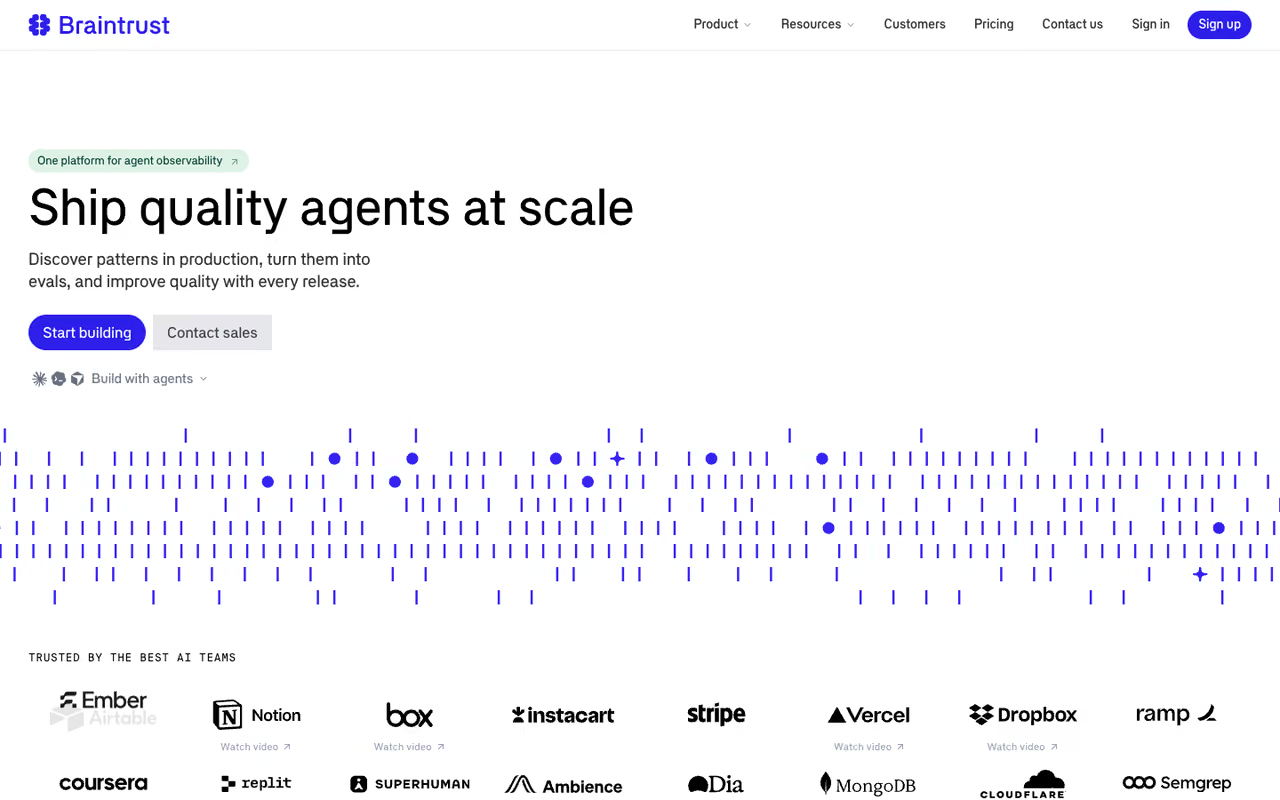
Braintrust takes the most opinionated stance in this whole category: observation and evaluation are the same job, so they should live in one workflow. You log production traces, turn the interesting ones into datasets, score them with code-based or LLM-as-judge graders, and gate deploys on the results. It's the tool I'd hand to a team that already knows what "good output" means and wants to enforce it.
Who it's best for: product teams with a real eval culture who want pre-deployment experiments wired into CI. It's used by Notion, Vercel, and Instacart, which tells you the workflow scales.
The tool for product teams with a real eval culture who want to enforce what good output means, with experiments wired into CI and deploys gated on scores. Score-based pricing surprises people, since the included 50,000 scores vanish fast on high traffic.
the free Starter tier gives you $10 in credits, 1 GB of processed data, and 10,000 scores with 14-day retention, which is enough to run a serious pilot. Pro is $249/month with 5 GB of data, 50,000 scores, and 30-day retention. Enterprise is custom with on-prem options.
The standout: the playground. You can fork a prompt, run it across a dataset against three models side by side, and see scores update live. It collapses the edit-test-compare loop into one screen.
The catch: the score-based pricing surprises people. If you're running per-request evals on high traffic, those 50,000 scores evaporate fast and overages add up. Budget for it before you turn on 100% sampling.

Langfuse
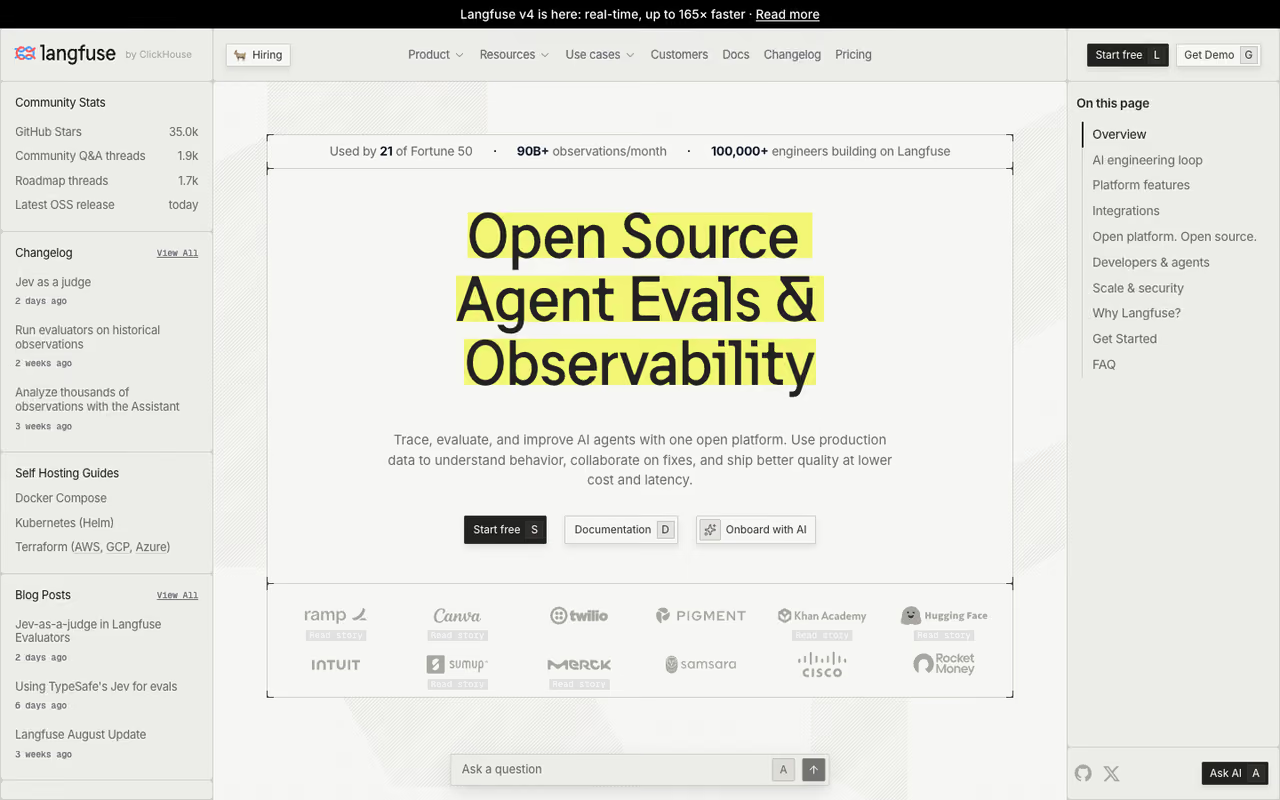
Langfuse is the open-source workhorse. It's MIT-licensed, you can self-host the whole thing with Docker Compose, and the free cloud tier is genuinely useful rather than a teaser. You get tracing, prompt management, datasets, custom scoring, and annotation queues without paying anything.
Who it's best for: teams that need data ownership, work in a regulated environment, or just don't want a usage meter running on every span. If "send our prompts to a third party" is a hard no from legal, start here.
The open-source workhorse for teams that need data ownership or work in regulated environments, with a free tier that supports the full eval workflow. Its LLM-as-judge evaluators are less polished than Braintrust's, and production self-hosting is real ops work.
the Hobby tier is free with 50,000 units per month and 30-day retention. Core is $29/month for 100,000 units and 90-day retention with unlimited users. Pro at $199/month adds SOC2, ISO27001, and HIPAA BAA. Self-hosting is free forever if you run the infra yourself.
The standout: the free tier supports the full eval workflow, not a crippled subset. Most "open core" tools hide scoring behind a paywall. Langfuse doesn't.
Where it falls short: the LLM-as-judge evaluators are less polished than Braintrust's, and self-hosting the production-grade setup (Postgres, ClickHouse, Redis, S3) is real ops work. The free cloud tier hides that complexity, but going on-prem means you own the cluster.
Arize Phoenix
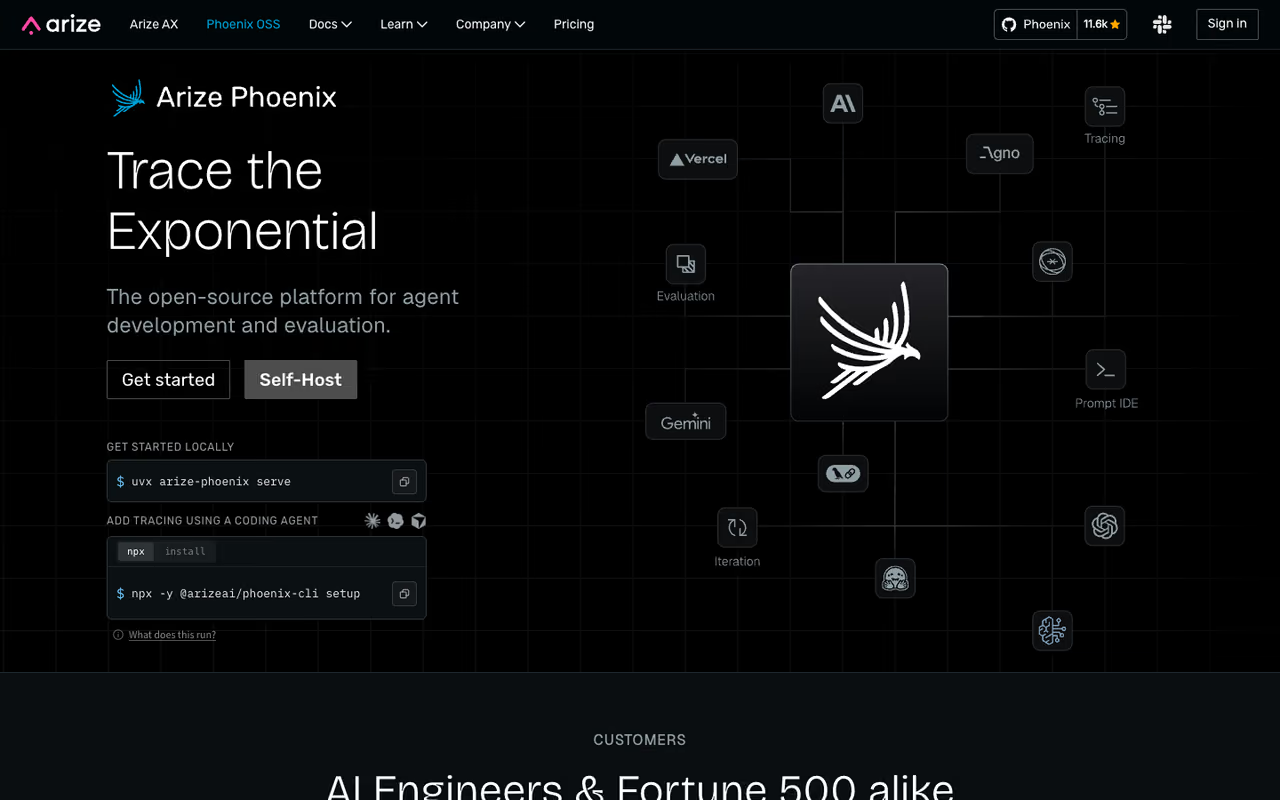
Phoenix is Arize's open-source tracing and eval tool, and its whole pitch is OpenTelemetry from the ground up. Your traces are standard OTel spans, so they work with the observability tools you already run. No proprietary format, no lock-in. If you've ever been burned by a vendor that owned your telemetry, that promise lands.
Who it's best for: teams running complex RAG pipelines who already think in spans and want root-cause debugging plus research-backed metrics like faithfulness, toxicity, and hallucination detection.
The open-source choice for teams running complex RAG pipelines who think in spans, with OpenTelemetry from the ground up and no lock-in. Self-hosting is free, but the bigger enterprise platform, AX, is sold separately.
the open-source project (ELv2 license, 9k+ GitHub stars) is free to self-host locally, in Docker, or on Kubernetes. Phoenix Cloud gives you two instances free, with paid tiers above that. For the bigger enterprise platform, Arize sells AX separately.
The standout: OTel-native means it slots into existing infra instead of replacing it. You instrument once and your traces flow everywhere.
The catch: the relationship between free Phoenix and paid Arize AX gets confusing. Phoenix covers a lot, but the heavier production monitoring and alerting features push you toward the commercial product, and that line isn't always obvious until you hit it.
If your evals are mostly about retrieval quality, pair this with a dedicated RAG stack. My best RAG tools guide covers the retrieval side in depth.

LangSmith
LangSmith is built by the LangChain team, and if your app already runs on LangChain or LangGraph, it's the path of least resistance. Tracing is basically automatic, the eval datasets feel native, and you don't fight an integration layer.
Who it's best for: anyone already deep in the LangChain ecosystem. The integration is so tight it's almost unfair to compare setup time against the others.
The path of least resistance if your app already runs on LangChain or LangGraph, with near-automatic tracing and native eval datasets. Outside that ecosystem the value drops sharply, and per-seat plus per-trace pricing gets expensive at scale.
the free Developer plan gives you 5,000 traces per month, one seat, 14-day retention. Plus is $39 per seat/month with 10,000 base traces included and overages at $2.50 per 1,000. Enterprise is custom.
The standout: zero-config tracing for LangChain apps. Flip a couple of env vars and every chain, tool call, and retrieval step shows up.
Where it falls short: the value drops sharply if you're not on LangChain. You can use the SDK directly, but then you're paying for an ecosystem tax without the ecosystem. The per-seat-plus-per-trace pricing also gets expensive at scale, which is the most common complaint I see.
For picking the framework underneath all this, see my best AI agent frameworks breakdown.

DeepEval
DeepEval is the open-source eval framework that feels like unit testing for LLMs. It's Apache 2.0, runs locally, and if you've written Pytest before, you already know how it works. You write assertions like assert_test(test_case, [HallucinationMetric(threshold=0.7)]) and wire them into CI.
Who it's best for: Python engineering teams that want evals as code, version-controlled in the repo, running on every pull request. This is the developer-first option.
Evals as code for Python teams, feeling like unit testing for LLMs and running on every pull request with prebuilt metrics. It is a library, not a product, so there is no dashboard for non-engineers, and LLM-as-judge scoring adds some run-to-run variance.
DeepEval the framework is free and open source under Apache 2.0. Confident AI, the managed platform from the same team, adds dashboards, collaboration, and production observability with a free tier plus paid plans for teams that need RBAC and dedicated support.
The standout: 14-plus prebuilt metrics (answer relevancy, faithfulness, hallucination, bias, toxicity) that drop straight into a Pytest suite. You get a real test harness without building scorers from scratch.
The catch: it's a library, not a product. There's no dashboard out of the box, so non-engineers can't poke at results. You also lean on LLM-as-judge for most metrics, which costs tokens and introduces some scoring variance run to run.
This is a natural fit if you're already shipping CI pipelines from my AI tools for developers roundup.

Ragas
Ragas defined the standard metrics for RAG evaluation, full stop. Faithfulness, context precision, and answer relevancy as a unified scoring system came out of this project, and most other tools borrowed the definitions. It's reference-free, so you don't need labeled ground truth to start scoring.
Who it's best for: anyone debugging a retrieval pipeline who wants to know whether the problem is bad retrieval or bad generation. It separates those two failure modes cleanly.
The reference for RAG evaluation, helping you tell bad retrieval from bad generation without labeled ground truth, and it is free with the lowest barrier here. It is purely a metrics library, so treat scores as directional and pair it with a tracing tool.
fully open source and free. Install it, import it, and you're running metrics in under ten lines of Python.
The standout: the lowest barrier to entry of anything here. It also generates synthetic test data from your own document corpus, so you can build an eval set without hand-writing questions.
Where it falls short: it's purely a metrics library. No UI, no dashboards, no experiment tracking, no production monitoring. The LLM-as-judge calls can return inconsistent scores between runs, so you treat the numbers as directional, not absolute. Most teams use Ragas for the metrics and pipe results into Langfuse or Phoenix for everything else.

Galileo
Galileo is the pick when hallucination is your primary failure mode and you can't afford to miss one. Its Luna-2 small models replace the usual LLM-as-judge pattern with distilled evaluators that hit similar accuracy at a fraction of the cost, which makes per-request evaluation on 100% of traffic actually affordable.
Who it's best for: production RAG and agent systems in domains where a wrong answer is expensive (finance, healthcare, legal support), and teams that want guardrails that block bad output before it ships, not just dashboards that report it after.
The pick when hallucination is your main failure mode and a wrong answer is expensive, with cheap small-model evaluators that make checking all traffic affordable and guardrails that block bad output. The agent metrics reflect Galileo's own view of agent behavior.
the free tier covers 5,000 traces per month with unlimited users and custom evaluations. Pro is $100/month (billed yearly) for 50,000 traces with RBAC and Slack support. Enterprise is custom with VPC and on-prem options.
The standout: Luna-2. Running evals with small purpose-built models instead of GPT-class judges means you can monitor every request without the token bill that usually makes 100% sampling a non-starter.
The catch: the agent-specific metrics (tool selection quality, action completion) are powerful but tuned for Galileo's view of how agents should behave. If your architecture is unusual, expect to spend time mapping your traces onto their model.

Maxim AI
Maxim AI goes wide on the agent problem: it combines experimentation, simulation, and observability for multi-agent systems in one place. The simulation piece is the differentiator. You define user personas and let it run hundreds of multi-turn conversations against your agent to surface edge cases manual testing never would.
Who it's best for: teams building conversational or multi-step agents who need to test trajectories, tool orchestration, and edge cases before real users find them. Companies like Klaviyo and ByteDance use it for exactly this.
Goes wide on agents, combining experimentation, simulation and observability, and its persona-driven simulation surfaces edge cases manual testing misses. It is overkill for single-turn scoring, where DeepEval or Braintrust will give you more value.
Developer is free with 10,000 logs per month. Professional is $29 per seat/month, Business is $49 per seat/month, and Enterprise is custom.
The standout: simulation at scale. Instead of writing test cases one at a time, you describe who your users are and Maxim generates the conversations, including the awkward ones that break agents.
Where it falls short: it's a lot of surface area. If you only need to score single-turn outputs, the simulation and multi-agent machinery is overkill, and you'll get more value from a leaner tool like DeepEval or Braintrust. The breadth is the point, but breadth has a learning curve.
If agents are your focus, my best AI agents guide pairs well with this.
How to choose
Match the tool to your actual constraint, not the longest feature list.
Data ownership is non-negotiable? Self-host Langfuse or Phoenix. Both are open source and run on your infra, and Langfuse's free tier gives you the full workflow if you'd rather start in the cloud.
You want one connected loop from prod logs to gated deploys? Braintrust. It's the most coherent end-to-end experience and worth the score-based pricing if your team will actually use the workflow.
You live in LangChain? LangSmith, no contest. The setup time you save pays for the per-seat cost.
Evals belong in CI as code? DeepEval for general LLM testing, Ragas if the system is RAG-heavy. Both are free and version-control cleanly.
Hallucination is the thing that gets you fired? Galileo, for the cheap per-request monitoring. Building multi-agent systems? Maxim, for the simulation.
A practical move: start with one open-source metrics layer (Ragas or DeepEval) plus one tracing platform (Langfuse or Phoenix), then graduate to a paid platform once you know which metrics you actually trust. You'll waste less money guessing.
If you're vetting AI tools like this regularly, our team curates the ones worth your attention in the Techpresso newsletter, and you can browse the wider set on our top tools page.
FAQ
What is an AI evaluation tool?
An AI evaluation tool measures the quality of an LLM application's outputs in a repeatable way. Instead of eyeballing a handful of prompts, you define metrics (faithfulness, relevancy, hallucination rate, tool accuracy), run them against a dataset, and get scores you can track over time. It's how you catch regressions before users do and prove a prompt or model change actually improved things.
What's the difference between LLM observability and evaluation?
Observability is about seeing what happened: tracing every step, span, and token in a request so you can debug. Evaluation is about judging whether what happened was good: scoring outputs against metrics or a reference. Tools like Braintrust and Galileo argue they should be one workflow, since you usually want to find a bad trace and then score it without switching tools.
Are open-source AI evaluation tools good enough for production?
Yes, for most teams. Langfuse, Arize Phoenix, DeepEval, and Ragas all run real production workloads. The trade-off is operational: self-hosting means you own the infrastructure (databases, scaling, uptime), and the LLM-as-judge metrics need some tuning to trust. Many teams run an open-source stack and only pay for a managed platform when collaboration or compliance demands it.
How much do AI evaluation platforms cost in 2026?
The good open-source frameworks (DeepEval, Ragas) are free. Hosted platforms have usable free tiers and paid plans that scale with usage: Langfuse Core is $29/month, LangSmith Plus is $39 per seat/month, Maxim Pro is $29 per seat/month, Galileo Pro is $100/month, and Braintrust Pro is $249/month. Watch for usage-based overages on traces and scores, which is where bills surprise teams.
Which AI evaluation tool is best for RAG applications?
Ragas defined the core RAG metrics and is the fastest way to score faithfulness, context precision, and answer relevancy. For tracing and root-cause debugging on top of that, pair it with Arize Phoenix or Langfuse. If you want managed hallucination guardrails for production, Galileo is built specifically for that failure mode.
Do I need an evaluation tool if I'm just prototyping?
If you're testing a quick idea, no. But the moment you have real users or you're tweaking prompts and can't tell if changes help or hurt, you need evals. Start with a free open-source library like DeepEval and a free tier on Langfuse. The cost of skipping evals shows up later as a confidently wrong output in front of a customer.
Related guides
Some offers on this page may be paid placements or contain affiliate links.
