
Best AI Trading Tools in 2026: 8 Platforms Compared

Key facts8 tools compared: Trade Ideas, TrendSpider, Composer, Tickeron, TradingView, 3Commas, Pionex…
- 8 tools compared: Trade Ideas, TrendSpider, Composer, Tickeron, TradingView, 3Commas, Pionex, Magnifi
- Trade Ideas (best for: Active day traders): $89-$178/mo
- TrendSpider (best for: Technical traders): $51-$321/mo
- Composer (best for: Hands-off automation): ~$32/mo (annual)
- Tickeron (best for: Signal followers): $80-$250/mo
Most "AI trading" tools are a chatbot bolted onto a chart, charging $200 a month for the privilege. A few are genuinely useful: they scan thousands of tickers in real time, backtest a strategy in seconds, or run a bot while you sleep. The gap between those two groups is enormous, and the marketing makes them sound identical.
I compared the main players side by side on pricing, features, and documentation across stocks and crypto. This is who they're for, what they actually cost, and where each one falls short. No tool here will print money for you. The good ones save you hours of screen time and stop you from fat-fingering a bad entry at 9:35am.
If you want one answer: for active US stock traders, Trade Ideas is still the strongest real-time AI scanner, and TrendSpider is the better pick if you live in charts and backtests. For hands-off automated portfolios, Composer wins on price and ease. Everything else below depends on what you trade.
Quick comparison
| Tool | Best for | Price | Standout |
|---|---|---|---|
| Trade Ideas | Active day traders | $89-$178/mo | Holly AI real-time signals |
| TrendSpider | Technical traders | $51-$321/mo | Automated backtesting |
| Composer | Hands-off automation | ~$32/mo (annual) | No-code strategy builder |
| Tickeron | Signal followers | $80-$250/mo | AI robots with track records |
| TradingView | Charting + alerts | Free-$239/mo | Best charts, huge community |
| 3Commas | Crypto automation | Free-$110/mo | DCA and grid bots |
| Pionex | Free crypto bots | Free (0.05% fee) | 16 built-in bots, no sub |
| Magnifi | Research and chat | Free-$11/mo | Plain-English investing Q&A |

Trade Ideas
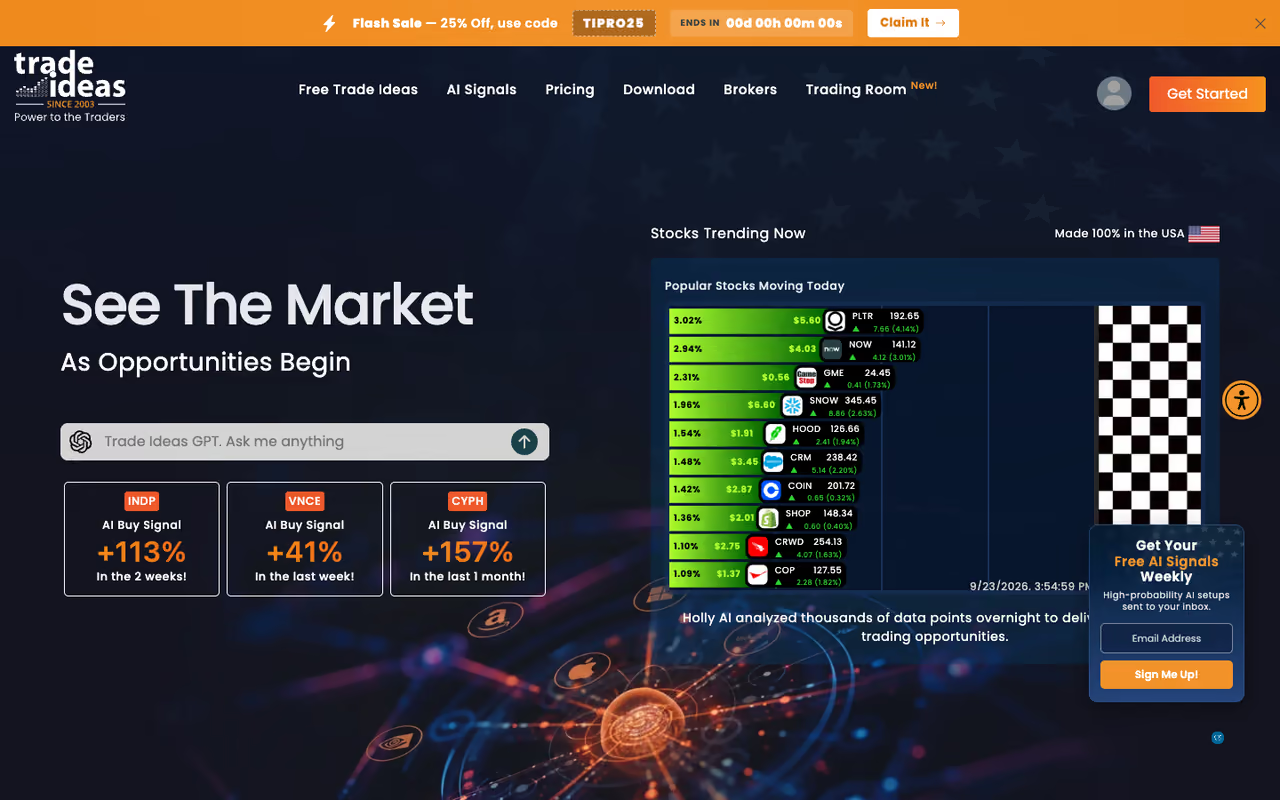
Trade Ideas is the closest thing to an AI co-pilot for day trading that I've found. Its engine, Holly, runs thousands of strategy simulations overnight and surfaces a shortlist of trade ideas for the next session, each with entry, stop, and target levels. During the day, the real-time scanner flags momentum, volume spikes, and unusual price action across the whole market.
The closest thing to an AI co-pilot for active equity traders watching screens during market hours. Holly's signals are genuinely useful, but the AI is locked behind the $178/month Premium tier, the interface looks dated, and it is overkill for occasional traders.
Pricing has two real tiers. TI Basic runs $89/month or $1,068/year, and gets you real-time data, charts, and paper trading. TI Premium is $178/month or $2,136/year and unlocks the Holly AI signals, backtesting, and risk levels, per their pricing page. The AI is locked behind Premium, so the cheaper plan is really just a scanner.
The standout is Holly. When the signals line up with a clean chart, the win rate feels meaningfully better than my own discretionary picks. It does not place trades for you by default, which I prefer.
The catch: it's expensive, the interface looks like it was designed in 2012, and Holly goes through cold streaks where she barely fires any signals for days. You're paying $2,000+ a year for an edge that's real but inconsistent. Overkill for anyone who trades a few times a month.

TrendSpider
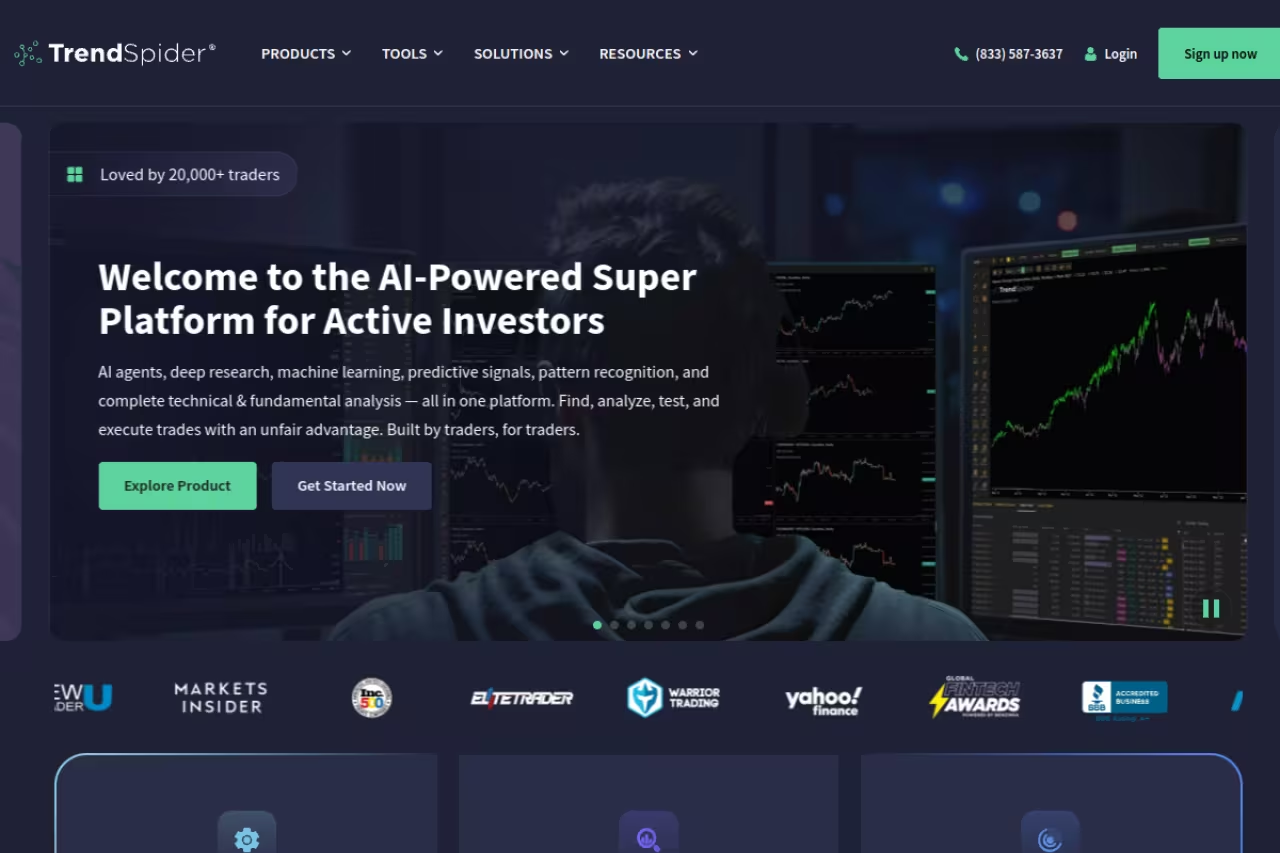
TrendSpider automates the tedious parts of technical analysis. It draws trendlines and support/resistance for you, detects chart patterns, and lets you build and backtest strategies without writing code. The "trading bots" feature can run a strategy and alert you, or route orders through a connected broker.
A solid pick for technical traders who want to backtest ideas properly instead of eyeballing charts. Backtesting alone can justify the cost, but expect a learning curve and a stingy AI allowance (25/month) on lower plans.
Pricing tiers run Standard, Premium, Enhanced, and Advanced. Standard starts around $82/month at list, Premium is $137, and Advanced jumps to $321/month, though their pricing page runs frequent promos that cut the first year by 30-40%. Every plan includes a monthly allowance of Sidekick AI messages and full charting.
The standout is backtesting. You can take a strategy idea, run it against years of data in seconds, and see real numbers before you risk a dollar. That alone justifies the cost if you actually trade your own systems.
Where it falls short: there's a real learning curve, and the AI message limit (25/month on lower plans) feels stingy once you start relying on it. The cheapest plan also caps your charting timeframe, which is annoying for intraday traders.
Composer
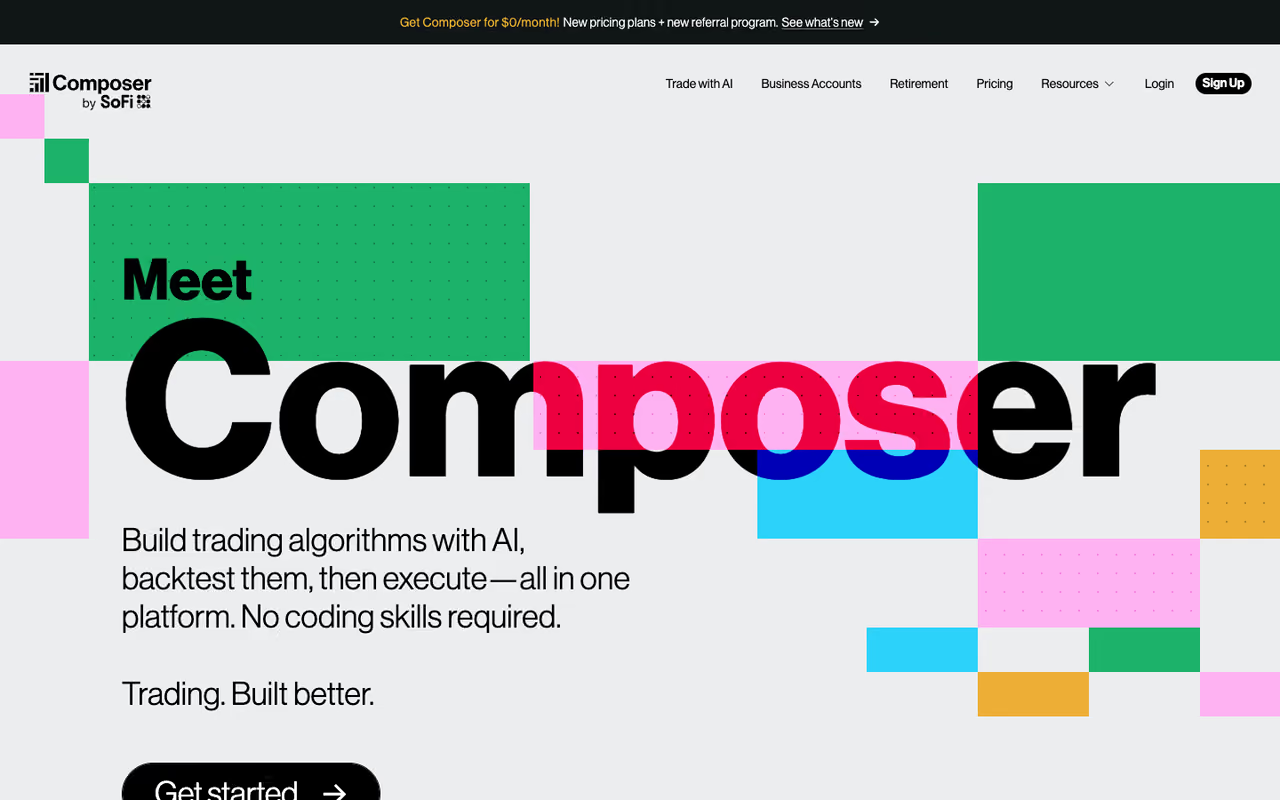
Composer is the one I'd hand to a friend who wants automation without learning to code. You describe a strategy, or build it with a drag-and-drop editor, backtest it, then deploy it to trade live through a connected brokerage account. There's an AI assistant that turns plain-English ideas into working strategies you can edit.
Best for busy people who want a rules-based portfolio running on autopilot, not someone glued to a five-minute chart.
Pick Composer if you want rules-based automation without learning to code. Going from idea to paper-running strategy took under an hour, but it is US brokerage only, and backtests always look better than real-world slippage.
Pricing is the friendly part. The automated trading plan lists around $32/month billed annually, and Composer routinely runs aggressive promos, plus a free tier and a 14-day trial. Compared to the $150+ tools above, it's a different universe.
The standout is how fast you go from idea to live, automated strategy. I had a momentum-rotation strategy backtested and paper-running in under an hour, with zero code.
The catch: it's symphonies and systematic strategies, not discretionary day trading. Backtests look gorgeous and real-world slippage never does, so treat past returns with suspicion. US brokerage accounts only, which rules out a lot of international readers.
If you're assembling a stack of AI tools for research and automation, our roundup of the best AI agents covers the broader autonomous-agent space worth pairing with this.
Tickeron
Tickeron leans hardest into the "AI robots" framing. It offers dozens of AI trading agents that generate daily buy/sell signals, plus a pattern search engine and trend prediction tools. Many robots publish audited-looking track records, which is rare and genuinely useful for setting expectations.
Suits traders who would rather follow signals than build systems, and who like seeing a robot's track record first. Transparency is the strength, while confusing tiers (up to $250/month) and cherry-picked best-case returns are the catch.
Pricing is tiered and confusing. Entry plans start around $80/month, swing-focused tiers sit near $90, and the day-trader tier runs up to $250/month. There's a separate crypto package around $35/month. Read the tier table carefully because each level limits which time frames and robots you can access.
The standout is transparency. Being able to see a robot's past performance and the time frame it trades beats the vague "our AI is amazing" claims everywhere else.
Where it falls short: the published returns are easy to misread (best-case robots get the spotlight), the pricing structure is a maze, and the platform throws a lot of overlapping tools at you. It feels designed to upsell. Verify any performance claim against the actual time frame before you trust it.
TradingView
TradingView isn't an AI bot, and that's exactly why it belongs here. It's the charting layer most serious traders already use, with the deepest indicator library, a scripting language (Pine Script) for custom strategies, and a massive community publishing ideas. AI features are arriving through integrations and alerts rather than a single "robot."
Not an AI bot, but the charting layer to build around if you want to bolt on AI tools and alerts from elsewhere. The charts are unmatched, though you wire up the AI yourself and the free plan's single-alert limit pushes you to pay.
TradingView raised prices in April 2026. There's a free plan, then Essential at $14.95/month, Plus at $34.95, Premium at $69.95, and Ultimate at $239.95, per current pricing. Most traders are fine on Essential or Plus.
The standout is the charting itself, which nothing else matches, plus alerts that can trigger webhooks to fire trades on connected platforms.
The catch: the AI here is what you wire up yourself, not a built-in scanner. If you want signals handed to you, this is the wrong tool. The free plan's single-alert limit pushes you to pay quickly.

3Commas
3Commas is a crypto automation hub. It connects to your exchange accounts and runs DCA bots, grid bots, and its SmartTrade order tool with trailing stops and take-profit ladders. It's more rule-based automation than pure AI, though it integrates TradingView signals to trigger bots.
A good fit for crypto traders automating DCA and grid strategies across multiple exchanges from one dashboard. Calling it AI is generous, and those bots can bleed in a strong trend, so it will not rescue a bad strategy.
There's a free plan for portfolio tracking on two accounts, then live bots start around $15/month billed annually, scaling up to the Expert tier near $110/month annually, per their pricing. A 7-day trial covers the paid tiers.
The standout is connecting several exchanges and running consistent bot logic across all of them, which manual trading can't match.
Where it falls short: calling it "AI" is generous, it's mostly smart automation. Grid and DCA bots can bleed badly in a strong trend against your position, and the tool won't save you from a bad strategy. The pricing tiers gate bot counts in ways that nudge you upward fast.
Pionex
Pionex takes a different angle: it's a crypto exchange with 16 trading bots built in for free. No subscription. You pay a flat 0.05% trading fee per order, maker or taker, which is lower than most exchanges. The grid bot and DCA bot are the headliners.
The budget route for crypto traders who want bots without a monthly subscription: 16 free bots and a flat 0.05% fee per order. The bots are simple and rule-based, and you are trusting the exchange with custody of your funds.
The pricing is the whole pitch: free bots, 0.05% per trade. Compared to subscription tools at $100+/month, the math is obvious for smaller accounts.
The standout is the grid bot in a ranging market. Set a range, let it buy low and sell high inside that band, and it quietly racks up small wins while sideways chop frustrates manual traders.
The catch: the bots are simple and rule-based, not adaptive AI. In a hard trend, a grid bot keeps buying into a falling asset, and you're holding bags. You're also trusting Pionex with custody of your funds, so size accordingly and don't park your life savings there.
Magnifi
Magnifi is the research-and-chat option. It's an AI investing assistant where you ask questions in plain English ("compare these two ETFs by expense ratio and 5-year return") and get clear answers with data, not a wall of jargon. It can connect to your brokerage accounts to give portfolio-aware suggestions.
A cheap, readable research layer for investors and part-time traders who want plain-English answers without a Bloomberg terminal. At around $11/month it is good value, but it is no execution engine, and you should double-check its numbers.
Pricing is gentle: there's a free version, and the paid tier sits around $11/month. For the value as a research layer, that's cheap.
The standout is how quickly it answers comparison questions. It collapses ten browser tabs of fund research into one conversation.
Where it falls short: it's an advisor and research tool, not an execution engine or signal generator. Don't expect day-trading alerts or automation. And as with any AI, double-check the numbers before acting on them, since it can present stale or wrong data confidently.
How to choose
Don't buy a stack. Start from how you actually trade.
If you day-trade stocks and want signals during market hours, Trade Ideas is the pick, with TrendSpider as the alternative if backtesting matters more than live alerts. Both are expensive, so only commit if you trade often enough to earn back $1,000+ a year.
If you want automation without watching screens, Composer for stocks/ETFs and Pionex or 3Commas for crypto. Composer wins on ease and price; Pionex wins if you want zero subscription.
If you mostly want better research and charts, TradingView for charting and Magnifi for plain-English answers. Cheap, no learning curve, and you can add AI signal tools later.
One rule across all of them: paper-trade first. Every AI tool here shows beautiful backtests, and live markets always perform worse than the simulation. Run any strategy on a paper account for a few weeks before risking real money. The tools that survive that test are the ones worth paying for.
If you're building a wider toolkit beyond trading, the Dupple top tools directory and our guide to the best AI tools for finance are good next stops, and Dupple X keeps you current on what's actually shipping in AI each week.
FAQ
What is the best AI trading tool in 2026?
For active US stock traders, Trade Ideas has the strongest real-time AI scanner thanks to its Holly engine. For technical traders who backtest, TrendSpider is the better fit. For hands-off automated portfolios, Composer offers the best mix of price and ease. The "best" tool depends entirely on whether you trade stocks or crypto and how active you are.
Can AI trading tools actually make money?
AI tools can improve your edge by scanning faster, backtesting strategies, and removing emotion from execution, but none of them guarantee profit. Backtests almost always outperform live results because of slippage and changing market conditions. Treat these tools as decision support, not money printers, and always paper-trade a strategy before going live.
Are there any free AI trading tools?
Yes. Pionex offers 16 crypto trading bots for free (you only pay a 0.05% trading fee). TradingView, Composer, Magnifi, and 3Commas all have free tiers, though the free versions are usually limited to one alert or basic tracking. Free tiers are a good way to test a platform before paying.
Do AI trading bots place trades automatically?
Some do, some don't. Composer, Pionex, and 3Commas can execute trades automatically once you connect a brokerage or exchange. Trade Ideas and TrendSpider focus on generating signals and alerts and only auto-trade if you explicitly connect a broker and enable it. Always start with alerts or paper trading before letting a bot touch live money.
How much should I spend on AI trading software?
It depends on how often you trade. Active day traders may justify $89-$321/month for Trade Ideas or TrendSpider if they trade most sessions. Casual investors should stay on free or sub-$15/month tools like TradingView Essential, Composer's lower tier, or Magnifi. A good rule: don't spend more on tools per month than you'd comfortably lose on a single bad trade.
Is AI trading legal and safe?
Using AI software to analyze markets, generate signals, and automate trades is legal in most countries, including the US. The risk isn't legal, it's financial: bad strategies lose money fast, and connecting bots to your funds means trusting the platform's security. Use reputable tools, enable two-factor authentication, never share API keys with withdrawal permissions, and size positions you can afford to lose.
Ready to keep up with the AI tools moving markets and everything else? Try Dupple X and get the signal without the noise.
Related guides
Some offers on this page may be paid placements or contain affiliate links.
