
Best AI Brand Monitoring Tools in 2026: 7 Platforms Compared

Key facts7 tools compared: Profound, Peec AI, Otterly.ai, Semrush, Scrunch AI, Brand24, Knowatoa
- 7 tools compared: Profound, Peec AI, Otterly.ai, Semrush, Scrunch AI, Brand24, Knowatoa
- Profound (best for: Enterprise and serious GEO teams): $499/mo
- Peec AI (best for: Mid-market value): €85/mo
- Otterly.ai (best for: Budget / first dip): $29/mo
- Semrush (best for: Teams already on Semrush): +$99/user/mo
A customer told me last month they found us through ChatGPT. Not Google. ChatGPT recommended us by name, in an answer, and they never typed our domain into a search bar. That is the whole game now, and most brands have no idea what these models say about them.
That is the problem AI brand monitoring tools solve. They run your prompts across ChatGPT, Perplexity, Gemini, Google AI Overviews, and Claude on a schedule, then tell you how often you get mentioned, which sources the models cite, where competitors beat you, and whether the sentiment is good or quietly terrible. OtterlyAI's 2026 research found that ChatGPT alone drives 56% of AI search referral traffic, with Gemini and Perplexity making up most of the rest. If you are not measuring that surface, you are flying blind on a channel that already sends real revenue.
This guide is for founders, marketers, and SEO leads who need to pick one without burning a quarter on demos. Short answer: Profound is the most complete platform if budget allows, Peec AI is the best value for mid-market teams (30% off for six months via our Peec link), and Otterly.ai is where to start if you just want to see the data without a big commitment. Here is the full breakdown.
Quick comparison
| Tool | Best for | Price (entry) | Standout |
|---|---|---|---|
| Profound | Enterprise and serious GEO teams | $499/mo | Conversation demand + deep citation data |
| Peec AI | Mid-market value | €85/mo | 6 engines, unlimited seats, clean analytics |
| Otterly.ai | Budget / first dip | $29/mo | Cheapest real entry point |
| Semrush | Teams already on Semrush | +$99/user/mo | Ties AI visibility to existing SEO data |
| Scrunch AI | Enterprise optimization | ~$300/mo | Fixing what AI gets wrong, not just tracking |
| Brand24 | Social listening + AI crossover | ~$99/mo | Classic mentions plus a native AI dashboard |
| Knowatoa | Solo founders / testing | Free tier | No-cost way to see how AI describes you |

Profound
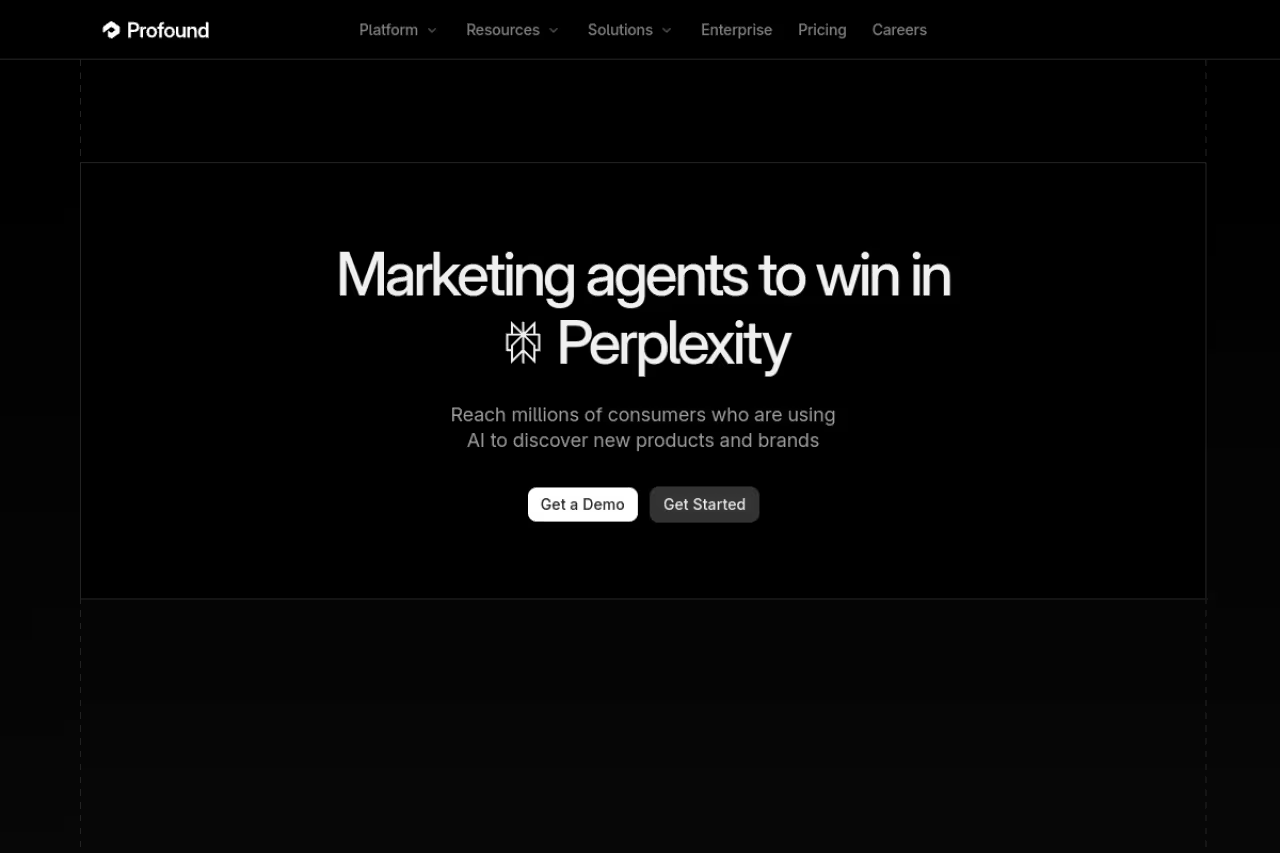
Profound is the tool the enterprise crowd keeps naming, and once you look at what it does, it's clear why. It does not just count mentions. It pulls conversation demand data (what people actually ask AI in your category), maps which URLs the models cite when they answer, and breaks visibility down by platform so you can see that you are strong in Perplexity but invisible in Gemini.
The enterprise choice for brands treating AI search as a real channel, with citation and conversation analytics that show exactly which pages models pull from. It is expensive and the Lite tier is thinner than the marketing implies, so a small startup should skip it.
Pricing: the self-serve Lite plan starts at $499/month with 3 seats, unlimited domains, and roughly 24,000 responses analyzed monthly. Enterprise contracts run $2,000+/month. Profound raised a Series C at a reported $1B valuation in February 2026, so they are pushing hard upmarket.
The standout is the citation and conversation analytics. Knowing the exact pages ChatGPT pulls from to describe your category is the difference between guessing at content and knowing what to write.
The catch: it is expensive, and the Lite tier is thinner than the marketing implies. Reviewers note Lite leans heavily on ChatGPT coverage with fewer features than the demo suggests. For a five-person startup this is overkill. For a brand spending real money on content, it pays for itself fast.

Peec AI
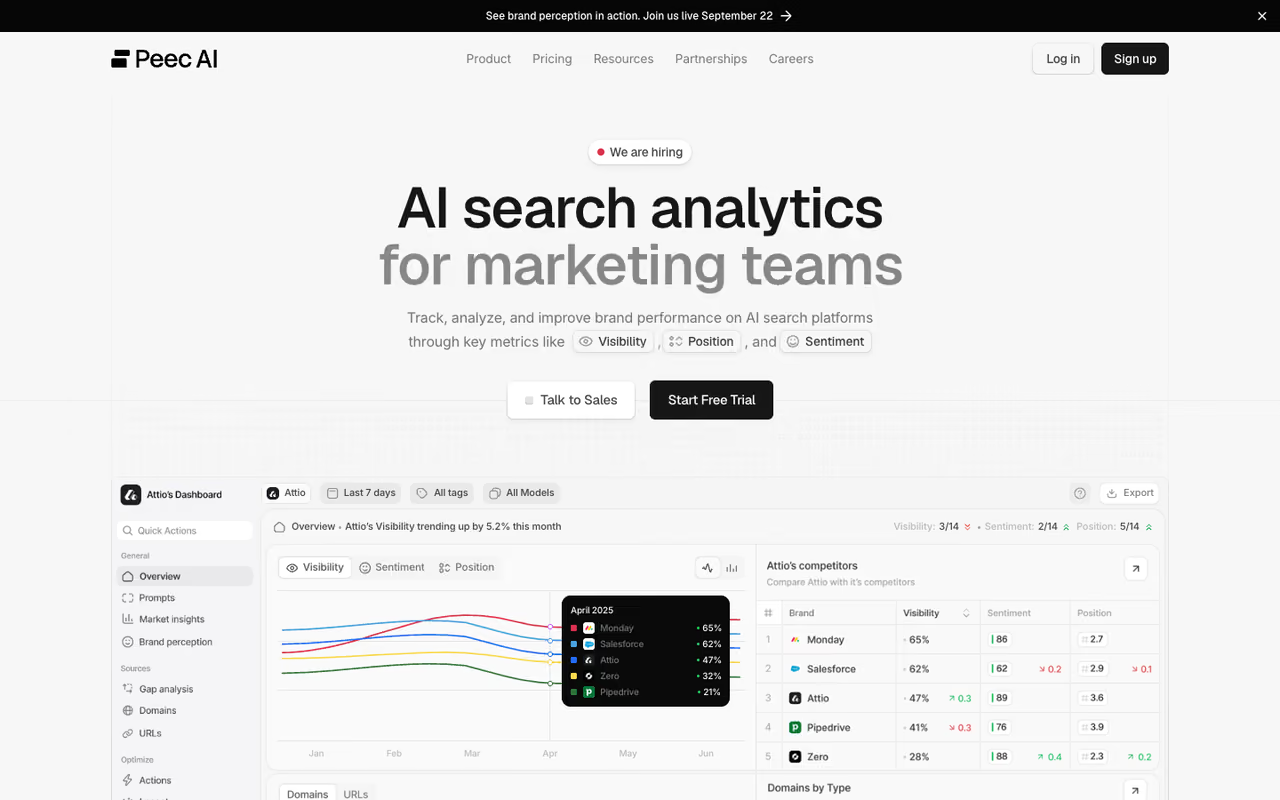
Peec AI is the value pick in this set. It tracks six engines (ChatGPT, Perplexity, Gemini, Google AI Mode, Copilot, and more on higher tiers), separates explicit brand mentions from source citations, and ships clean analytics with a Looker Studio connector. The interface is the kind you actually want to open on a Monday.
The value pick for mid-market SEO and marketing teams, with unlimited seats and URL-level insights across multiple engines. The per-model add-ons add up if you want full coverage, and multi-brand agencies should price the new per-brand model carefully.
Pricing: Starter runs €85/month, Pro €205/month, and Advanced €425/month, with yearly billing saving up to 15%. Every plan includes unlimited seats, which is rare and genuinely useful when the whole team wants access. Each plan includes three AI models, and extra models are add-ons (around +€30 to +€140/month depending on tier).
The standout is the seat policy combined with URL-level insights. You can hand logins to your whole content team at no extra cost and still see which specific pages drive your mentions.
Where it falls short: the per-model add-on math gets annoying. If you want to track six engines properly you are stacking add-ons, and Peec recently moved to a per-brand model with separate agency tiers, so multi-brand agencies should price it carefully before committing.

Otterly.ai
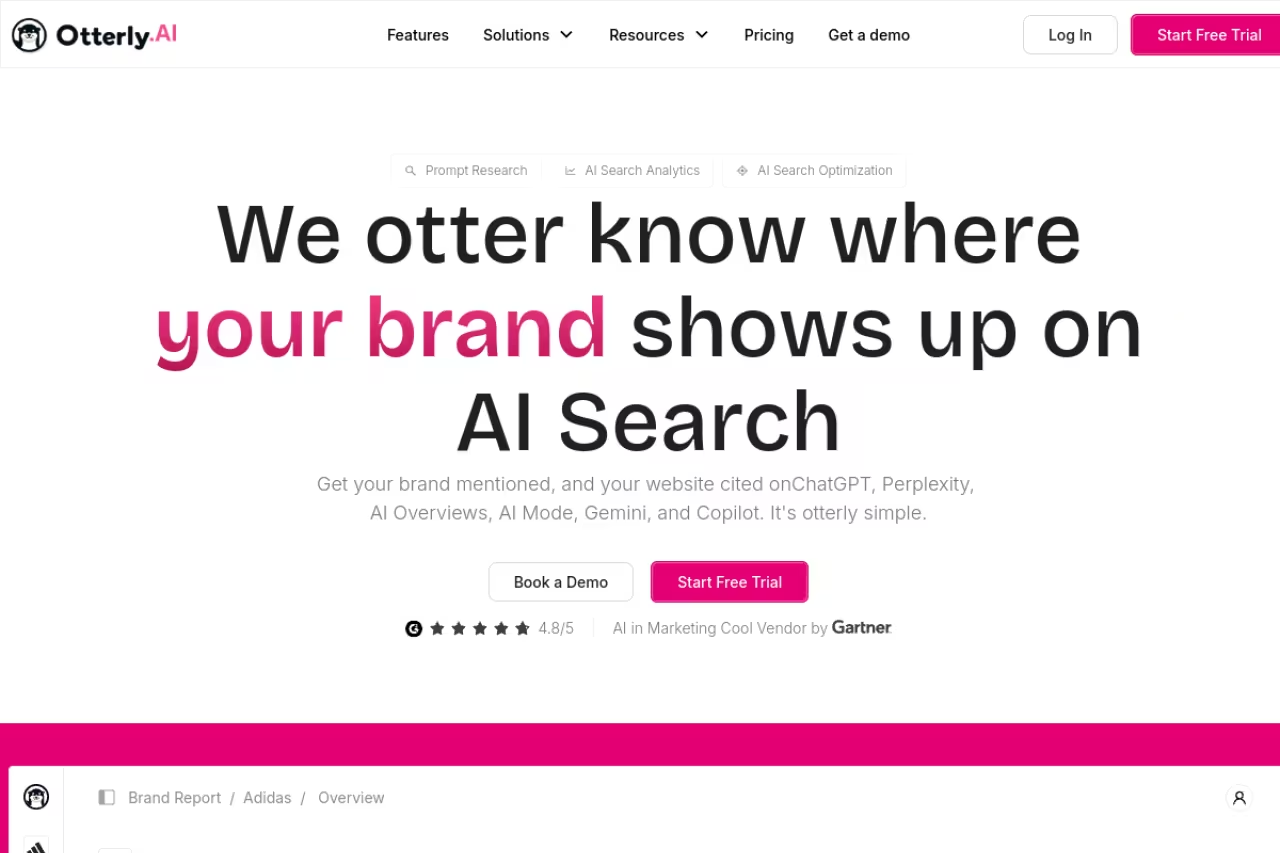
Otterly.ai is how I tell people to start. At $29/month it is the cheapest credible entry point in the category, and it covers the four engines that matter most for the price: ChatGPT, Google AI Overviews, Perplexity, and Microsoft Copilot. You get daily tracking and unlimited team members even on the bottom tier.
Where I tell people to start: the cheapest credible entry point, with daily tracking across the four engines that matter most. The 15 prompts on Lite vanish fast, and the jump to Standard makes the value thinner against Peec.
Pricing: the Lite plan is $29/month for 15 prompts, Standard is $189/month for 100 prompts (adds API access and the Looker Studio connector), and Premium is $489/month for 400 prompts. Annual billing saves about 15%. Google AI Mode and Gemini are paid add-ons rather than included, which is the main thing to watch.
The standout is the price-to-data ratio. For less than a single team Netflix plan you get a genuine read on where you stand, plus a Semrush integration that is handy if you already live in that ecosystem.
The catch: 15 prompts on the Lite plan disappears fast. A real brand has dozens of questions worth tracking, so most teams outgrow Lite within a month and jump to the $189 Standard tier, where the value gets thinner against Peec.

Semrush AI Visibility
If your team already runs Semrush for SEO, adding AI visibility there is the path of least resistance. The AI Visibility Toolkit bolts onto your existing account and lets you compare traditional rankings and AI mentions in one place, which matters because the two are increasingly linked. Pages that rank well also tend to get cited by AI.
The path of least resistance if your team already pays for Semrush, putting rankings and AI mentions side by side in one login. As a pure AI monitor it is less focused than Peec or Profound, and it makes little sense as a standalone purchase.
Pricing: the AI Visibility Toolkit is $99 per user on top of your base Semrush subscription. The bundled Semrush One plans start at $199/month (Starter, 50 tracked prompts), $299/month (Pro+), and $549/month (Advanced, 200 prompts and share-of-voice). Enterprise AIO is custom-quoted.
The standout is consolidation. Seeing your organic keyword data and your AI citation data side by side helps you connect the dots that standalone trackers miss.
Where it falls short: as a pure AI monitor it is less focused than Peec or Profound, and the add-on-per-user pricing climbs quickly for bigger teams. If you are not already on Semrush, buying the whole platform just for AI tracking makes little sense.

Scrunch AI
Scrunch AI is less about counting mentions and more about fixing what AI gets wrong. It tracks your presence across ChatGPT, Perplexity, Claude, Gemini, Google AI Mode, and Meta AI, then flags when models pull from outdated, incorrect, or misleading sources about your company. It also offers an "agent experience" layer that serves an AI-optimized version of your site to bots. The company is backed by $19M in venture funding and serves brands like Lenovo and SKIMS.
Aimed at enterprise brands that want to fix what AI gets wrong, flagging outdated or incorrect sources and serving bots an optimized site version. The price and focus point at large companies, so a startup wanting share of voice will find it heavy.
Pricing: entry sits around $300/month, with the Pro tier climbing toward $1,000/month. This is firmly an enterprise spend.
The standout is misinformation detection. If a model is confidently describing your pricing or features wrong, that is a bigger fire than a low mention rate, and Scrunch is built to catch it.
The catch: the price and the focus both point at large companies. A startup that just wants to know its share of voice will find this heavier and pricier than it needs.
Brand24
Brand24 comes at this from the social listening side, and that is its angle. It already monitors 25 million sources across 108 languages for classic brand mentions, and it has added an AI visibility dashboard plus a GPT-powered Brand Assistant that summarizes sentiment and suggests responses. If you want one tool covering both social chatter and AI answers, this is the closest thing.
A good fit for brand and PR teams that want social listening and an AI visibility layer in one subscription, covering Reddit, news and reviews. The AI tracking is newer and less granular than dedicated GEO tools.
Pricing: plans run roughly $99/month (Individual) to $249/month (Pro), with custom enterprise pricing above that. All plans include a 14-day trial, and annual billing cuts the cost meaningfully.
The standout is breadth. You get Reddit, news, reviews, and social mentions plus an AI dashboard in a single subscription, which is efficient if reputation is your job.
Where it falls short: the AI-specific tracking is newer and less granular than dedicated GEO tools. If your only goal is precise citation and prompt-level data across LLMs, a purpose-built tracker will go deeper.
Knowatoa
Knowatoa earns its spot because it has a genuinely useful free tier. Type your URL into the homepage and it runs a free audit showing how AI models describe and rank you right now. The paid product tracks mentions, rankings, sentiment, and citations across ChatGPT, Claude, Perplexity, Gemini, and more, with daily updates, and it includes an AI Search Console that checks whether bots like GPTBot and PerplexityBot can actually crawl your site.
A smart first look for solo founders and small teams, since the free audit shows how AI models describe you now, plus a bot-access check most trackers skip. Free and lower tiers are limited, so growing brands will graduate to Peec or Profound.
Pricing: there is a free plan, with paid tiers scaling up from there. That free entry point is the draw.
The standout is the bot-access check. Plenty of sites are invisible to AI not because of bad content but because their robots rules block the crawlers. Knowatoa surfaces that in a way most trackers skip.
The catch: the free and lower tiers are limited in prompt volume and depth. It is a great first look, but a growing brand will graduate to Peec or Profound for serious reporting.
How to choose
Start with budget and team size, not features. There are three honest paths.
If you are testing the waters or running solo, start free or cheap. Run Knowatoa's free audit, then put $29/month into Otterly to get real tracking going. You will learn more in two weeks of data than in a month of reading guides like this one.
If you are a mid-market team that has decided AI search matters, go to Peec AI. The unlimited seats, six-engine coverage, and clean analytics hit the sweet spot for most companies, and €85 to €205/month is defensible spend.
If you are enterprise with budget and a content team, Profound is the most complete platform, and Scrunch is the pick if your priority is fixing misinformation rather than just measuring share of voice. If you already live in Semrush, add its toolkit before buying a second tool.
One more filter: check which engines each tool covers natively versus as paid add-ons. Several tools advertise broad coverage but charge extra for Gemini or Google AI Mode, and those two are not optional in 2026.
Whichever you pick, monitoring is only half the work. The other half is fixing what you find, which is the discipline of generative engine optimization. If your data shows you are invisible, that is a content and citation problem to solve, not just a number to watch. We dig into the why behind low AI visibility in why your brand isn't showing up in AI search, and the team that keeps up with these shifts reads Techpresso every morning for the moves that matter.
FAQ
What is the best AI brand monitoring tool in 2026?
For most teams, Peec AI offers the best balance of coverage, analytics, and price at €85/month with unlimited seats. Profound is the strongest enterprise option if budget allows, and Otterly.ai at $29/month is the best cheap starting point. The right pick depends on your team size and how seriously you are treating AI search as a channel.
How much do AI brand monitoring tools cost?
Pricing ranges widely. Entry-level tools like Otterly start at $29/month, mid-market platforms like Peec AI run €85 to €425/month, and enterprise tools like Profound and Scrunch AI start around $300 to $499/month and climb past $2,000/month for full contracts. Knowatoa offers a free tier to test the concept first.
Which AI platforms should a brand monitoring tool track?
At minimum, ChatGPT, Perplexity, Google AI Overviews, and Gemini, since these drive the bulk of AI referral traffic. Strong tools also cover Microsoft Copilot, Google AI Mode, and Claude. Watch out for tools that charge extra add-on fees for Gemini or Google AI Mode, because those engines are too important to skip in 2026.
Is AI brand monitoring the same as SEO?
No, though they overlap. Traditional SEO targets ranked links in Google. AI brand monitoring measures how often models mention and cite you inside generated answers, where there are no blue links to click. Pages that rank well often get cited by AI too, so the disciplines feed each other, but you need dedicated tools to see the AI side. See our guide to AI SEO tools for how the two connect.
Can I track my brand in ChatGPT for free?
Partly. Knowatoa offers a free audit and free tier that shows how AI models currently describe you, and you can always ask ChatGPT or Perplexity directly to see a snapshot. But manual checks do not scale or run on a schedule, so paid tools exist to track dozens of prompts daily across engines and alert you when something changes. For more on tracking specific engines, see AI search visibility for ChatGPT and Perplexity.
Related guides
Some offers on this page may be paid placements or contain affiliate links.
Across our whole catalogue the median is $24 a month and 33% of tools advertise a free tier. Figures are the lowest recurring monthly price quoted in our own review of each tool, read on 2026-08-19. Full method and every category.
