
The 8 Best AI Agent Frameworks in 2026

Key facts8 frameworks compared: LangGraph, OpenAI Agents SDK, CrewAI, Pydantic AI, Google ADK…
- 8 frameworks compared: LangGraph, OpenAI Agents SDK, CrewAI, Pydantic AI, Google ADK, Microsoft Agent Framework, Claude Agent SDK, LlamaIndex
- LangGraph (best for: Stateful, production-grade workflows): Free (MIT); paid hosting
- OpenAI Agents SDK (best for: Fast multi-agent apps on OpenAI): Free, pay for tokens
- CrewAI (best for: Role-based agent teams, quick start): Free tier; $25/mo Pro
- Pydantic AI (best for: Type-safe agents, FastAPI shops): Free (open source)
A year ago, picking an agent framework felt like betting on a coin flip. Half the projects were abandoned by the time you finished reading their docs. That has changed. GitHub repos for agent frameworks grew over 500% between 2024 and 2025, and the survivors have hardened into real tools that run in production at Klarna, Uber, and LinkedIn.
The problem now is the opposite one: too many credible choices. LangGraph, CrewAI, the OpenAI Agents SDK, Pydantic AI, Google's ADK, and Microsoft's freshly merged Agent Framework all want to be the layer you build on. Some are graph engines for stateful workflows. Some are five-line wrappers for a quick multi-agent demo. Picking wrong means a rewrite three months in.
I compared the docs, production write-ups, and GitHub activity for most of these. If you want the short answer: LangGraph is the one to reach for when something has to survive real users, edge cases, and a compliance review. But it's overkill for a weekend prototype, and the rest of this list exists because "best" depends entirely on what you're shipping. This is for engineers and technical founders who are past the demo stage and need to choose something they won't regret.
One newer name worth watching is Hermes Agent, Nous Research's open-source agent that keeps a single persistent memory across Telegram, Slack, email, and the CLI.
Quick comparison
| Framework | Best for | Price | Standout |
|---|---|---|---|
| LangGraph | Stateful, production-grade workflows | Free (MIT); paid hosting | Checkpointing + time-travel debugging |
| OpenAI Agents SDK | Fast multi-agent apps on OpenAI | Free, pay for tokens | Handoffs + built-in tracing |
| CrewAI | Role-based agent teams, quick start | Free tier; $25/mo Pro | Readable crews in a few lines |
| Pydantic AI | Type-safe agents, FastAPI shops | Free (open source) | Typed inputs, tools, and outputs |
| Google ADK | Multimodal + Gemini, GCP deploys | Free (open source) | Native A2A + Vertex deployment |
| Microsoft Agent Framework | Enterprise .NET / Azure | Free SDK; Azure costs | AutoGen + Semantic Kernel merged |
| Claude Agent SDK | Coding agents, Anthropic stack | Free SDK; usage credits | Same harness as Claude Code |
| LlamaIndex | RAG-first agents over your data | Free OSS; paid cloud | Best-in-class retrieval |
LangGraph
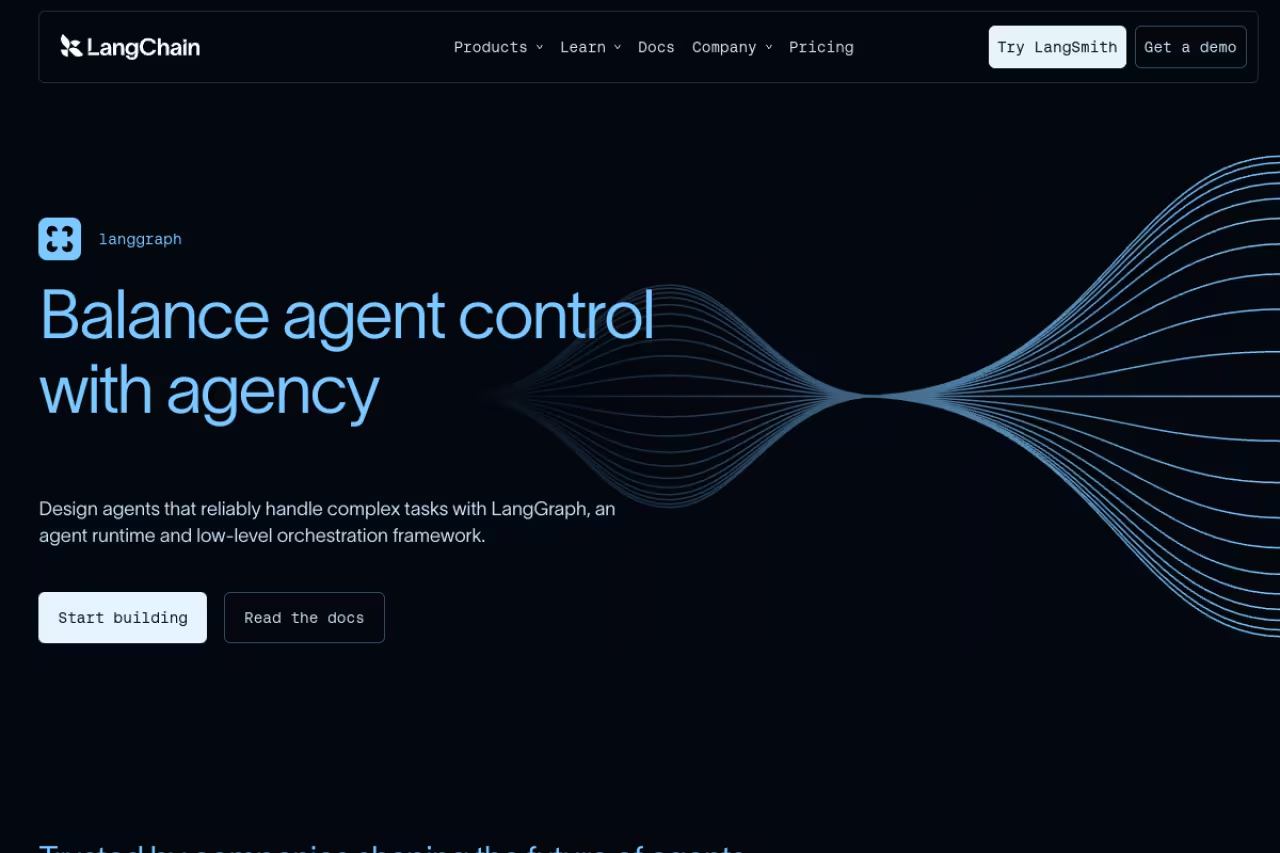
LangGraph models your agent as a directed graph: nodes are steps, edges are transitions, and a shared state object travels through the whole thing. That sounds academic until you hit a real bug at 2am and realize you can replay the exact run, inspect the state at every node, and rewind to the step that went wrong.
The choice for stateful, long-running agents that pause for human approval or coordinate sub-agents, with checkpointing and time-travel debugging. The learning curve is steep, and it is more ceremony than a three-tool-call agent needs.
The docs confirm it's MIT-licensed and free, with a paid hosted layer (LangGraph Platform) if you want managed deployment and the LangSmith observability stack on top.
The standout is durability. Checkpointing means an agent can crash, get redeployed, and resume mid-task instead of starting over. Time-travel debugging lets you fork a run from any past state. Production teams care about this more than they care about elegant syntax, which is why it shows up in deployments at Klarna and LinkedIn with tens of millions of monthly downloads.
The catch: the learning curve is steep. You're writing graph definitions and reasoning about state reducers before you get a "hello world" agent running. For a simple linear task, it's more ceremony than the job needs. If your agent is three tool calls in a row, you don't need a state machine.
OpenAI Agents SDK
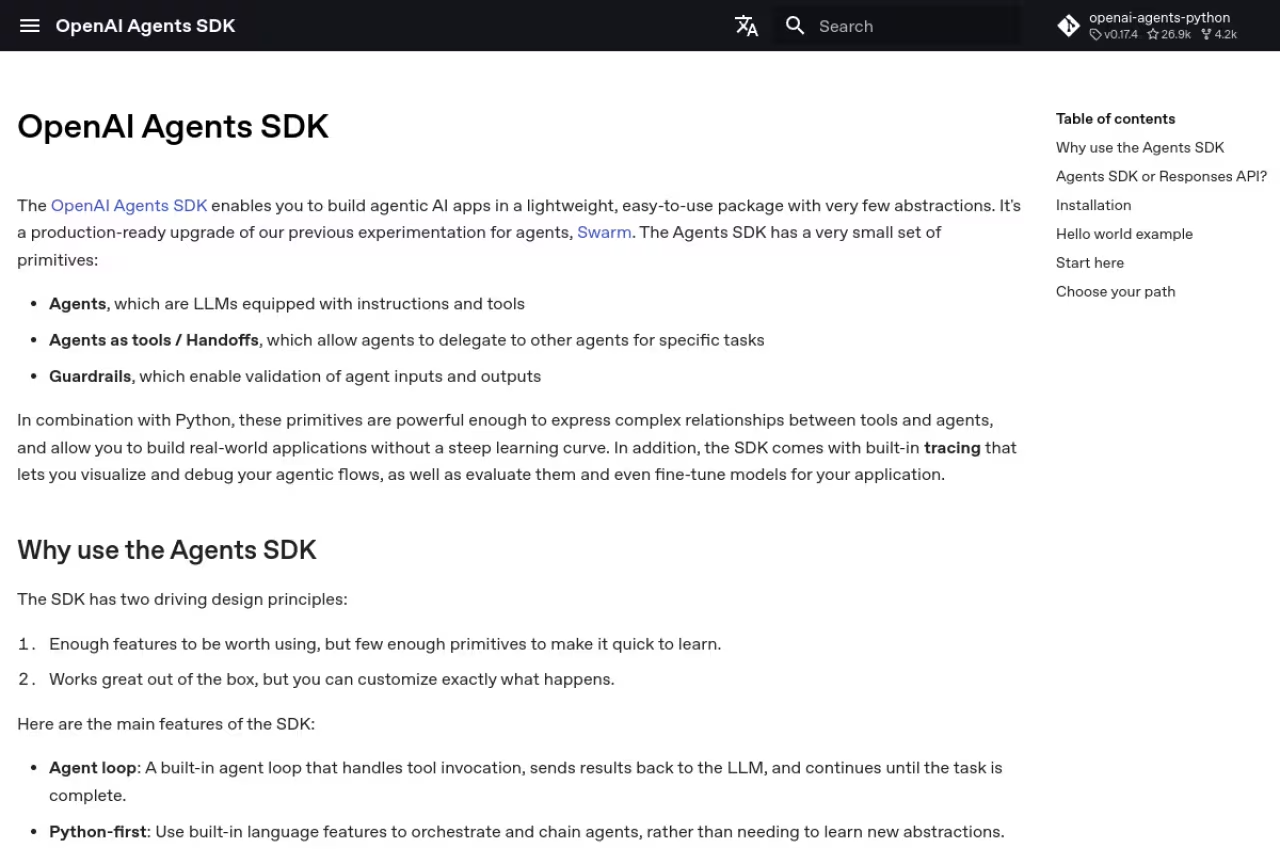
The OpenAI Agents SDK is the production successor to OpenAI's old Swarm experiment, and it's deliberately thin. The whole philosophy is "very few abstractions": you define agents, give them tools, and wire up handoffs where one agent delegates to another. There's a TypeScript version too with Zod-powered schema validation, so you're not locked to Python.
This is the right pick if you're already on the OpenAI stack and want to move fast without learning a graph DSL. Best for teams shipping a customer-facing assistant or a triage system where a router agent hands off to specialists.
The standout features are handoffs and built-in tracing. Handoffs make multi-agent delegation feel native instead of bolted on, and the tracing dashboard plugs straight into OpenAI's eval and fine-tuning tools. The SDK itself is free; you just pay for the tokens your models consume.
Where it falls short: it's provider-friendly to OpenAI by design. You can point it at other models, but the smoothest path assumes you're using OpenAI's APIs and their tracing platform. If you're trying to stay model-agnostic on principle, the gravity here pulls one direction.
The right pick if you are already on the OpenAI stack and want to move fast without a graph DSL, ideal for customer-facing assistants and triage systems. It is provider-friendly to OpenAI by design, so model-agnostic teams will feel the pull.

CrewAI
CrewAI is the fastest way I know to get a team of agents collaborating. You define roles ("researcher," "writer," "editor"), assign tasks, and the framework handles delegation. A working multi-agent crew is genuinely a few lines of readable code, which is why it's the default reach for prototypes and demos.
The fastest way I know to get a team of agents collaborating, and the default reach for prototypes and business workflows. You give up fine-grained control of execution flow, and the per-execution managed pricing adds up fast.
The OSS core hit 1.0 GA and sits around 47k GitHub stars. The managed platform charges per execution: a free tier with 50 executions a month, then Professional at $25/month for 100 executions with overages at $0.50 each, and custom enterprise pricing above that. CrewAI claims roughly three-quarters of the Fortune 500 have used it.
The standout is readability. A new engineer can open a CrewAI script and understand the agent team in thirty seconds, which matters more for team velocity than people admit.
The catch: that simplicity hides control. When a crew misbehaves, you have less fine-grained say over execution flow than you'd get with LangGraph, and the per-execution pricing on the managed tier adds up fast at scale. Fifty free runs disappear in an afternoon of testing.
Pydantic AI
Pydantic AI brings the FastAPI developer experience to agents. If you already trust Pydantic to validate your API payloads, this extends that same type-safe discipline to LLM inputs, tools, and outputs. You declare what an agent should return as a typed schema, and the framework enforces it.
It's best for teams that value explicit contracts and want their agent code to feel like the rest of their typed Python. The framework is model-agnostic, supporting OpenAI, Anthropic, Gemini, DeepSeek, Grok, Cohere, Mistral, and more, plus Bedrock and Vertex. It's open source and free, with active releases (v1.x shipped through spring 2026).
The standout is structured output you can actually rely on. Streaming validation means you get typed, validated results instead of parsing freeform text and praying the JSON is well-formed. For anything that feeds downstream systems, that's the difference between shipping and firefighting.
Where it falls short: it's younger and more conventional than the graph-based options. If your agent needs complex branching, long-running state, or a hierarchy of sub-agents, Pydantic AI gives you less orchestration machinery out of the box. It's a clean foundation, not a full workflow engine.
A clean, type-safe foundation for teams that want explicit contracts and agent code that feels like the rest of their typed Python. It is model-agnostic and free, but offers less orchestration for complex branching or long-running state.
If you're evaluating frameworks like this for your own team and want a faster way to test ideas across models, Dupple X gives you access to the major models in one place so you can prototype without juggling six API keys.
Google ADK
Google's Agent Development Kit (ADK) landed in 2026 with native multimodal support through Gemini and SDKs for Python, TypeScript, Java, and Go. That language spread alone makes it interesting if your stack isn't Python-only.
Pick it if you are on Google Cloud or building multimodal agents, with SDKs for Python, TypeScript, Java and Go and A2A agent discovery. It is the youngest framework here and leans hard on Gemini and Vertex.
ADK ships A2A (Agent-to-Agent) "Agent Cards" so agents from different teams can discover and call each other, and it deploys to Vertex AI Agent Engine for managed hosting. Google announced integrations with 30-plus platforms including Notion, Linear, MongoDB, and Stripe.
The standout is the combination of multimodal-first design and cross-team agent discovery. If you're building in an org where multiple teams ship agents that need to talk to each other, the A2A protocol is a real advantage instead of a buzzword.
The catch: it's the youngest framework here and it leans hard toward the Google ecosystem. The smoothest experience assumes Gemini and Vertex. You can use other models, but you'll feel the seams, and the community is still small compared to LangChain's.
Microsoft Agent Framework
Microsoft Agent Framework went GA in 2026 and is the merger of two older Microsoft projects: AutoGen (the conversational multi-agent system) and Semantic Kernel (the enterprise SDK). One framework now, with .NET and Python support.
Built for enterprise shops on Azure and the Microsoft stack, especially C# teams, with identity, observability and compliance hooks included. Outside the Microsoft world there is little reason to start here, and older AutoGen tutorials are stale.
It ships native MCP and A2A support, OpenTelemetry, Azure Monitor, and Entra ID auth baked in. The SDK is free; you pay for the Azure services around it.
The standout is enterprise plumbing. Identity, observability, and compliance hooks that usually take weeks to bolt on are there from the start, which is exactly what a regulated org needs before it ships an agent to customers.
Where it falls short: if you're not in the Microsoft world, there's little reason to start here, and the AutoGen-to-Agent-Framework migration left some older tutorials stale. AutoGen itself is now in maintenance mode, so old code samples you find may point at a deprecated path.
Claude Agent SDK
The Claude Agent SDK (renamed from the Claude Code SDK in late 2025) is Anthropic's toolkit built on the same harness that runs Claude Code. If you've watched Claude Code chew through a coding task, this is the engine underneath, exposed for your own agents in Python and TypeScript.
A battle-tested agent loop for coding agents and anyone wanting strong tool use, hooks and subagents out of the box. It is tightly coupled to Claude models, and the credit-then-billing model takes a moment to plan around.
The SDK gives you a query() primitive, lifecycle hooks, subagents, and MCP support out of the box. The SDK is free, though in 2026 it started drawing from a separate monthly Agent SDK credit on Claude subscription plans (roughly $20 on Pro, more on Max tiers) before standard API billing kicks in.
The standout is that you inherit a battle-tested agent loop instead of building one. The hooks and subagents system means you can build a fairly sophisticated agent without reinventing the orchestration layer Anthropic already solved for Claude Code.
The catch: it's tightly coupled to Claude models. That's fine if Claude is your model of choice, but it's not a neutral, multi-provider framework. You're buying into the Anthropic stack, and the credit-then-billing model takes a minute to reason about for cost planning.

LlamaIndex
LlamaIndex started as a retrieval library and grew agent capabilities on top, which makes it the natural choice when your agent's main job is reasoning over your own documents and data. If retrieval quality is the bottleneck, this is where the depth is.
The natural choice for RAG-first products where the answer lives in your own documents, with unmatched data connectors and query engines. As a general orchestrator it is less opinionated than LangGraph or CrewAI for non-retrieval tool work.
The open-source library is free; LlamaCloud adds managed parsing and indexing as a paid layer.
The standout is retrieval. Nobody in this list matches LlamaIndex for the breadth of data connectors, indexing strategies, and query engines. If you've fought with chunking and embeddings before, the difference in answer quality is obvious. (For the wider retrieval stack, our best RAG tools guide goes deeper.)
Where it falls short: as a general agent orchestrator it's less opinionated than LangGraph or CrewAI. The agent abstractions are solid but secondary to the retrieval core. If your agent does a lot of multi-step tool work that isn't retrieval-heavy, you may find yourself wanting more orchestration structure.
How to choose
Skip the feature-matrix paralysis. Answer three questions instead.
What's the shape of the work? If your agent is stateful, long-running, or needs human approval mid-flight, go LangGraph. If it's a few agents handing off tasks, the OpenAI Agents SDK or CrewAI will get you there in a fraction of the code. If it's mostly retrieval over your data, LlamaIndex. If it's coding, Claude Agent SDK.
What's your stack? Already on OpenAI? Use their SDK. Deep in Azure and .NET? Microsoft Agent Framework. Google Cloud and Gemini? ADK. A typed Python shop that loves FastAPI? Pydantic AI. Matching the framework to your existing infrastructure saves more time than any individual feature.
How much control do you need? More control costs more complexity. LangGraph gives you the most and asks the most. CrewAI gives you the least friction and the least fine-grained say. Be honest about whether you're building a product that needs to survive a compliance audit or a tool that needs to work by Friday.
One more thing: whatever you pick, instrument it from day one. Agents fail in ways that are invisible without tracing. Pair your framework with proper LLM observability tools and an evaluation setup before you ship, not after the first incident.
If you're still mapping the wider space, our roundups of the best AI agents and best AI agent platforms cover the no-code and managed end, and the top tools directory tracks what's gaining traction week to week.
FAQ
What is the best AI agent framework in 2026?
For production systems that need reliability, LangGraph is the strongest all-around pick thanks to checkpointing, time-travel debugging, and durable execution used by companies like Klarna and Uber. But "best" depends on your use case: CrewAI wins for fast role-based prototypes, the OpenAI Agents SDK for OpenAI-native apps, and LlamaIndex for retrieval-heavy agents.
Is LangGraph free to use?
Yes. LangGraph is MIT-licensed open source and free to use. You only pay for the LLM tokens your agents consume. LangChain also offers a paid hosted layer (LangGraph Platform with LangSmith) if you want managed deployment and observability, but the core framework costs nothing.
What's the difference between LangGraph and CrewAI?
LangGraph models agents as a directed graph with explicit shared state, giving you fine-grained control over execution and the ability to handle complex, stateful workflows. CrewAI uses role-based agent teams that you define in a few readable lines. CrewAI is easier to learn and faster to prototype; LangGraph offers more precise control and better durability for production.
Do I need a framework to build an AI agent?
No, but it saves serious time. You can call an LLM API and write your own loop for tool use, memory, and orchestration. A framework handles those pieces for you, so you build in days instead of weeks. For a simple single-step task, raw API calls are fine. For anything with multiple agents, tools, or state, a framework pays for itself quickly.
Which AI agent framework is best for beginners?
CrewAI has the lowest barrier to entry: you can stand up a multi-agent crew in a few lines of readable Python without learning a graph DSL. The OpenAI Agents SDK is also beginner-friendly if you're already using OpenAI, thanks to its minimal abstractions. Both let you ship something working before you commit to a heavier framework like LangGraph.
Is the OpenAI Agents SDK only for OpenAI models?
The SDK works best with OpenAI's APIs and tracing tools, but it's provider-agnostic and you can point it at other models. The handoffs, guardrails, and tracing features are designed around the OpenAI ecosystem, so you'll get the smoothest experience there. If staying fully model-neutral is a priority, Pydantic AI or LangGraph give you more flexibility.
Related guides
Some offers on this page may be paid placements or contain affiliate links.
