
Why Your Brand Is Not Showing Up in AI Search (and How to Fix It)

Your brand is invisible in AI search because AI models like ChatGPT, Perplexity, and Google AI Overviews only cite brands that appear consistently across authoritative sources with structured, parseable content. HubSpot AEO is one dashboard for that job. We also reviewed Peec AI for ChatGPT and Perplexity citations specifically (30% off for six months via the partner link). First-party numbers: SEO statistics. If your competitors are showing up in AI search results and you're not, this is the gap you need to close.
Updated October 2026: statistics replaced with dated, sourced studies (Pew Research, Ahrefs), Dupple traffic data added, HubSpot AEO pricing re-checked on October 9, 2026, and a free manual check added.
Dupple data: on our 40 most-visited dupple.com/learn guides, ChatGPT sent 1,579 of the 2,259 visits that came from AI assistants between April 6 and October 4, 2026 (70%), ahead of Claude (273), Gemini (212), Copilot (124) and Perplexity (71). If you can only test one assistant first, test ChatGPT.
AI assistants no longer answer only from what they memorized in training. ChatGPT search, Perplexity, Gemini and Google AI Overviews run live web searches for many buying questions, then quote the handful of pages they trust most. A brand gets left out for one of five fixable reasons, summarized below.
Start your HubSpot AEO 28-day free trial ->
| Why AI skips your brand | What the assistant sees | First fix | How to check |
|---|---|---|---|
| Content is not structured for extraction | Long prose with no direct answer to quote | Answer-first sections, tables, FAQ | Can one sentence of your page answer the buyer's question? |
| Too few third-party mentions | Your brand only on your own site and socials | Get named in roundups, reviews, comparisons | Search your category on G2, Capterra and "best X" articles |
| Inconsistent entity signals | Different descriptions on every profile | One brand description everywhere, Organization schema | Compare your site, LinkedIn and directory bios |
| Nobody is measuring AI visibility | No data on which prompts mention you | Track 20-25 buyer prompts weekly | Ask ChatGPT, Gemini and Perplexity your buyers' questions |
| Competitors got there first | Rivals cited, so they keep getting cited | Close specific citation gaps, prompt by prompt | Note which brands appear for each prompt |
How do AI assistants decide which brands to mention?
Assistants retrieve a set of pages for the question, then summarize the brands those pages agree on. Two studies show how much that favors brands other sites already talk about. Ahrefs analyzed about 75,000 brands across ChatGPT, AI Mode and AI Overviews and found that branded web mentions correlated 0.656 with AI Overview visibility, while the number of backlinks showed only a very weak relationship (December 2025). And when Google shows an AI summary, people click far less: Pew Research Center tracked 900 US adults in March 2025 and found they clicked a traditional result on 8% of visits with an AI summary, against 15% without one, and clicked a link inside the summary on just 1% of visits.
The practical consequence: being mentioned inside the answer matters more than ranking under it. The five reasons below are where most brands lose that mention.
Why can't AI assistants quote your content?
AI models don't read pages top to bottom like a person. They pull out passages that answer the question on their own: a clear heading, a direct first sentence, a table row, a short FAQ answer. A page written as one long story has no passage an assistant can lift without rewriting it, so it quotes a competitor whose page does.
What AI models look for: Direct answers in the first 40-50 words of a section. Clear H2/H3 headings that match common questions. FAQ sections with concise, factual answers. Numbered lists for processes and steps. Comparison tables with specific data points. Sentences structured as semantic triples: 'HubSpot provides AI-powered CRM tools for mid-market companies' is parseable; 'With our innovative solutions, businesses can transform their operations' is not.
How to fix it: Restructure your key pages using answer-first formatting. Start each section with a direct answer to the implied question, then add supporting detail. Add FAQ schema markup (JSON-LD) to your most important pages. Use comparison tables with specific numbers. HubSpot AEO analyzes your content structure and recommends specific changes to make it AI-parseable. The tool identifies which pages are being cited by AI and which are being ignored, so you know exactly where to focus.
Why do AI assistants trust other sources over your website?
An assistant treats your own website as a biased source. It looks for independent confirmation: the same brand, described the same way, on review sites, comparison articles, industry publications and knowledge bases. That is why the Ahrefs study above found branded mentions tracked AI visibility far more closely than backlinks. A link without your name next to it does little; a sentence naming your brand on a page the assistant already retrieves does a lot.
What counts as authoritative: review platforms (G2, Capterra, TrustRadius), "best X" roundups and comparison pages in your category, industry publications and analyst notes, Wikipedia and other knowledge bases, podcast and conference pages, and news coverage. Each mention should repeat the same specific facts about what you do and for whom.
How to fix it: Audit where your brand appears online versus where your competitors appear. Focus on getting mentioned (not just linked) on the sites AI models crawl most frequently. This includes comparison pages, industry roundups, and expert interviews. HubSpot AEO tracks which sources are citing your brand in AI responses and shows you where competitors are getting cited that you're not. This gap analysis is the fastest path to improving AI visibility. See our guide on best AI search visibility tools for a deeper comparison of monitoring platforms.
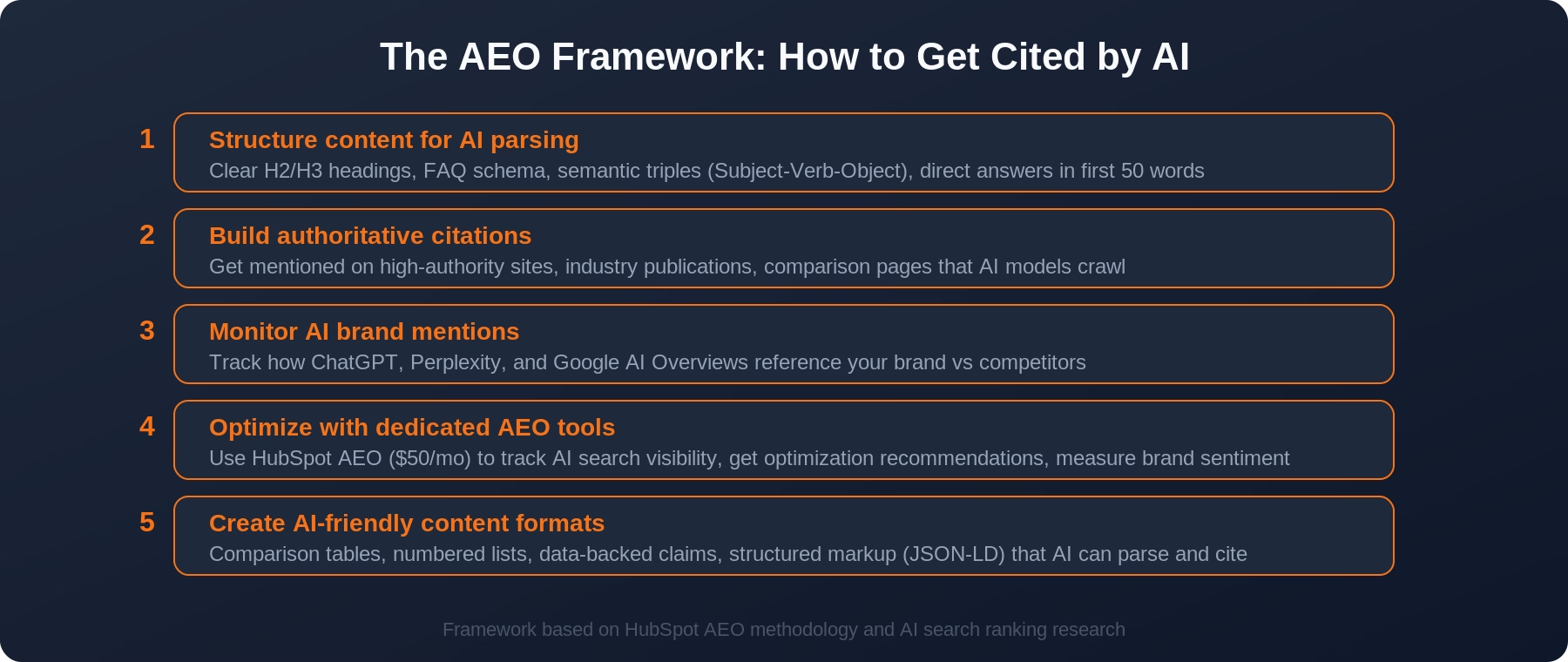
The 5-step AEO framework: structure content, build citations, monitor AI mentions, optimize with tools, create AI-friendly formats.
Does your brand send mixed entity signals?
AI models build an "entity profile" for each brand from what the web says about it. If your website calls you a "revenue platform", LinkedIn says "CRM", and a directory listing still describes a product you retired two years ago, the model cannot tie your brand to one clear category with confidence. When it is unsure, it names a brand it is sure about.
How to fix it: Standardize your brand description across all platforms. Use the same core messaging: what you do, who you serve, what makes you different. Ensure your key product names, features, and value propositions are described consistently everywhere. Add Organization schema markup (JSON-LD) to your website with accurate, up-to-date information. HubSpot's AI tools help maintain brand consistency across your website, email, and content by using centralized brand voice settings that HubSpot AI applies to all generated content.
Are you measuring AI search visibility at all?
Most teams still report on Google Search Console, rankings and sessions. Those numbers can hold steady while assistants answer your buyers' questions with a competitor's name. Pew found that around one in five Google searches (18%) produced an AI summary in March 2025, and when a summary appeared, clicks on regular results fell from 15% to 8% of visits. You can rank first and still be absent from the answer.
How to fix it: Start tracking AI search visibility alongside traditional SEO metrics. HubSpot AEO monitors how ChatGPT, Perplexity, Google AI Overviews, and other AI engines reference your brand. It shows you which queries mention your brand, which mention competitors instead, and what content changes would improve your AI visibility. The 28-day free trial gives you immediate visibility into where your brand stands in AI search today.
For teams already using HubSpot's CRM and marketing tools, AEO data connects directly to your existing dashboards. You can see how AI search visibility correlates with lead generation, website traffic, and revenue. This CRM-connected approach is what makes HubSpot's AEO different from standalone monitoring tools: it ties AI visibility to business outcomes, not just vanity metrics.
Free manual check (30 minutes): write down 20 questions a buyer asks before choosing a product like yours ("best X for small teams", "X vs Y", "is X worth it"). Ask each one in ChatGPT, Gemini and Perplexity in a logged-out or fresh session. Record which brands are named and which pages are cited. Repeat monthly with the same prompts, because answers change from one run to the next (see why ChatGPT drops most of its citations overnight) and only the trend over several runs is reliable. For engine-by-engine tactics, read AI search visibility on ChatGPT, Perplexity, Gemini and Claude.
What happens if competitors already show up in AI answers?
If your competitors appear in AI search results and you don't, they capture demand you never see. When ChatGPT names three CRM tools and yours isn't one of them, that buyer never visits your website, never sees your pricing page and never enters your pipeline. The gap compounds: pages that get cited get read and linked more, which earns them more mentions, which gets them cited again.
How to fix it: Run a competitive analysis of AI search visibility. Ask ChatGPT, Perplexity, and Google the questions your buyers ask. Note which brands appear and which don't. HubSpot AEO automates this with scheduled monitoring across AI engines, showing your share of voice versus competitors over time. The tool identifies specific content and citation gaps you can address immediately.
The same shift explains why AI marketing tools now sit in most marketing stacks. The question is moving from "who ranks highest on Google" to "who gets recommended by AI", and the tactics that win are different. Brands that start now build an advantage that late movers find hard to close.
How much does AI visibility tracking cost?
You can start for free with the manual check above. A dedicated tracker saves the weekly copy-paste and adds competitor share of voice. Pricing below was checked on the vendor's page on October 9, 2026.
| Option | Price (USD) | What you get | Trial |
|---|---|---|---|
| Manual prompt check | $0 | 20 prompts by hand in ChatGPT, Gemini, Perplexity | Not applicable |
| HubSpot AEO | $50/month, or $45/month billed annually | 25 tracked prompts across ChatGPT, Perplexity and Gemini, more prompts sold separately; no other HubSpot subscription required | 28-day free trial, no credit card |
Dupple data: Toolradar, our software directory, evaluates 253 SEO tools as of October 2026, and the median cheapest paid plan among its top 10 is $47.20 per month, so a $45-50 monthly tracker sits right at the going rate for search software. For a side-by-side of dedicated trackers, see our AI search visibility tools comparison and best AEO and GEO tools.
The 30-Day AI Search Visibility Action Plan
Week 1: Audit your current AI visibility. Start a HubSpot AEO free trial and benchmark where your brand appears (and doesn't) in AI search. Ask ChatGPT, Perplexity, and Google AI Overviews 20 queries your buyers would ask. Document which brands get recommended. This baseline shows you exactly how big the gap is.
Week 2: Structure your top 10 pages for AI parsing. Add FAQ schema markup, restructure content with answer-first formatting, include comparison tables with specific data, and ensure every key page uses semantic triple sentences. HubSpot AEO identifies which pages to prioritize based on query relevance and current AI citation gaps.
Week 3: Build authoritative citations. Get your brand named on 5-10 independent pages that assistants already retrieve for your category. Update review-site profiles with complete, accurate details, offer expert quotes to comparison articles, refresh directory listings, and send product news to the industry publications your buyers read.
Week 4: Monitor and iterate. Review HubSpot AEO data to see which changes improved AI visibility. Double down on what's working. The key metric is 'share of voice in AI answers': the percentage of relevant queries where your brand appears versus competitors. Track this weekly alongside your traditional SEO metrics for a complete picture of search visibility.
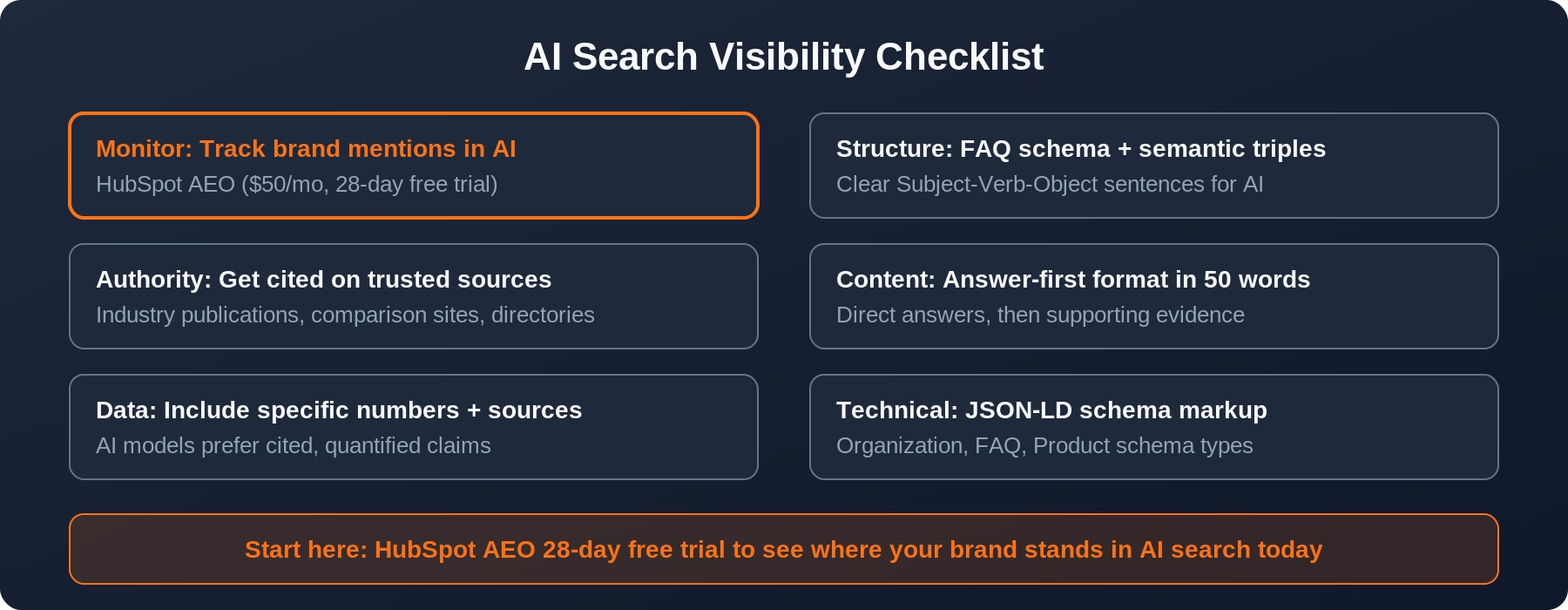
Complete AI search visibility checklist. Start with HubSpot AEO's 28-day free trial to benchmark your current position.
FAQ
Why is my brand not showing up in ChatGPT?
ChatGPT draws from training data and web sources to generate answers. If your brand isn't mentioned consistently across authoritative sites (industry publications, review platforms, comparison pages), ChatGPT won't include it in recommendations. The fix is Answer Engine Optimization (AEO): structuring your content for AI parsing and building citations on sources AI models trust. HubSpot AEO tracks your brand's presence in ChatGPT and other AI engines, showing exactly where gaps exist.
What is Answer Engine Optimization (AEO)?
AEO is the practice of optimizing your brand's content and online presence so AI engines (ChatGPT, Perplexity, Google AI Overviews, Gemini, Claude) cite and recommend you. It differs from traditional SEO because AI assistants don't show a ranked list; they write one answer from several sources. AEO focuses on structured content, third-party mentions, consistent entity signals and direct answers that AI models can quote with confidence.
How long does it take to appear in AI search results?
Pages that assistants retrieve through live search (ChatGPT search, Perplexity, Google AI Overviews) can reflect a change within days to a few weeks of being recrawled. Answers that rely on a model's training data move only when the model is retrained, which takes months. The fastest wins come from restructuring pages that already rank and earning mentions on pages assistants already cite for your category.
Is AEO different from SEO?
Yes. SEO optimizes for ranked lists of links (Google's traditional results). AEO optimizes for synthesized AI answers where only a handful of brands get mentioned per question. SEO metrics focus on rankings and click-through rates. AEO metrics focus on brand mentions, share of voice, and citation frequency in AI-generated answers. Both matter, and AEO matters more each quarter: Pew found an AI summary on 18% of Google searches in March 2025, and those summaries nearly halved clicks on regular results. HubSpot AEO tracks both channels in a single dashboard.
How much does HubSpot AEO cost?
HubSpot AEO starts at $50/month with a 28-day free trial. It monitors your brand's visibility across ChatGPT, Perplexity, Google AI Overviews, and other AI engines. The tool provides optimization recommendations, competitive analysis, and tracks share of voice over time. For teams already using HubSpot's marketing platform or CRM, AEO data integrates directly into existing dashboards. The 28-day free trial gives you full access to see where your brand stands before committing.
Can I check my AI search visibility for free?
Yes. Write 20 questions your buyers ask, run each in ChatGPT, Gemini and Perplexity in a fresh session, and record which brands and pages are named. Repeat with the same prompts every month. It costs nothing but about 30 minutes; paid trackers like HubSpot AEO ($50/month) automate the same check and add competitor share of voice.
Which AI assistant should I optimize for first?
ChatGPT, for most brands. On our 40 most-visited dupple.com/learn guides, ChatGPT sent 70% of the visits that came from AI assistants between April 6 and October 4, 2026 (1,579 of 2,259), well ahead of Claude, Gemini, Copilot and Perplexity. Google AI Overviews matter too because they sit on top of the largest search engine.
Do backlinks still matter for AI search?
Less than brand mentions. Ahrefs' December 2025 study of about 75,000 brands found branded web mentions correlated 0.656 with AI Overview visibility, while backlink counts showed only a very weak relationship. Links still help pages get crawled and ranked, which is how assistants find them, but a mention of your brand name on a trusted page does more for AI answers than an anonymous link.
Conclusion: AI Search Is the New Front Door
Brands named in AI answers capture demand that traditional SEO reports never show. When a buyer asks ChatGPT for a recommendation and your competitor is named while you are not, no Google ranking wins that buyer back. The gap between brands assistants name and brands they skip widens every quarter.
The fix isn't complicated, but it requires a different approach than traditional SEO. Structure your content for AI parsing. Build authoritative citations across the sources AI models trust. Monitor your AI visibility alongside traditional metrics. HubSpot AEO gives you the tools to do all three, starting with a 28-day free trial that shows you exactly where your brand stands today.
Start measuring what matters. Your competitors already are. See our comparison of AI search visibility tools and AI marketing tools for additional context on building your AI search strategy.
Sources and method: HubSpot AEO pricing, prompt allowance and trial terms checked on the vendor's page on October 9, 2026. Click and visibility figures from Pew Research Center (March 2025 browsing data, published July 2025) and Ahrefs (December 2025). Dupple data: visits by source from our own analytics for dupple.com/learn, April 6 to October 4, 2026; tool counts from Toolradar, October 2026. See how we rate tools and our editorial policy.
Some offers on this page may be paid placements or contain affiliate links.
Across our whole catalogue the median is $23.50 a month and 37% of tools advertise a free tier. Figures are the lowest recurring monthly price quoted in our own review of each tool, read on 2026-10-23. Full method and every category.