
ChatGPT Throws Away Most of Its Citations Overnight

Someone on a marketing team screenshots a ChatGPT answer that links to their site, drops it in Slack, and treats the quarter as won. Ask the same question the next morning and most of those links are gone.
Dupple is a Semrush affiliate. If you start a trial through the link in this article, Dupple may earn a commission, at no extra cost to you.
GetMentions ran that test on purpose. In June 2026 it took 2,398 real queries from 56 brand accounts and asked them once a day for seven days, logged out, same wording, same location, with web search on. The week produced 67,144 answers and 530,875 citations across ChatGPT, Google AI Mode, Perplexity, and Gemini. On ChatGPT, 79.2% of the sources behind a typical answer changed from one day to the next. Of the domains cited on day one, 40.9% were still there on day two. By day seven, 33.4% remained. Domains that showed up all seven days were 1.1% of a query's sources.
That is not a rank you hold. It is a draw the model runs again tomorrow.
The same prompt, two different search engines
A citation can also die without waiting overnight. Semrush and Kevin Indig, in a study published on the Semrush blog on 30 June 2026, ran 100 prompts through GPT-5.2 twice: once in Instant mode, and once in Thinking mode. The set covered 20 buyer journeys in B2B software, finance, consumer tech, and health.
For the same prompt, only 25.6% of cited domains overlapped. Nearly three in four sources were different. The share of answers that cited anything rose from 50% to 68% when reasoning went up. Sources per response went from 2.6 to 4.5. The model fired 4.6 times as many internal sub-queries. High reasoning touched 173 unique domains, against 127 for the fast mode, and 99 of those domains never appeared in Instant mode at all.
The sites changed with the mode. Reddit appearances fell from 15% to 7%. User-generated content and review sites fell from 14.3% to 6%. Government and academic sources rose from 1.9% to 8.8%. Official documentation rose from 12.4% to 17.5%. Brand domains barely moved, 62.4% against 60.6%. Indig's line in the study was direct: the brand that wins under minimal reasoning is not the brand that wins under high reasoning.
ChatGPT routes harder questions into Thinking mode on its own. Comparisons, evaluations, regulatory questions. At the comparison stage, that mode ran 24 sub-queries per prompt against 5.5, and cited 9.8 sources against 5.8. A page built for the quick answer can be missing from the answer a buyer actually gets.
The listicle bill comes due
Much of the 2025 spend chasing those citations went into URLs with "best" or "top" in the address. Seer Interactive tracked more than 2 million ChatGPT citations on a fixed prompt set from November 2025 through February 2026, and counted any such URL as a listicle.
From December to January, listicle citations fell 30%, from about 160,000 to 111,000. All citations in the set fell 22.7% that month, from 931,000 to 719,000, so the roundups were cut harder than the rest. Thirteen of 16 industries moved down. Wikipedia nearly doubled its share, from 3.6% to 5.9%. Reddit nearly tripled. The listicles that still grew had a 2026 date on the page, a disclosed method or outside ratings, and a numbered layout.
Why the ROI story does not close
The channel is getting bigger while the scoreboard stays foggy. Semrush's 2026 AI Visibility Index, 126 million U.S. prompts from January through April, reported that 45% of marketing leaders cannot accurately measure brand visibility inside AI answers, and only 9% can track the relevant metrics across platforms. Adobe's numbers in that release are the other half of the problem. AI traffic to U.S. retail sites rose 1,324% between October 2024 and May 2026. Travel rose 2,215%.
A citation is also a weak proxy for being named. In a Semrush study with Indig published on 9 June 2026, researchers logged 3,981 domain appearances across 115 prompts, 14 countries, and four engines. Of those, 61.7% were ghost citations: a source link, and no brand name in the answer. Another 13.2% were both cited and named. Another 25.1% were a name with no link. When a brand's domain appeared at all, ChatGPT cited it 87% of the time and wrote the name into the answer 20.7% of the time. Gemini did the reverse, naming the brand in 83.7% of appearances and citing it 21.4% of the time.
A line item called "get us cited in ChatGPT" can hit its target and still leave the buyer reading a paragraph that never says who you are. The engines do not share sources, either. In the GetMentions week, 84% of the domains cited for a question were used by only one of the four engines.
The closest public stand-in for a return is a survey in the Index. Among teams that folded SEO and AI visibility into one workflow, 81% said traffic or leads from AI platforms had risen. Among teams running the two apart, 36% said the same. Self-reported, not a controlled test. It is what you would expect if a footnote and a recommendation are being booked as one win.
ChatGPT and Gemini are not even the same shape of answer. The Index puts ChatGPT at about 15 sources per response, heavy on Reddit and Wikipedia, and Gemini at about 3. On Gemini, overlap between a mentioned brand and a cited domain can sit as low as 30%.
What to count instead of a screenshot
Track how often you appear across many runs, per engine, and split the fast mode from the slow one. Thinking mode leans on documentation, original research, and references a government or university site would link. Instant mode still leans on reviews and community threads. Those are different budgets. Count a mention and a link as separate events. The June study says they usually are not the same event.
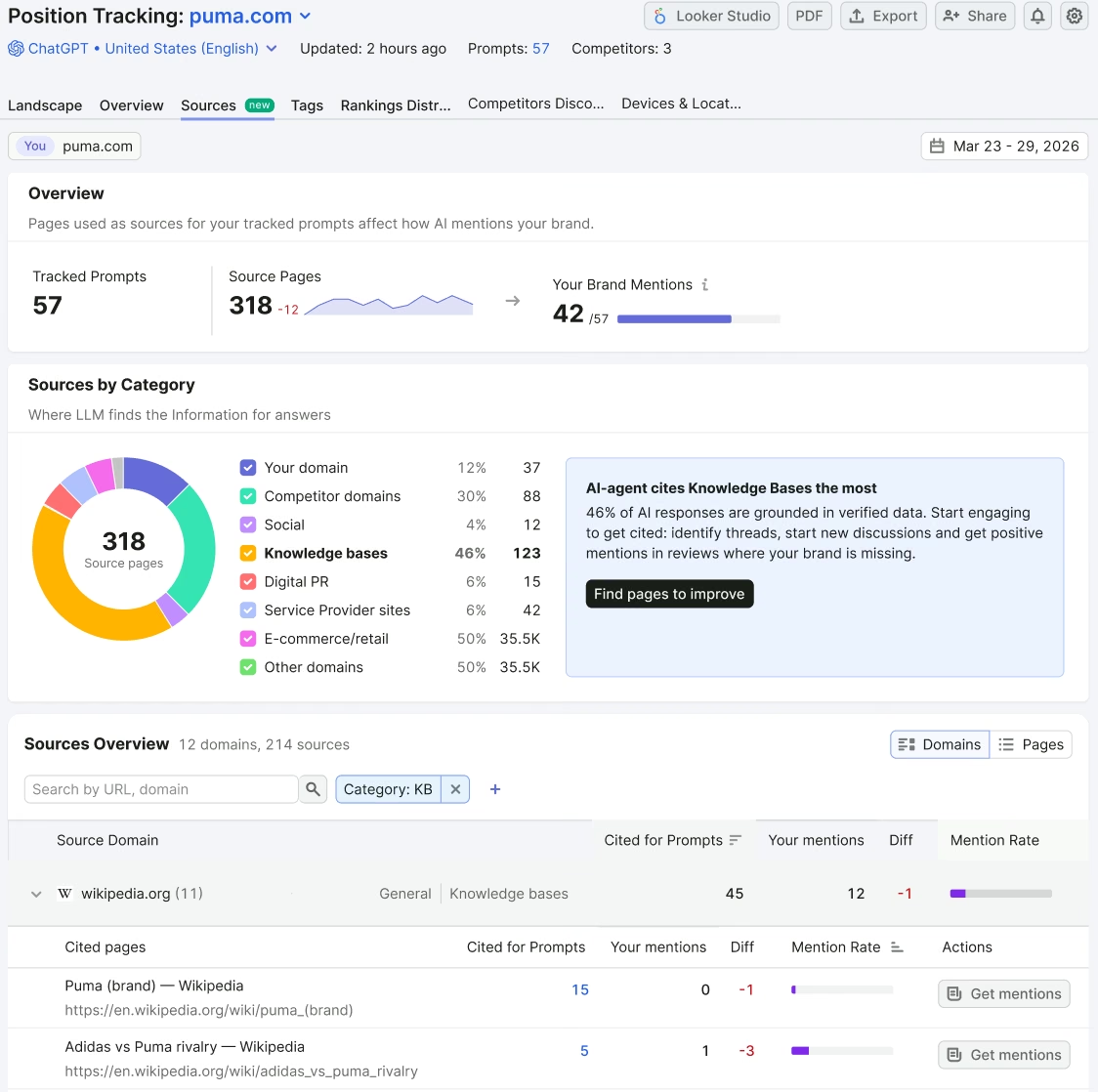
The Sources report inside Prompt Tracking, part of the Semrush AI Visibility Toolkit. Each cited page shows how many tracked prompts it was used for, how often the brand was actually named, and what changed since the last update. Screenshot: Semrush.
The Semrush AI Visibility Toolkit measures brand presence, sentiment, and citations across ChatGPT, Perplexity, Gemini, Google AI Mode, and Claude, and Semrush says it is backed by a database of more than 158 million real LLM prompts. Its Prompt Tracking tool runs the prompts you choose every day on ChatGPT, Google AI Mode, AI Overviews, and Gemini, which is exactly the repeated sampling the GetMentions week did by hand. The Sources report then lists every domain and page cited in those answers, so you can watch a source drop out overnight, see which competitor pages took its place, and check whether a citation came with your brand name or without it.
Stop judging AI visibility from one screenshot. Try the Semrush AI Visibility Toolkit to track your mentions, citations, and cited sources across ChatGPT, Google AI Mode, and Gemini every day.
A link used to be something you could point at for months. On ChatGPT, most of the sources under an answer are replaced by the next day, a second reasoning mode replaces them again, and a large share of the links that remain never put the brand in the sentence. Pricing that like a ranking is how the ROI math breaks.
Some offers on this page may be paid placements or contain affiliate links.
