
Zero-Click Search: Why Nearly 60% of Google Searches Never Reach Your Site (and What to Do About It)

A zero-click search is a search that ends without a click to any website, because the answer already sits on the results page or in an AI summary. In 2024, 58.5% of US Google searches ended that way, and when Google shows an AI summary, people click a regular result on just 8% of visits. HubSpot AEO (Answer Engine Optimization) helps brands adapt by tracking visibility across AI search engines and optimizing content to become the answer these tools cite, starting at $50/month with a 28-day free trial.
Updated October 2026: statistics re-sourced to dated studies (SparkToro, Pew Research, Ahrefs, Bain, Semrush), the 65% headline figure corrected to SparkToro's 58.5%, Dupple traffic data added, and HubSpot AEO pricing re-checked on October 9, 2026.
Dupple data: between July 6 and October 4, 2026, dupple.com/learn received 29,763 visits from search engines and AI assistants, and 3,233 of them (10.9%) came from AI assistants such as ChatGPT, Claude and Gemini. Zero-click search takes visits away, but the assistants that answer instead of Google also send readers to the pages they cite.
If your organic traffic has plateaued or dropped while your rankings held, zero-click search is the likely cause. Here is the evidence, who it hurts most, and five concrete ways to adapt.
Start your HubSpot AEO 28-day free trial ->
Zero-click search in numbers (October 2026)
| Finding | Figure | Source and date |
|---|---|---|
| US Google searches ending with no click | 58.5% (59.7% in the EU) | SparkToro and Datos, 2024 data, published July 2024 |
| Clicks to the open web per 1,000 US Google searches | 360 | SparkToro and Datos, July 2024 |
| Click rate on regular results when an AI summary shows | 8% of visits, vs 15% without one | Pew Research Center, March 2025 data |
| Clicks on links inside the AI summary | 1% of visits | Pew Research Center, March 2025 data |
| Google searches that showed an AI summary | 18% | Pew Research Center, March 2025 data |
| Click-through rate of the top result when an AI Overview appears | 58% lower | Ahrefs, 300,000 keywords, February 2026 |
| Searches that end without visiting another site | About 60% | Bain & Company, survey of 1,117 consumers, December 2024 |
| Estimated loss of organic web traffic | 15% to 25% | Bain & Company, February 2025 |
What is zero-click search?
A zero-click search happens when a user gets an answer directly from the search results page without clicking through to any website. Featured snippets, knowledge panels, People Also Ask boxes, local packs, calculators, sports scores and AI Overviews all satisfy the question on the page. The user searches, reads the answer, and leaves.
The pattern is not new: featured snippets have been answering questions on the results page for years. Two things sped it up. First, Google's AI Overviews spread fast: Semrush measured them on 13.14% of queries in March 2025, up from 6.49% in January 2025, and Pew counted an AI summary on 18% of the searches its panel ran that month. Second, assistants such as ChatGPT, Perplexity, Gemini and Claude answer many questions that used to start on Google, and they link out only to the few sources they cite.
Why is zero-click search cutting your traffic?
Your rankings are holding but traffic is dropping. This is the most confusing symptom. Google Search Console shows your positions are stable or even improving, but organic traffic is flat or declining. The explanation: your keywords are being answered by AI Overviews or featured snippets, so users never click through even though you rank well. Ahrefs measured a 58% lower click-through rate for the top-ranking page when an AI Overview appears (300,000 keywords, December 2025 data).
Informational queries are hit hardest. Queries like "what is CRM", "how does email marketing work" and "best time to send marketing emails" are now answered on the results page. If your content plan relies on informational posts for top-of-funnel traffic, zero-click search erodes that base. The content still builds some awareness when your brand is named in the answer, but it no longer sends the visits it used to.
Your competitors are adapting. Brands that see the shift are optimizing for featured snippets and AI citations, building owned audiences through email and community, and measuring brand impressions as well as clicks. Brands that keep chasing last year's organic traffic targets are fighting over a shrinking pool of clicks. See our AI marketing tools guide for platforms that help you adapt.
How did Google AI Overviews change search?
Google AI Overviews are AI-written summaries that appear at the top of the results for many queries. Unlike a featured snippet, which quotes one page, an AI Overview blends several sources into one answer, with small citation links beside or below it.
The effect on clicks is large and now well measured. Ahrefs compared 300,000 keywords and found the top-ranking page earns a 58% lower click-through rate when an AI Overview appears (December 2025 data against a December 2023 baseline). Pew's panel clicked a regular result on 8% of visits with an AI summary and 15% without, and clicked inside the summary on only 1%. Semrush shows one site whose Google impressions more than doubled between May 2024 and September 2025 while its click-through rate fell from about 1.5% to under 0.5%. Google's AI Mode goes further and is even harder to track, as our piece on AI Mode and informational search explains, and our SEO statistics page tracks the trend quarter by quarter.
This is why Answer Engine Optimization (AEO) has become essential. Traditional SEO gets you ranked in the list below the AI Overview. AEO gets your brand cited inside the AI Overview and in ChatGPT, Perplexity, and other AI search tools. Being one of the 3-5 sources cited in an AI Overview drives brand visibility even in a zero-click environment. HubSpot AEO tracks whether your brand is being cited in AI Overviews and recommends specific content changes to improve your citation rate.
Which businesses does zero-click search hurt most?
B2B companies: Informational content that once drove demo requests is now answered by AI before users reach your site. The fix: optimize for commercial-intent queries ('best CRM for startups' vs 'what is CRM') and ensure your brand appears in AI recommendations for buyer-ready queries. HubSpot's CRM platform connects content performance to pipeline data so you can see which content still drives revenue, not just traffic.
Ecommerce brands: Product comparison queries are increasingly answered by AI Overviews and AI shopping tools. When someone searches "best running shoes for flat feet", Google's AI Overview can return a short list without a click to any store. The fix: publish product content AI models cite (structured data, detailed specifications, expert reviews) and diversify acquisition beyond organic search.
SaaS companies: Feature comparison and pricing queries are prime targets for AI Overviews. 'Salesforce vs HubSpot' now gets an AI-generated comparison summary that satisfies many users without clicks. The fix: create content with unique data and perspectives that AI models cite as authoritative, and invest in owned channels (email, community) that don't depend on search traffic.
Local businesses: Google's local pack already answers "near me" queries with business details, reviews, hours and directions, all without a website visit. The fix: keep your Google Business Profile complete and accurate, and build a direct channel (email, SMS) that does not depend on search.
How do you adapt your strategy to zero-click search?
Optimize for AI Citations, Not Just Rankings
Traditional SEO aims for position #1 in organic results. In a zero-click world, you need to be cited inside AI Overviews and AI search answers. This requires structured content that AI can parse and cite: FAQ schema, comparison tables, specific data points, and clear semantic triple sentences. HubSpot AEO monitors your citation rate across AI engines and identifies content gaps that prevent your brand from being cited.
Shift from Informational to Commercial Content
Informational queries ("what is X") are the most exposed because AI can answer them completely. Commercial queries ("best X for Y", "X vs Y", "X pricing") still drive clicks because buyers want to compare options in depth. Shift your content mix toward pages with unique analysis, dated pricing breakdowns and first-party data that an AI summary cannot fully replace, and that it is likely to cite. Our guide on how to get your brand cited by ChatGPT and Perplexity shows what those pages have in common.
Build Owned Audiences You Control
Email lists, communities, and direct customer relationships don't depend on search algorithms. Every visitor from search should have a clear path to joining your owned audience. HubSpot's email marketing tools (free tier available) help you build and nurture these owned audiences with AI-powered personalization. When search traffic declines, owned audiences keep your pipeline full.
Measure Brand Impressions, Not Just Clicks
In a zero-click world, your brand name appearing in an AI Overview or ChatGPT answer has value even without a click. It builds awareness and credibility that influences future purchase decisions. Start tracking brand mention frequency in AI answers alongside traditional traffic metrics. HubSpot AEO provides this measurement: share of voice across AI engines, brand sentiment in AI responses, and competitive positioning in AI-generated recommendations.
Diversify Traffic Sources Beyond Search
Relying on organic search for 60%+ of your traffic is increasingly risky. Diversify into channels you control: email marketing, social media, podcasts, webinars, partnerships, and community. HubSpot's marketing platform manages all these channels from a single dashboard, so you can shift budget and effort toward channels that drive measurable results. See our AI marketing tools comparison for platforms that help diversify your acquisition strategy.
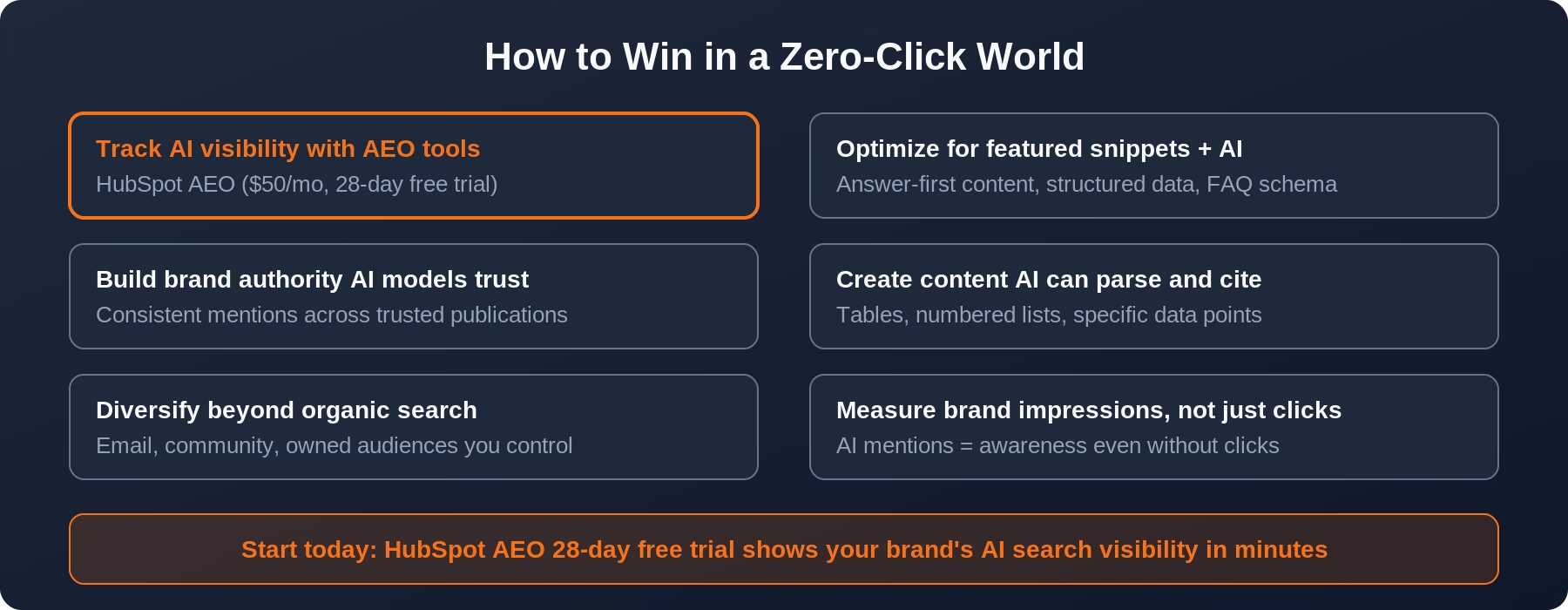
Six strategies to adapt to zero-click search. Start with AI citation monitoring via HubSpot AEO.
FAQ
What percentage of searches are zero-click?
About 58.5% of US Google searches and 59.7% of EU Google searches ended without a click to any website in 2024, according to SparkToro's study of Datos clickstream data (published July 2024). Bain & Company's December 2024 survey puts it at about 60% of searches ending without a visit to another site. The share rises when an AI summary appears: Pew found people clicked a regular result on only 8% of those visits in March 2025.
Are zero-click searches bad for my business?
Not necessarily. Zero-click searches where your brand appears in the AI Overview or featured snippet still build brand awareness. The problem is zero-click searches where competitors get cited and you don't. HubSpot AEO helps you distinguish between these scenarios by tracking which AI answers mention your brand and which mention competitors. The goal isn't to fight zero-click search; it's to ensure your brand is the answer AI cites.
How do I check if my queries are zero-click?
Compare your Google Search Console data (impressions vs clicks) for your top keywords. If impressions are high but clicks are declining, your queries are likely being answered by AI Overviews or featured snippets. HubSpot AEO provides a more detailed view by tracking your brand's presence in AI-generated answers across ChatGPT, Perplexity, and Google AI Overviews, showing you exactly where your brand appears and where it doesn't.
What is Answer Engine Optimization (AEO)?
AEO is the practice of optimizing your content and brand presence so AI search engines cite and recommend you. Unlike traditional SEO (which optimizes for ranked link lists), AEO optimizes for synthesized AI answers where only a handful of brands get mentioned. Key AEO practices include: structuring content with FAQ schema and semantic triples, building authoritative citations across trusted sources, and monitoring AI brand mentions. HubSpot AEO ($50/month, 28-day free trial) is the dedicated tool for tracking and improving AI search visibility.
Will zero-click search kill SEO?
No, but it's transforming SEO. Traditional ranking-focused SEO still matters for commercial queries that drive clicks. However, measuring success only by rankings and organic traffic misses the full picture. The future of search marketing combines SEO (rankings and clicks) with AEO (AI citations and brand mentions). Brands that add AEO to their search strategy now will have a significant advantage as AI search grows. The tools that win are the ones that measure both channels, which is why HubSpot AEO integrates with HubSpot's broader marketing analytics.
How much do AI Overviews reduce clicks?
Ahrefs found that the top-ranking page gets a 58% lower click-through rate when a Google AI Overview appears, based on 300,000 keywords and December 2025 data (published February 2026). Pew Research Center measured the same direction from the user side: 8% of visits with an AI summary led to a click on a regular result, against 15% of visits without one, in March 2025.
Do AI assistants send any traffic at all?
Yes, to the pages they cite. Between July 6 and October 4, 2026, AI assistants such as ChatGPT, Claude and Gemini sent 3,233 of the 29,763 search and AI visits to dupple.com/learn (10.9%). Clicks from assistants are fewer than classic search clicks, but they land on the specific page the answer quoted.
Conclusion: Adapt to the Zero-Click Reality or Lose Market Share
Zero-click search is not a passing trend. It is how a growing share of people now find answers and shortlist products. Google keeps showing AI Overviews on more queries, assistants keep answering questions that used to start on Google, and the share of searches that never reach a website keeps rising.
The brands that thrive in this environment are doing three things: optimizing for AI citations (not just rankings), building owned audiences they control, and measuring brand visibility in AI search alongside traditional metrics. HubSpot AEO provides the monitoring and optimization tools to execute this strategy, with a 28-day free trial that shows you exactly where your brand stands in the zero-click landscape today.
Don't wait for your organic traffic to decline further. Start measuring AI search visibility now, and build the content and citation foundation that keeps your brand visible wherever buyers search. See our guides on AI search visibility tools, why your brand is not showing up in AI search and AI customer service tools for more on how AI is reshaping the customer journey.
Sources and method: figures from SparkToro and Datos (July 2024), Pew Research Center (July 2025), Ahrefs (February 2026), Bain & Company (February 2025) and Semrush (May 2026), each read on October 9, 2026. HubSpot AEO pricing and trial terms checked on the vendor's page the same day. Dupple data comes from our own analytics for dupple.com/learn. See how we rate tools and our editorial policy.
Some offers on this page may be paid placements or contain affiliate links.
