
Best Webinar Platforms in 2026: 8 Tools Compared for Live and Automated Events

Key facts8 tools compared: Demio, Livestorm, eWebinar, Zoom Webinars, GoTo Webinar, WebinarJam…
- 8 tools compared: Demio, Livestorm, eWebinar, Zoom Webinars, GoTo Webinar, WebinarJam, Contrast, ON24
- Demio (best for: Marketing & sales teams): $45/mo (annual)
- Livestorm (best for: B2B teams in the EU): Pay-per-attendee
- eWebinar (best for: Evergreen/automated only): $99/mo
- Zoom Webinars (best for: Existing Zoom shops): $79/mo + Pro plan
Most webinar tools feel like they were designed in 2014 and never updated. Clunky registration pages, attendees stuck downloading desktop apps, and a "live" experience that breaks the moment more than 200 people show up. If you run webinars for marketing, sales, or product, you already know the pain: the software gets in the way of the thing you actually came to do.
The good news is the gap between platforms has widened. Some tools now run entirely in the browser with HubSpot and Salesforce syncing in real time. Others have gone all-in on automated, evergreen webinars that run while you sleep. And a few have stayed expensive enterprise fortresses that only make sense if you have a six-figure events budget.
I compared eight platforms across their live demos, evergreen funnel features, and public reports from real audience use. If you want the short answer: Demio is my pick for most marketing and sales teams because it runs in the browser, looks clean, and does not punish you with setup. If you only care about automated webinars, eWebinar is the better buy. The full breakdown is below.
Quick comparison
| Tool | Best for | Price (entry) | Standout |
|---|---|---|---|
| Demio | Marketing & sales teams | $45/mo (annual) | Clean browser experience, no downloads |
| Livestorm | B2B teams in the EU | Pay-per-attendee | GDPR-first, polished analytics |
| eWebinar | Evergreen/automated only | $99/mo | Best automated webinar engine |
| Zoom Webinars | Existing Zoom shops | $79/mo + Pro plan | Familiar, reliable at scale |
| GoTo Webinar | Traditional B2B | $49/mo/organizer (annual) | Predictable, no surprises |
| WebinarJam | Info-product sellers | $499/yr | Big rooms, monetization built in |
| Contrast | Software companies | Free tier + paid | Native HubSpot, content repurposing |
| ON24 | Large enterprises | ~$25k+/yr | Deep analytics, content hubs |

Demio: the one I recommend to most teams
Demio is the platform I keep coming back to. It runs entirely in the browser, so your attendees click a link and they are in. No desktop installs, no "please wait while we set up your audio." For a marketing or sales webinar where every drop-off is a lost lead, that friction matters more than people think.
Who it's for: marketing and sales teams running live or on-demand webinars who want something that looks professional out of the box.
My default for marketing and sales teams who want a professional, browser-based webinar where attendees just click and join. Bigger rooms get expensive, as a 500-seat Growth plan with add-ons can approach $300 a month.
the Starter plan is $45/month billed annually ($63 month-to-month) and covers 50 attendees with a single host. The Growth plan scales attendee capacity up to 150, 500, 1,000, or 3,000 and adds multiple hosts, custom branding, and on-demand webinars. Premium runs $196/month per host annually and unlocks Demio AI, 1080p streaming, live captions, and a dedicated CSM. You can verify the current tiers on Demio's pricing page.
The standout: the registration-to-replay flow is the smoothest of the platforms compared here. Polls, handouts, and CTAs fire mid-session without breaking the stream, and the analytics tie engagement back to individual registrants so your CRM gets useful data, not just attendance counts.
The catch: it gets expensive fast once you need bigger rooms. The $45 entry price is honest, but a 500-seat Growth plan plus the email automation and landing pages you will probably want can push total cost toward $300 or more per month. The 3-hour session limit on Starter also trips up anyone running long workshops.

Livestorm: the European B2B favorite
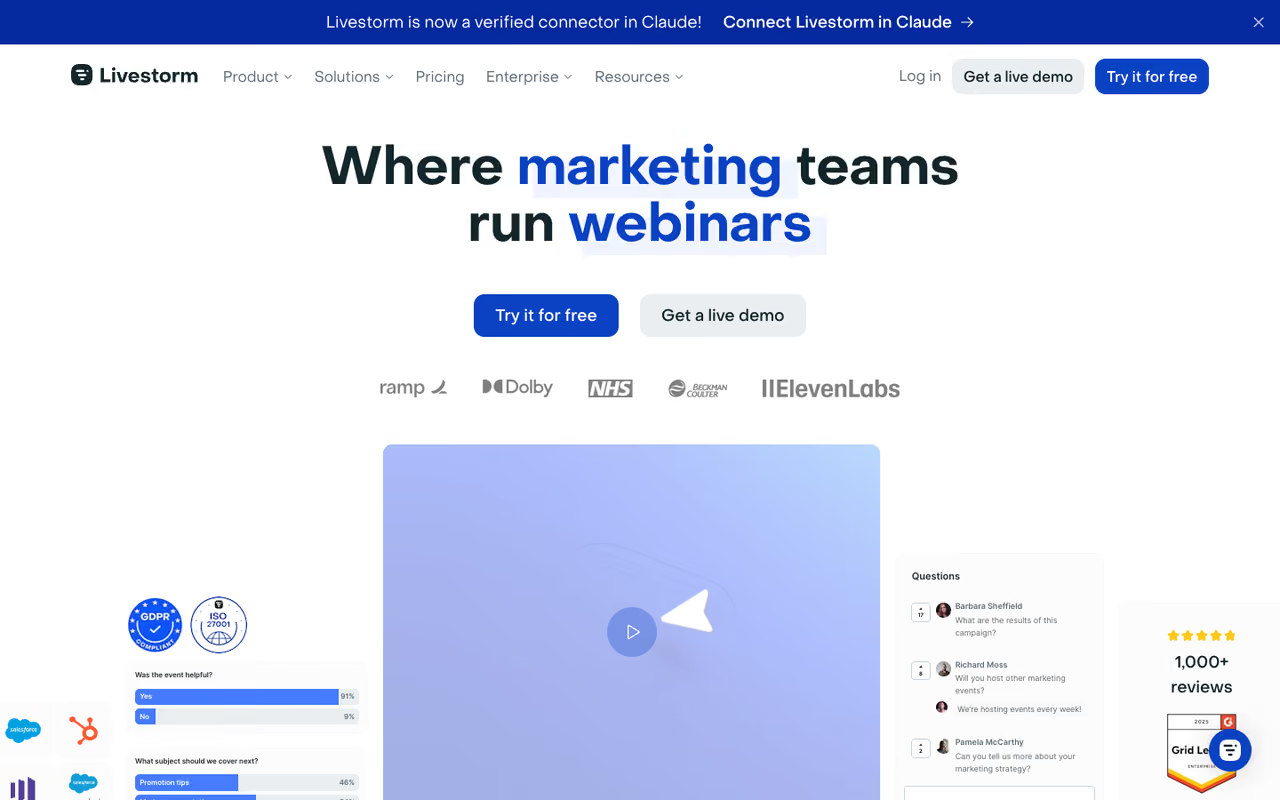
Livestorm is the browser-based platform most B2B marketing teams in Europe reach for, and for good reason. It is GDPR-first by design, the analytics are genuinely useful, and the integrations with Salesforce, Marketo, and Pardot are solid rather than bolted on.
Who it's for: B2B marketing teams, especially EU organizations that need compliance handled and clean reporting for the demand-gen team.
The browser-based favorite of B2B and EU marketing teams who need GDPR handled and analytics ops will actually open. Credit pricing makes budgeting harder, and several features need a sales call to price.
Livestorm moved to a pay-per-attendee model. The Pro plan is built around attendee credits at roughly €2.50 each, covering up to 3,000 live attendees per event with unlimited events and recordings. One credit is consumed per unique participant per session over a 12-month window, and team members do not count. Enterprise adds 12-hour sessions, a dedicated CSM, and SLA-backed support. The structure is laid out on Livestorm's pricing page.
The standout: the analytics. Livestorm gives you attendance, engagement, and conversion data in a layout your marketing ops person will actually open, and the credit model means an under-attended webinar does not waste a full seat allocation.
The catch: the credit-based pricing makes budgeting harder. If your webinars are unpredictable in size, you can burn through credits faster than expected, and several useful features sit behind add-ons that require a sales call to price. If you want a flat, knowable monthly bill, this model will frustrate you.

eWebinar: the automated webinar specialist
eWebinar does one thing and does it better than anyone: it turns a recorded video into an automated, interactive webinar that runs on a schedule or on demand. If your goal is an evergreen funnel that sells a product or onboards customers without you showing up live, this is the tool.
Who it's for: founders and marketers who want a set-and-forget evergreen webinar, plus customer success teams automating onboarding sessions.
The specialist for founders and marketers who want a set-and-forget evergreen webinar that feels live. It is purely automated with no live support, and $99/month for one webinar is pricey for a single funnel.
Level 1 is $99/month (about $1,010/year) for one active eWebinar and 1,000 registrants per month. Level 2 is $199/month for five webinars and 3,000 registrants. Level 3 is $299/month for 15 webinars and 5,000 registrants, with extra webinars at $15/month per five. All tiers include unlimited recurring sessions and unlimited team members. Details are on eWebinar's pricing page.
The standout: the interactions feel live even though they are not. Programmed chat messages, polls, and CTAs trigger at set timestamps, and a real person can jump into the chat to answer questions. Attendees rarely realize the presentation is recorded.
The catch: there is no live webinar support at all. This is purely automated. If you need to run a live launch or a real-time Q&A, you will need a second tool. At $99/month for a single webinar, it is also pricey if you only run one evergreen funnel.
If you are building an automated funnel like this, it pairs well with the kind of AI workflow tooling we cover in our roundup of the best AI agents. And if you want a curated shortlist of software across categories, our top tools directory is a good starting point.
Zoom Webinars: the safe, familiar choice
Zoom Webinars is the default for a reason. Everyone knows how to join a Zoom, it scales reliably, and your IT team already trusts it. For large internal town halls or webinars where reliability beats polish, it is hard to argue against.
Who it's for: companies already standardized on Zoom who want webinars without learning a new tool.
The safe, familiar choice for companies already on Zoom, and reliable at 500-plus attendees. It is an add-on that needs a Workplace Pro subscription, and the marketing and analytics features are thin.
the 300-attendee plan is $79/month and the 500-attendee plan is $95/month. The catch most people miss is that Zoom Webinars is an add-on. You need a Zoom Workplace Pro subscription underneath it, so the real cost is higher than the sticker. Capterra and other deal-flow data put the median Zoom Webinars contract closer to $997/year.
The standout: familiarity and reliability. At 500-plus attendees, Zoom holds up better than most, and the recording and transcription tooling is mature.
The catch: the marketing features are thin. Registration pages are basic, engagement analytics are limited compared to Demio or Livestorm, and the add-on pricing model means your final bill is rarely what the webinar page advertised. It is a meeting tool that does webinars, not a webinar platform.
GoTo Webinar: predictable and no-nonsense
GoTo Webinar has been around forever and it shows, in both good and bad ways. The interface is dated, but the pricing is refreshingly transparent and the platform does exactly what it says.
Who it's for: traditional B2B teams who value predictable pricing and an established, trusted name.
A fit for traditional B2B teams who value transparent per-organizer pricing and an established name. The interface feels dated, and there is no real evergreen automation, so you pay for stability, not innovation.
four clear tiers. Lite is $49/month per organizer (annual) for 250 participants, Standard is $99/month for 500, Pro is $199/month for 1,000, and Enterprise is $399/month for 3,000. Monthly billing runs higher. Capterra lists the full GoTo Webinar pricing breakdown.
The standout: you know exactly what you are paying. No attendee credits, no required base subscription, no surprise add-ons. The per-organizer pricing is simple to forecast.
The catch: it feels old. The attendee experience and the analytics lag behind the newer browser-native platforms, and there is no real evergreen automation. You are paying for stability and a recognizable name, not innovation.

WebinarJam: built for selling
WebinarJam is the info-product crowd's tool. If your webinar exists to sell a course, coaching program, or high-ticket offer, the monetization and big-room features are aimed squarely at you.
Who it's for: course creators, coaches, and marketers running sales webinars to large audiences.
Built for course creators and coaches running sales webinars to big audiences, with offers and countdown timers baked in. It is annual-only, from $499/year, so occasional webinar hosts face a real upfront commitment.
sold annually only. Basic is $499/year, Pro is $699/year, and Premium is $999/year, scaling attendee caps from a few hundred up to 5,000. There is no monthly option, so you commit upfront.
The standout: the rooms get big and the selling tools are baked in. Offers, countdown timers, and CTAs are designed to convert during the session, and the price-per-attendee at the top tier is competitive if you fill the room.
The catch: the annual-only commitment is a real barrier if you only run a few webinars a year. The interface can feel cluttered, and if a session has technical hiccups, it tends to do so under load, which is exactly when you do not want it.

Contrast: the modern pick for software companies
Contrast is the newest entrant here and it is aimed at software companies specifically. It runs in the browser, syncs natively with HubSpot, and leans hard into repurposing webinar recordings into clips and content afterward.
Who it's for: B2B SaaS marketing teams that live in HubSpot and want to squeeze content out of every webinar.
A modern option for B2B SaaS teams living in HubSpot who want to turn recordings into clips. It is newer with a smaller ecosystem, and outside HubSpot you lose much of the appeal.
there is a free plan covering unlimited webinars with up to 30 registrants per month and 30-day storage, which is generous for testing. Paid tiers scale by registrant volume; the entry paid plan starts around €60/month, and larger plans are quoted by volume. Check Contrast's pricing page for current numbers since they update tiers regularly.
The standout: the HubSpot integration and the content repurposing. Registrant data, engagement, and lead scores sync automatically, and the built-in editor turns a 45-minute webinar into shareable clips without exporting to a separate tool. G2 named it among the easiest to use in 2026.
The catch: it is newer, so the ecosystem is smaller and pricing can climb quickly for teams with fluctuating webinar volume. If you are not a HubSpot shop, you lose a big part of the appeal.

ON24: the enterprise heavyweight
ON24 is the platform you graduate to when webinars become a core revenue channel and you have the budget to match. It is not for small teams, and it does not pretend to be.
Who it's for: large enterprises running dozens of events a year with serious analytics and content-hub requirements.
The enterprise heavyweight for organizations running dozens of events a year who need deep engagement analytics. Contracts typically run $25,000 or more per year, so it is overkill for anyone running a handful of webinars.
no public pricing. Contracts typically range from $25,000 to over $100,000 per year, with a median around $38,750 based on verified buyer data. Expect 3-5% annual escalation clauses written into multi-year deals. ON24 was acquired by Cvent in April 2026, so the product roadmap is worth watching.
The standout: the depth. Engagement scoring, content hubs, certification tracking, and analytics that feed directly into your demand-gen reporting. At enterprise scale, nothing else here comes close on data.
The catch: the price and the commitment. You sign annual contracts with volume commitments, and the setup is heavyweight. For a team running a handful of webinars a year, it is overkill by an order of magnitude.
How to choose
Skip the feature checklists and answer three questions.
Are your webinars live or evergreen? If you run live sessions, Demio, Livestorm, or Zoom cover you. If you want automated, set-and-forget funnels, go straight to eWebinar. Mixing both? Demio handles live and on-demand without forcing a second tool.
What does your stack run on? HubSpot-native teams should look hard at Contrast. Salesforce and Marketo shops are well served by Livestorm. If everyone already lives in Zoom, the path of least resistance is Zoom Webinars, with the caveat that the marketing features are thin.
How predictable is your audience size? Flat per-organizer pricing (GoTo, Demio) is easiest to budget. Pay-per-attendee (Livestorm) saves money on small webinars but punishes unpredictability. Annual-only commitments (WebinarJam, ON24) only make sense if you run webinars consistently.
For most teams reading this, the honest answer is Demio for live and on-demand, eWebinar if you are purely evergreen. The enterprise options are worth their price only when webinars are a measured revenue line, not a marketing experiment. If you are still mapping out your wider AI and marketing stack, our guide to the best AI marketing tools covers what pairs well with these platforms, and Dupple X helps you stay on top of the tools worth your attention.
FAQ
What is the best webinar platform for small businesses in 2026?
For most small businesses, Demio offers the best balance of price and polish, starting at $45/month billed annually for a clean, browser-based experience with no downloads. If you only run automated webinars, eWebinar at $99/month is purpose-built for evergreen funnels. GoTo Webinar's Lite plan ($49/month per organizer) is a solid no-frills option if you want predictable pricing above all.
Is Zoom Webinars worth it compared to dedicated platforms?
Zoom Webinars is reliable and familiar, but it is a meeting tool that does webinars rather than a true webinar platform. The registration pages and engagement analytics lag behind Demio and Livestorm, and it requires a Zoom Workplace Pro subscription underneath the $79/month webinar add-on. If your team already runs on Zoom and you mainly need reliability at scale, it is worth it. For marketing-driven webinars where lead data matters, a dedicated platform pays off.
What is the cheapest way to run automated webinars?
eWebinar is the dedicated tool for automated webinars, starting at $99/month for one active webinar and 1,000 monthly registrants. If you want to run automated sessions inside a platform that also handles live events, Demio's Growth tier includes on-demand webinars, which can be more cost-effective if you need both live and evergreen in one place.
Do I need a GDPR-compliant webinar platform?
If you collect registrant data from anyone in the EU, yes. Livestorm is built GDPR-first and is the common choice for European B2B teams, with EU data hosting and compliance handled by default. Most enterprise platforms like ON24 also offer compliance, but you should confirm data residency and processing terms in writing before signing.
How much should a webinar platform cost per month?
For a small to mid-sized marketing team, expect to pay $45 to $200 per month for a capable platform like Demio, Livestorm, or GoTo Webinar at a few hundred attendees. Automated-only tools like eWebinar start at $99/month. Enterprise platforms like ON24 run $25,000 or more per year. Total cost of ownership often climbs once you add email automation and landing pages, so budget for the full stack, not just the webinar license. If the budget is zero, our free webinar software comparison checks which free plans fit a small B2B session.
Related guides
Some offers on this page may be paid placements or contain affiliate links.
Across our whole catalogue the median is $24 a month and 33% of tools advertise a free tier. Figures are the lowest recurring monthly price quoted in our own review of each tool, read on 2026-08-19. Full method and every category.
