
Best Social Customer Service Software in 2026

Key facts8 tools compared: Sprout Social, Gorgias, Zendesk, Sprinklr, Hootsuite, Gladly, NapoleonCat…
- 8 tools compared: Sprout Social, Gorgias, Zendesk, Sprinklr, Hootsuite, Gladly, NapoleonCat, Khoros
- Sprout Social (best for: Mid-market marketing + care in one): $199/user/mo
- Gorgias (best for: Ecommerce / Shopify stores): $10/mo (50 tickets)
- Zendesk (best for: Helpdesk-first teams adding social): $55/agent/mo
- Sprinklr (best for: Large enterprise, 30+ channels): ~$50k/yr
Your customers are not opening support tickets. They are tagging you on X, DMing your Instagram, replying to a TikTok comment, and firing off a WhatsApp message all in the same afternoon. If your support team is bouncing between five native apps to catch all of it, things slip. A complaint sits unanswered for six hours and becomes a screenshot with 4,000 likes.
Social customer service software fixes the fragmentation. It pulls every public mention and private message into one inbox, routes conversations to the right agent, tracks response times, and increasingly automates the easy replies. The trick is matching the tool to your reality. A nine-person DTC brand and a global airline running 30 channels need very different things, and the price gap between them is enormous.
I dug through these platforms and their current pricing. The short answer: Sprout Social is the best all-around pick for mid-market teams that handle both marketing and care, Gorgias is the one I'd hand an ecommerce store, and Sprinklr is where enterprises with serious volume end up. Below is the full breakdown with the catches. If you want a wider view of the category, our top tools directory tracks the platforms worth watching.
Quick comparison
| Tool | Best for | Price (starting) | Standout |
|---|---|---|---|
| Sprout Social | Mid-market marketing + care in one | $199/user/mo | Unified Smart Inbox |
| Gorgias | Ecommerce / Shopify stores | $10/mo (50 tickets) | Order data inside every ticket |
| Zendesk | Helpdesk-first teams adding social | $55/agent/mo | Social as one channel of many |
| Sprinklr | Large enterprise, 30+ channels | ~$50k/yr | Channel breadth + AI QA |
| Hootsuite | Publishing teams adding inbox | $99/user/mo | Familiar stream-based UI |
| Gladly | Voice-heavy, people-first brands | ~$180/seat/mo | Customer-centric, not ticket-centric |
| NapoleonCat | Small teams, agencies, SMBs | $79/mo | Auto-moderation + ad comments |
| Khoros | Enterprise community + care | Custom | Community management depth |

Sprout Social: the best all-rounder for mid-market teams
Sprout Social is what I recommend most often when a team needs to publish content and answer customers without buying two separate tools. The Smart Inbox combines messages, comments, mentions, and reviews from every connected network into a single threaded view, so an agent never has to log into Instagram and X separately to handle one customer.
Who it's best for: marketing teams of 5 to 25 people where the same humans post content and field questions. It handles SLA tracking, message tagging, and agent collaboration without the enterprise weight of Sprinklr.
The all-rounder when the same people publish and answer customers, ideal for marketing teams of 5 to 25. The catch is per-user pricing: a team of eight on Advanced runs over $38,000 a year, so pure care teams overpay.
Pricing is per user and it climbs. The Standard plan is $199/user/month, Professional is $299, and Advanced is $399, all billed annually. The Advanced tier is where you get sentiment analysis, the API, and helpdesk integrations. AI features like Enhance Reply live up at that top tier.
The catch: per-user pricing punishes growth. A team of eight on Advanced runs over $38,000 a year before add-ons like Listening, which are billed separately. For pure social care without the publishing side, you're paying for a lot you won't touch.

Gorgias: the ecommerce specialist
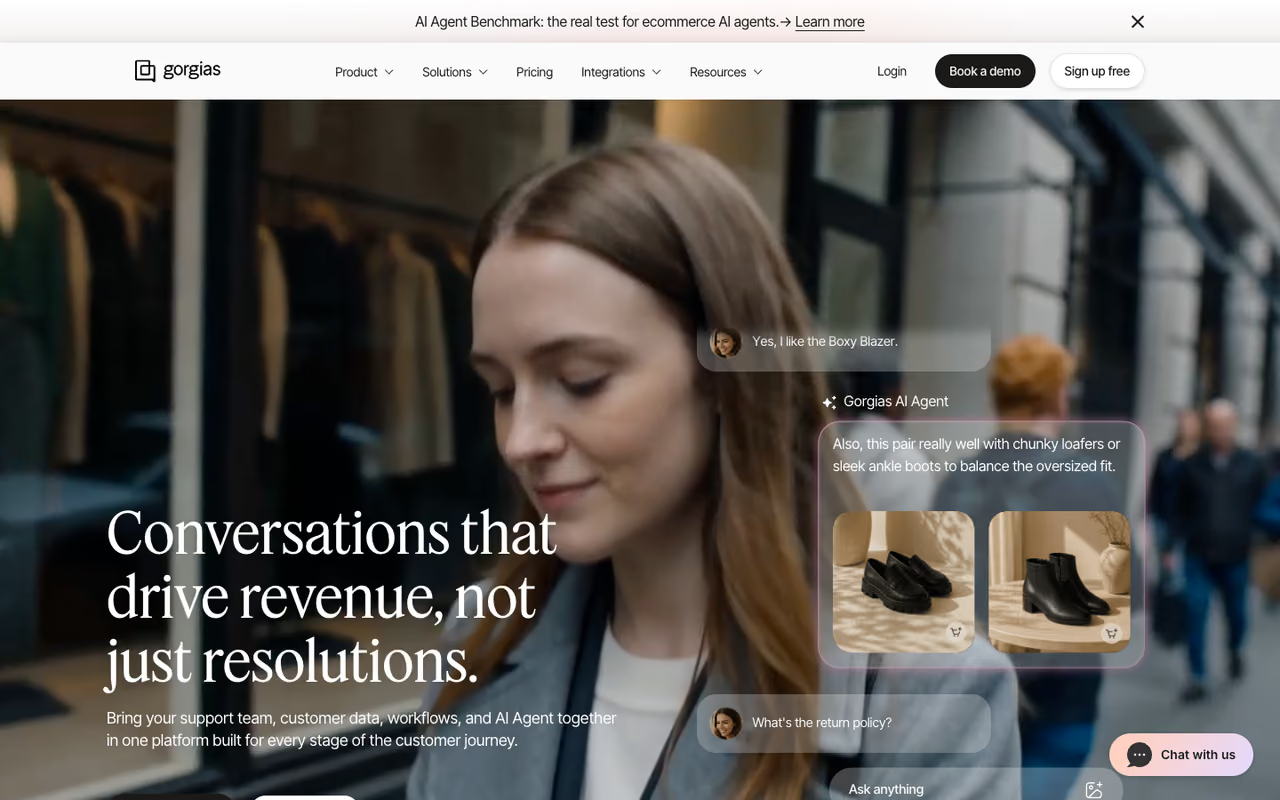
Gorgias was built for online stores, and it shows. When a customer DMs your Instagram asking "where is my order," the agent sees the full Shopify order, tracking, and refund history right beside the message. They can issue a refund or edit the order without leaving the ticket. Most general helpdesks can't do that natively.
Who it's best for: Shopify, BigCommerce, and Magento stores that get a steady stream of social and DM questions tied to orders. Small and mid-sized DTC brands love it.
The pricing model is refreshingly different. Instead of per-agent, Gorgias charges by billable tickets and gives you unlimited team members on every plan. Starter is $10/month for 50 tickets, Basic is $50/month (annual) for 300, Pro is $300/month for 2,000, and Advanced is $750/month for 5,000. The AI Agent add-on resolves conversations fully autonomously at $0.90 per resolved conversation on annual billing.
The clear pick for Shopify, BigCommerce, and Magento stores whose social DMs are about orders, with refunds handled inside the ticket. Ticket-based pricing can spike in a viral month, and non-ecommerce businesses get far less out of it.
The catch: ticket-based pricing can surprise you in a busy month. Overages run $36 per 100 tickets on the Pro plan, and a viral post that triggers hundreds of comments pushes you into a higher bracket fast. It's also genuinely ecommerce-focused, so SaaS or service businesses get less out of it. If you're building out a store's full stack, our list of the best AI tools for ecommerce is a useful companion.

Zendesk: social as one lane in a bigger helpdesk

Zendesk isn't a social-first tool, and that's exactly why some teams pick it. If you already run email, chat, and phone support through a ticketing system, adding Facebook, Instagram, WhatsApp, and X messaging as channels keeps everything in one queue. Social becomes one lane in a unified helpdesk rather than a separate operation.
Who it's best for: support-led teams where social is meaningful but not dominant, and you want every conversation in the same place with the same routing rules.
Zendesk Suite pricing starts at $55/agent/month for Team, $89 for Growth, and $115 for Professional, billed annually. Social messaging channels are included across the Suite tiers. The AI add-on layers on roughly $50/agent/month if you want advanced automation.
The catch: as a publishing or listening tool, it's thin. You won't schedule content or monitor brand sentiment across the open web the way Sprout or Sprinklr let you. It treats social as inbound support, full stop. If your social team and support team are different people with different goals, Zendesk only serves one of them.
Choose Zendesk if support-led teams already run email, chat, and phone there and want social as one lane in a single queue. It is thin for publishing or listening, so it only serves the support side.

Sprinklr: the enterprise heavyweight
Sprinklr is the platform large brands graduate to when they're managing dozens of channels and millions of conversations. It covers over 30 channels including social, WhatsApp, live chat, SMS, and email on a single codebase. Its AI quality management can score 100% of conversations across channels, and its conversational IVR deflects inbound calls to self-service.
Who it's best for: global enterprises with 25-plus agents, high volume, and a need for governance, workforce management, and listening under one roof.
Here's the big 2026 change: Sprinklr killed its self-serve plans, with end of service for existing self-serve customers on April 30, 2026. New customers now go through enterprise contracts only, with typical minimums running $50,000 to $100,000 per year and a median annual contract around $129,000.
The catch: the price and the complexity. Sprinklr is genuinely powerful, but it's overkill for small teams and the implementation is a project, not a weekend setup. On G2 it scores 8.1 for social customer service against Sprout's 8.6, so you're paying enterprise rates and still not topping the category.
Built for global enterprises with 25-plus agents that need governance, workforce management, and listening in one place. It is overkill for small teams, with $50,000 to $100,000 minimums and an implementation that is a project.

Hootsuite: the publishing veteran with an inbox
Hootsuite has been around longer than most of this list, and a lot of social managers already know its stream-based layout by heart. Its inbox consolidates comments and messages, and after folding in Sparkcentral's technology, its care features got noticeably stronger for handling DMs and mentions at volume.
Who it's best for: teams that primarily publish and schedule but want to add a real customer-care inbox without switching their whole stack.
A sensible add-on inbox for teams that mostly publish and schedule and want real customer care without switching stacks. Per-user pricing climbs with headcount, and care is not its core DNA, so purpose-built tools feel more polished.
Pricing is per user: the Standard plan is $99/user/month with 5 social accounts, and Advanced is $249/user/month with unlimited accounts, both on annual billing.
The catch: like Sprout, the per-user model gets expensive as your team grows, and Hootsuite's core DNA is publishing, not care. The dedicated Sparkcentral inbox historically started around $600/month for bigger care operations. For deep social-service workflows, purpose-built tools feel more polished.
If you're still mapping out your wider stack, our roundup of the best AI social media tools covers the publishing and content side that pairs with these care platforms.

Gladly: people-first, not ticket-first
Gladly flips the usual model. Instead of treating each message as a disposable ticket, it builds a single lifelong conversation per customer across email, chat, SMS, voice, and social. An agent picking up an Instagram DM sees the customer's entire history in one thread, no matter which channels they used before.
Who it's best for: retail and consumer brands that compete on relationships and have voice-heavy support, where knowing the customer matters more than closing tickets fast.
Go with Gladly for retail and consumer brands that compete on relationships and voice-heavy support, thanks to one lifelong conversation per customer. It is expensive and rigid, with seat minimums that overshoot simple needs.
Pricing is quote-based and premium, roughly $180 to $210 per seat/month on annual contracts with seat minimums. SMS is billed on top.
The catch: it's expensive and rigid. The 12-month commitment with minimum seats means you pay for a fixed headcount even if your team shrinks. The people-first model is genuinely good, but for a small team with simple needs it's more cost than you need.

NapoleonCat: the affordable pick for small teams
NapoleonCat is the one I'd point a small business or agency toward. Its Social Inbox covers comments, messages, and reviews, and its standout is automatic moderation: you can auto-hide spam, auto-reply to common questions, and moderate comments on Facebook, Instagram, and TikTok ads. That last part matters because ad comments are a real support and reputation channel most tools ignore.
Who it's best for: SMBs and agencies managing multiple client accounts on a budget.
Pricing is flat, not per-seat: the Pro plan with the Social Inbox runs $89/month, Expert is $119/month, and plans start with 5 social profiles and 2 users.
The catch: it's not built for high-volume care. There's no deep SLA management, no voice, and the collaboration tools are basic next to Sprout or Zendesk. Past a certain ticket volume you'll outgrow it. For a lean team handling a few hundred interactions a month, the value is hard to beat.
The affordable choice for small businesses and agencies juggling client accounts, with auto-moderation of spam and ad comments. Flat pricing keeps costs low, but it has no deep SLA management or voice and you will outgrow it.

Khoros: enterprise care plus community
Khoros competes with Sprinklr at the top end, but its real edge is community management. If you run branded forums or support communities alongside social care, Khoros ties them together so a question answered in your community deflects dozens of repeat tickets. It's strong in telecom, healthcare, and wellness.
Who it's best for: enterprises where an owned community is a core support channel, not an afterthought.
Reach for Khoros when an owned community is a core support channel for an enterprise, since it ties forums to social care. It is narrower than Sprinklr on listening and analytics, and small or mid teams should skip it.
Pricing is custom and enterprise-tier only, in the same range as Sprinklr.
The catch: Khoros is narrower than Sprinklr on listening and analytics, so if breadth across channels is your priority, Sprinklr wins. And like any enterprise platform, the contract and onboarding are a commitment. Small and mid teams should skip it.
How to choose the right one
Forget feature lists for a second and answer three questions.
First, who handles social? If the same people post content and answer customers, a unified tool like Sprout or Hootsuite saves you a second subscription. If support is a separate team with its own ticketing, bolt social onto Zendesk and keep one queue.
Second, what's your volume and business model? Ecommerce stores with order questions should start with Gorgias because the order context inside every ticket is a real time-saver. Teams under a few hundred interactions a month should look at NapoleonCat before paying per-seat anywhere. Brands with 25-plus agents and 20-plus channels are in Sprinklr or Khoros territory whether they like the price or not.
Third, per-user or per-volume? Per-user pricing (Sprout, Hootsuite, Zendesk, Gladly) is predictable but punishes team growth. Per-volume pricing (Gorgias tickets and AI resolutions) scales with usage and can be cheaper for small teams but spikes in busy months. Model your actual numbers first.
One more thing worth budgeting for: AI agents now resolve a real share of social conversations without a human. Gorgias and Sprinklr both lean hard into autonomous resolution, and if a chunk of your inbound is repetitive "where's my order" questions, that automation pays for itself. Our guides to the best AI customer support tools and the best AI chatbots for business go deeper on that layer.
Want a faster way to keep up with which tools are actually worth your time? Dupple X is our research membership for operators who'd rather not spend a weekend comparing pricing pages. You can start a yearly trial here.
FAQ
What is social customer service software?
It's a tool that pulls customer messages, comments, mentions, and reviews from social platforms (Instagram, X, Facebook, TikTok, WhatsApp) into one inbox so a support team can respond from a single place. Most add routing, SLA tracking, tagging, analytics, and increasingly AI that drafts or fully resolves replies.
How much does social customer service software cost?
It ranges enormously. Flat-rate tools like NapoleonCat start at $79 to $119/month total. Per-seat platforms like Zendesk ($55/agent/month) and Sprout Social ($199/user/month) scale with team size. Enterprise platforms like Sprinklr now require contracts that typically start at $50,000 per year. Match the model to your volume before the price tag.
What's the best social customer service software for ecommerce?
Gorgias is the strongest fit for online stores. It integrates directly with Shopify, BigCommerce, and Magento, showing the customer's full order and tracking history inside every social message so agents can refund or edit orders without leaving the ticket. Its ticket-based pricing also suits stores with unpredictable seasonal volume.
Can social customer service software automate replies with AI?
Yes. Most 2026 platforms now ship AI agents that resolve common questions autonomously. Gorgias charges about $0.90 per resolved conversation, Sprinklr scores and automates at scale, and Sprout's Enhance Reply drafts responses for agents to approve. Automation works best on repetitive, high-volume questions like order status or password resets.
Do I need a separate tool if I already use Zendesk?
Not necessarily. Zendesk includes social messaging channels (Facebook, Instagram, WhatsApp, X) across its Suite plans, so you can route social into your existing helpdesk queue. You'd only add a dedicated tool like Sprout or Sprinklr if you also need content publishing, social listening, or deeper community management that Zendesk doesn't cover.
Sprout Social or Sprinklr: which is better?
For most mid-market teams, Sprout Social. It's easier to set up, costs far less, and scores higher on G2 for social customer service (8.6 vs 8.1). Sprinklr wins only at true enterprise scale, when you're running 30-plus channels with thousands of daily conversations and need governance, workforce management, and listening unified in one platform.
Related guides
Some offers on this page may be paid placements or contain affiliate links.
