
The 8 Best Inventory Management Software in 2026

Key facts8 tools compared: Zoho Inventory, Cin7 Core, Katana, Fishbowl, inFlow, Sortly, Square for…
- 8 tools compared: Zoho Inventory, Cin7 Core, Katana, Fishbowl, inFlow, Sortly, Square for Retail, MRPeasy
- Zoho Inventory (best for: Multichannel sellers on a budget): Free, then $29/mo
- Cin7 Core (best for: Scaling ecommerce + wholesale): $349/mo
- Katana (best for: Makers and light manufacturing): $299/mo
- Fishbowl (best for: QuickBooks-heavy warehouses): $349/mo
Stockouts cost you sales. Overstock ties up cash. And somewhere between those two failures sits a spreadsheet that lied to you about how many units you actually have on the shelf. If you have ever oversold a SKU on a Friday night and spent Monday apologizing to customers, you already know why inventory software exists.
The problem is that "inventory management software" covers wildly different products. A maker selling candles on Shopify needs something completely different from a contract manufacturer tracking work orders and bills of materials. Most roundups blur that line and recommend the same enterprise tool to everyone. I compared the main options across retail, ecommerce, and light manufacturing to sort out who each one actually fits.
Short answer: Zoho Inventory is the best starting point for most small and mid-size sellers. It is affordable, syncs across sales channels, and the free tier is genuinely usable. If you make physical products, Katana handles production tracking better at a similar price. Here is the full breakdown.
Quick comparison
| Tool | Best for | Starting price | Standout |
|---|---|---|---|
| Zoho Inventory | Multichannel sellers on a budget | Free, then $29/mo | Free tier + Zoho ecosystem |
| Cin7 Core | Scaling ecommerce + wholesale | $349/mo | Built-in EDI and B2B portal |
| Katana | Makers and light manufacturing | $299/mo | Live production scheduling |
| Fishbowl | QuickBooks-heavy warehouses | $349/mo | Deep QuickBooks integration |
| inFlow | Wholesale and B2B fulfillment | $186/mo | Showroom and sales orders |
| Sortly | Field teams and physical assets | Free, then $49/mo | Photo-first mobile app |
| Square for Retail | Brick-and-mortar retail | Free, then $89/mo | POS and inventory in one |
| MRPeasy | Small manufacturers needing MRP | $49/user/mo | Full production planning |
Zoho Inventory: the best all-around pick
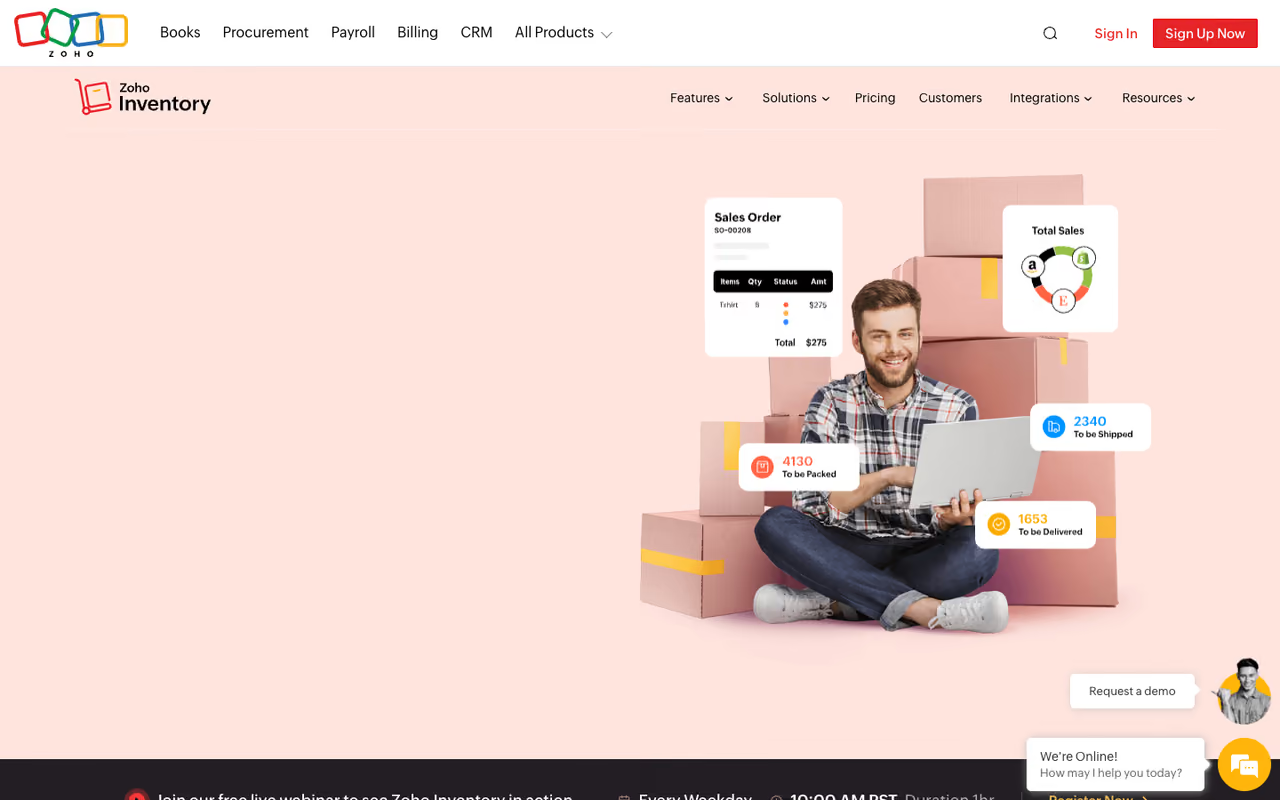
Zoho Inventory is cloud order and stock management built for sellers who move product across more than one channel. It connects to Shopify, Amazon, eBay, and Etsy, tracks stock across multiple warehouses, and handles purchase orders, sales orders, and shipping from one place.
Who it is best for: small to mid-size ecommerce and wholesale businesses that want real multichannel sync without paying enterprise prices. If you already use Zoho Books or Zoho CRM, the connection is automatic and that alone can justify the choice.
The all-around pick for small to mid-size ecommerce and wholesale sellers who want real multichannel sync without enterprise prices, especially if you already use Zoho Books or CRM. Order limits are real (500 on Standard) and there is no full MRP.
Pricing is the headline. There is a free plan that covers 50 orders a month with one user and two locations, which is enough to run a side business or validate a new store. Paid plans, billed annually, run $29/month (Standard, 500 orders), $79/month (Professional, 3,000 orders), $129/month (Premium), and $249/month (Enterprise, 15,000 orders), per the official pricing page. Serial and batch tracking show up at the Professional tier.
The standout is value. You get composite items, dropshipping, backorders, and multi-warehouse tracking at a price point where competitors are still asking for a sales call. The ecosystem integration is the quiet multiplier: accounting, CRM, and inventory talking to each other without middleware.
The catch: order limits are per-month and they are real. Hit 500 orders on Standard and you either buy add-on order packs or jump a tier. Support is decent but not white-glove, and the deepest manufacturing features (full MRP, work orders) are not here. This is a stock-and-fulfillment tool, not a production system.

Cin7 Core: built for ecommerce that is outgrowing its tools
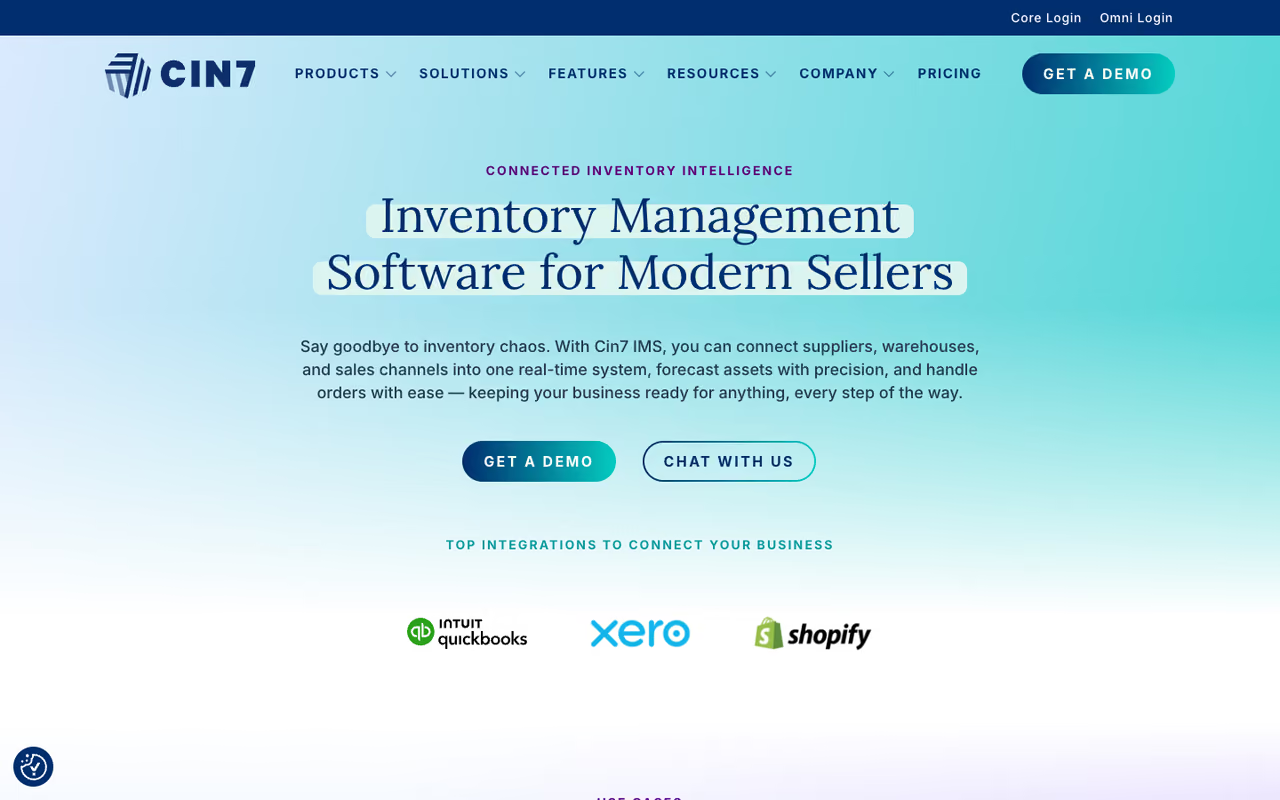
Cin7 (the product formerly known as DEAR) is an inventory and order management platform aimed at product businesses running serious multichannel volume. It does built-in EDI, B2B sales portals, and connects to a long list of marketplaces, 3PLs, and accounting tools.
Who it is best for: growing ecommerce and wholesale operations that sell across many channels and are tired of stitching together apps. If you are shipping into big retailers that require EDI, this is one of the few mid-market tools that includes it.
Built for growing ecommerce and wholesale operations selling across many channels, with EDI, B2B portals and forecasting included. At $349/month minimum it is overkill for small teams, and setup is involved enough that many customers pay for onboarding.
Pricing starts at $349/month for the Standard plan (6,000 sales orders a year, 5 users), $599/month for Pro, and $999/month for Advanced, according to Cin7's pricing page. The Omni product, aimed at larger brands, is custom-quoted.
The standout is breadth without a custom enterprise contract. EDI, branded B2B ordering, demand forecasting, and warehouse management come baked in. For a brand doing meaningful revenue, all of that in one subscription beats licensing four separate tools.
Where it falls short: it is overkill for small teams. At $349/month minimum, this is not a tool you grow into casually, and setup is involved enough that many customers pay for onboarding. A few hundred orders a month does not need this much runway yet.

Katana: the maker's choice
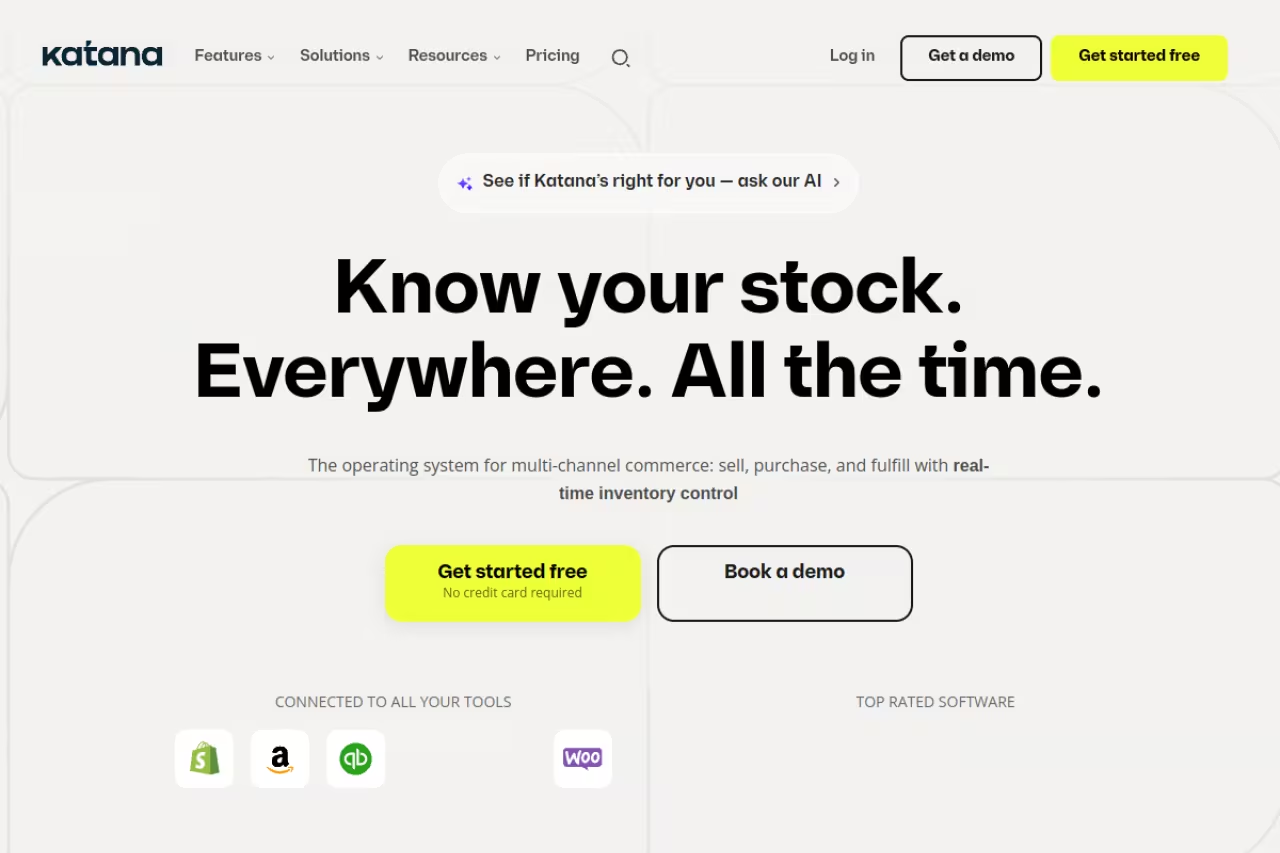
Katana is cloud inventory built around manufacturing. It tracks raw materials, work-in-progress, and finished goods together, then schedules production so you can see what you can actually build with the stock on hand. It plugs into Shopify, WooCommerce, QuickBooks, and Xero.
Who it is best for: makers, small manufacturers, and anyone running a bill of materials. If you turn raw inputs into finished products, Katana's live production view is the feature you will use every day.
The maker's choice for small manufacturers running a bill of materials, with a live production view and unlimited users, SKUs and integrations from $299/month. If you manufacture nothing, you pay for capability you will never touch.
Pricing starts at $299/month, and as of February 2026 Katana revamped its pricing after customer complaints about high-volume low-ticket orders. All plans include unlimited users, SKUs, and integrations, which is unusual in this category and removes the per-seat math that plagues competitors.
The standout is the production engine. Most "inventory" tools treat manufacturing as an afterthought. Katana makes it the center: visual scheduling, automatic material booking, and real-time stock as you produce. For a small brand that builds its own products, that clarity is worth more than a longer feature list.
The catch: it is purpose-built, so if you do not manufacture anything, you are paying for capability you will never touch. Reporting is lighter than the enterprise systems, and very high order volumes can still get expensive depending on your mix. Pure resellers should look at Zoho or Cin7 instead.
This is also where lean teams use AI to fill gaps. If you are pairing inventory software with forecasting or research, Dupple X bundles the AI tools operators actually use to move faster.

Fishbowl: the QuickBooks warehouse workhorse
Fishbowl is a long-running inventory and manufacturing platform best known for its tight QuickBooks relationship. It handles multi-location warehousing, barcode scanning, manufacturing, and asset tracking, available both on-premise and as the cloud-based Fishbowl Drive.
Who it is best for: established small and mid-size businesses already living in QuickBooks that need warehouse-grade control. If accounting runs on QuickBooks and you have outgrown its native inventory features, Fishbowl is the natural bridge.
The natural bridge for established small and mid-size businesses living in QuickBooks that need warehouse-grade control, with one of the most mature accounting syncs around. The interface feels dated and real costs land above the $349/month starting price.
Pricing starts around $349/month for Fishbowl Drive (cloud, 2 users) and $399/month for Fishbowl Advanced (on-premise with hosting and one integration), based on current G2 pricing data. Costs climb with extra seats and integrations, so treat the starting number as a floor.
The standout is the QuickBooks sync. It is one of the most mature accounting integrations in the category, which matters when inventory value has to match the books exactly. The barcode and warehouse features are battle-tested.
Where it falls short: the interface feels dated next to Katana or Cin7, and the real cost lands higher than the sticker once you add users and modules. The on-premise legacy means setup can be heavier than a pure cloud tool. You are buying reliability and QuickBooks depth, not a modern UI.

inFlow: straightforward wholesale and B2B
inFlow is an inventory system aimed at wholesalers, distributors, and B2B sellers. It covers purchase orders, sales orders, barcoding, and a built-in B2B showroom that lets customers place orders directly.
Who it is best for: small wholesale and B2B operations that want order management plus a customer-facing ordering portal without building one. The showroom alone pulls it ahead for distributors.
A straightforward fit for small wholesale and B2B operations, and the built-in showroom lets buyers order for themselves. Tier order caps bite busy distributors fast, manufacturing features cost extra, and its integration ecosystem is smaller than Cin7's.
Pricing runs $186/month for Entrepreneur (2 users, 100 sales orders/month), $436/month for Small Business (5 users, 1,000 orders), and $999/month for Mid-Size (10 users, 5,000 orders), with 20% off for annual billing per Capterra's listing. BOM and work orders are paid add-ons.
The standout is the B2B showroom plus clean order workflows. inFlow nails the unglamorous parts of wholesale: reorder points, purchasing, and letting your buyers self-serve. It is easier to learn than Cin7 or Fishbowl.
The catch: order caps are tied to each tier, so a busy distributor can hit the Entrepreneur ceiling fast and jump to a much pricier plan. Manufacturing features cost extra, and the ecosystem of integrations is smaller than Cin7's.

Sortly: photo-first tracking for field teams
Sortly takes a different angle. Instead of order management, it focuses on visual asset and inventory tracking with a phone-first app. You photograph items, organize them into folders, scan barcodes and QR codes, and check stock from anywhere. Think tools, equipment, parts, and supplies more than ecommerce SKUs.
Who it is best for: field service teams, contractors, labs, and any operation tracking physical stuff across locations where a photo beats a spreadsheet row. If your "inventory" is equipment and consumables, Sortly fits where the others do not.
Pick it for field teams, contractors and labs tracking equipment and consumables, where photos and mobile scanning beat a spreadsheet. It has no real order management, marketplace sync or accounting depth, so it is asset tracking, not an ecommerce backbone.
Pricing includes a free plan for 1 user and 100 items. Paid tiers, billed annually, are $49/month (Advanced, 500 items, 2 users), $149/month (Ultra, 2,000 items, 5 users), and $299/month (Premium), per Sortly's pricing. Month-to-month costs slightly more.
The standout is the mobile experience. The app is the product, and it shows. Scanning, photos, custom fields, and low-stock alerts all work smoothly on a phone, which is exactly what a tech in a van or a manager on a warehouse floor needs.
Where it falls short: it is not built for selling. There is no real order management, no marketplace sync, and no accounting depth. Item caps on lower tiers are tight. This is asset tracking done well, not an ecommerce backbone.
Square for Retail: POS and inventory in one box
Square for Retail bundles point of sale, payments, and inventory into one system aimed at physical stores. You track stock, get low-stock alerts, manage purchase orders and vendors, and sell across register, online store, and locations from the same catalog.
Who it is best for: brick-and-mortar retailers and omnichannel shops that want POS and inventory unified instead of bolting an inventory app onto a separate register. If you already take payments with Square, turning on retail inventory is frictionless.
A natural fit for brick-and-mortar and omnichannel retailers who want POS and inventory unified, especially if you already take payments with Square. Processing fees add up at volume and inventory depth tops out below dedicated tools.
Pricing has a Free plan ($0/month, you pay only processing fees) that includes basic inventory tracking and unlimited items. The Plus plan runs $89/month per location and unlocks COGS reports, vendor management, and advanced inventory, with Premium custom-quoted, per NerdWallet's review. Note that processing fees apply on every sale regardless of plan.
The standout is the all-in-one simplicity. Inventory updates as you ring sales, so your counts stay live without a sync step. For a single store or a small chain, that tight loop between selling and stock is the whole pitch.
The catch: you are tied to the Square payments ecosystem, and the processing fees add up at volume. Inventory depth tops out below dedicated tools, and it is weak for manufacturing or complex multichannel wholesale. Great for retail, limiting for everything else.

MRPeasy: real MRP for small manufacturers
MRPeasy is a cloud ERP and material requirements planning system built specifically for small manufacturers and distributors. It ties inventory directly to production planning, purchasing, sales orders, and shop-floor scheduling, with full bill-of-materials and work-order support.
Who it is best for: small manufacturers (roughly 10 to 200 employees) that have outgrown spreadsheets and need true production planning, not just stock counts. If you schedule production runs and track WIP, this goes deeper than Katana on the planning side.
Real production planning for small manufacturers of roughly 10 to 200 employees who have outgrown spreadsheets, going deeper than Katana on planning. The interface is functional rather than pretty, and per-user pricing from $49 scales with headcount.
Pricing is per user with a two-user minimum: $49/user/month (Starter), $69 (Professional), $99 (Enterprise), and $149 (Unlimited), per MRPeasy's pricing page. Annual billing brings discounts.
The standout is the planning depth. Production scheduling, capacity planning, lot traceability, and procurement all connect, giving small shops ERP-grade control at a fraction of a full ERP rollout. It is a lot of system for the money.
Where it falls short: the interface is functional rather than pretty, and the per-user pricing scales with headcount, so a larger shop pays accordingly. Pure sellers and retailers will find most of the manufacturing features irrelevant. It rewards businesses that genuinely plan production.
How to choose
Start with what you do, not with feature lists.
If you sell across channels and watch your budget, Zoho Inventory is the default. Multichannel sync, multi-warehouse, and purchasing at a price nobody else matches, with a free tier to test before paying.
If you make physical products, the question is depth. Light manufacturing and a clean visual workflow point to Katana. Heavier production planning, capacity, and traceability point to MRPeasy.
If you run a store, look at where sales happen. Brick-and-mortar with a register favors Square for Retail. Wholesale with purchase orders and a buyer portal favors inFlow. High-volume multichannel ecommerce that needs EDI favors Cin7 Core. Tracking equipment instead of selling it points to Sortly. And if your accounting already lives in QuickBooks, Fishbowl is the proven bridge.
One rule that saves money: do not buy for the company you hope to be in three years. Order caps and per-user pricing mean you can always move up, and overpaying for unused capacity today is its own kind of waste. For more on stacking the right operational tools, see our guides to the best ERP software, the best AI supply chain tools, and the best AI tools for ecommerce. You can also browse our wider top tools directory. If AI forecasting is on your roadmap, Dupple X gives you the tools to get there.
FAQ
What is the best inventory management software for small businesses?
For most small businesses, Zoho Inventory offers the best mix of price and capability. It has a free plan, paid tiers from $29/month, multichannel sync, and multi-warehouse support. If you manufacture products, Katana is the better small-business pick; if you run a physical store, Square for Retail combines POS and inventory in one.
How much does inventory management software cost in 2026?
It ranges widely. Entry tools like Zoho Inventory and Sortly start free or around $29 to $49/month. Mid-market platforms like Cin7, Fishbowl, and inFlow start at $186 to $349/month. Per-user systems like MRPeasy run $49 to $149 per user. Expect real costs above the sticker once you add users, integrations, or order capacity.
Is there free inventory management software?
Yes. Zoho Inventory has a free plan covering 50 orders a month, Sortly offers a free tier for 100 items, and Square for Retail has a $0/month plan (you pay only payment processing fees). These free tiers are genuinely usable for small operations, though order and item caps push growing businesses toward paid plans.
What is the difference between inventory and manufacturing software?
Inventory software tracks stock levels, orders, and fulfillment for products you buy and resell. Manufacturing software adds bills of materials, work orders, and production scheduling for products you build from raw materials. Tools like Katana and MRPeasy cover both; Zoho Inventory and Square focus on stock and sales without deep production planning.
Does inventory management software integrate with QuickBooks?
Most do. Fishbowl has one of the deepest QuickBooks integrations in the category and is often chosen specifically for it. Zoho Inventory, Cin7, Katana, and inFlow also sync with QuickBooks Online, though the depth varies. If accounting accuracy is critical, verify the sync covers cost of goods and stock value, not just sales totals, and pair it with the right accounting software for small business.
Which inventory software is best for ecommerce?
For high-volume multichannel ecommerce, Cin7 Core leads thanks to built-in EDI, marketplace connections, and B2B portals. For smaller ecommerce sellers, Zoho Inventory delivers most of the same multichannel sync at a far lower price. Pair either with the right AI tools for ecommerce to handle forecasting and listings.
Related guides
Some offers on this page may be paid placements or contain affiliate links.
