
Best Expense Management Software in 2026 (Compared and Ranked)

Key facts8 tools compared: Ramp, Brex, Expensify, Airwallex, Zoho Expense, Navan, SAP Concur, Rippling…
- 8 tools compared: Ramp, Brex, Expensify, Airwallex, Zoho Expense, Navan, SAP Concur, Rippling Spend
- Ramp (best for: Most startups and SMBs): Free; Plus $15/user/mo
- Brex (best for: Funded startups, multi-entity): Free; Premium $12/user/mo
- Expensify (best for: Solo and small teams): Free; paid from $5/user/mo
- Airwallex (best for: International spend): Free; Grow $12/user/mo
Expense management used to mean a shoebox of receipts and a finance person quietly resenting you. In 2026 it means corporate cards that block out-of-policy spend before it happens, OCR that reads a receipt photo in two seconds, and a sync that pushes everything into your accounting software without a human touching a spreadsheet. The category got good. The hard part now is picking.
This guide compares the main players against the questions that actually matter: how fast you can close the books, how much busywork the software removes, and what it really costs once your headcount grows. Most of the friction comes from the gap between the marketing page and what your accountant sees on the 28th of the month.
If you want the short answer: for most startups and growing teams, Ramp is the one to beat. It's free, the card controls are genuinely good, and it removes more manual work than anything else on this list. But "best" depends on whether you spend in one currency or twenty, whether you travel constantly, and whether you already live inside an HR platform. Here's the full breakdown.
Quick comparison
| Tool | Best for | Price | Standout |
|---|---|---|---|
| Ramp | Most startups and SMBs | Free; Plus $15/user/mo | AI that auto-reviews expenses |
| Brex | Funded startups, multi-entity | Free; Premium $12/user/mo | Global card issuing in 50+ countries |
| Expensify | Solo and small teams | Free; paid from $5/user/mo | Fast SmartScan receipt capture |
| Airwallex | International spend | Free; Grow $12/user/mo | Native multi-currency, low FX markup |
| Zoho Expense | Budget-conscious teams | Free (3 users); from $3/user/mo | Cheapest paid tier that's actually full |
| Navan | Travel-heavy teams | Free travel; Expense $15/user/mo | Booking and expense in one flow |
| SAP Concur | Large enterprises | Custom (~$8-18/user/mo) | Deep compliance and global tax |
| Rippling Spend | Companies already on Rippling | From ~$11/user/mo | Tied to payroll and HR data |

Ramp: the default pick for most teams
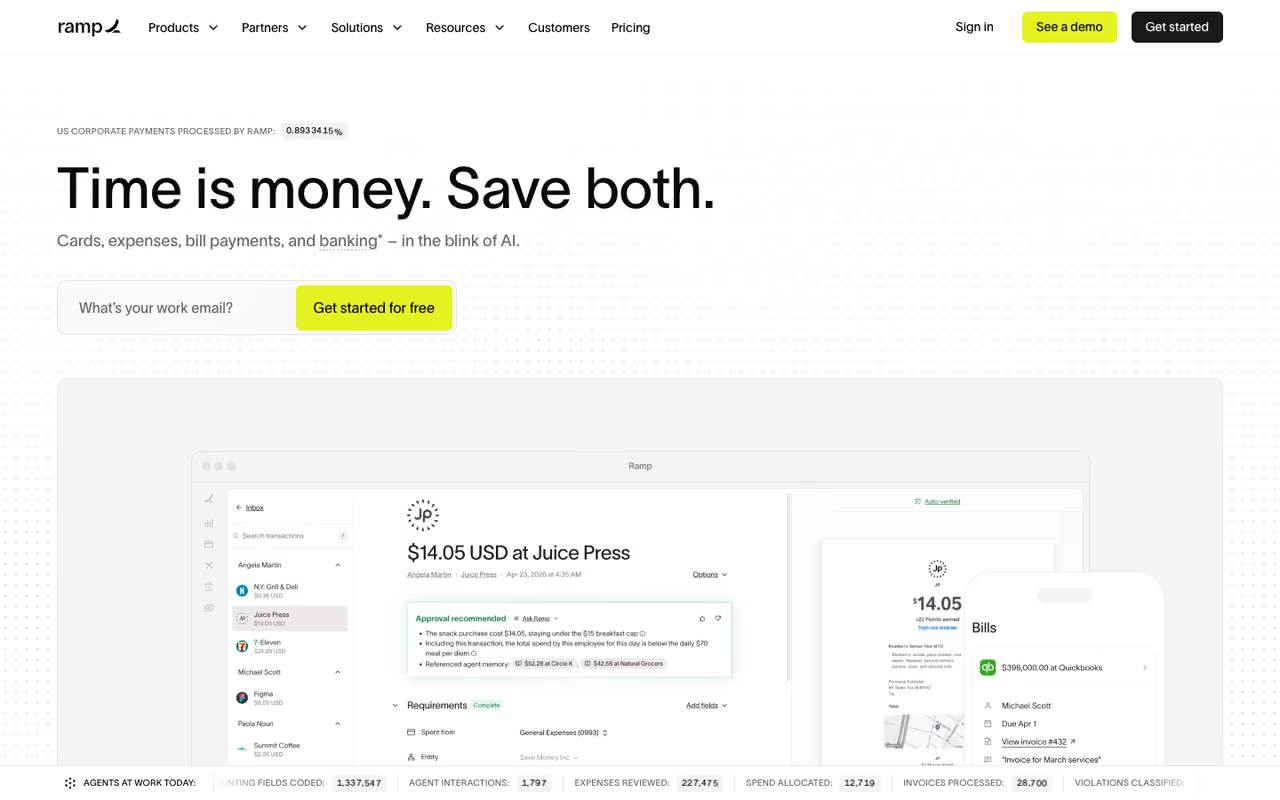
Ramp bundles corporate cards, expense management, bill pay, and accounting automation into one free platform, and it's the product I'd hand a founder who has never set up expenses before. You issue unlimited physical and virtual cards, set per-card limits and category rules, and Ramp matches receipts to transactions and codes them to the right ledger account on its own.
The default for startups and SMBs that want faster closes without a subscription: the core platform is free and its receipt matching is the best of the group. The trade-off is that it assumes you run spend through Ramp cards, so it weakens for heavy foreign-currency spenders.
the core platform is genuinely free, no per-seat fee. Plus runs $15 per user per month and adds AI expense reviews, advanced approval routing, and NetSuite and Sage Intacct integrations. Enterprise is custom.
The standout: the AI. On Plus, Ramp reviews submitted expenses, flags the ones that break policy, and recommends approvals so your finance lead isn't clicking through a hundred line items. Even on the free tier, the receipt matching is the best of the group.
The catch: Ramp makes money on card interchange, so the model assumes you'll actually run spend through Ramp cards. If your company already has a banking relationship you won't move, or you spend heavily in foreign currencies, the value drops fast. International support exists but it's not the core strength.

Brex: built for funded startups that scale fast
Brex is Ramp's closest rival and the better fit if you're venture-backed, operate across multiple entities, or need to issue cards in different countries. The card controls go deep: per-employee and per-vendor limits, dynamic approval chains, and AI that flags compliance issues before they hit your books. Note that Capital One closed its $5.15 billion acquisition of Brex on April 7, 2026, so the product now sits inside a major bank. Worth knowing if you're signing a multi-year deal.
Pick Brex if you are venture-backed or run multiple entities, since Enterprise adds local card issuing in 50+ countries that Ramp does not match yet. The trade-off is some uncertainty after the Capital One acquisition and a history of favoring larger funded accounts.
Essentials is free and covers cards, expenses, bill pay, and accounting connections for up to two entities. Premium is $12 per user per month for custom policies, dynamic approvals, and deeper ERP and HRIS connections. Enterprise is custom and adds local card issuing in 50+ countries.
The standout: global reach. If you have entities in the US, UK, and EU, Brex handles local card issuing and multi-currency in a way Ramp doesn't match yet.
Where it falls short: Brex has historically pushed customers toward larger, funded accounts, and smaller bootstrapped teams have at times felt squeezed out. The post-acquisition direction under Capital One is also still settling, so factor in some uncertainty.

Expensify: still the fastest for small teams
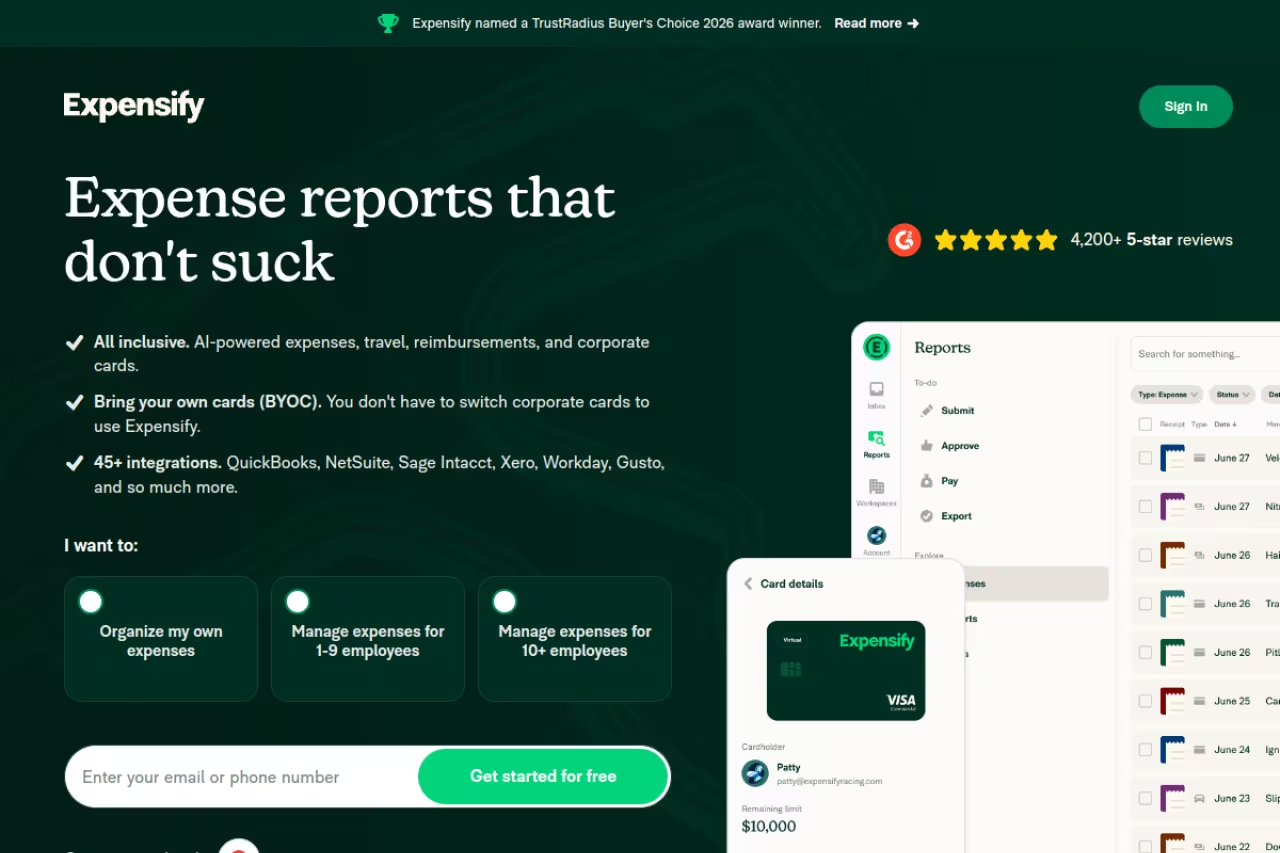
Expensify is the veteran here, and for a solo operator or a five-person team it's hard to beat on speed. You photograph a receipt, SmartScan reads the merchant, amount, and date, and the expense is logged. The mobile app is the best in the category for one specific job: capturing a receipt in three seconds at a restaurant table.
A fast choice for freelancers, solo founders and small teams that mostly need receipt capture and reimbursements, with SmartScan logging an expense in seconds. Watch the pricing sting: below 50% Expensify Card spend, your per-user cost can roughly double.
there's a free tier for basic tracking. Paid plans start at $5 per user per month (Collect) and $9 per user per month (Control), per the pricing page. Both have a discount if you use the Expensify Card for at least half your spend.
The standout: SmartScan and the reimbursement flow. Approve an expense report and the money can land in someone's bank account the next day.
The catch: the pricing has a sting. The advertised rate assumes you put 50% or more of company spend on the Expensify Card. Fall below that and your per-user cost can roughly double. For teams that won't commit to the card, the real number is closer to $10-18 per user, which makes free options like Ramp look a lot better.
If you're putting together a wider finance and ops stack, our roundup of the best AI tools for small business pairs well with whatever expense tool you land on.

Airwallex: the international choice
Airwallex earns its spot if any meaningful share of your spend happens outside your home currency. Its expense management sits on top of multi-currency wallets and global accounts, so you can hold and spend in 20+ currencies and pay at interbank FX rates with a 0.5% markup instead of the 2-3% your bank quietly charges.
The international choice for companies with foreign vendors, contractors or travel, holding 20+ currencies at a 0.5% FX markup. A domestic-only US startup gets less out of it, and the expense piece can feel heavier than a pure expense tool.
the Explore plan is $0 per month with 10 free company cards and unlimited virtual employee cards. Grow is $12 per active Spend user per month plus a platform fee, per Airwallex's pricing.
The standout: FX. If you regularly pay suppliers in EUR, GBP, or USD from a non-matching base currency, the savings on FX markup alone can cover the subscription several times over.
Where it falls short: the domestic-only US startup gets less out of it than a Ramp or Brex. The platform is broad, and the expense piece is one module among payments, treasury, and global accounts, so it can feel heavier than a pure expense tool.
Zoho Expense: best value on a budget
Zoho Expense is the pick when cost is the deciding factor and you don't need corporate cards baked in. It does receipt autoscan, mileage tracking, multi-currency, custom approval flows, and policy enforcement at a price nobody else matches.
Go with Zoho Expense when cost decides: it is free for up to 3 users and $5 per user on Premium for card integration and policy checks. It shines most inside the Zoho suite and is merely fine wired into a non-Zoho accounting stack.
free for up to 3 users. Standard is $3 per user per month and Premium is $5 per user per month (annual billing), per Zoho's pricing. That's the cheapest full-featured paid tier in this list.
The standout: price-to-feature ratio. At $5 per user you get corporate card integration, automated policy checks, and analytics that some rivals lock behind much pricier plans.
The catch: it shines brightest if you also use Zoho Books and the rest of the suite. As a standalone tool wired into a non-Zoho accounting stack, the integrations are fine but not the smooth experience you get inside the family.

Navan: when travel is the main event
Navan (formerly TripActions) merges travel booking and expense management into one flow, which is exactly what you want if your team flies often. Book a flight or hotel inside Navan and the expense is created and categorized automatically. No screenshot of a confirmation email, no manual entry.
The pick for travel-heavy teams, where booking a trip creates and categorizes the expense automatically. If your team rarely travels you are paying for a travel engine you will not use, and a pure expense tool will be cheaper and simpler.
the travel booking product is free, funded by supplier commissions. Expense management is free for the first 5 monthly expensing users, then $15 per user per month, per Navan's pricing. Enterprise is custom.
The standout: the booking-to-expense link. For travel-heavy companies, eliminating the gap between "I booked a trip" and "I filed the expense" removes most of the monthly admin.
Where it falls short: if your team rarely travels, you're paying for a travel engine you won't use. A pure expense tool will be cheaper and simpler.

SAP Concur: the enterprise standard
SAP Concur is the incumbent in large enterprises, and for good reason: the compliance, global tax handling, and audit controls are built for companies with thousands of employees and finance teams in multiple countries. If your procurement department has a vendor checklist, Concur is probably already on it.
The enterprise standard for multi-country compliance, with deep VAT/GST handling and legacy ERP integrations. Expect a dated interface, implementation that takes months, and per-report pricing that gets expensive at volume, so skip it for small teams.
Concur doesn't publish transparent list pricing. Reporting from buyers puts it around $8-18 per active user per month, or roughly $9 per expense report, with negotiated enterprise rates running well below list.
The standout: depth. Few tools match Concur on global VAT/GST handling, integrations with legacy ERP systems, and the kind of granular policy controls a 5,000-person company needs.
The catch: it's overkill for small teams, and it shows its age. The interface feels dated next to Ramp or Brex, implementation takes months, and the per-report pricing model can get expensive if your expense volume is high. This is an enterprise tool, full stop.

Rippling Spend: best if you already run on Rippling
Rippling Spend makes the most sense if Rippling already runs your payroll and HR. Because it sits on the same employee data, onboarding a new hire automatically provisions their card and applies the right spend policy by department or role. No separate setup.
Worth it only if Rippling already runs your HR and payroll, because new hires automatically get a card and the right spend policy. Otherwise you would adopt a whole HR platform just for an expense tool, and the pricing is opaque.
modular and quote-based, generally cited around $11 per employee per month for the spend module, on top of your existing Rippling plan.
The standout: the unified employee record. Spend policies that follow org structure automatically are a real time-saver when you're hiring fast.
Where it falls short: it's not a strong standalone buy. If you're not already on Rippling, you're adopting a whole HR platform to get an expense tool, which rarely makes sense. The pricing is also opaque compared to Ramp's flat, public numbers.
How to choose
Skip the feature checklists and answer three questions.
Where do you spend? Mostly domestic, in one currency, on a small team? Ramp or Expensify. Lots of international vendors or FX? Airwallex. Constant travel? Navan.
How big and how funded are you? Bootstrapped and watching every dollar? Zoho Expense or free-tier Ramp. Venture-backed and scaling across entities? Brex. Thousands of employees with a compliance department? Concur.
What do you already run on? If Rippling owns your HR and payroll, Rippling Spend removes setup friction. If you live in QuickBooks or Xero, almost everything here integrates, so weight the card controls and AI instead.
For most readers of this newsletter, the honest recommendation is to start free with Ramp, run it for a month, and upgrade to Plus only when the AI review features start saving your finance lead real hours. You can always layer Airwallex on top later if international spend becomes a thing.
If you want a faster way to evaluate tools like these before you commit, Dupple X gives you AI-assisted research and side-by-side comparisons, and our top tools directory tracks pricing changes across the category so you're not relying on a stale blog post.
Tired of testing finance tools one tab at a time? Try Dupple X free for a year and compare expense platforms, pricing, and reviews in one place.
FAQ
What is the best expense management software for small businesses?
For most small businesses, Ramp is the best starting point because the core platform is free and includes corporate cards, receipt matching, and accounting sync with no per-seat fee. If you mainly need fast receipt capture and reimbursements without cards, Expensify or Zoho Expense are cheaper, simpler alternatives.
Is there free expense management software?
Yes. Ramp's core platform is free with no per-user cost, Brex Essentials is free, Airwallex's Explore plan is $0 per month, and Zoho Expense is free for up to 3 users. These free tiers are real products, not crippled trials, though card-based tools like Ramp and Brex earn revenue through interchange when you spend on their cards.
How much does expense management software cost?
It ranges widely. Card-led platforms like Ramp and Brex are free at the base tier, with paid plans at $12-15 per user per month. Standalone tools like Zoho Expense start at $3 per user, Expensify from $5, and enterprise software like SAP Concur typically runs $8-18 per active user per month under custom contracts.
What's the difference between Ramp and Brex?
Both bundle corporate cards with expense management and are free at the base tier. Ramp is the simpler default for US-based startups and SMBs, with strong AI-driven expense reviews. Brex goes deeper on multi-entity and international setups, issuing cards in 50+ countries, which suits funded companies operating across borders. Brex is now owned by Capital One after the 2026 acquisition closed.
Do I need corporate cards to use expense management software?
No. Tools like Expensify, Zoho Expense, and SAP Concur work fine for tracking expenses and reimbursing employees who spend on personal or existing company cards. Card-native platforms like Ramp, Brex, and Airwallex give you tighter real-time controls because they own the card, but they're optional, not required.
Which expense tool is best for international spending?
Airwallex is the strongest choice for international spend thanks to native multi-currency wallets, local accounts in 20+ currencies, and a 0.5% FX markup that undercuts most banks. Brex is a good alternative for companies needing local card issuing across multiple countries and entities.
Related guides
Some offers on this page may be paid placements or contain affiliate links.
