
Best Fleet Management Software (2026): 8 Platforms I'd Actually Run

Key facts8 tools compared: Samsara, Motive, Fleetio, Geotab, Verizon Connect, Azuga, RTA Fleet360…
- 8 tools compared: Samsara, Motive, Fleetio, Geotab, Verizon Connect, Azuga, RTA Fleet360, Fleet Complete
- Samsara (best for: All-in-one telematics + AI safety): ~$27-60 + hardware
- Motive (best for: Trucking, ELD/HOS compliance): ~$25-35 + ~$150 hardware
- Fleetio (best for: Maintenance and work orders): $4-10, published
- Geotab (best for: Enterprise + government scale): ~$10-18 base, reseller-set
Fleet software is one of those purchases where the demo looks great and the contract is where you get hurt. Every vendor shows you a slick live map and an AI dash cam catching someone running a stop sign. Then you find out the hardware costs $200 a vehicle, the contract is three years, and the pricing is "call us." After digging through pricing pages, analyst reviews, and a pile of contradictory G2 numbers, I wanted to cut through that.
Here's the short version. If you run a mixed fleet and want one platform that does GPS, AI safety cams, and compliance without feeling like 2010 software, Samsara is my top pick. If you're a trucking operation where ELD and hours-of-service compliance is the whole game, Motive is built for you. And if your real problem is maintenance and keeping vehicles on the road rather than tracking dots on a map, Fleetio is the one I'd start with, partly because it's the only major player that publishes its prices.
This guide is for fleet managers, operations leads, and founders running anything from 5 vans to 500 trucks. I'll tell you what each tool costs, what it's good at, and where it falls short.
Quick comparison
| Tool | Best for | Price (per vehicle/mo) | Standout |
|---|---|---|---|
| Samsara | All-in-one telematics + AI safety | ~$27-60 + hardware | Single platform, strong dash cams |
| Motive | Trucking, ELD/HOS compliance | ~$25-35 + ~$150 hardware | AI dashcam, fleet card |
| Fleetio | Maintenance and work orders | $4-10, published | Transparent pricing, no hardware lock-in |
| Geotab | Enterprise + government scale | ~$10-18 base, reseller-set | Open platform, huge marketplace |
| Verizon Connect | Established GPS tracking | ~$25-40 + hardware | Mature reporting, big install base |
| Azuga | Driver behavior + coaching | ~$25, quote-based | Gamified safety scoring |
| RTA Fleet360 | Public sector / municipal | Quote-based | Deep maintenance, multi-department |
| Fleet Complete | SMB to enterprise asset tracking | ~$6.65-35 modular | Pay per module, AT&T-backed |

Samsara: the all-in-one I'd pick for most fleets
Samsara is the platform most people picture when they think modern fleet management. It pulls GPS tracking, AI dash cams, ELD compliance, maintenance alerts, and routing into one dashboard that doesn't feel like enterprise software from a decade ago. That breadth is why it keeps winning satisfaction surveys: in one 2026 provider comparison, 84% of fleet professionals reported being satisfied or very satisfied, ahead of Geotab and Motive.
Who it's best for: mixed fleets that want one vendor instead of stitching three together. If you've got vans, trucks, and equipment and you want safety cams plus tracking plus compliance under one login, this is the cleanest answer.
The standout is the AI dash cam. It detects erratic driving and stop-sign violations, films the event, and the dual-facing cameras record up to 33 hours of 1080p footage. Admins can livestream a camera for five minutes a month, and the system even flags lens obstructions on its own. Samsara also runs a 30-day free trial, which is rare in this space.
The catch: pricing runs roughly $27 to $60 per vehicle per month plus hardware, and you won't see a number until you talk to sales. Contracts are typically multi-year. For a 5-van operation that just wants dots on a map, it's overkill and overpriced. This is a platform you grow into, not down to.
The cleanest all-in-one for mixed fleets that want GPS, AI dash cams and ELD compliance under one login, with a 30-day free trial. Pricing is quote-only at roughly $27 to $60 per vehicle per month plus hardware, so it is overkill for a 5-van operation.

Motive: the trucking and compliance specialist
Motive (the company formerly known as KeepTruckin) earned its reputation in trucking, and it shows. Its FMCSA-registered ELD automates hours-of-service logging and spits out audit-ready compliance reports, which matters enormously if a DOT audit is a real risk for your business.
Who it's best for: trucking fleets and any operation where ELD and HOS compliance depth is the primary driver. If safety violations and log accuracy keep you up at night, Motive's trucking heritage gives it an edge over the generalists. It also implements faster than Samsara, around 2.7 months versus 3.4 on average.
The standout in 2026 is the AI Dashcam Plus, which builds the vehicle gateway directly into the camera, cutting install time to under 10 minutes. It detects over 15 unsafe behaviors, including ones Samsara misses like lane swerving and smoking, and Motive is the first to put stereo-vision depth perception into an ELD-integrated camera. The Motive Card also combines fleet management and spend management, which no competitor matches.
The catch: Motive stopped publishing prices, so you're back to custom quotes, usually starting in the mid-$20s per vehicle plus around $150 in hardware. And if you're not a trucking-style fleet, a lot of that compliance muscle goes unused. For a landscaping or HVAC fleet, the heavy ELD focus is more than you need.
The trucking and compliance specialist, with an FMCSA-registered ELD and an AI dashcam that installs in under 10 minutes. Pricing is custom quotes, and a landscaping or HVAC fleet will not use most of that compliance muscle.

Fleetio: maintenance-first, and the only one with honest pricing
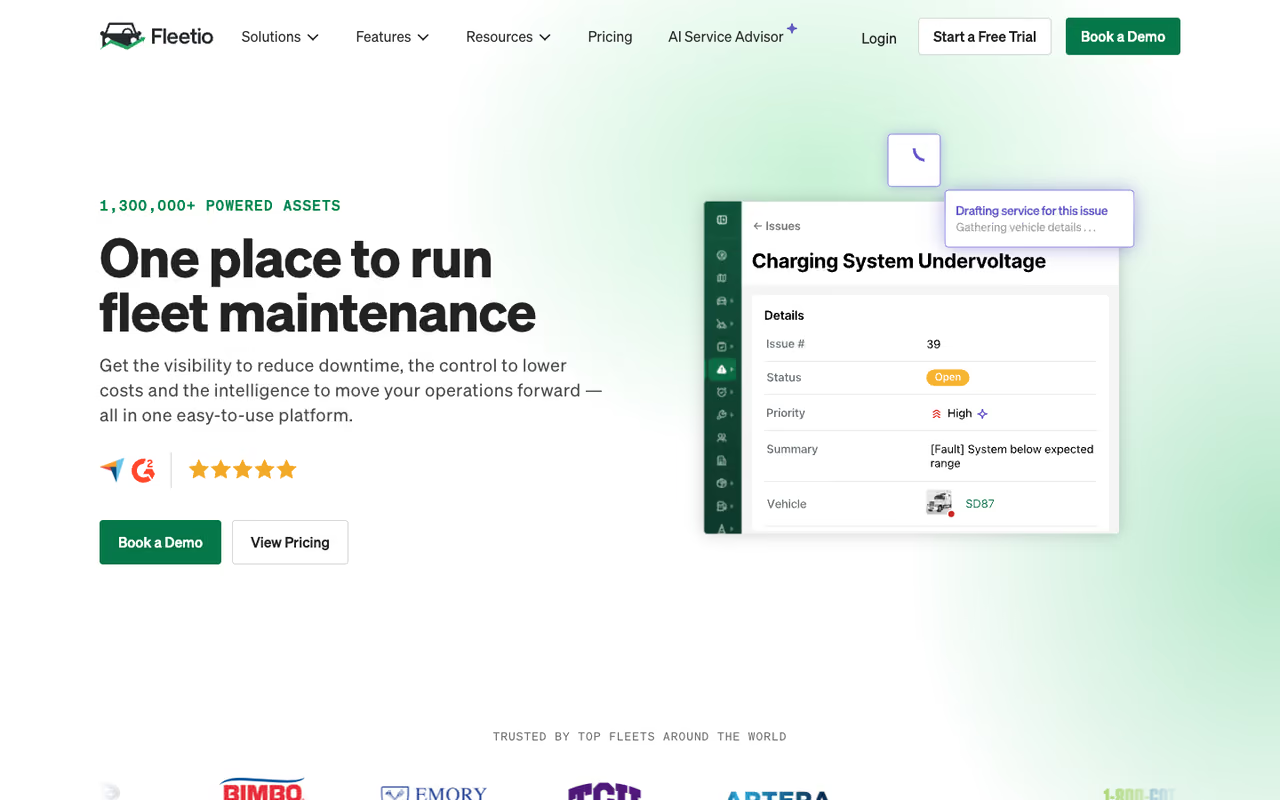
Most tools on this list start with "where is the vehicle." Fleetio starts with "is the vehicle going to break down." It's a fleet maintenance platform: preventive maintenance schedules, work orders, parts inventory, inspections, and service history. It plays nicely with telematics from Samsara or Geotab rather than replacing them.
Who it's best for: fleets where uptime and maintenance cost are the real pain, not GPS. Construction, delivery, equipment-heavy operations, and anyone tired of tracking oil changes in a spreadsheet. It pairs well if you already run a tracking provider and need a maintenance brain on top.
The standout is the pricing transparency. Fleetio actually publishes its plans: Essential at $4 per vehicle per month, Professional at $7, and Premium at $10, all billed annually with unlimited users and a 14-day free trial with no credit card. In a category built on "contact sales," that alone is refreshing. There's no hardware to buy because it's software-first.
The catch: it's not a tracking or telematics platform on its own. If you want live GPS and AI cams, you'll be running Fleetio alongside something else, which means two bills. There's also a 5-vehicle minimum, so the smallest operators hit a $20 to $50 floor.
Pick Fleetio when uptime and maintenance cost hurt more than GPS, with published plans starting at $4 per vehicle per month. It is not telematics on its own, so expect to run it beside a tracker, pay two bills and meet a 5-vehicle minimum.
If you're stitching together a stack like this, the same logic applies to the rest of your operations software. I keep a running list of the tools I actually trust over on Dupple's top tools page, and our best AI tools for business roundup covers the layer above the fleet.

Geotab: the enterprise and government heavyweight
Geotab is the biggest player you've maybe never demoed. It tracks over 5 million vehicles across 160 countries and processes more than 100 billion data points a day. Its MyGeotab platform sits in the Leaders quadrant of Gartner's Magic Quadrant for commercial telematics, and it's trusted by Fortune 500 companies and the largest public-sector fleets, including the US federal government.
Who it's best for: large fleets, enterprises, and governments that need deep, customizable reporting and the broadest integration options. The open platform and Marketplace offer hundreds of third-party integrations, so you can bend the data to almost any workflow.
The standout is that open ecosystem. Where Samsara wants to be your everything, Geotab is happy to be the data backbone that everything else plugs into. Base telematics often runs cheaper too, in the $10 to $18 per vehicle range, with hardware sometimes around $100 per device.
The catch: the learning curve is the single most consistent criticism across every review site. MyGeotab is not software you master in an afternoon. And because Geotab sells through resellers, your contract terms, support quality, and hardware pricing all depend on which partner you buy from. Two Geotab customers can have completely different experiences.
The enterprise and government heavyweight, with an open ecosystem and hundreds of integrations that make it a data backbone, often cheaper at $10 to $18 per vehicle. The learning curve is the most consistent criticism, and reseller sales mean experiences vary by partner.

Verizon Connect: the mature, established option
Verizon Connect is the safe, corporate choice. It's been around in various forms for years, has a massive install base, and offers mature GPS tracking, routing, dispatch, and compliance reporting. The reporting depth is genuinely strong, and the brand backing means it's not going anywhere.
Who it's best for: mid-to-large fleets that value a long track record and detailed reporting over cutting-edge AI features. If procurement wants a name nobody gets fired for choosing, this is it.
The standout is reporting maturity. After years of acquisitions and development, the platform covers most things a traditional fleet needs, from fuel cards to maintenance reminders to driver behavior.
The catch: it's one of the pricier options, roughly $25 to $40 per vehicle per month plus $150 to $300 in hardware per vehicle. Reviewers regularly flag the contract terms and support as the weak spots, and the interface feels dated next to Samsara. You're buying stability, not innovation.
The safe, corporate choice for mid-to-large fleets that value a long track record and strong reporting over cutting-edge AI. It is one of the pricier options, reviewers flag contracts and support, and the interface feels dated, so you are buying stability, not innovation.

Azuga: built around driver behavior
Azuga carved out its niche on driver coaching and safety scoring. It does the standard GPS tracking, routing, and dispatch, but the personality of the product is its gamified driver-behavior system, complete with rewards, scorecards, and coaching workflows.
Who it's best for: fleets where driver safety and culture are the priority. If you want to actually change how people drive (not just record that they drove badly), Azuga's gamification approach gets buy-in better than a pure surveillance pitch.
The standout is the results customers report: a 57% reduction in driving citations, a 38% drop in accidents, and 53% less fleet wear and tear, according to Azuga's own data. The smart dash cam and coaching tools back that up, and it holds a strong 4.7 out of 5 across 158 G2 reviews.
The catch: pricing starts around $25 per vehicle and is quote-based, and contracts typically run two to three years. The flip side is there are no early termination fees, which softens the long lock-in a bit. Still, that's a long commitment for a smaller fleet to make on day one.
Go with Azuga when driver safety and culture are the priority, since its gamified coaching and scorecards aim to change behavior, not just record it. Pricing is quote-based from around $25 per vehicle, with two to three year contracts.
RTA Fleet360: the public-sector specialist
RTA Fleet360 is the one most commercial buyers have never heard of and most city fleet managers know cold. It's the most widely adopted fleet management information system in the public sector, built for municipalities, transit agencies, and the kind of fleets that have to defend every dollar to a city council.
Who it's best for: government and municipal fleets juggling fire, police, sanitation, and public works under one system, with custom chargeback rates per department. It's also a strong fit for any operation where maintenance accountability and lifecycle cost data drive replacement budgets.
The standout is depth in maintenance and reporting built for accountability. Cost-per-mile, labor, parts, and lifecycle expense dashboards give you defensible numbers for funding requests. In 2026 RTA also launched Ron360, a conversational AI assistant that lets staff ask operational and compliance questions in plain English instead of building reports.
The catch: pricing is quote-based and aimed at organizations, not the 10-van small business. If you're commercial and just want tracking, this is more system than you need, and the public-sector orientation means some workflows assume a government structure you may not have.
The public-sector specialist for municipal fleets that need per-department chargeback and defensible cost-per-mile and lifecycle numbers. Commercial buyers wanting simple tracking will find more system than they need, and some workflows assume a government structure.

Fleet Complete: modular and SMB-friendly
Fleet Complete (now operating under Powerfleet) is the pick when you want to pay only for the pieces you use. Over 50,000 businesses run it, from small shops to Fortune 500s, and the AT&T partnership gives it real distribution muscle in North America.
Who it's best for: small and mid-sized businesses that don't want to buy a giant platform. The modular pricing means you can start with basic tracking and add asset tracking, dispatch, or video telematics as you grow.
The standout is that à la carte structure. Through AT&T Fleet Complete, you can subscribe to individual modules: HOS/ELD around $6.65 a month, asset tracking around $9.50, the full fleet tracker around $17.10, and video telematics around $19. You're not forced into an all-or-nothing bundle, which keeps the entry cost low.
The catch: stacking modules can add up to more than a bundled competitor once you need several, and the brand transition to Powerfleet has created some confusion about product names and roadmaps. It's also less of a single polished experience than Samsara, since you're assembling capabilities rather than getting them in one box.
Pick it when you want to pay only for the pieces you use, from HOS/ELD at around $6.65 a month up to video telematics at around $19. Stacking modules can cost more than a bundle, and the Powerfleet transition has muddied product names and roadmaps.
How to choose
Skip the feature checklists for a second and answer one question: what's actually costing you money?
If the answer is accidents, claims, and unsafe driving, you want AI safety cameras, so look at Samsara, Motive, or Azuga. If it's compliance and DOT audits, Motive's ELD depth is the safest bet. If it's vehicles sitting in the shop, your problem is maintenance, and Fleetio solves that better than any telematics platform, often alongside one of them.
Then filter by size. Under 20 vehicles, prioritize transparent pricing and short contracts: Fleetio and Fleet Complete's modular plans are the least painful to start and leave. Mid-market mixed fleets are the sweet spot for Samsara. Enterprise and government should be looking at Geotab and RTA, where depth and integration matter more than onboarding speed.
Last filter: contract length. Almost everyone here wants a multi-year deal with per-vehicle hardware. Always ask for the hardware cost and the termination terms in writing before you sign, because that's where the real total cost hides. If you're building out the rest of your ops stack too, our guides on expense tracking tools and inventory forecasting cover the adjacent spend.
Want to run leaner on the rest of your software while you're at it? Dupple X bundles a stack of business tools at one price, which takes the sting out of the per-seat bills piling up around your fleet system.
FAQ
What is the best fleet management software in 2026?
For most mixed fleets, Samsara is the strongest all-in-one because it combines GPS tracking, AI dash cams, and compliance in one platform with high user satisfaction. But "best" depends on your problem: Motive wins for trucking and ELD compliance, Fleetio wins for maintenance, and Geotab wins for enterprise scale and integrations. There's no single answer for a 5-van shop and a 500-truck carrier.
How much does fleet management software cost per vehicle?
Most telematics platforms run roughly $20 to $60 per vehicle per month, plus $100 to $300 in hardware per vehicle. Samsara and Verizon Connect sit at the higher end, Geotab's base telematics can start around $10 to $18, and maintenance-focused Fleetio is far cheaper at $4 to $10 because it doesn't require hardware. Nearly all telematics vendors quote custom pricing rather than publishing it.
Do I need hardware for fleet management software?
For GPS tracking and AI dash cams, yes: those need a vehicle gateway and cameras installed, which is where hardware costs and multi-year contracts come from. Software-first tools like Fleetio that focus on maintenance and work orders don't require any hardware, which is why their pricing is so much lower and their contracts are shorter.
Which fleet software is best for small businesses?
For small fleets under about 20 vehicles, Fleetio and Fleet Complete are the friendliest starting points. Fleetio publishes transparent per-vehicle pricing from $4 a month with a 14-day free trial and no credit card, and Fleet Complete's modular plans let you pay for only the features you use. Both avoid the giant all-or-nothing contracts that the enterprise-focused platforms push.
What is the difference between fleet tracking and fleet maintenance software?
Fleet tracking software (Samsara, Geotab, Verizon Connect) tells you where vehicles are and how they're being driven using GPS and telematics hardware. Fleet maintenance software (Fleetio) manages service schedules, work orders, parts, and repair history to keep vehicles running. Many fleets run both: a telematics platform for location and safety, plus a maintenance platform for uptime.
Is Samsara better than Motive?
It depends on your fleet. Samsara scores higher on overall satisfaction (84% vs 70% in one 2026 survey) and offers a broader all-in-one platform, making it the better generalist. Motive is faster to implement and detects more unsafe behaviors like lane swerving, and its ELD compliance heritage makes it the stronger choice specifically for trucking operations focused on hours-of-service rules.
Related guides
Some offers on this page may be paid placements or contain affiliate links.
