
The Best Home VoIP Service in 2026: 7 Picks I'd Actually Recommend

Key facts7 services compared: Ooma, Voiply, AXvoice, Vonage for Home, magicJack, Google Voice, Ooma…
- 7 services compared: Ooma, Voiply, AXvoice, Vonage for Home, magicJack, Google Voice, Ooma Premier
- Ooma (best for: Most homes, long-term value): $0/mo + taxes (Telo box $99.99)
- Voiply (best for: No upfront hardware spend): $8.95/mo or $7.46/mo annual
- AXvoice (best for: Budget hunters): $8.25/mo on annual prepay
- Vonage for Home (best for: International callers): $9.99/mo (North America plan)
The copper landline in my parents' house cost them about $45 a month for unlimited US calling and nothing else. No spam filtering, no voicemail-to-email, no app. When I swapped them to a home VoIP box, the bill dropped to a few dollars in taxes and the call quality got better, not worse. That gap is the whole story of residential VoIP in 2026.
The problem is that "best home VoIP service" pulls up a wall of near-identical comparison sites pushing whoever pays the highest affiliate commission. Half of them still list providers that shut down last year. So I went through the current options myself, checked the live pricing pages, and threw out anything that wasn't actually shipping.
If you want the short answer: Ooma is the pick for most homes. You buy the box once and the base service is genuinely free beyond taxes. If you'd rather pay a small flat fee and skip buying hardware, Voiply is the better fit. Budget-first and don't mind a contract? AXvoice. The rest of this covers who each one is really for.
Quick comparison
| Service | Best for | Price | Standout |
|---|---|---|---|
| Ooma | Most homes, long-term value | $0/mo + taxes (Telo box $99.99) | Free base service forever |
| Voiply | No upfront hardware spend | $8.95/mo or $7.46/mo annual | Cheap, modern app, spam bot |
| AXvoice | Budget hunters | $8.25/mo on annual prepay | Lowest sustained monthly cost |
| Vonage for Home | International callers | $9.99/mo (North America plan) | Unlimited to 60+ countries on world plan |
| magicJack | Set-and-forget cheapskates | ~$49/yr device + plan | One yearly payment, done |
| Google Voice | Light callers, app-only | Free (personal) | Zero monthly cost, voicemail transcription |
| Ooma Premier | Spam-heavy households | $9.99/mo add-on | Best call screening in the category |

Ooma: the one I recommend to almost everyone
Ooma works on a model that still surprises people. You buy the Ooma Telo adapter once for $99.99, plug it between your router and any normal phone, and the base calling service costs $0 a month after that. You pay applicable taxes and fees, which usually land somewhere around $4 to $7 depending on your state, and that's the bill.
Who it's best for: families who make a lot of US calls and want to stop paying a monthly phone bill entirely. The math gets good fast. The box pays for itself against a landline in roughly two to three months.
The base plan covers unlimited nationwide calling, caller ID, voicemail, and 911 with address alerts. Call quality is the thing people notice. Ooma uses its own HD voice and a feature called PureVoice that prioritizes voice packets, so you don't get the choppy audio that gives VoIP a bad name.
The standout is that "free" actually means free here, not a 12-month teaser rate. Every plan ships with a 2-month trial of Ooma Premier, the $9.99/month upgrade that adds serious spam blocking and a second line.
The catch: you pay $99.99 upfront for hardware, and keeping your existing number costs $39.99 unless you commit to a year of Premier, in which case the port is free. If you hate buying gear or you move often, that upfront box is friction.
The default pick for families making lots of US calls who want to drop the monthly phone bill. After a $99.99 adapter, base service is $0, but the upfront hardware cost and a $39.99 number port are friction if you move often.
Voiply: the cheapest way in without buying a box
Voiply is the option I point people to when they don't want to drop $100 on hardware up front. Residential service runs $8.95 a month, or $7.46 a month if you prepay for the year (that's $89.50 annually, which works out to two free months).
Who it's best for: renters, people who move, and anyone who'd rather expense a small flat fee than own equipment. The setup leans on a mobile app plus an optional adapter, so you can run your home line from your phone if you want.
What you get for the price is more modern than the old-guard providers: unlimited US calling, enhanced E911, voicemail-to-email, HD voice, number porting, and a spam-call bot that screens robocallers before they reach you. The app makes it feel less like a 2010 landline replacement and more like a real cloud phone.
The standout is that spam bot. Robocalls are the number one reason people abandon home phones, and Voiply baking real filtering into the base plan is the right call.
The catch: the buy-it-outright adapter is a steep $299.99, or $15/month to lease, so if you specifically want a physical box plugged into a desk phone, the value drops hard. Use the app or a cheap third-party ATA and you're fine. Lock into the hardware lease and you've erased the savings.
Choose Voiply if you want a cheap flat fee without buying a box, which suits renters and people who move. The spam bot is a real draw, but the $299.99 adapter or $15 per month lease erases the savings.
AXvoice: lowest sustained monthly cost
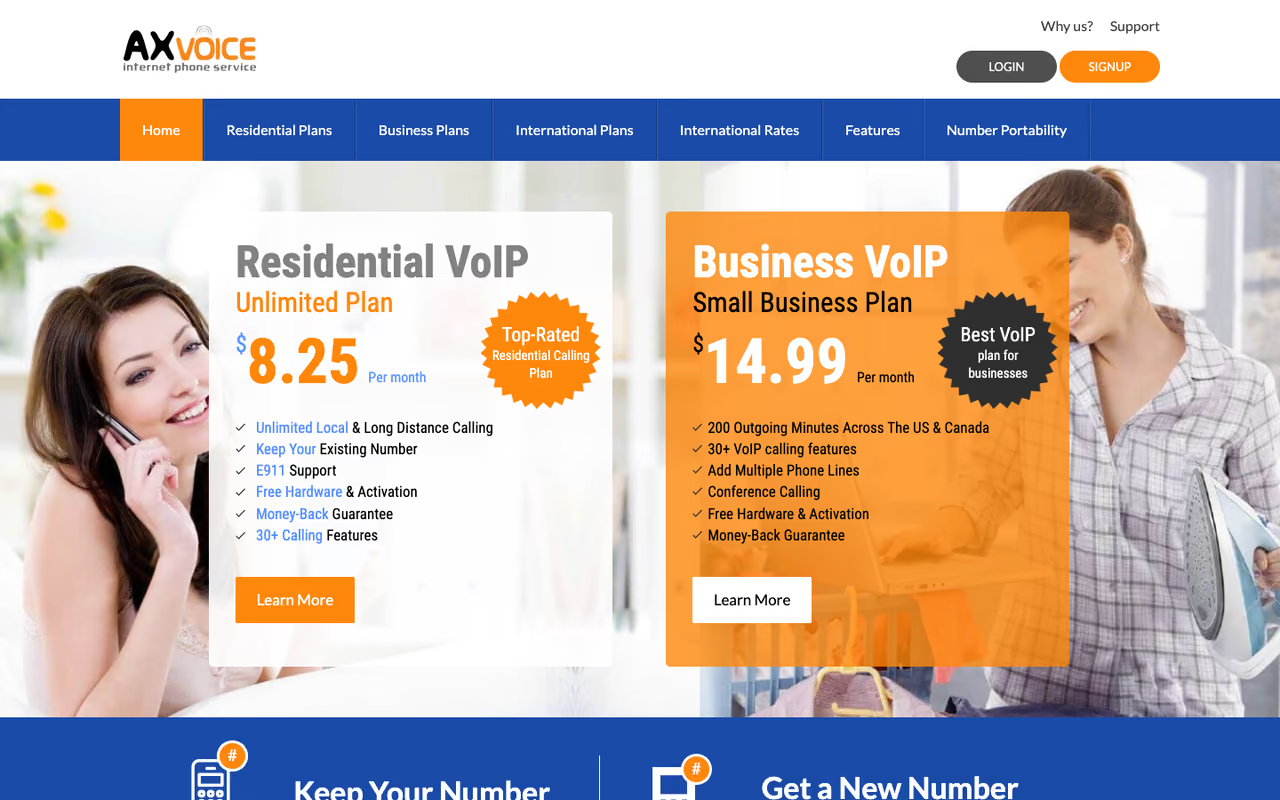
AXvoice is the budget play. The unlimited USA/Canada residential plan comes to $8.25 a month when you prepay annually (about $99 for the year), which is one of the lowest sustained rates from a provider that's been around long enough to trust.
Who it's best for: cost-focused households that call the US and Canada, don't need a slick app, and are comfortable with a yearly commitment. AXvoice has been doing residential VoIP since before it was trendy, and the service is stable.
You get 30-plus calling features, online account management, and a free VoIP adapter included with the home plans. It's a bring-your-own-phone setup: plug a regular handset into the adapter and you're done. Nothing fancy, nothing missing.
The standout is simply the price floor. For unlimited US and Canada calling with a real adapter included, $8.25/month is hard to beat from an established name.
The catch: a couple of things. The "unlimited" plan is technically capped (think a couple thousand minutes, which no normal home will hit), and several users report a $40 to $48 equipment charge if they cancel, even when they used their own gear. Read the cancellation terms before you prepay a year.
The budget play for cost-focused households that call the US and Canada and can commit to a year. At $8.25 per month with a free adapter it is hard to beat, but read the cancellation terms, since some users report equipment charges.
Vonage for Home: built for international callers
Vonage for Home is still running in 2026, and it earns a spot for one specific reason: international calling. The North America plan is $9.99/month for unlimited US, Canada, Puerto Rico, and Mexico, but the real draw is the world plan with unlimited calling to 60-plus countries.
Who it's best for: households with family abroad. If you regularly call landlines and mobiles in other countries, Vonage's international bundle beats paying per-minute everywhere else. The service also lets you make and take calls on your home phone plus up to three smartphones through the app.
The standout is breadth. Twenty-plus included features, app access on multiple devices, and the widest international coverage of anything on this list.
The catch: at $9.99/month for the basic North America tier, it's pricier than Voiply or AXvoice for plain domestic calling, and the genuinely cheap international value is locked behind the annual world plan. If you never call overseas, you're paying for a feature you won't touch.
Pick Vonage for Home if your family is abroad, because the world plan covers unlimited calling to 60-plus countries. For plain domestic calling at $9.99 per month it costs more than Voiply or AXvoice, so skip it if you never call overseas.
If your "home office" has quietly become your actual business, a residential line eventually hits its ceiling. That's the moment to look at proper cloud phone systems. The Dupple newsletter breaks down the AI and software tools founders are switching to. Start a Dupple X trial if you want that in your inbox.
magicJack: pay once a year and forget it
magicJack is the device that refuses to die, and honestly that's a compliment. You buy the USB device for around $49.99, and the plan covers 12 months of unlimited US and Canada calling. Multi-year deals drop the per-year cost further, with a 3-year plan running about $119.
Who it's best for: people who want the absolute least amount of ongoing thought. One payment a year, no monthly bill to track, no app to babysit. It's the closest thing to "install and forget" in the category.
The standout is the billing simplicity. Caller ID, voicemail, call forwarding, and call waiting are included, and free calls between magicJack users anywhere in the world are a nice bonus if relatives also use it.
The catch: it's bare-bones. Call quality is fine, not great, and you're tied to magicJack's hardware. Porting your existing number costs an extra one-time fee. It's a cheapskate's tool, and it owns that.
The install-and-forget device for people who want one payment a year and no monthly bill to track. It is bare-bones, with fine rather than great call quality, hardware lock-in and an extra fee to port your existing number.
Google Voice: free, if you call lightly
Google Voice personal accounts cost nothing, and for a certain kind of home user that's the entire pitch. You get a real US phone number, free calls within the US, voicemail with surprisingly good transcription, and call forwarding to your devices.
Who it's best for: light callers and the app-first crowd. If your "home phone" is really just a number you give out that rings your laptop and cell, Google Voice does that for $0 and ties neatly into the rest of Google's stack.
The standout is the price (free) plus the voicemail transcription, which is still better than most paid providers years later.
The catch: it's not a landline replacement. There's no plug-in adapter for a physical home phone, 911 support is limited and depends on your setup, and porting a number in costs a one-time $20. Google support is also famously thin. Treat it as a smart secondary line, not your emergency-call line.
Free and smart for light callers and the app-first crowd, with voicemail transcription that beats most paid providers. It is not a landline replacement, as there is no adapter, 911 support is limited and Google support is thin.
Ooma Premier: the spam-killer upgrade
I'm listing Ooma Premier separately because it solves the one problem every home phone has: robocalls. At $9.99/month on top of an Ooma Telo, Premier adds the best call screening in residential VoIP. It blocks known spammers, suspected spammers, and anonymous callers, and it can route them to voicemail or kill the ring entirely.
Who it's best for: households drowning in spam calls, or anyone who wants a real second line, voicemail monitoring (listen before you pick up), and calling to Canada and Mexico baked in.
The standout is the layered spam protection. Most providers bolt on a basic blocklist. Premier actually categorizes callers and lets you decide per category.
The catch: it only makes sense if you're already on Ooma hardware, and at $9.99/month it costs about the same as Voiply or Vonage's whole service. You're paying for screening and the extra line, so make sure those are what you actually need.
A worthwhile upgrade if robocalls are driving you mad, since it categorizes callers and adds a real second line. It only makes sense on Ooma hardware, and at $9.99 per month you should be sure you want screening and the extra line.
How to choose
Skip the feature checklists. Three questions get you to the right pick.
First, do you want to own hardware or avoid it? If buying a box once and never paying monthly sounds good, Ooma wins outright. If you'd rather a small recurring fee with no upfront spend, go Voiply or AXvoice.
Second, do you call internationally? If yes, Vonage's world plan is built for you and nothing else here competes. If you only call the US and Canada, you're overpaying with Vonage.
Third, how heavy is your usage and how much do robocalls bother you? Light, app-based caller who wants $0: Google Voice. Heavy caller who wants robocalls gone: Ooma plus Premier. Set-and-forget once a year: magicJack.
One non-negotiable across all of them: VoIP rides on your internet, so a stable connection matters more than the provider. A flaky router will make any of these sound bad. If your home line is becoming a business line, that's a different category. Browse our top tools directory or our guide to communication tools for remote teams for the next tier up. If you're staffing up support or sales, call center software and a CRM for small business are the natural next steps, and AI meeting assistants handle the calls you actually want recorded.
FAQ
What is the cheapest home VoIP service in 2026?
For lowest sustained monthly cost, AXvoice at $8.25/month on annual prepay and Voiply at $7.46/month annual are the cheapest recurring options. But Ooma is effectively cheaper long-term: after the one-time $99.99 box, you pay only taxes and fees (roughly $4 to $7/month), so over a few years it's the lowest total cost. Google Voice is free if you only need an app-based line.
Can I keep my current phone number when switching to home VoIP?
Yes, every provider here supports number porting, but the fee varies. Ooma charges $39.99 (free if you take a year of Premier), magicJack and Google Voice charge a one-time fee around $19.95 to $20, and most others fold it in. Porting takes a few days, so don't cancel your old service until the transfer completes.
Does home VoIP work during a power or internet outage?
Standard home VoIP needs power and internet, so a regular outage takes your phone down with it. If outages are a real risk, get a box with battery backup and an LTE failover, like the Ooma Telo LTE at $19.99/month, which keeps the line alive when your broadband drops. Otherwise keep a charged cell as your backup for emergencies.
Is VoIP call quality as good as a landline?
On a decent connection, it's better. Providers like Ooma and Voiply use HD voice that carries more audio range than old copper lines. The caveat is your network: VoIP is only as good as your internet, so a congested or unstable connection causes the choppiness people blame on VoIP. Wire the adapter directly to your router when you can.
Do I need a special phone for home VoIP?
No. Almost every provider includes or sells an adapter (an ATA) that lets any standard corded or cordless phone work over the internet. You plug the adapter into your router and your existing phone into the adapter. App-only services like Google Voice are the exception, since they run on your phone or computer without hardware.
Which home VoIP service is best for blocking robocalls?
Ooma Premier has the strongest call screening, categorizing known spammers, suspected spammers, and anonymous callers and letting you handle each group differently. Voiply's built-in spam bot is the best option that's free with the base plan. If robocalls are your main reason for switching, weigh those two first.
Home VoIP isn't the experiment it was a decade ago. The providers that survived are stable, the call quality is solid, and the savings against a copper landline are real. Pick based on whether you want to own hardware, how far you call, and how much you hate spam, then stop overthinking it. For the wider set of tools founders and operators are adopting, a Dupple X trial keeps you current.
Related guides
Some offers on this page may be paid placements or contain affiliate links.
