
Best AI Legal Tools in 2026: 8 Picks I'd Actually Trust


Key facts8 tools compared: Harvey, CoCounsel, Spellbook, Lexis+ with Protégé, Vincent AI, Paxton AI…
- 8 tools compared: Harvey, CoCounsel, Spellbook, Lexis+ with Protégé, Vincent AI, Paxton AI, Luminance, Clio Duo
- Harvey (best for: BigLaw + corporate legal): ~$100-200/seat/mo at scale
- CoCounsel (best for: Litigators on Westlaw): $180-639/user/mo
- Spellbook (best for: Contract drafting in Word): ~$99-199/user/mo
- Lexis+ with Protégé (best for: Research-heavy firms): ~$128-494/user/mo
Legal work is full of tasks that eat hours and reward nobody: reading a 60-page lease for one indemnity clause, pulling case law you half-remember, redlining the same NDA for the fortieth time. AI is genuinely good at this now. The problem is that the category is loud, the pricing is opaque, and a chunk of the marketing oversells what these tools can actually do without a lawyer checking the output.
So I went through them. I looked at what each tool is built for, what it really costs (most vendors hide this behind a demo call), and where it falls down. If you only read one line: for a large firm or a serious in-house team with budget, Harvey is the strongest all-rounder. For solos and small firms who want most of that value without a six-figure contract, look at Paxton or Vincent AI instead.
One honest caveat up front. A 2025 Stanford study found that even the best legal research tools hallucinated in 17% to 33% of queries. These tools save real time. None of them removes the need to verify citations. Treat every output as a draft, not an answer.
Quick comparison
| Tool | Best for | Price | Standout |
|---|---|---|---|
| Harvey | BigLaw + corporate legal | ~$100-200/seat/mo at scale | Vault + Workflows for document review |
| CoCounsel | Litigators on Westlaw | $180-639/user/mo | Tied to Westlaw primary law |
| Spellbook | Contract drafting in Word | ~$99-199/user/mo | Native Word add-in |
| Lexis+ with Protégé | Research-heavy firms | ~$128-494/user/mo | Shepard's citation checking |
| Vincent AI | Firms avoiding Westlaw lock-in | from ~$399/user/mo | Free via 40+ state bars |
| Paxton AI | Solos + small firms | $499/mo or $2,999/yr | Self-serve, no demo gate |
| Luminance | Contract-heavy enterprises | Custom (quote) | Proprietary legal LLM |
| Clio Duo | Existing Clio firms | +$39/user/mo add-on | Lives in your matter data |
Harvey: the BigLaw standard

Harvey is the tool everyone benchmarks against. It raised at an $11 billion valuation in March 2026 and is now used by more than 1,300 firms and legal departments, including Paul Weiss, A&O Shearman, PwC and KPMG. The platform splits into four parts: Assistant for research and drafting, Vault for reviewing thousands of documents at once, Workflows for codifying repeatable legal tasks, and a Deep Research mode for multi-step agentic work.
The benchmark for large firms and corporate legal teams doing high-volume review, due diligence and litigation support, with Vault as the standout. The price gap is brutal for smaller buyers, so it is overkill for anyone under about 50 lawyers.
Harvey doesn't publish numbers. For Am Law 100 firms with 200+ seats, reporting puts it around $100 to $200 per user per month. Mid-market firms with fewer seats get quoted far higher, often $1,000 to $2,000 per seat per month, with total enterprise contracts running $50K to $200K a year.
The standout: Vault. Pointing it at a deal room and getting a structured first pass across hundreds of contracts is the feature that justifies the spend for the firms that can afford it.
Where it falls short: The price gap between big and small buyers is brutal. If you don't have 200 seats, the per-user cost balloons, and sales cycles run six months or longer. Reports suggest initial quotes can drop 40-60% through negotiation, which tells you the list price is mostly a starting position. Overkill for anyone under about 50 lawyers.
CoCounsel: built around Westlaw
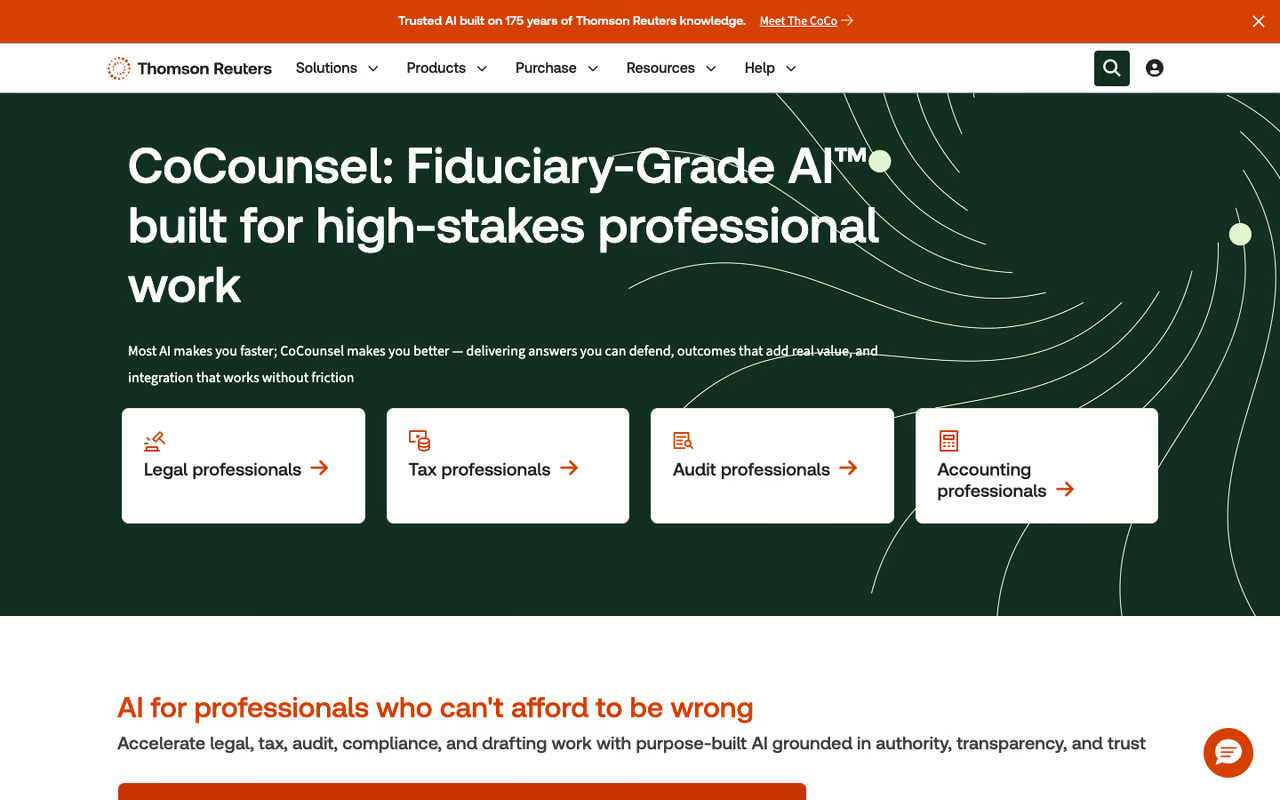
CoCounsel is Thomson Reuters' legal AI, and its whole pitch rests on one thing: it sits on top of Westlaw's primary law. If your research already runs through Westlaw, CoCounsel feels like a natural extension rather than a bolt-on. It handles document review, deposition prep, contract analysis, and legal research with citations linked back to verified sources.
A natural extension if your litigators already pay for Westlaw, with citations linked back to verified sources. You generally cannot buy it without Westlaw, and the all-in cost is hard to pin down, so verify its output.
Plans run from a Basic tier at $180 per user per month up to $639 for Westlaw Advantage with CoCounsel Essentials. The catch buried in those numbers: you generally can't buy CoCounsel without a Westlaw subscription, so your real all-in cost is Westlaw ($200-400+/month) plus the add-on.
The standout: Grounding in Westlaw's editorial content and KeyCite. For citation reliability, having the underlying law verified by Thomson Reuters' team matters.
Where it falls short: The bundling. You're locked into the Westlaw ecosystem, and the pricing is famously hard to pin down because it depends on your existing contract. In the same Stanford benchmark, Westlaw's AI hallucinated in roughly a third of test queries, so the "trusted source" framing only goes so far. Thomson Reuters disputed that methodology, but the lesson holds: verify.
Spellbook: contract drafting where lawyers already work
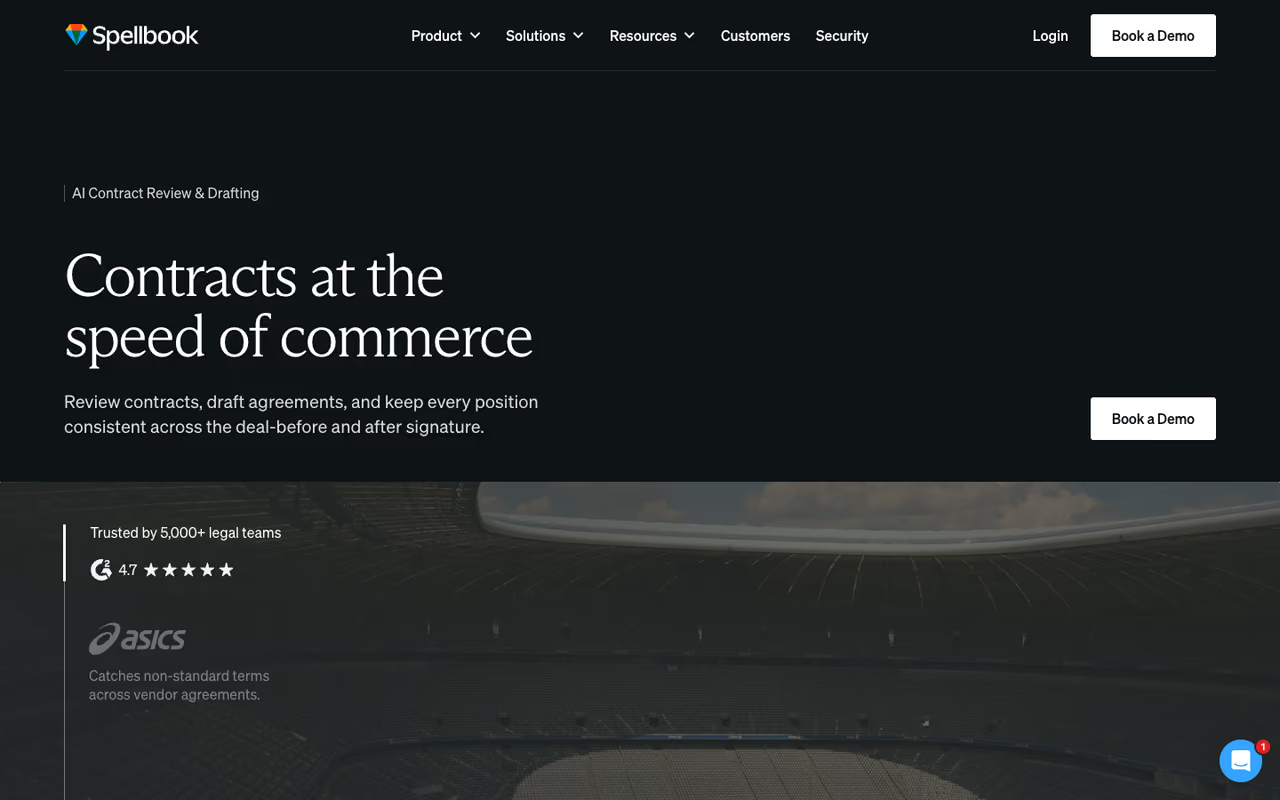
Spellbook made a smart bet: lawyers live in Microsoft Word, so build there. It's a native Word add-in that drafts clauses, flags risky language, generates redlines, and applies playbooks during live negotiation. No new app to learn, no copy-pasting between tools. For transactional and in-house work, that placement is the entire value.
The clear choice for lawyers who draft and redline contracts in Word all day, with suggestions appearing inline. It is not a research platform, and the move to quote-based pricing makes budgeting harder than it used to be.
Spellbook moved to custom, per-user pricing and no longer lists rates on its pricing page. Third-party reporting puts the Starter plan near $99/user/month and Enterprise near $199/user/month, typically with a 10-seat minimum on larger plans. There's a 7-day free trial you can start without a sales call.
The standout: The Word integration is the best in the category. Suggestions appear inline as you draft, which beats switching to a separate chat window every time you need help with a clause.
Where it falls short: It's a drafting and review tool, not a research platform. Don't expect Westlaw-grade case law or litigation support. And the move to quote-based pricing makes budgeting harder than it used to be.
If your team is already drowning in AI subscriptions and you want the strategic tools that actually move revenue, our Dupple X membership curates the picks worth paying for, so you stop guessing.
Lexis+ with Protégé: research with a citation safety net
LexisNexis renamed Lexis+ AI to Lexis+ with Protégé in early 2026. The draw is the combination: Lexis legal content, the Protégé AI assistant, and Shepard's citation checking in one workflow. In that same Stanford study, Lexis posted the lowest hallucination rate of the major research tools at 17%, which is the best of a flawed bunch.
Pick it for research-heavy firms that want conversational search backed by Shepard's citation checking in one workflow. It ties you to a legacy subscription with quote-only pricing, and users report it can be uneven on multi-jurisdictional questions.
Quote-based, generally $128 to $494 per user per month, with full agentic Protégé features running higher. You'll need a conversation with a Lexis rep to get a real number.
The standout: Shepard's. Running a citation through Shepard's to check if it's still good law, inside the same assistant that surfaced it, closes a gap most tools leave open.
Where it falls short: Like CoCounsel, it ties you to a legacy research subscription and its pricing model. Users report the assistant can still be uneven on complex, multi-jurisdictional questions.
Vincent AI: research without the Westlaw or Lexis tax
Vincent AI from vLex (now part of Clio) is the strongest answer to "I don't want to be locked into Westlaw or Lexis." After the Fastcase merger, vLex carries millions of U.S. legal documents, and it's matured into a workflow agent rather than a plain search box.
The research option for firms that do not want to be locked into Westlaw or Lexis, and strong on multi-jurisdictional work. Check what your state bar actually unlocks, because the free tier is lighter than paid Vincent AI.
Around $399 per user per month for the core research package, with enterprise pricing for larger firms. The real headline: over 40 state bars include Fastcase/vLex access as a free member benefit, so many lawyers can use a version of this at no cost.
The standout: Multi-jurisdictional and comparative research. Vincent posted 58% accuracy in the Stanford benchmark, second only to Lexis among the tools tested.
Where it falls short: Coverage outside the U.S. is strong but uneven by jurisdiction, and the free bar-association tier is a lighter product than the paid Vincent AI. Check what your state bar actually unlocks before assuming it covers your workflow.
Paxton AI: the self-serve option for solos
Paxton AI is the tool I'd point a solo or small firm to first, mostly because you can sign up and try it without sitting through a demo. It handles drafting, contract analysis, and research across federal regulations, state laws, and case law, and it carries SOC 2, ISO 27001 and HIPAA certifications, which matters for client-data work.
The one I would point a solo or small firm to first, since you can try it without a demo. The Individual plan is $499/month and it lacks the brand trust and content depth for litigation-grade work at a large firm.
Refreshingly clear. The Individual plan is $499/month or $2,999/year (the annual rate roughly halves the cost), with a 7-day free trial and no credit card to start. Enterprise is custom.
The standout: No demo gate. For a market where everyone else hides behind "book a call," being able to just try the product is a real advantage.
Where it falls short: It doesn't carry the brand trust of Harvey or the Westlaw/Lexis content depth, so for litigation-grade research at a large firm it won't be the primary tool. For a solo, that tradeoff is usually fine.

Luminance: contract automation at enterprise scale
Luminance was built by Cambridge mathematicians and runs on a proprietary legal LLM trained on over 150 million documents. It covers the full contract lifecycle: a first-pass "spellcheck" for risk, an in-Word negotiation chatbot, compliance checking, and high-volume due diligence. More than 1,000 organizations across 70 countries use it, including all of the Big Four.
An enterprise contract-automation pick for large legal teams with high contract volume, built on a purpose-built legal model. It is a contract and compliance specialist rather than a research tool, and quote-only pricing assumes a procurement team.
Custom, quote-only. No public numbers, which puts it in the same opaque tier as Harvey for budgeting purposes.
The standout: The purpose-built legal model. Because it isn't just wrapping a general-purpose LLM, its contract review tends to be precise on the structured tasks it's tuned for, with some teams reporting big cuts to negotiation time.
Where it falls short: It's a contract and compliance specialist, not a research or litigation tool. And the quote-only pricing means it's really aimed at companies with a procurement team, not small practices.

Clio Duo: AI that already knows your matters
Clio Duo is different from everything above. It's not a standalone research or drafting platform. It's an AI layer inside Clio's practice management software, so it already has context on your matters, documents, and deadlines. Ask it to summarize a matter, extract a deadline, or draft a client email, and it answers from your actual data.
Choose it if your firm already runs on Clio and wants AI that starts with your matters, documents and deadlines. It is a productivity assistant rather than a deep research engine, and no reason to switch to Clio.
An add-on at roughly $39 per user per month on top of your Clio Manage plan, which itself ranges from $49 to $149/user/month. You don't have to buy Duo for every user.
The standout: Context. Most tools start cold; Duo starts with your case data already loaded, which makes the everyday admin work feel less like prompting and more like asking a colleague.
Where it falls short: It's a productivity assistant, not a deep research or contract-analysis engine. If you're not already on Clio, it isn't a reason to switch.
How to choose
Skip the feature matrices and answer three questions.
What's the work? Heavy contract drafting points to Spellbook or Luminance. Case law research points to Lexis+ with Protégé, Vincent AI, or CoCounsel. Mixed firm-wide use at scale points to Harvey.
What's the budget per seat? Under a few hundred dollars a month, Paxton, Clio Duo, or your state bar's free Vincent access are realistic. Enterprise budgets open up Harvey, Luminance, and the full Lexis stack.
What do you already pay for? If you're locked into Westlaw, CoCounsel is the path of least resistance. On Clio, start with Duo. The cheapest good tool is often the one that extends a subscription you already have.
Start with a free trial before any annual commitment. Run it on real work for a week, and check whether it actually saves the hours it promises. For a wider view of what's worth paying for across categories, our top tools list and the rundown on the best AI agents are good next stops, and if coding is part of your workflow, the best AI for coding covers that side.
Frequently asked questions
What is the best AI tool for lawyers in 2026?
For large firms and corporate legal teams, Harvey is the strongest all-rounder thanks to its Vault document review and Workflows automation. For solos and small firms, Paxton AI and Vincent AI give you most of the value at a fraction of the cost. There's no single winner; it depends on whether your work is research, drafting, or contract review.
How much do AI legal tools cost?
It ranges widely. Clio Duo is about $39/user/month as an add-on. Spellbook and research tools like Lexis+ with Protégé run roughly $99-494/user/month. Paxton is $499/month or $2,999/year. Harvey and Luminance are enterprise-only with custom contracts that can hit $50K-$200K a year for large firms.
Can AI legal tools be trusted for legal research?
Only with verification. A 2025 Stanford study found even the best tools, including Lexis and Westlaw, hallucinated in 17% to 33% of queries. They save real time on a first pass, but every citation and conclusion needs a human lawyer to confirm it before it goes anywhere near a filing.
Do I need Westlaw or Lexis to use AI legal research?
No. CoCounsel is tied to Westlaw and Lexis+ with Protégé to LexisNexis, but Vincent AI from vLex was built specifically to avoid that lock-in, and over 40 state bars offer Fastcase/vLex access as a free member benefit. Paxton AI also runs independently of both incumbents.
What's the best AI legal tool for contract drafting?
Spellbook is the top pick for most teams because it lives natively inside Microsoft Word, where lawyers already draft. For large enterprises with high contract volume and a procurement budget, Luminance's purpose-built legal model is the stronger choice.
Ready to cut the guesswork on which AI tools are worth your money? Dupple X gives you the curated picks and the playbooks to actually use them.
Related guides
Some offers on this page may be paid placements or contain affiliate links.
