
Best AI Due Diligence Tools (2026): 8 Picks Compared

Key facts8 tools compared: Harvey, Luminance, Kira by Litera, Spellbook, LegalFly, Datasite, Ansarada…
- 8 tools compared: Harvey, Luminance, Kira by Litera, Spellbook, LegalFly, Datasite, Ansarada, DealRoom
- Harvey (best for: Big legal teams reviewing huge data rooms): Custom (enterprise)
- Luminance (best for: M&A contract diligence at scale): Custom (quote only)
- Kira by Litera (best for: Provision extraction across contract piles): Custom
- Spellbook (best for: Small legal teams living in Word): ~$99-$350/user/mo
Due diligence used to mean a room full of associates reading the same 8,000 contracts to find three change-of-control clauses that matter. The work was slow, expensive, and weirdly low-use for people billing $600 an hour. That math broke. The tools that fix it have gotten genuinely good in the last 18 months, and the gap between a team using them and a team that isn't is now measured in days, not percentage points.
This guide compares the AI tools deal teams and legal teams actually use for diligence: data rooms that read their own contents, contract-review engines that flag risk across thousands of agreements, and legal copilots that draft the issues memo for you. Some are built for a four-person fund. Some need an AmLaw budget and a procurement cycle.
If you want the short version: for legal teams reviewing huge document sets, Harvey is the most capable option available. For pure M&A contract diligence at scale, Luminance is the specialist. For a sell-side data room that also does the AI work, Datasite is the institutional default. The rest below earn their place for narrower reasons, and I'll be honest about where each one falls down.
Quick comparison
| Tool | Best for | Price | Standout |
|---|---|---|---|
| Harvey | Big legal teams reviewing huge data rooms | Custom (enterprise) | Vault reads up to 100,000 docs at once |
| Luminance | M&A contract diligence at scale | Custom (quote only) | Proprietary legal AI, on-prem option |
| Kira by Litera | Provision extraction across contract piles | Custom | 90%+ extraction accuracy, trusted by 64% of AmLaw 100 |
| Spellbook | Small legal teams living in Word | ~$99-$350/user/mo | Diligence inside Microsoft Word |
| LegalFly | In-house and EU teams with privacy needs | Custom | Scrubs sensitive data before it hits the model |
| Datasite | Sell-side data rooms + AI redaction | $25K+/yr | Best AI redaction in any VDR |
| Ansarada | Sell-side deal intelligence | From $479/mo | Predicts the winning bidder by day 7 |
| DealRoom | Buyer-led corp dev teams | $15K-$25K/yr | Diligence tracker + VDR + AI summaries |

Harvey
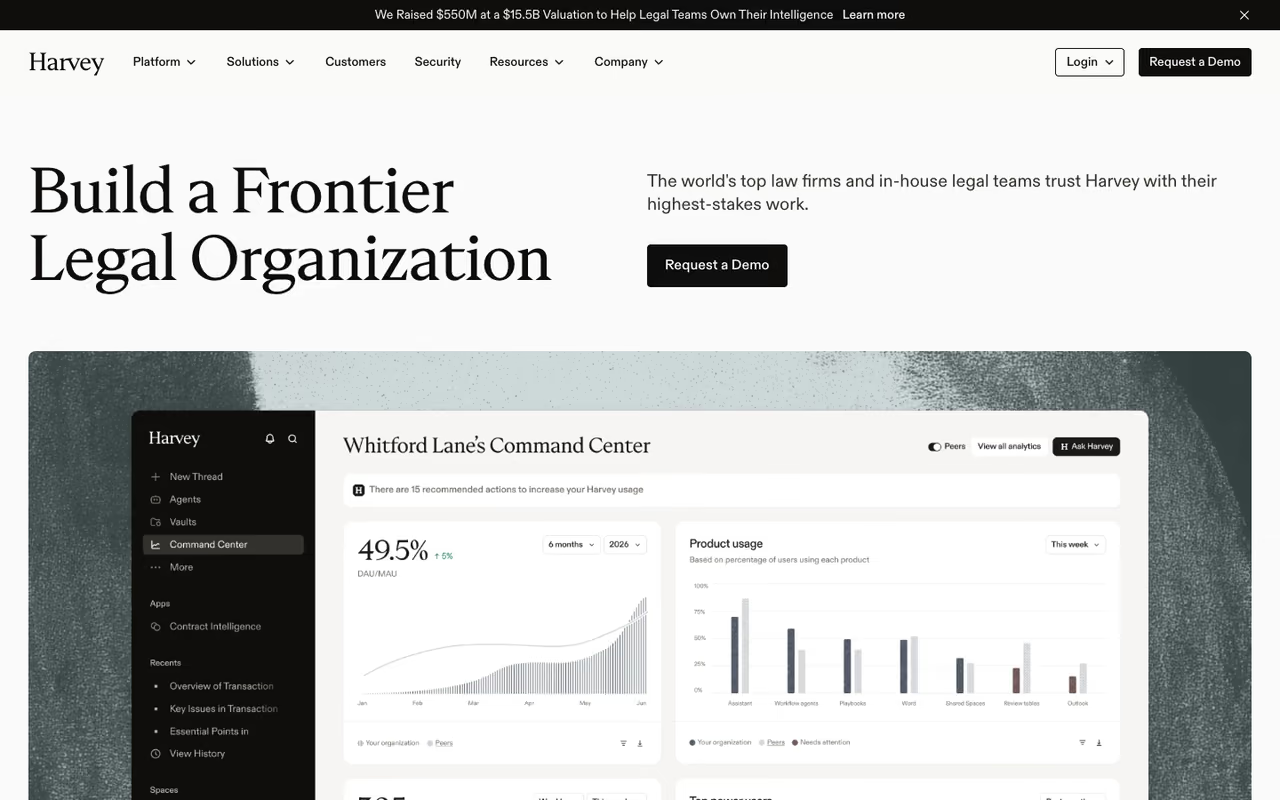
Harvey is the legal copilot that the largest firms standardized on, and after using it on a sample data room I understand why. The piece that matters for diligence is Vault: you upload a document set, and Harvey analyzes the whole thing in parallel inside an isolated environment. It scans for the unusual stuff, atypical clauses, change-of-control triggers, compliance anomalies, and lays the findings out in a structured matrix you can actually hand to a partner.
Who it's best for: large legal teams and corporate legal departments running real M&A diligence, e-discovery, or large-deal contract review.
The choice for large legal teams running real M&A diligence, where Vault analyzes a whole document set in parallel and returns a structured matrix. It is built for AmLaw 100 firms, so the price and procurement make it overkill for small teams.
enterprise and quote-based. Harvey doesn't publish numbers, and onboarding involves a sales conversation. Plan for an enterprise commitment, not a credit-card signup.
The standout: Vault can ingest up to 100,000 documents at once and process them together. Pair that with a workflow builder that lets you chain review steps in plain language, and you can turn a week of associate time into an afternoon of review-and-verify.
The catch: this is built for AmLaw 100 firms and well-funded in-house teams. The price and the procurement process make it overkill for a solo dealmaker or a five-person startup legal function. You're buying a platform, not a feature.
Luminance
Luminance came out of Cambridge mathematicians in 2015 and has been pointed at legal-specific AI since the start, which shows. Where a lot of newer tools wrap OpenAI's models, Luminance runs its own legal-trained models. For M&A diligence over thousands of contracts, its Diligence product builds an interactive heat map of the whole set, predicts which documents are relevant, and runs a traffic-light analysis that flags non-compliant clauses inside each agreement.
Who it's best for: enterprise legal teams and top-tier firms doing high-volume M&A diligence where document count runs into the thousands.
Pick Luminance for high-volume M&A diligence over thousands of contracts, with its own legal-trained models and an on-premises option for deals where data cannot leave your environment. The enterprise weight means smaller teams will struggle to justify setup and budget.
entirely undisclosed. Luminance is quote-only, and per pricing reviews enterprise subscriptions include usage-based components that scale with team size. Expect a sales call before you see a number.
The standout: the on-premises deployment option and ISO 27001 certification. For deals where data can't leave your environment, that's the difference between a tool you can use and one legal will veto.
Where it falls short: the same enterprise positioning that makes it powerful makes it heavy. Smaller teams will find the setup and the budget hard to justify, and the proprietary model means you're betting on Luminance's roadmap rather than the frontier-model arms race.
Datasite
Datasite is the virtual data room the big banks live in. It's trusted by Goldman Sachs, Blackstone, and Johnson & Johnson, and it covers the whole deal lifecycle from first diligence request to post-merger integration. The AI work here is practical rather than flashy: automatic document categorization so the index builds itself, and the best automated redaction I've seen in any VDR.
Who it's best for: sell-side teams and advisors running large-cap M&A who need a secure, institutional data room that also does AI grunt work.
The institutional data room for sell-side teams running large-cap M&A, with practical AI that categorizes documents and handles redaction better than anything I have seen. It is priced and built for big deals, so a startup raise buys capacity it will not use.
custom per project, scaling with data volume, user count, and deal length. Market analysis pegs it at $25K+/yr as the enterprise standard, with no published tiers.
The standout: the AI redaction. Finding and concealing personal information across thousands of pages by hand is exactly the kind of soul-destroying task that should be automated, and Datasite does it better than anyone. It's also added an MCP connector so you can point your own AI tools at the deal environment.
The catch: it's priced and built for large deals. For a sub-$50M transaction or a startup raise, you're paying for a lot of capacity you won't touch. The interface is powerful but not the friendliest if you're not a full-time deal professional.
If you're a smaller team building your AI stack rather than buying a single enterprise platform, it's worth thinking about how these diligence tools fit alongside the rest of your workflow. Our Dupple X bundle and our top tools directory are where I'd start mapping that out.
Kira by Litera
Kira is the original contract-analysis engine, now part of Litera, and it's still the reference point for provision extraction. It uses machine learning trained on over a million legal contracts to pull clauses, flag risk, and generate summaries across large agreement sets. In diligence it does the unglamorous core job well: turning an unstructured pile of PDFs into a structured, reviewable grid of exactly the provisions you care about.
Who it's best for: transactional legal teams and firms that need reliable, auditable provision extraction across hundreds or thousands of contracts.
The specialist scalpel for transactional teams that need reliable, auditable provision extraction across hundreds or thousands of contracts. Its roots are extraction, not conversation, so Harvey or Luminance feel more complete if you want a do-everything copilot.
custom, sales-led. No public numbers.
The standout: accuracy and trust. Kira reports 90%+ extraction accuracy, and Litera says 64% of AmLaw 100 firms use it. For 2026 it's adding Grid Chat for natural-language querying across your review data and an assistant called Lito to guide drafting and review.
Where it falls short: Kira's roots are in extraction, not conversation. The newer generative features are arriving, but if you want a do-everything copilot that drafts memos and answers open questions, Harvey or Luminance feel more complete. Kira is the specialist scalpel, not the Swiss Army knife.
Spellbook
Not every team needs a six-figure platform. Spellbook brings AI contract review directly into Microsoft Word, which is where most transactional lawyers already work. Its Spellbook Associate agent can triage multiple documents from a single prompt, so you can run a lightweight diligence pass without leaving the document you're redlining.
Who it's best for: small and mid-size legal teams, in-house counsel, and solo practitioners who want AI review without changing how they work.
A lightweight way to run AI contract review inside Word for small and mid-size teams, in-house counsel and solo practitioners, with no new interface to learn. It hits a ceiling on large batches, and a recent price increase stung early users.
custom quotes, but published estimates put it at roughly $99/user/month for Starter up to about $350/user/month for Enterprise, after a price increase in late 2025. Enterprise carries a six-month minimum.
The standout: it lives in Word. There's no new interface to learn and no data room to configure. For a deal where the "data room" is a shared folder of 40 contracts, that's the right amount of tool.
The catch: it's not built for true large-scale diligence. Spellbook shines on individual documents and small batches. Throw 5,000 contracts at it and you'll feel the ceiling. The recent price jump also stung early users who signed up at half the current rate.
LegalFly
LegalFly is a legal operating system for in-house teams, with modules for intake, review, drafting, research, and diligence. The reason it's on this list is its privacy architecture: it automatically scrubs sensitive data before anything reaches the underlying AI model. For diligence over confidential or regulated material, that's a real differentiator rather than a marketing line.
Who it's best for: in-house legal, procurement, and compliance teams, especially in the EU or in regulated industries where data handling is non-negotiable.
A fit for in-house legal, procurement and compliance teams in the EU or regulated industries, since it scrubs sensitive data before it reaches the AI model. It is younger than Kira or Luminance on pure M&A volume, and leans toward in-house operations.
custom quotes only. LegalFly raised an $16.3M Series A in 2024 and sells to corporates, so expect enterprise-style contracts.
The standout: the privacy-first design plus jurisdiction-aware checks. It can verify contracts against GDPR or DORA language and track compliance across legal systems, which matters if your deal crosses borders.
Where it falls short: it's younger and less battle-tested than Kira or Luminance on pure M&A diligence volume. The company's own positioning leans toward in-house operations rather than the heavy sell-side or buy-side transaction work the data-room platforms handle.
Ansarada
Ansarada is a virtual data room with an unusual party trick: it predicts deal outcomes. Its AI-Predict feature scores bidder engagement from how reviewers behave in the data room, and the company claims it can predict the winning bidder by day 7 with 97% accuracy. For a sell-side advisor, that's actionable intelligence about who's actually serious.
Who it's best for: sell-side advisors and founders running a raise or a sale who want signal on bidder intent, not just a place to store files.
Choose Ansarada when you are selling or raising and want signal on bidder intent as well as a place to store files. Its AI is about deal intelligence and data-room hygiene, not deep contract analysis, and larger rooms climb in price quickly.
storage-based, starting around $479/month for 250 MB and scaling to a few thousand a month for larger rooms, with unlimited users and a "free until the deal goes live" model. That last part is genuinely useful: you can prep the room before paying.
The standout: the bidder prediction and engagement scoring. Knowing which buyer is reading the customer contracts at 11pm tells you where to push. Aida, its AI assistant, also handles sorting, translation across 14 languages, and bulk redaction.
The catch: the AI here is about deal intelligence and data-room hygiene, not deep contract analysis. It won't write your issues memo. And while the entry price is approachable, larger rooms climb quickly, and the storage-based model can surprise you if your document set balloons.
DealRoom
DealRoom is built specifically for buyer-led M&A and corporate development teams. Instead of treating diligence as a folder of files, it runs it as a project: Kanban-style trackers, a diligence checklist, and a data room all in one place, with AI that summarizes across multiple documents in a click and auto-generates a deal playbook.
Who it's best for: corp dev teams managing multiple concurrent acquisitions who want diligence, the data room, and integration tracking in a single system.
Built for corp dev teams running several acquisitions at once, treating diligence as a project with trackers, a checklist and a data room in one system. Its AI is not the deepest for raw contract analysis, so heavy document reading favors Harvey or Kira.
clearer than most. A Diligence plan at $15,000/year and a full M&A platform at $25,000/year, both with unlimited users and proration for shorter projects.
The standout: the workflow model. Most tools here are either a data room or an analysis engine. DealRoom is a project-management layer for the whole deal, which is exactly what an acquirer running five deals at once actually needs.
Where it falls short: the AI is helpful but not the deepest on this list for raw contract analysis. If your bottleneck is reading 10,000 agreements rather than coordinating a team, a Harvey or Kira will do more of the heavy lifting. DealRoom organizes the work; it doesn't fully replace the reviewer.
How to choose
Start with what your bottleneck actually is, because these tools solve different problems that all get called "due diligence."
If your problem is reading a mountain of contracts, you want an analysis engine: Harvey, Luminance, or Kira. Pick Harvey if you want a full copilot that also drafts and researches, Luminance if you need on-prem or proprietary models for data-sensitivity reasons, and Kira if you mainly need rock-solid provision extraction you can audit.
If your problem is running the deal, you want a data-room platform: Datasite for large-cap institutional deals, Ansarada if you're sell-side and want bidder intelligence, DealRoom if you're a buyer juggling several acquisitions.
If you're a smaller team without an enterprise budget, Spellbook or LegalFly get you 80% of the value at a fraction of the commitment. Spellbook if you live in Word, LegalFly if data privacy is the gating concern.
One honest note: most of the genuinely capable diligence tools are quote-only, which means the real cost is opaque until you talk to sales. Budget for that conversation, and ask specifically about per-deal versus annual pricing, because for a one-off transaction a per-deal data room often beats an annual platform subscription. If you're assembling a broader AI stack rather than buying one platform, the Dupple X bundle is the cheapest way to test-drive a lot of these categories before committing. For where AI agents are heading more broadly, our guide to the best AI agents covers the autonomous side, and our roundup of the best AI for legal research pairs well with anything on this list.
FAQ
What is the best AI due diligence tool in 2026?
For legal teams reviewing large document sets, Harvey is the most capable, thanks to Vault's ability to analyze up to 100,000 documents at once. For dedicated M&A contract diligence at scale, Luminance is the specialist with its own legal-trained models. For sell-side data rooms, Datasite is the institutional standard. The "best" choice depends on whether your bottleneck is reading contracts or running the deal.
How much do AI due diligence tools cost?
It varies widely. Smaller tools like Spellbook run roughly $99 to $350 per user per month. Data-room platforms like Ansarada start around $479/month and scale with storage. DealRoom publishes plans at $15,000 to $25,000 per year. Enterprise legal AI like Harvey, Luminance, and Kira is quote-only and typically requires an annual enterprise commitment, often well into five figures.
Can AI replace human lawyers in due diligence?
No, and none of these vendors claim it can. These tools accelerate the review by extracting provisions, flagging risk, and summarizing large sets, which can cut document-review time by 50% to 90%. A qualified lawyer still verifies the findings, makes judgment calls, and signs off. The shift is from reading everything to reviewing what the AI surfaced.
Are AI due diligence tools secure enough for confidential deals?
The serious ones are built for it. Datasite, Luminance, and LegalFly carry certifications like ISO 27001 and SOC 2, several offer on-premises or isolated-environment deployment, and reputable vendors don't train their public models on your data. LegalFly goes further by scrubbing sensitive data before it reaches the model. Always confirm the specific data-handling terms in writing before uploading deal documents.
What's the difference between an AI data room and an AI contract review tool?
An AI data room (Datasite, Ansarada, DealRoom) is where you store, organize, and share deal documents securely, with AI handling tasks like redaction, categorization, and deal intelligence. An AI contract review tool (Harvey, Luminance, Kira, Spellbook) reads the actual contracts to extract clauses, flag risk, and answer questions. Large deals often use both: a data room to host the files and a review engine to analyze them.
Related guides
Some offers on this page may be paid placements or contain affiliate links.
