
Best AI DevOps Tools in 2026: 9 Picks I'd Actually Deploy

Key facts9 tools compared: GitHub Copilot, Datadog (Bits AI SRE), incident.io, PagerDuty AIOps…
- 9 tools compared: GitHub Copilot, Datadog (Bits AI SRE), incident.io, PagerDuty AIOps, Harness, Snyk, Cursor, Spacelift, HyperExecute
- GitHub Copilot (best for: Code, PRs, pipeline scripts): $10-$39/user/mo
- Datadog (Bits AI SRE) (best for: Autonomous incident investigation): Usage-based, host + agent
- incident.io (best for: Coordinating the response): Free-$25/user/mo + on-call add-on
- PagerDuty AIOps (best for: Alert noise reduction at scale): $21-$41/user/mo + AIOps add-on
Most "AI DevOps" tools in 2026 are one of two things: a chatbot bolted onto a dashboard, or a genuine agent that reads your telemetry, forms a hypothesis, and hands you a fix. The gap between those two is huge, and the marketing copy does everything it can to hide it.
I compared these tools' documentation, pricing pages, and public user reports to see which ones earn their seat in a real stack. The honest answer is that no single product covers the whole DevOps lifecycle. You assemble a stack: something for code, something for the pipeline, something for observability, something for the incident itself.
If you want the short version: GitHub Copilot is still the default for code and PR work, Datadog with its Bits AI SRE agent is the one I'd trust to investigate an incident while I'm still finding my laptop, and incident.io is where the response actually gets coordinated. The rest of this list fills the gaps around them. This is for engineers who own production, not for people shopping by feature checklist.
Quick comparison
| Tool | Best for | Price | Standout |
|---|---|---|---|
| GitHub Copilot | Code, PRs, pipeline scripts | $10-$39/user/mo | Lives where you already work |
| Datadog (Bits AI SRE) | Autonomous incident investigation | Usage-based, host + agent | Reasons over your full telemetry |
| incident.io | Coordinating the response | Free-$25/user/mo + on-call add-on | AI inside Slack, not a separate tab |
| PagerDuty AIOps | Alert noise reduction at scale | $21-$41/user/mo + AIOps add-on | Mature event correlation |
| Harness | CI/CD with deployment guardrails | Free tier, then per-developer | AI deployment verification |
| Snyk | Catching vulns before they ship | Free, then $25/dev/mo | Fix PRs, not just findings |
| Cursor | AI-first editor for infra code | $0-$200/mo | Multi-file edits across a repo |
| Spacelift | Terraform/OpenTofu automation | Free tier, then usage-based | AI explains why a run failed |
| HyperExecute | Slow Selenium/Cypress/Playwright suites | Free / $159/mo (annual) | Test orchestration across JIT VMs, up to 70% faster |
GitHub Copilot
Copilot is the tool most DevOps engineers already touch every day, and in 2026 it's grown well past autocomplete. It writes Terraform, debugs your CI YAML, explains a gnarly bash one-liner, and now drafts whole pull requests from a plain-English description through Copilot Workspace. For the unglamorous glue work that fills a DevOps week, it pays for itself fast.
The easy default for anyone writing infrastructure code, pipeline scripts or Kubernetes manifests in VS Code, JetBrains or the GitHub web UI. Copilot pays for itself on glue work, but usage-based billing makes costs harder to forecast for teams leaning on agent mode.
Pricing changed this year. Per the official plans page, individual tiers are Free (2,000 completions/month), Pro at $10/user/month, Pro+ at $39/user/month, and Max at $100/user/month. For teams, Business is $19/user/month and Enterprise is $39/user/month. The bigger shift: as of June 1, 2026, GitHub moved to usage-based billing, so each plan now includes a monthly pool of AI Credits and you pay for overflow by token.
The catch: that usage-based model makes costs harder to forecast. A team leaning hard on agent mode and frontier models can blow through its credit allotment, and the bill stops being a flat per-seat number. Budget for the overflow, or cap which models your org can call.

Datadog (Bits AI SRE)
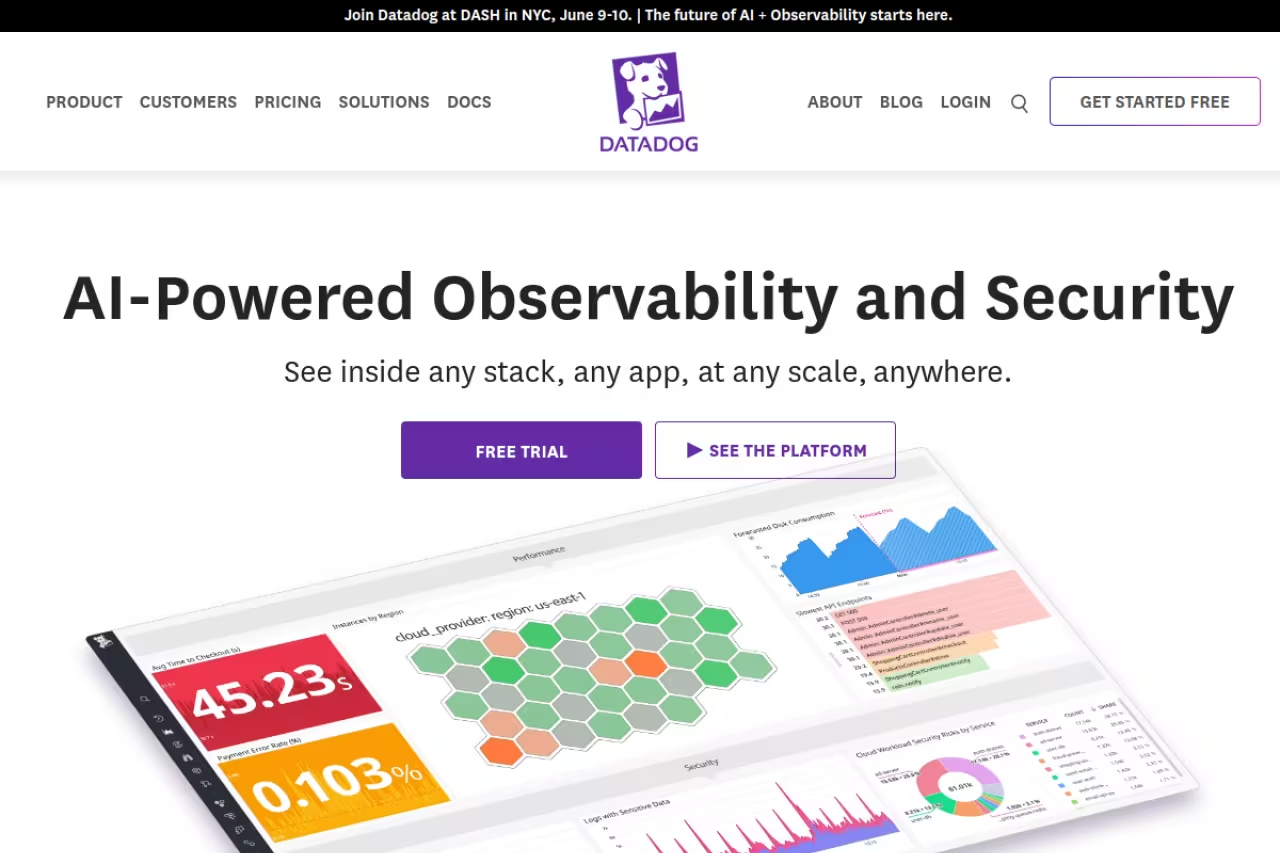
Plenty of observability platforms claim "AI." Datadog's Bits AI SRE is one of the few that does the part I actually care about: when an alert fires, it investigates on its own. It reasons across metrics, APM traces, logs, change tracking, and even your GitHub source, then writes up a root-cause analysis in minutes instead of you tabbing through fifteen dashboards half-awake.
Pick Datadog's Bits AI SRE if you already run on Datadog and want an agent investigating alerts before a human is online. The root-cause write-ups are genuinely good, but billing is hard to predict, so adopting the platform just for this is a big swing.
Datadog's recent update made Bits AI SRE roughly twice as fast and added human-in-the-loop triage, so you can approve actions from chat without copying findings somewhere else. The company says it identifies root causes up to 90% faster on its internal benchmarks. Pricing rides on Datadog's usual per-host and per-feature model, with AI capabilities layered on top.
The catch: Datadog billing is famously hard to predict, and host counts, custom metrics, log volume, and indexed spans all stack up. The AI is genuinely good, but you're buying into an ecosystem that gets expensive at scale. If you're not already a Datadog shop, adopting the whole platform just for the SRE agent is a big swing.

incident.io
Investigating an incident is one job. Running the response is another, and it's where teams quietly waste the most time. incident.io lives inside Slack or Microsoft Teams and uses AI to suggest a severity, assign roles, recommend a workflow, and draft the post-mortem from the channel history once you're done. On the Pro plan it adds an AI chat agent and Scribe, which writes the timeline so nobody has to scroll back through 400 messages.
A smart fit for teams that declare incidents in Slack or Teams and want structure without a heavy separate tool. incident.io handles severity, roles and post-mortems well, but on-call add-ons push the real per-seat cost up and it fights you if your culture is not chat-first.
Per incident.io's pricing page, Basic is free, Team is $19/user/month ($15 annual) with AI and automation, and Pro is $25/user/month with the AI-native post-mortem editor. On-call is an add-on: +$10/user/month on Team, +$20 on Pro, or $20/user/month standalone.
Where it falls short: once you add on-call, the real per-seat cost climbs past the headline number, so a Team plan with on-call lands around $25-$31/user/month. It's also chat-first by design. If your culture doesn't run incidents in Slack, the whole model fights you.
PagerDuty AIOps
If your problem is alert volume rather than incident coordination, PagerDuty has one of the most mature event-correlation engines on this list. Its AIOps layer groups related alerts into a single incident, suppresses the noise, and routes what's left to the right responder with context attached. For an on-call rotation drowning in pages, that's the difference between a sustainable schedule and burnout.
The choice for larger orgs where alert volume, not coordination, is the problem. PagerDuty's event correlation groups and suppresses noise mature enough to save an on-call rotation, but AIOps is a quote-driven add-on and overkill for a team with three services.
Per PagerDuty's pricing, the base platform runs Free (up to 5 users), Professional at $21/user/month, and Business at $41/user/month, with yearly billing around 16% off. AIOps is a paid add-on layered on top of those tiers rather than a per-seat price, so it's quote-driven for most teams.
The catch: AIOps sits behind that add-on, and the all-in cost climbs quickly. For a small team the noise reduction may be overkill. PagerDuty earns its keep when you're correlating signals across dozens of services, not when you have three.
Setting up a DevOps stack like this from scratch is exactly the kind of operational sprawl we cut down to size inside Dupple X, where the goal is fewer tools doing more.

Harness
Harness is a CI/CD platform with AI woven into the parts that scare people: deployments and rollbacks. Its AIDA assistant helps you author and debug pipelines, and its deployment verification watches your metrics after a release and rolls back automatically when it spots a regression. That continuous-verification step is the feature I'd miss most.
Go with Harness if you want pipeline automation plus a safety net on every deploy. Automatic rollback on a post-release regression is the standout, but it is a platform commitment, and smaller teams happy with GitHub Actions or GitLab CI will not feel the pull.
Harness consolidated around a Free tier and paid plans, all priced per developer in 2026. The Free plan covers CI/CD for up to 5 services with 2,000 monthly cloud credits and includes AIDA, so you can trial the AI features without a contract. Paid tiers scale by service count and developer seat up to quote-based Enterprise.
Where it falls short: Harness is a platform commitment, not a quick add-on. The free tier is generous for evaluation, but production usage at scale means real spend and real onboarding. Smaller teams happy with GitHub Actions or GitLab CI won't feel the pull.

Snyk
Security that shows up after you've shipped is theater. Snyk scans dependencies, containers, and infrastructure-as-code as you write, flags known vulnerabilities, and opens fix PRs with the patched version already bumped. For DevSecOps, that "here's the fix, not just the problem" behavior is what gets developers to actually act.
A solid DevSecOps pick for catching vulnerable dependencies and misconfigured IaC before merge, with fix PRs that arrive already patched. Watch the per-contributor billing at renewal, and expect to outgrow the free tier's monthly test limits on a busy repo.
Per Snyk's published tiers, Free gives you 200 open-source tests, 100 container tests, and 300 IaC tests per month. Team is $25 per developer per month (billed annually) with no test limits and the automated fix PRs. Enterprise is custom, adding SSO, RBAC, and policy controls. Billing is per contributing developer, meaning anyone who committed to a private repo in the last 90 days.
The catch: that per-contributor model surprises people at renewal, since the headcount it counts is often larger than your active security users. The free tier's monthly test limits are also easy to hit on a busy repo, which nudges you toward paid sooner than you'd expect.

Cursor
Cursor is an AI-first code editor, and DevOps folks underrate it. When you're refactoring a Helm chart, editing across a dozen Terraform modules, or untangling a sprawling pipeline definition, Cursor's repo-wide context and multi-file edits beat a chat window pasting snippets back and forth. It understands the whole codebase, not the one file you have open.
The editor for engineers who live in infra code and want AI that reasons across the whole repo, from Helm charts to Terraform modules. It means switching editors, and the credit system is opaque once you lean on premium models.
Cursor's 2026 tiers are Hobby (free), Pro at $20/month, Pro+ at $60/month, Ultra at $200/month, and Teams at $40/user/month with SSO and admin controls. Annual billing saves 20%. Paid plans include a monthly credit pool equal to the plan price; Auto mode is unlimited, but manually selecting frontier models draws down credits.
Where it falls short: the credit system is opaque, and heavy use of premium models drains your pool faster than the flat price suggests. It's also a full editor switch. If your team is locked into VS Code with Copilot, the migration friction may not be worth it. I cover the trade-offs more in my guide to the best AI coding agents.

Spacelift
Spacelift automates Terraform, OpenTofu, Pulumi, and CloudFormation, and its Saturnhead AI layer tackles the part of IaC that wastes the most time: figuring out why a run failed. Its Spacelift Intelligence features include an Infra Assistant that knows your stacks and state, and automatic AI analysis of failed runs, so the "why did this plan break" investigation goes from an afternoon to a paragraph.
Built for platform teams managing infrastructure-as-code across many stacks and providers, with AI that explains why a run failed. The strongest AI features sit in the enterprise tier, and if you are not running managed IaC yet, you may not feel the problem.
Spacelift has a free tier for small projects and moves to usage-based pricing for larger teams, with the AI features sitting in its higher and enterprise editions. Check the current plans directly, since the AI packaging shifted over the past year.
The catch: the strongest AI pieces land in the enterprise tier, so smaller teams get a taste but not the full assistant. And if you're not already running managed IaC, Spacelift is solving a problem you may not feel yet.
HyperExecute
Every other tool here makes something faster except the part that usually is not: the test suite. Once cross-browser coverage pushes a suite past a few hundred cases, it becomes the longest step in the pipeline, and no amount of runner tuning fixes it; the constraint is serial execution, not the machine.
HyperExecute by TestMu AI is a test orchestration cloud that runs as a step inside your existing pipeline. Download the CLI in the job, point it at a YAML file, and it fans the suite across just-in-time VMs, deciding how to split the work rather than making you write shard logic. It replaces the traditional hub-and-node grid with a single isolated environment per task, script, dependencies, browser and artifacts all on the same machine, which removes the network hops that make distributed grids both slow and flaky. Failures come back with unified logs and AI root cause analysis instead of five places to look.
Boomi cut cycle time from 9.5 hours to under two and tripled coverage. Transavia measured 70% faster.
Pick HyperExecute if Selenium, Cypress or Playwright suites dominate your pipeline time rather than builds. It fans tests out for you and returns AI root cause analysis, but it only orchestrates an existing suite and pricing scales with concurrency.
Price: Free forever (300 minutes/month, 2 concurrent sessions), then $159/month billed annually. Free parallels for open source.
The catch: It is an orchestration layer, not a test writer. You need a suite already. Priced by concurrency, so the bill scales with how parallel you go, and "up to 70%" is a ceiling that depends on how latency-bound your current setup is.
How to choose
Don't buy by category. Buy by bottleneck. Figure out where your team actually bleeds time, then add one tool there.
- You spend your days writing infra code and scripts. Start with Copilot or Cursor. Copilot if you want to stay put in your editor, Cursor if you want repo-wide reasoning.
- Deploys are scary and rollbacks are manual. Harness, for the automated deployment verification.
- Incidents take forever to diagnose. Datadog with Bits AI SRE, if you're already on the platform. The autonomous investigation is the payoff.
- On-call is drowning in alerts. PagerDuty AIOps for correlation, incident.io for coordinating the actual response. Many teams run both.
- Vulnerabilities keep slipping into production. Snyk, early in the pipeline, with fix PRs turned on.
Pick one. Wire it in properly. Measure whether mean-time-to-resolution or deploy frequency actually moved before you add the next. A stack of half-configured AI tools is worse than one tool you trust. For the broader picture of how autonomous agents are reshaping ops work, my rundown of the best AI agents is a good next read, and the top AI tools directory is handy for comparing options side by side.
If you want a curated stack instead of assembling one yourself, Dupple X bundles the tools that earn their seat. You can start a yearly trial here.
FAQ
What are the best AI DevOps tools in 2026?
The strongest picks span the lifecycle: GitHub Copilot and Cursor for writing infrastructure code, Harness for CI/CD with deployment verification, Datadog's Bits AI SRE for autonomous incident investigation, incident.io and PagerDuty AIOps for incident response and alert correlation, and Snyk for catching vulnerabilities before they ship. No single tool covers everything, so most teams combine two or three based on their biggest bottleneck.
Can AI fully automate DevOps work?
Not yet, and you shouldn't want it to. In 2026, AI DevOps tools produce a strong first draft: a root-cause hypothesis, a fix PR, a correlated incident. The judgment, the context, and the exception handling still belong to the engineer. The realistic win is cutting investigation and toil time, not replacing the on-call rotation. Treat these tools as a fast junior teammate, not an autopilot.
How much do AI DevOps tools cost?
It ranges widely. Coding assistants like Copilot start at $10/user/month and Cursor at $20/month. Incident tooling like incident.io runs free to $25/user/month before on-call add-ons. Observability platforms like Datadog and AIOps add-ons from PagerDuty are usage- or quote-based and can reach thousands per month at scale. Watch for usage-based billing on Copilot and Cursor, where heavy agent use pushes costs past the headline price.
Is GitHub Copilot or Cursor better for DevOps?
It depends on your workflow. Copilot is better if your team already works in VS Code, JetBrains, or GitHub and you want PR drafting and pipeline help without switching tools. Cursor is better when you're making large, multi-file changes across an infrastructure repo and want the editor to reason over the whole codebase. Many engineers keep Copilot for daily flow and reach for Cursor on big refactors.
What's the difference between AIOps and an AI SRE agent?
AIOps, like PagerDuty's, focuses on the signal layer: correlating alerts, suppressing noise, and routing incidents to the right people. An AI SRE agent, like Datadog's Bits AI SRE, goes a step further and investigates the incident itself, reasoning across telemetry to produce a root-cause analysis. AIOps tells you what to look at; an SRE agent tries to tell you why it broke. They complement each other rather than compete.
Related guides
Some offers on this page may be paid placements or contain affiliate links.
