
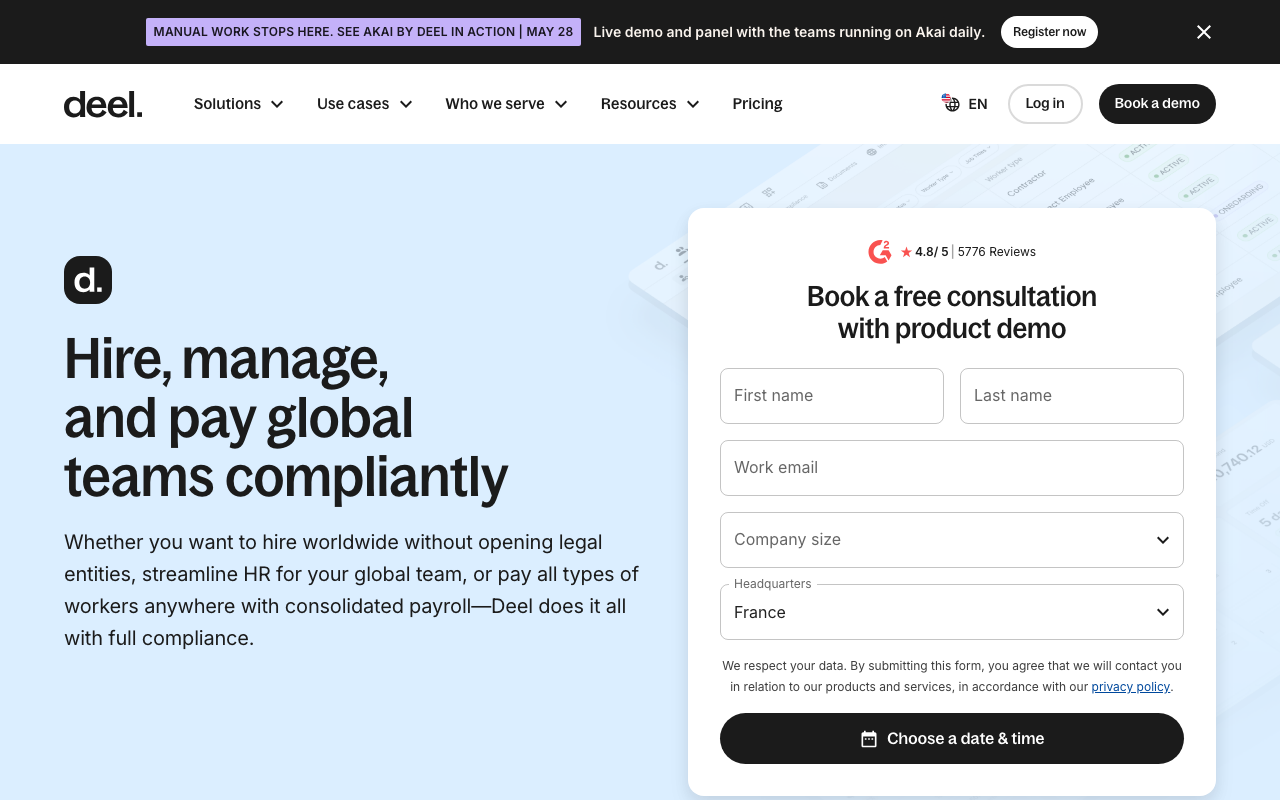
What Is Deel?
Deel is the global hiring and payroll platform that lets companies legally employ contractors and full-time employees in 150+ countries. Founded in 2019, Deel has raised over $700M and serves 35,000+ companies globally including Nike, Reddit, and Klarna. The product handles contracts, compliance, payments, taxes, and benefits across borders.
The pitch is removing the friction of global hiring. Hiring a Brazilian engineer used to require setting up a Brazilian entity, working with local lawyers, navigating Brazilian tax law, and paying through international wire transfers. Deel handles all of this through Employer of Record (EOR) services: Deel employs the worker legally in their country; you pay Deel a flat fee; the worker becomes effectively your team member.
The product targets startups hiring globally without setting up entities, mid-market companies running distributed teams, and enterprises managing complex multi-country workforces. Less useful for companies hiring only in one country (use local payroll providers).
See Deel Demo Get started →How Deel Works
Three main hiring modes. Contractors signs through Deel; Deel generates compliant contracts, handles invoicing, processes payments in their local currency, and provides tax forms (1099, W-8BEN, etc.). Employer of Record (EOR) for full-time employees: Deel becomes the legal employer in the worker's country; you pay Deel a markup; the worker receives full local benefits, payroll, and protections. Direct payroll for countries where you have your own entity.
Contracts are pre-generated by country, compliant with local laws, in local languages where required. Workers e-sign; payments scheduled automatically. Misclassification audits catch common mistakes (treating contractors as employees in ways that trigger local labor disputes).
Payments process in 100+ currencies. Workers receive in their preferred currency (or stablecoin in some countries); you pay in USD, EUR, GBP, or your home currency. Deel handles currency conversion, tax withholding, and local compliance.
Benefits administration covers health insurance, equity, time off, and stipends. Local benefits vary by country; Deel sources country-appropriate options. Equity plans handle cross-border vesting and tax implications.
Compliance dashboards track classification risk, contract expirations, missing documents, and local compliance requirements. Audit trails support due diligence and acquisitions.
Integrations include QuickBooks, Xero, NetSuite (accounting), BambooHR, Rippling, Workday (HRIS), Slack (notifications), and Greenhouse (recruiting).
Deel Pricing in 2026
Contractors: $49/contractor/month flat fee.
Employer of Record (EOR): Starting at $599/employee/month. Varies by country.
Global Payroll: Custom pricing for direct payroll in countries where you have an entity.
Deel HR: Free HRIS for companies using Deel for payments.
Get Deel Pricing See plans →Where Deel Wins
- 150+ countries: broadest global coverage.
- Fast onboarding: contracts and payments live in days, not months.
- Compliance baked in: country-specific contracts, tax forms, classifications.
- Strong integrations: works with major HRIS and accounting tools.
- Free Deel HR: HRIS bundled when using Deel for payments.
Where It Falls Short
- EOR costs add up: $599+/employee/month is high for long-term employment.
- Some countries weaker than others: depth varies by region.
- Customer support quality variable: scaling support has lagged hyper-growth.
- UI can feel busy: many features add complexity.
Deel vs Remote vs Oyster vs Papaya Global
Hr tools, published pricing
| Tool | Pricing | Model |
|---|---|---|
| Deel | $14/mo (Find talent), $49/mo (Hire contractors), $125/mo (US PEO), $325/mo (Contractor of Record), $599/mo (EOR) | Subscription |
| Flocksy | $445/mo (lowest published recurring price) | Subscription |
| Employment Hero | $600/mo (lowest published recurring price) | Subscription |
| Deputy | $4.5/mo (lowest published recurring price) | Subscription |
| Jibble | $2.99/mo (lowest published recurring price) | Subscription |
| Jubilee | $39/mo (lowest published recurring price) | Subscription |
Remote is the closest competitor with similar pricing and scope.
Oyster targets fewer countries with deeper local expertise.
Papaya Global targets enterprise multi-country payroll consolidation.
Velocity Global targets enterprise EOR with white-glove service.
Who Should Use Deel
Startups hiring globally: skip entity setup costs and timelines.
Remote-first companies: distributed team management in one platform.
Mid-market companies expanding internationally: enter new countries before committing to entities.
Skip it if: you hire in one country only (use local payroll), have fewer than 5 international hires (use direct contractor arrangements), or have strict data residency requirements that Deel cannot meet.
How Deel works
Deel is a global employment and payroll platform covering hiring, paying and administering workers in 150+ countries. It is really several businesses sold under one brand: Employer of Record (Deel hires the employee through its own local entity on your behalf), contractor management and Contractor of Record, a US PEO, global and local payroll running on Deel-owned entities and a single payroll engine, an HRIS called Deel HR, visa and immigration work through Deel Mobility, device and access management through Deel IT, and benefits administration. The company states more than $20B in payroll processed, 40,000+ customers and 2,000+ in-house compliance experts.
You pick one module or stack several on the same HRIS foundation, which means adding a module later does not require a data migration. On the EOR side, Deel onboards the worker into its local entity and then handles contracts, payroll runs, tax filings, benefits enrollment and ongoing HR and legal support. Global Payroll is presented as a roughly three-week onboarding: week one you upload worker data and configure local pay rules, week two Deel calculates pay and applies local regulations, week three covers compliance tracking and reporting. It comes either fully Managed, with a dedicated payroll manager and SLA-backed onboarding, or self-serve.
Deel IT ships devices already configured and MDM-enrolled across 130+ countries, and ties access grants and revocations to HR lifecycle events. Integration happens mainly through the Deel API at developer.deel.com into HRIS, finance and ERP systems, plus an app store of partner connectors.
Where Deel wins
- Owned entities and an in-house payroll engine, rather than a broker network of third-party partners. That structural difference determines who is actually liable and how quickly a new country can go live.
- The product surface is unusually wide. EOR, contractors, Contractor of Record, US PEO, payroll, HRIS, ATS, immigration, benefits and IT device management from one vendor can replace four or five point tools.
- Core prices are published, which most EOR competitors gate behind a sales call: EOR at $599 per employee per month, contractors at $49 a month, Contractor of Record at $325 a month, US PEO at $125 a month, and the Find Talent ATS at $14 per worker per month.
- Month-to-month billing with no long-term contract required and no stated minimum employee count.
- Modules share one HRIS foundation, so adding Engage, Compensation or Recruit later needs no migration. Core HR starts at $5 per employee per month.
- Deel IT covers procurement, MDM enrollment before shipment and 24/7 IT support across 130+ countries, which is rare coverage for a distributed team.
Where it falls short
- Costs stack fast and not obviously. Full Deel HR is quoted at $56 per employee per month once modules are combined ($5 core, $14 Recruit, $22 Develop and up), so the $5 headline is not the number for a real HR deployment.
- No free tier and no self-serve trial. Global Payroll, Deel IT and the main site all route to a demo booking, with no pricing published for those modules.
- EOR at $599 per employee per month is a serious per-head cost. Below roughly 5 to 10 workers in a country it usually beats standing up an entity, but above that the maths often flips.
- The published integration app store is thin and weighted toward smaller or less familiar vendors (Personio, Human Interest, JIRA, Drata, signNow, Mesh Payments). The major HRIS and ERP names are not listed as prebuilt connectors, so real integration means building against the Deel API.
- Global Payroll documentation does not say whether you must own local entities for the non-EOR payroll product, which is the single most important scoping question a payroll buyer has.
- Deel IT and Mobility pages name no specific MDM platforms or partners, so device-stack compatibility can only be confirmed in a sales call.
Who should use Deel
Deel suits companies hiring across borders that want a single vendor for employment, payroll, HR and device logistics, and it is strongest when you have a handful of workers spread across many countries, where EOR clearly beats opening entities. It is also a sensible consolidation play for teams already on Deel EOR who want HRIS and IT sitting on the same record.
Skip it if you are a domestic-only employer, because per-head pricing buys you nothing you cannot get cheaper locally. Skip it too if you need deep prebuilt integration with an existing enterprise HRIS or ERP rather than API development work, or if you need to compare payroll and IT costs before you are willing to sit through a sales call.
Frequently Asked Questions
What is Employer of Record (EOR)?
Deel legally employs the worker in their country; you direct their work but Deel handles employment compliance.
How long does setup take?
Contractors live in 1-2 days. EOR setup typically 1-3 weeks depending on country.
Does Deel handle equity?
Yes. Equity grants compliant across countries; tax implications handled.
What countries are supported?
150+ countries for contractors and EOR. Specific country support listed on Deel website.
Does Deel integrate with QuickBooks?
Yes natively. Payments and expenses sync to QuickBooks and Xero.