
The 8 Best Chatbot Builders in 2026 (Compared and Ranked)

Key facts8 tools compared: Chatbase, Voiceflow, Botpress, Intercom Fin, Tidio, ManyChat, Landbot, Sierra
- 8 tools compared: Chatbase, Voiceflow, Botpress, Intercom Fin, Tidio, ManyChat, Landbot, Sierra
- Chatbase (best for: Support bots from your docs): Free, then $40/mo
- Voiceflow (best for: Designing custom agent flows): Free, then $60/mo
- Botpress (best for: Developers who want LLM + code): Free (pay-as-you-go)
- Intercom Fin (best for: Established support teams): $0.99 per resolution
"Chatbot builder" means something different than it did two years ago. Back then you were wiring up keyword triggers and decision trees and praying the customer typed exactly what you expected. Now the good platforms hand you an LLM agent that reads your help docs, holds a real conversation, and only escalates when it's stuck. The tooling caught up to the hype, mostly.
That shift also made the category messy. Some tools are built for support deflection, some for Instagram DM marketing, some for designing voice agents, and a few try to do all of it badly. Pricing went from "pick a tier" to credit math, per-resolution billing, and usage caps that auto-upgrade you mid-month. Picking the wrong one is an expensive mistake.
I compared all eight of these tools, reading the actual pricing pages, documentation, and public user reports on where the bills tend to land. If you want one answer: Chatbase is the fastest way to get a genuinely useful support bot live, and Voiceflow is the pick if you care about controlling exactly how the conversation flows. Everything else depends on your channel and budget. Here's the full breakdown.
Quick comparison
| Tool | Best for | Starting price | Standout |
|---|---|---|---|
| Chatbase | Support bots from your docs | Free, then $40/mo | Trains on your content in minutes |
| Voiceflow | Designing custom agent flows | Free, then $60/mo | Visual builder with real control |
| Botpress | Developers who want LLM + code | Free (pay-as-you-go) | Open-source, multi-LLM |
| Intercom Fin | Established support teams | $0.99 per resolution | Highest deflection rate |
| Tidio | Shopify and small ecommerce | Free, then $29/mo | Lyro AI + live chat in one |
| ManyChat | Instagram and WhatsApp marketing | Free, then $15/mo | Social DM automation |
| Landbot | Lead-gen and conversational forms | From $46/mo | Beautiful no-code flows |
| Sierra | Fortune 500 enterprise | Custom (outcome-based) | Agents that take real actions |

Chatbase: the fastest path to a working support bot
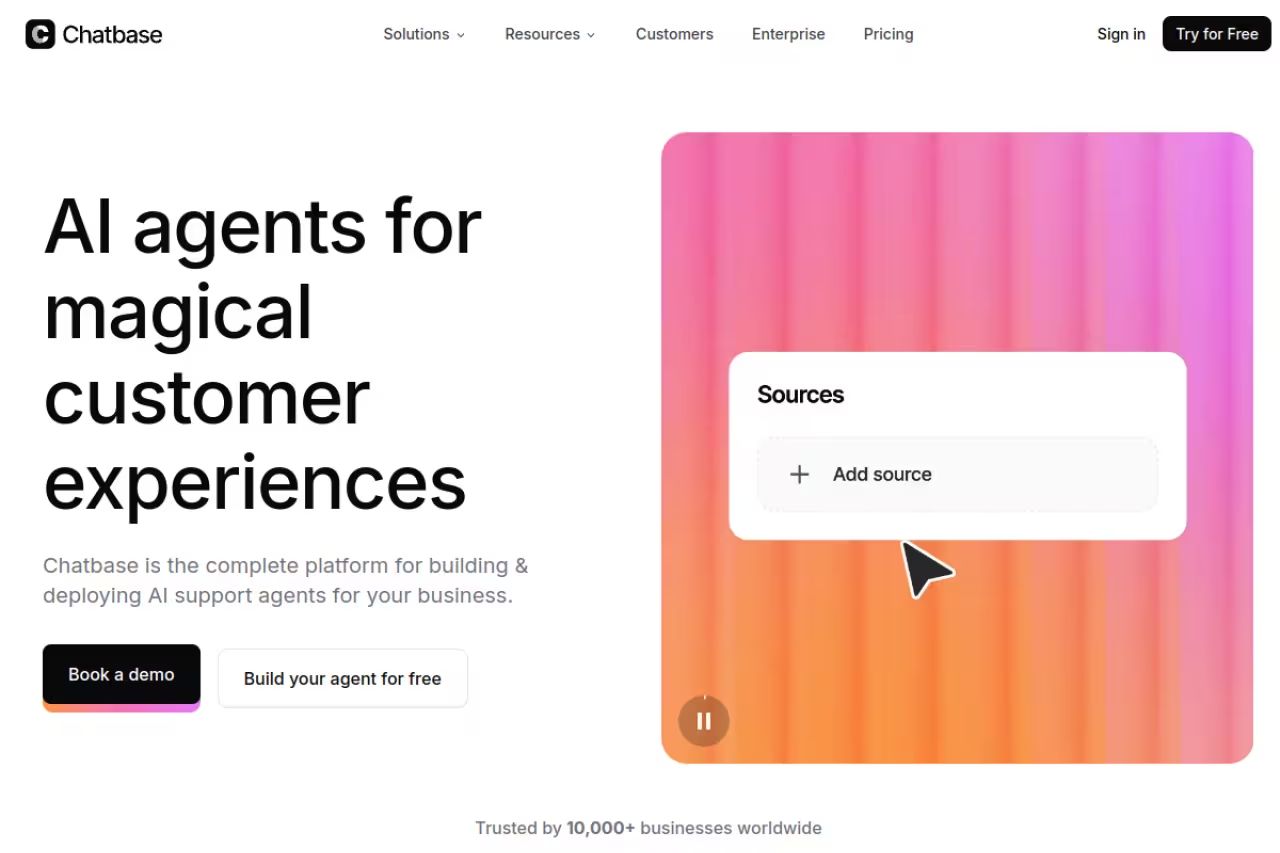
Chatbase does one thing extremely well: you point it at your website, help center, or a stack of PDFs, and a few minutes later you have a bot that answers questions using your actual content. No flow diagrams, no intent training. It rebuilt itself over the past year as a full AI customer service platform, with agents that can take actions and hand off to humans, not just a doc-answering widget.
The fastest path for founders and small support teams who want a bot live this afternoon, trained on their own docs. It is built around retrieval, so branching logic is weaker, and credits drain quickly on smarter models like Claude Opus.
Free plan with 50 message credits and 1 agent. Hobby is $40/month (or $32 on annual) with 1,500 credits. Standard is $150/month with 10,000 credits and 2 agents. Pro hits $500/month with 40,000 credits. One detail worth flagging: credits scale with model choice. A standard model burns 1 credit per reply, but Claude Opus costs 5 credits each, so a "smart" bot drains your bundle five times faster.
The standout: Time to value. I had a usable bot trained on real docs faster here than anywhere else on this list.
The catch: The free tier's 50 credits is barely a demo, and inactive agents get deleted after 14 days. Removing the "Powered by Chatbase" badge costs $39/month on top. It's also weaker if you need branching logic, since it's built around retrieval, not designed conversation paths.

Voiceflow: the builder when you need control
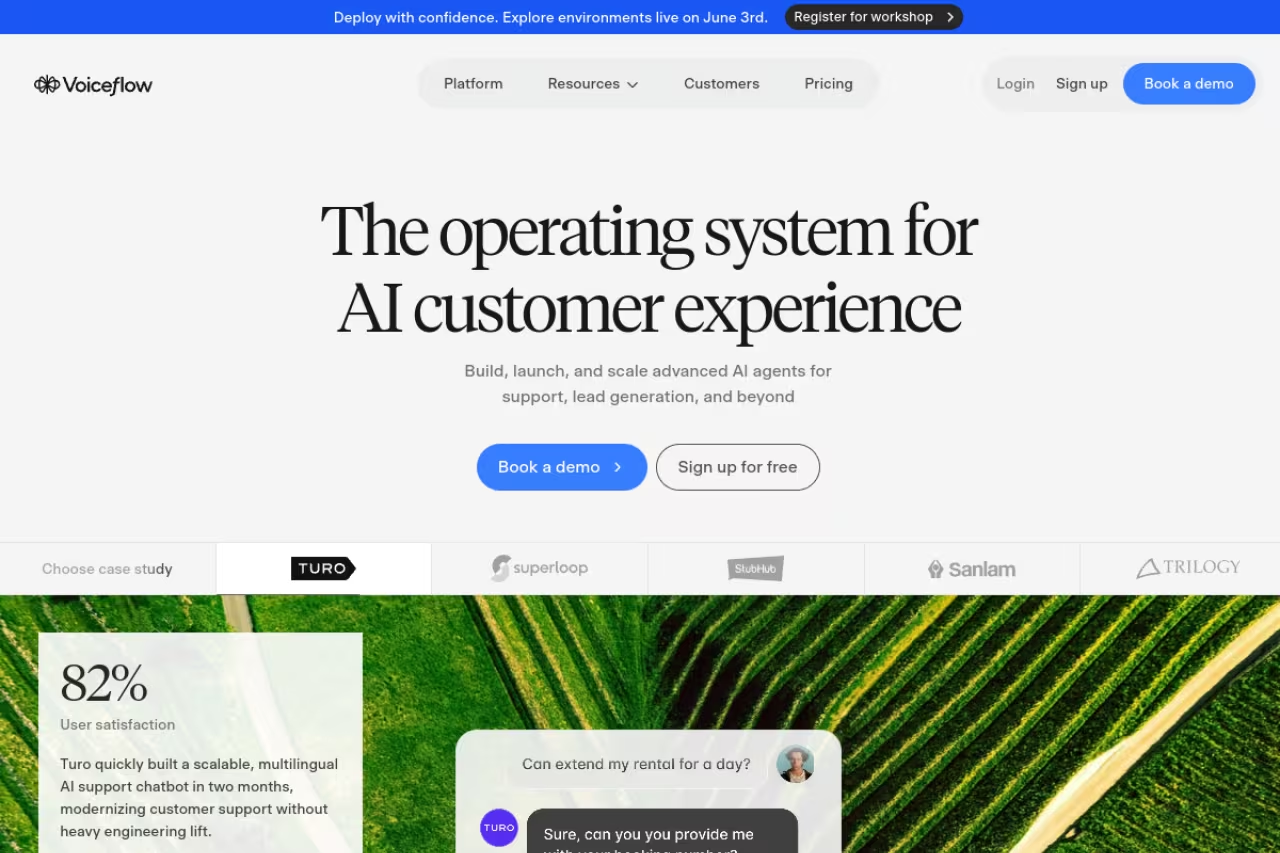
Voiceflow started as a tool for designing Alexa skills and grew into a serious agent-building canvas. The visual builder is the best in the category if you want to define exactly what happens at each step: when the LLM responds freely, when it follows a script, when it calls an API, when it hands off. You get the flexibility of code with a drag-and-drop interface.
Go with Voiceflow when you have outgrown train-on-docs bots and need designed conversations across chat and voice. The visual builder gives granular control, but it has a learning curve, and extra editor seats and voice calls add up fast.
The free Sandbox gives 1,000 credits/month, up to 2 agents, and 1 editor. Pro is $60/month with 10,000 credits, 20 agents, and access to GPT and Claude models. Business is $150/month with 30,000 credits and unlimited agents. Each plan includes only one editor seat. Extra seats run $50/month, which adds up fast for a team. Voice calls eat credits much faster than chat, so model your usage before committing.
The standout: Granular control. If you've ever been frustrated that a bot won't do exactly what you designed, this is the fix.
Where it falls short: The power comes with a learning curve. A non-technical marketer will find it heavier than Chatbase or Tidio. And credit-based pricing means a chatty, high-traffic bot can cost more than the sticker suggests. For comparison shopping on agent platforms generally, our best AI agents guide covers the broader category.

Botpress: open-source muscle for developers
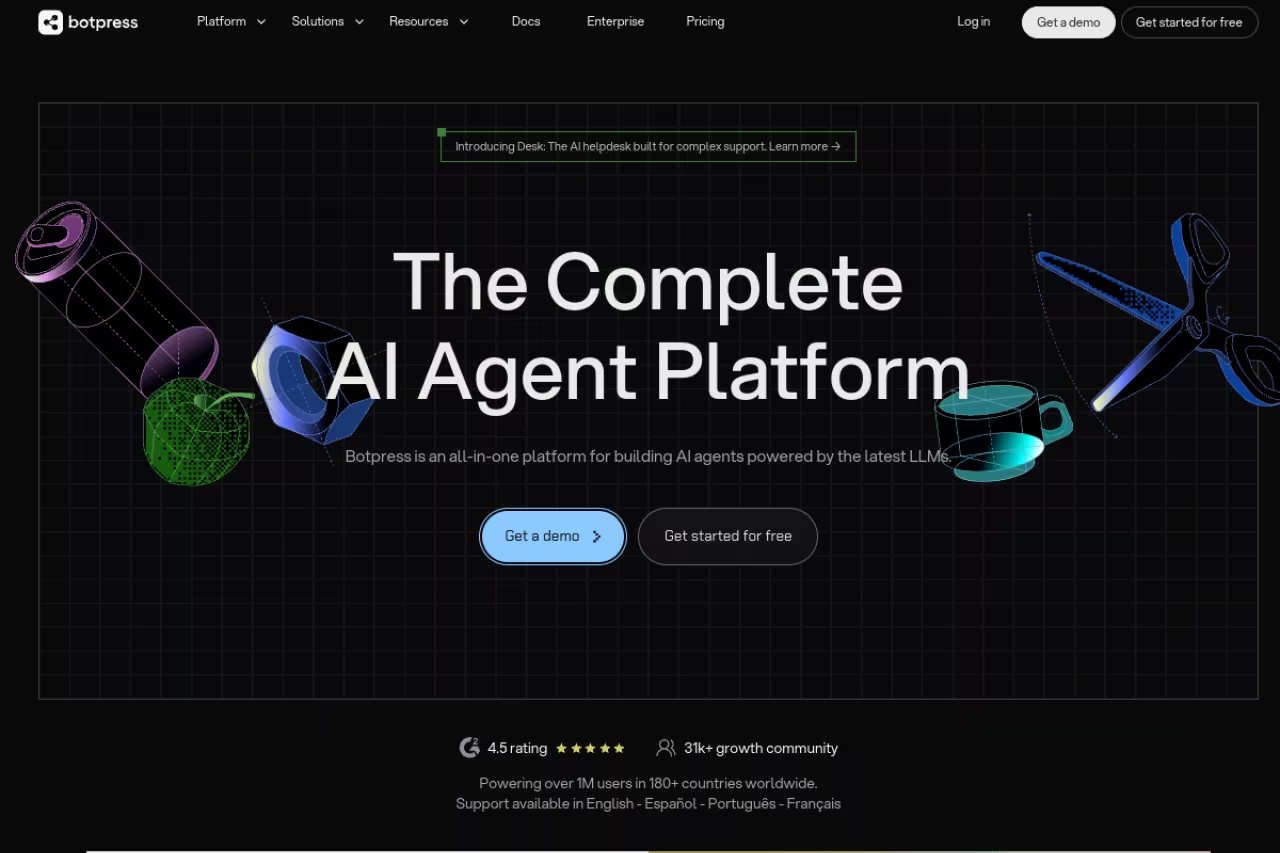
Botpress is where I'd send a developer who wants to build something custom without starting from a blank file. It pairs a visual flow builder with full code access, supports multiple LLM providers, and the core is open-source, so you're never fully locked in. The flexibility is real, and so is the complexity.
Where I would send a developer who wants a custom, branching agent with model flexibility and self-hosting. No markup on AI tokens is rare, but it is not truly no-code and usage-based billing makes monthly costs hard to predict.
The Pay-as-you-go plan is genuinely $0/month and includes 500 incoming messages, one seat, and a $5 monthly AI credit. Past that $5, LLM usage is billed at provider cost with no markup, which is fair but means costs can climb quietly. As of the May 2026 pricing update, AI spend is bundled proportionally into purchased conversations for new workspaces. Read the meter carefully here.
The standout: No markup on AI tokens and the option to self-host. For developers, that combination is rare.
The catch: This is not a no-code tool despite the visual builder. Without engineering help, you'll hit a wall. The usage-based billing also makes monthly costs hard to predict, which finance teams hate.
Intercom Fin: the deflection champion
Intercom leaned hard into AI with Fin, its support agent, and the results back it up. Fin consistently posts some of the highest resolution rates in independent tests, which is the metric that matters if your goal is cutting ticket volume. If you're already running support through Intercom's inbox, turning Fin on is close to effortless.
The deflection champion for mid-size and larger support teams already living in a help-desk tool, paying $0.99 only when Fin resolves something. Real resolution rates run roughly 42-50%, and the per-resolution model gets expensive at scale.
Fin is $0.99 per resolution on every Intercom plan, with a 50-resolution monthly minimum. You only pay when Fin actually resolves something, which sounds great until you do the math: 1,000 resolutions is $990/month, on top of seat costs. Escalations that Fin can't handle aren't billed.
The standout: Pay-per-outcome aligns cost with value. You're paying for resolved tickets, not seats or messages.
Where it falls short: Real-world resolution rates run roughly 42-50%, so forecast accordingly. And the per-resolution model gets expensive at scale, exactly when you'd hope for volume discounts. The full Intercom seat pricing stacks on top, so the "$0.99" headline undersells the total.
If your support stack is becoming a budget line you can't ignore, it's worth auditing the whole toolset. Our Dupple X members get the playbooks we use to keep this kind of spend in check.

Tidio: the small-ecommerce all-rounder
Tidio bundles live chat, ticketing, and an AI agent called Lyro into one tool that's friendly to non-technical owners. It shines for Shopify stores and small ecommerce, where you want a single widget handling sales questions and support without hiring anyone to run it.
A friendly all-in-one for Shopify and small online stores wanting live chat plus AI in one package, starting free. The pricing is genuinely confusing, with separate AI add-ons and forced auto-upgrades, so real cost lands well above $29.
Free plan exists and every account gets 50 free Lyro AI conversations. Paid plans start at Starter ($29/month) and Growth ($59/month). Lyro AI is a separate add-on at around $32.50/month per 50 conversations on top of your base plan. So the real monthly cost for a store wanting AI plus flows lands closer to $100-150 than the advertised $29.
The standout: It's the easiest "everything in one box" option for a store owner who doesn't want to think about it.
The catch: The pricing is genuinely confusing. Conversation-based billing, separate AI add-ons, and forced auto-upgrades at 95% usage can cause sudden cost jumps. Watch the meter or you'll get a surprise.

ManyChat: built for social DMs, not your website
ManyChat plays a different game than the support tools above. It automates conversations inside Instagram, Facebook Messenger, WhatsApp, and SMS. If your growth comes from social, ManyChat turns comments and DMs into automated funnels that capture leads and drive sales.
Built for creators, ecommerce brands and marketers who live on Instagram and WhatsApp, with excellent comment-to-DM lead capture flows. It is not a website support bot, and contact-based pricing quietly raises your bill as your audience grows.
Free for up to 1,000 contacts on Instagram and Messenger. Pro starts at $15/month for 500 contacts and scales with your list, hitting $29/month at 2,500 contacts. There's a separate AI add-on at $29/month. WhatsApp messages carry Meta's per-conversation fees on top, so factor those in if WhatsApp is your channel.
The standout: Nobody does Instagram and WhatsApp DM automation better. The keyword-triggered comment-to-DM flows are genuinely effective for lead capture.
Where it falls short: This is not a website support bot. If you want something answering questions on your homepage from your docs, look elsewhere. Contact-based pricing also means a growing audience quietly raises your bill.

Landbot: conversational forms that convert
Landbot makes the prettiest no-code bots on this list. Its drag-and-drop builder turns boring forms into conversational flows that feel like chatting with a person, which lifts completion rates for lead gen and surveys. It works on web and WhatsApp.
The prettiest no-code builder here, ideal for marketers running lead-gen campaigns, quizzes and conversational landing pages. AI capabilities lag doc-trained tools like Chatbase, and price per chat climbs steeply for higher-volume sites.
The Starter plan is $46/month with 500 chats, 100 AI chats, and 2 seats. Pro is $105/month with 2,500 chats and 300 AI chats. WhatsApp functionality jumps to around $233/month. Annual billing knocks off 20%. The AI chat limits are tight relative to the total chat count, so heavy AI use pushes you up fast.
The standout: Design quality. The bots look great out of the box and the flow builder is a pleasure to use for marketing campaigns.
The catch: The AI capabilities lag behind doc-trained tools like Chatbase. Landbot is strongest as a structured conversational form, weaker as an open-ended question-answering agent. The price-per-chat also climbs steeply for higher-volume sites.

Sierra: the enterprise heavyweight
Sierra, from former Salesforce co-CEO Bret Taylor, isn't competing for your side project. It builds AI agents for the Fortune 500, agents that don't just answer but take action: processing returns, updating CRM records, managing orders. It reportedly serves around 40% of the Fortune 50 and crossed $150M in ARR within eight quarters.
An enterprise heavyweight for large companies that need agents taking real action inside their systems, with governance to match. There is no self-serve or transparent pricing, so it is overkill for anyone under a few hundred employees.
Custom and outcome-based. Sierra doesn't publish numbers, which tells you the segment. If you have to ask, you're probably not the buyer yet.
The standout: Agents that genuinely act inside your business systems, not just chat. That action layer is what justifies the valuation.
Where it falls short: No self-serve, no transparent pricing, no quick start. This is a procurement-and-implementation engagement, not a tool you spin up over coffee. Overkill for anyone under a few hundred employees.
How to choose
Start with the job, not the brand. Three questions sort most of this out.
What channel? Website support points to Chatbase, Intercom Fin, or Tidio. Instagram and WhatsApp marketing means ManyChat. Lead-gen forms favor Landbot. Designing custom multi-step agents lands on Voiceflow or Botpress.
How much control do you need? If "train on my docs" is enough, Chatbase wins on speed. If you need to define every branch and API call, Voiceflow (no-code) or Botpress (with code) give you that control. Don't pay for flexibility you won't use.
What's your real budget at volume? Headline prices lie here more than in most categories. Map your expected monthly conversations against each model: per-resolution (Fin), per-credit (Voiceflow, Chatbase), per-contact (ManyChat), or per-chat (Landbot). The cheapest sticker is often the most expensive at scale. Run the numbers before you commit, and revisit them at three months when your usage is real.
My honest default for most teams: start free on Chatbase to validate the use case, then graduate to Voiceflow if you need designed flows or Intercom Fin if deflection rate is the only metric you care about.
FAQ
What is the best chatbot builder for small businesses?
For most small businesses, Chatbase or Tidio are the strongest picks. Chatbase gets a support bot trained on your docs live in minutes for $40/month, while Tidio bundles live chat and the Lyro AI agent in one tool that's ideal for Shopify stores. Both have free tiers to test before paying.
Are there free chatbot builders worth using?
Yes. Botpress offers a genuinely free pay-as-you-go plan with 500 messages and a $5 AI credit monthly. Voiceflow's free Sandbox includes 1,000 credits and 2 agents, and Chatbase, Tidio, and ManyChat all have free tiers. The free plans are real but limited, so expect to upgrade once you're past testing.
Do I need coding skills to build a chatbot?
Not for most tools. Chatbase, Tidio, Landbot, and ManyChat are fully no-code. Voiceflow is no-code but has a steeper learning curve. Botpress is the exception: despite its visual builder, you'll want a developer to get real value from it.
How much does an AI chatbot cost per month?
It ranges widely. A small business bot runs $30-60/month on tools like Tidio or Chatbase. Mid-size support teams using Intercom Fin pay $0.99 per resolution, so 1,000 resolutions is roughly $990/month plus seats. Enterprise platforms like Sierra use custom outcome-based pricing. Watch usage-based models, since credits and per-conversation fees inflate the real bill.
What's the difference between a chatbot builder and an AI agent platform?
The line has blurred. Older chatbot builders followed scripted decision trees, while modern AI agent platforms use LLMs to hold open conversations and take actions like processing a refund or updating a record. Most tools here, Chatbase, Voiceflow, Botpress, Fin, and Sierra, are really AI agent platforms now. For a wider view, see our guide to the best AI agents and our top AI tools roundup.
Which chatbot builder has the highest resolution rate?
Intercom Fin consistently posts among the highest support resolution rates in independent benchmarks, which is why it bills per resolved ticket. Real-world rates land around 42-50% depending on your content quality, so the cleaner your help docs, the more tickets any of these tools will deflect.
Whichever you pick, the bot is only as good as the content behind it. If you want the templates and vetted tool stack we use to ship these fast, Dupple X is where we keep them.
Related guides
Some offers on this page may be paid placements or contain affiliate links.
Across our whole catalogue the median is $24 a month and 33% of tools advertise a free tier. Figures are the lowest recurring monthly price quoted in our own review of each tool, read on 2026-08-19. Full method and every category.
