
The 9 Best AI Receptionists in 2026 (Compared and Priced)

Key facts9 tools compared: Reception.ai, Goodcall, Smith.ai, Rosie, Dialzara, My AI Front Desk, Retell…
- 9 tools compared: Reception.ai, Goodcall, Smith.ai, Rosie, Dialzara, My AI Front Desk, Retell AI, Vapi, Synthflow
- Reception.ai (best for: SMBs living on inbound calls): From $29/mo (free trial)
- Goodcall (best for: Most small service businesses): From $79/mo (unlimited minutes)
- Smith.ai (best for: High-stakes calls (legal, medical)): From $95/mo (50 calls)
- Rosie (best for: Solo operators and tradespeople): From $49/mo (250 min)
Every missed call is a customer who already called someone else. If you run a clinic, a plumbing crew, a law office, or a small agency, you know the math: the phone rings while you're with a client, it goes to voicemail, and that lead is gone. A human receptionist solves it for about $3,000 a month. An AI receptionist now does most of the same job for under $100.
The catch is that "AI receptionist" means two very different things in 2026. Some products are turnkey: you sign up, point your number at them, and they book appointments by tonight. Others are developer platforms where you assemble the voice agent yourself from speech, language, and telephony parts. Both are valid. Picking the wrong one wastes weeks.
I compared the main contenders on pricing pages, documentation, and public user reports, looking at how each one handles bookings, transfers, and the awkward edge cases that trip bots up. If you want the short version: Reception.ai is the new front-runner for small and medium businesses that live on inbound calls, Goodcall is the best all-around pick for most small service businesses, Smith.ai wins when calls are high-stakes and you want a human safety net, and Retell AI is what you want if you're a developer building something custom. The rest of this covers when each one actually makes sense.
Quick comparison
| Tool | Best for | Price | Standout |
|---|---|---|---|
| Reception.ai | SMBs living on inbound calls | From $29/mo (free trial) | ElevenLabs voice, 24/7 in 70+ languages |
| Goodcall | Most small service businesses | From $79/mo (unlimited minutes) | Per-caller billing, no per-minute anxiety |
| Smith.ai | High-stakes calls (legal, medical) | From $95/mo (50 calls) | Live human agents as backup |
| Rosie | Solo operators and tradespeople | From $49/mo (250 min) | Dead-simple setup, natural voice |
| Dialzara | Practices watching the budget | From $29/mo (60 min) | Cheapest real entry tier |
| My AI Front Desk | Scheduling-heavy businesses | Free tier, then $99/mo | Genuinely usable free plan |
| Retell AI | Developers building custom agents | $0.07-$0.31/min | Pay only for what you use |
| Vapi | Engineers who want full control | ~$0.05/min + your components | Lowest orchestration fee |
| Synthflow | No-code agencies and teams | Per-minute, plans scale up | Build agents without code |
Reception.ai
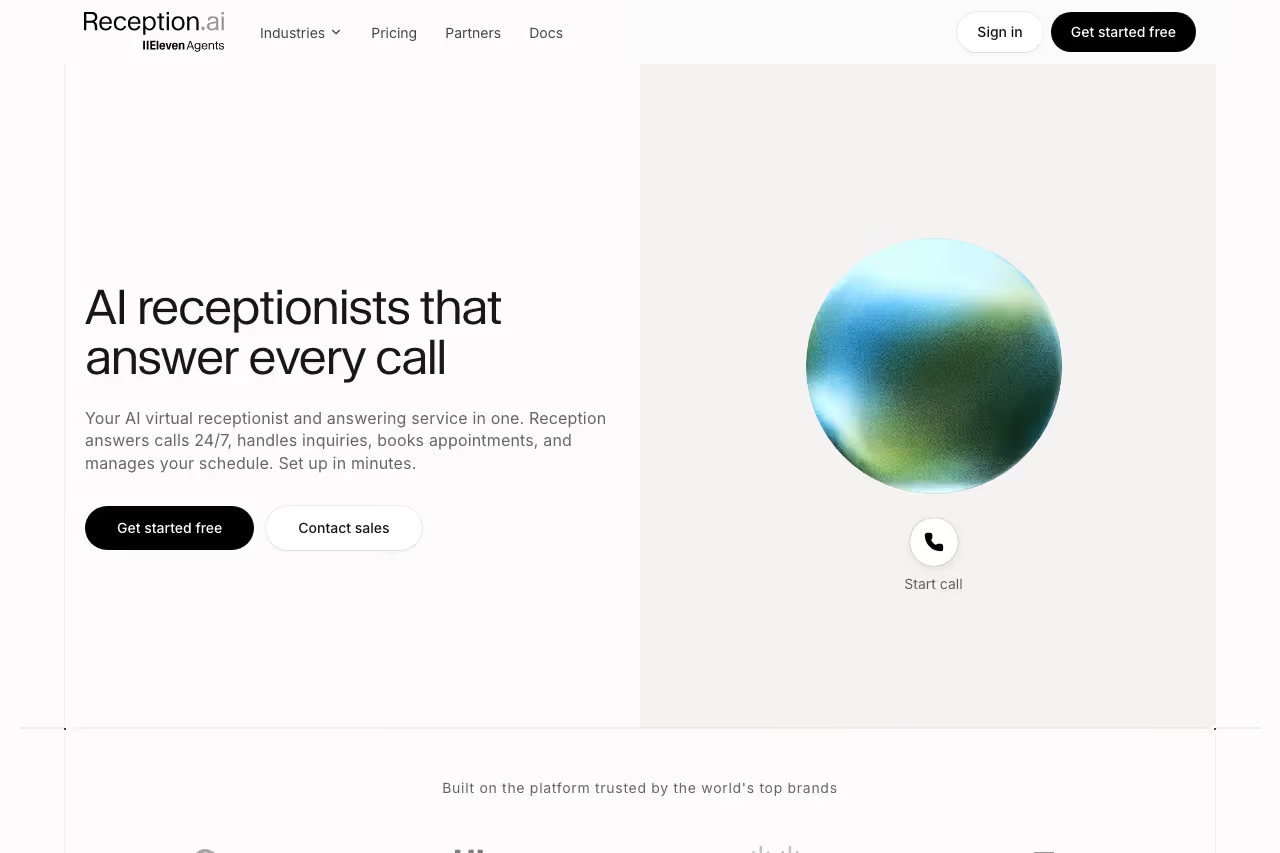
Reception.ai is an AI phone receptionist built by ElevenLabs on its ElevenAgents infrastructure, which means the voice quality that made ElevenLabs the industry benchmark now answers your business line. It picks up every call 24/7, handles inquiries in natural conversation across 70+ languages with automatic language detection, books, reschedules, or cancels appointments over the phone, and logs everything (clients, conversations, revenue) in a single dashboard.
Who it's best for: small and medium businesses that live on inbound calls. Clinics, salons, law offices, and home services, where a missed call is a missed customer.
Pick Reception.ai if you are a small business that lives on inbound calls, like clinics, salons and law offices. It sets up in minutes by scanning your website, with ElevenLabs voice quality, but it is built for inbound reception, not outbound campaigns or deep custom workflows.
Pricing starts with a free 14-day trial (30 minutes/month), then Basic at $29/mo (75 min), Plus at $79/mo (275 min, most popular), and Premium at $199/mo (1,000 min, multi-location). Enterprise is custom.
Setup is the standout for speed: sign up, and it scans your website to learn your services, hours, team, and location. You get a dedicated phone number at account creation (US & Canada) and can be live in minutes. A public booking page, automatic CRM, analytics, and integrations (Google Calendar, Zapier, webhooks) round it out.
The catch: it's built for inbound reception. If you need outbound calling campaigns or deep custom agent workflows, you'll want a full voice-agent platform like ElevenAgents instead.

Goodcall: the best default for service businesses
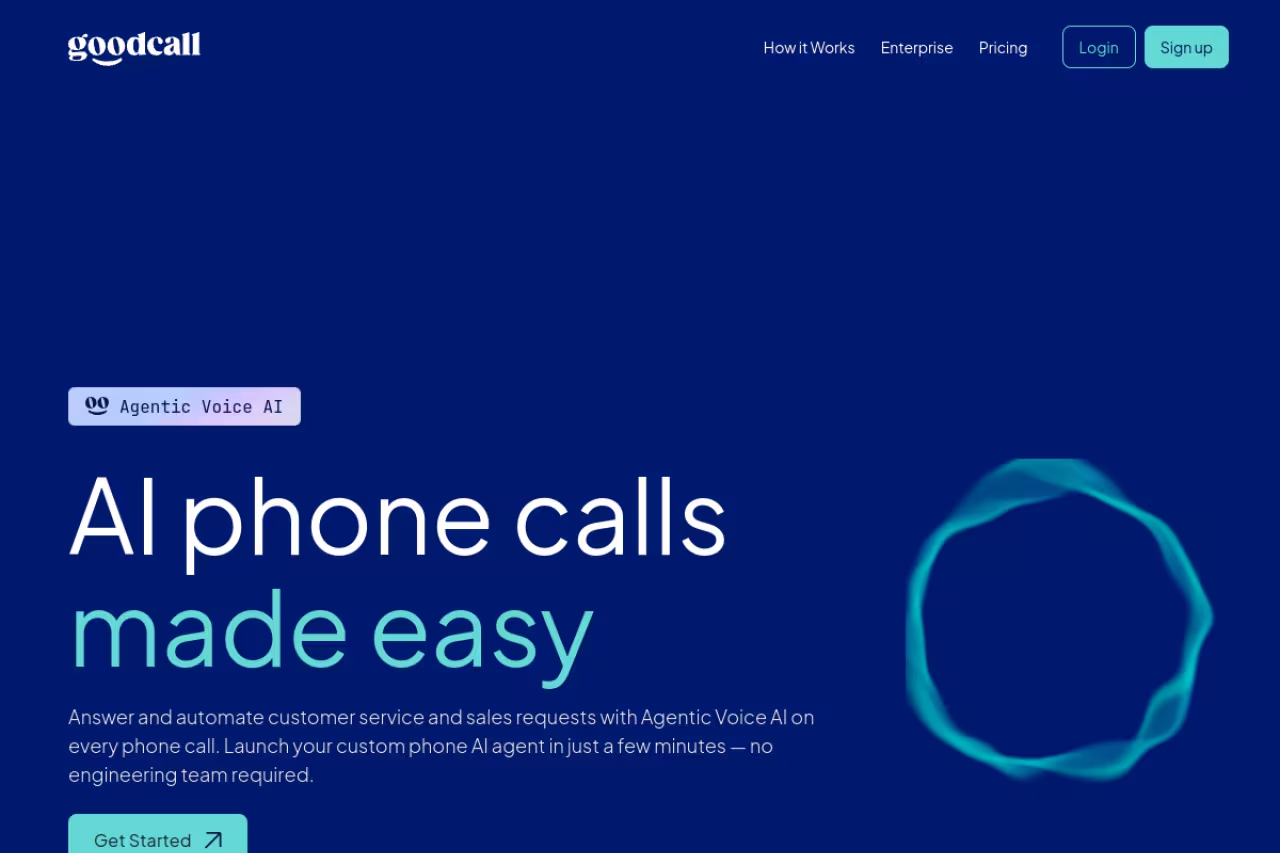
Goodcall is an AI phone agent built around one idea: answer every inbound call, qualify the caller, book the appointment, and send an SMS follow-up, all without a human touching it. You configure "skills," which are logic flows for your specific business, connect a calendar and CRM, and let it run.
Who it's best for: small service businesses (HVAC, salons, dental, home services) that get steady inbound calls and want predictable billing. The pricing model is the reason I rank it first. Goodcall charges per unique caller, not per minute. Someone who calls ten times in a month counts as one. Long calls don't punish you. According to its pricing page, Starter is $79/month for up to 100 unique callers, Growth is $129 for 250, and Scale is $249 for 500. Annual billing drops those to $66, $108, and $208. Every plan includes unlimited minutes, and there's a 14-day free trial.
The standout is that per-caller billing removes the math anxiety that ruins per-minute plans. You're not watching a meter while a chatty customer talks for eight minutes.
The catch: overage is $0.50 per unique caller above your cap, and the cheaper plans limit you to one logic flow. If your business has several distinct call types (new bookings, reschedules, vendor calls), you'll feel the squeeze until you're on Growth or Scale.
The best default for small service businesses with steady inbound calls, thanks to billing per unique caller instead of per minute, so long calls never punish you. The catch is $0.50 overage per caller and a single logic flow on the cheaper plans.

Smith.ai: AI with a human net for calls that matter
Smith.ai is the established name here, and it earns the spot by not pretending AI is perfect. Its AI receptionist handles routine calls, but live North America-based agents are available as backup when a call gets complicated or sensitive. For a law firm or a medical office, that hybrid model is the difference between trusting the system and lying awake about it.
Who it's best for: businesses where a botched call costs real money or trust. Legal intake, healthcare, high-ticket consulting.
Go with Smith.ai for legal intake, healthcare or high-ticket consulting, where a botched call costs real money. Live North America-based agents back up the AI when a call gets sensitive, but per-call pricing climbs fast at volume and it is a premium service.
Pricing, per the Smith.ai AI receptionist plans, starts at $95/month for 50 calls, then $270 for 150 calls, and $800 for 500. Overage runs around $2.40 per call. There's a 30-day money-back guarantee and no setup fee. Spam blocking and lead qualification come standard.
The standout is the live agent network. When the AI hits a wall, a trained human picks up instead of dropping the caller into a dead end.
Where it falls short: it's priced per call, so it gets expensive fast if you field a lot of volume. At 500 calls you're at $800/month, which is real money. And the human-backup option costs more than the pure-AI tiers. This is a premium service, not a budget one.

Rosie: the fastest setup for solo operators
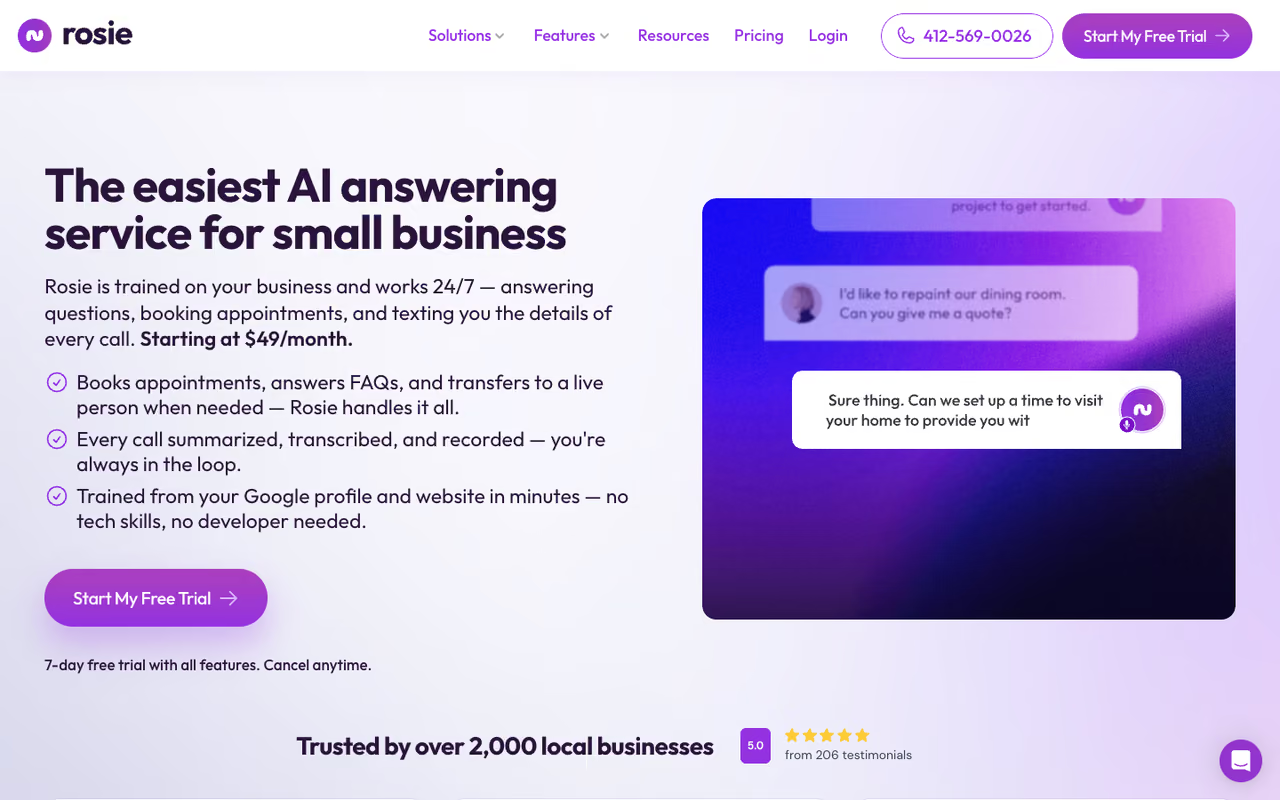
Rosie is built for the person who is the business: the contractor, the solo lawyer, the one-chair salon. You answer a few questions, it trains on your FAQs, and it's live in minutes. The voice quality is among the most natural of the tools on this list, which matters when your callers are skeptical that a bot is talking to them.
Who it's best for: solopreneurs and tradespeople who need calls answered and messages taken without a learning curve.
Looking at the Rosie pricing, Professional is $49/month for 250 minutes, Scale is $149 for 1,000 minutes, and Growth is $299 for 2,000 minutes. There's a 7-day free trial. All plans include 24/7 coverage, custom FAQs, call summaries, and bilingual support.
The standout is genuine simplicity. If you've been burned by complex setups, Rosie respects your time.
The catch: appointment booking only unlocks on the $149 Scale plan. That makes the $49 entry tier a message-taking service, not a true receptionist that closes the loop on scheduling. If booking is your whole reason for buying, budget for Scale from day one.
The fastest setup for solo operators like contractors, solo lawyers and one-chair salons, with natural voice quality and live in minutes. Appointment booking only unlocks on the $149 Scale plan, so the $49 tier is really a message-taking service.
If you want a soft sell here: keeping up with which of these tools actually ships new capabilities is a job in itself. The Dupple X newsletter tracks AI tooling so you don't have to refresh ten pricing pages a week.

Dialzara: the cheapest real entry point
Dialzara is the value play. It does the core job (24/7 answering, appointment booking, lead qualification, call routing, voicemail transcription) at a price that undercuts almost everyone.
Who it's best for: small practices and shops that want a real AI receptionist on a tight budget, including dental and chiropractic offices.
Per the Dialzara pricing page, Business Lite is $29/month for 60 minutes, Business Pro is $99 for 220 minutes, Business Plus is $199 for 500, and Business Elite is $349 for 1,000. Overage ranges from $0.35 to $0.48 per minute depending on tier. There's a 7-day free trial and no setup fee.
The standout is that $29 entry price, which is the lowest functional tier I found that still books appointments and routes calls.
Where it falls short: 60 minutes on the Lite plan disappears fast. If your calls average three minutes, that's 20 calls before you hit overage. The cheap tier is realistically a trial, not a destination. Most businesses should plan on Pro or Plus.
The cheapest real entry point for small practices on a tight budget, with booking and call routing from $29/month. The 60 minutes on Lite disappear fast, about 20 calls at three minutes each, so most businesses should plan on Pro or Plus.
My AI Front Desk: a free tier you can actually use
My AI Front Desk, now branded Frontdesk AI, leans into scheduling and Q&A across phone, chat, SMS, and email. The thing that sets it apart is a free plan that isn't just a teaser.
Who it's best for: scheduling-dominated businesses and anyone who wants to test a full AI receptionist without a card on file.
The free plan gives you 20 voice minutes a month, 10 chatbot conversations, and a small knowledge base, no credit card required. The Business-in-a-Box plan is $99/month, or $79 billed annually, with 200 voice minutes, 100 chatbot conversations, and CRM sync. Overage credits run a penny each.
The standout is that free tier. Twenty minutes won't run a business, but it's enough to hear how the AI handles your real callers before you commit.
The catch: 20 free voice minutes is a demo, not a plan, and the jump to $99 is the only real option above it. Power features like API access and verified outbound caller ID also sit behind the Business tier.
A free plan you can actually use to hear how the AI handles your real callers, no card needed, and it suits scheduling-dominated businesses. Twenty free voice minutes is a demo, not a plan, and the jump to $99 is the only real option above it.

Retell AI: the builder's choice
Retell AI is not a turnkey receptionist. It's the platform you use to build one. You bring (or pick) your speech-to-text, language model, and voice, and Retell orchestrates the call. For a developer, that control is the whole point.
Who it's best for: technical teams and agencies building a custom voice agent into a product or a client deployment.
Retell AI is the builder's choice for technical teams and agencies creating a custom voice agent, with usage-based pricing and no feature gates. It is engineering work with no five-minute setup, so without in-house skills you will spend more on labor than you save.
Pricing is usage-based: the Retell pricing page lists $0.07 to $0.31 per minute depending on the model and voice you choose, with $10 in free credits to start. A typical stack with a mid-tier model lands around $0.11 to $0.15 per minute. There are no platform fees or feature gates.
The standout is that you pay only for what you use, and you control every layer of the call.
Where it falls short: this is engineering work. There's no "set up your receptionist in five minutes" path. If you don't have someone comfortable wiring up models and telephony, you'll spend more on labor than you save on subscription fees. For a deeper look at this category, see my guide to the best AI voice agents.

Vapi: maximum control, maximum responsibility
Vapi sits in the same developer bucket as Retell but pushes even further toward raw flexibility. It's the layer between your phone system and your AI models, and it charges a low orchestration fee while you bring your own components.
Who it's best for: engineers who want to control speech, language, and telephony independently and optimize cost per minute.
The base orchestration fee is around $0.05 per minute, the lowest among major platforms, but you add your own speech-to-text, language model, and voice keys on top, which typically pushes the all-in cost to $0.07 to $0.25 per minute. New users get $10 in free credits.
The standout is that $0.05 base rate and the freedom to swap any component.
The catch: at scale, total stack costs can run into thousands per month once you add every layer, and the burden of assembling and maintaining the stack is entirely on you. This is a power tool, not a plug-and-play receptionist.
Vapi is maximum control for engineers who want to swap speech, language and telephony components and optimize cost per minute, at a $0.05 base rate. You assemble and maintain the whole stack yourself, and total costs can run into thousands per month at scale.
Synthflow: no-code agents for teams and agencies
Synthflow splits the difference between turnkey and developer platforms. You build voice agents through a visual no-code interface, which makes it a fit for agencies deploying receptionists for clients without writing code.
Who it's best for: agencies and ops teams that want custom agents but don't have, or don't want to use, an engineering team.
Synthflow bundles its components, so per-minute pricing runs higher than BYO platforms (commonly cited around $0.12 per minute), but you get an all-inclusive experience and plans that scale up to agency tiers.
The standout is no-code agent building with everything included, so there's no stack to assemble.
Where it falls short: the bundled, all-inclusive model costs more per minute than wiring up Retell or Vapi yourself, and the agency-grade plans get pricey. You pay for the convenience of not touching code.
Synthflow splits the difference for agencies and ops teams that want custom voice agents through a no-code interface with everything bundled. You pay more per minute than wiring up Retell or Vapi yourself, and agency plans get pricey.
How to choose
Forget the feature checklists for a second and answer three questions.
First, do you want it working tonight or are you building something? If you want calls answered today, pick a turnkey tool: Goodcall, Smith.ai, Rosie, Dialzara, or My AI Front Desk. If you're a developer shipping a custom agent, go to Retell, Vapi, or Synthflow.
Second, what happens when the AI fails? If a botched call costs you a $10,000 client, pay for Smith.ai's human backup. If a missed call just means a callback, the pure-AI tools are fine and far cheaper.
Third, how do you want to be billed? Per-minute plans (Rosie, Dialzara) reward short calls and punish long ones. Per-caller billing (Goodcall) is steadier if your customers call repeatedly. Per-call billing (Smith.ai) is predictable but adds up at volume. Match the model to how your phone actually rings.
If you're also weighing chat and ticket coverage alongside voice, my roundups of the best AI customer support tools and best AI chatbots for business cover the other half of the front desk. And if scheduling is the real bottleneck, the best AI scheduling assistants guide goes deeper than any receptionist can.
FAQ
What is the best AI receptionist for a small business?
Reception.ai now leads for businesses that live on inbound calls, with ElevenLabs voice quality answering 24/7 in 70+ languages and pricing from $29/month. For most small service businesses, Goodcall remains a strong all-around pick because it answers calls 24/7, books appointments, and bills per unique caller instead of per minute, starting at $79/month with unlimited minutes. If your calls are high-stakes (legal or medical), Smith.ai's hybrid AI-plus-human model is worth the higher price. For solo operators on a budget, Rosie at $49/month or Dialzara at $29/month are the easiest cheap entry points.
How much does an AI receptionist cost in 2026?
Most AI receptionists run between $29 and $250 per month for small businesses. Entry tiers like Dialzara ($29) and Rosie ($49) sit at the low end, mainstream plans like Goodcall ($79) and My AI Front Desk ($99) in the middle, and human-backed services like Smith.ai climb to $270 or more at higher call volumes. Developer platforms (Retell, Vapi) bill per minute, roughly $0.05 to $0.31, so your monthly cost depends on call volume.
Can an AI receptionist book appointments during the call?
Yes, but not on every plan. Goodcall, Dialzara, Smith.ai, and My AI Front Desk book appointments on their standard tiers by connecting to your calendar. Watch the fine print: Rosie only unlocks appointment booking on its $149 Scale plan, so its $49 tier is effectively a message-taking service. Always confirm booking is included before you sign up if scheduling is your main reason for buying.
Are AI receptionists HIPAA compliant for medical offices?
Some are. Dialzara markets HIPAA compliance for healthcare with a Business Associate Agreement available, and Smith.ai's hybrid model is commonly used by medical and legal practices. Compliance details change and vary by plan, so verify the current BAA terms directly with the vendor before routing any patient calls. Don't assume a tool is compliant just because it serves small businesses.
What's the difference between an AI receptionist and a developer voice platform?
A turnkey AI receptionist (Goodcall, Rosie, Smith.ai) is ready in minutes: you sign up, connect your number, and it answers calls. A developer voice platform (Retell, Vapi) gives you the building blocks (speech-to-text, language model, voice, telephony) to assemble your own agent. Platforms are cheaper per minute and infinitely customizable, but they require engineering work. If you just want your phone answered, pick a turnkey tool. To explore the platform side, see the best AI voice agents guide.
Will callers know they're talking to an AI?
Often, no. Voice quality has improved enough that tools like Rosie and Goodcall sound close to a human on routine calls. Most AI receptionists also disclose that they're an automated assistant, which many callers appreciate. The bigger tell isn't the voice, it's how the bot handles surprises. The best ones route to a human or take a message gracefully; weaker ones loop or hang up. Test each tool with your own awkward questions before going live.
If you want to keep this kind of tooling research off your plate, the Dupple X newsletter sends the AI tools and pricing changes worth knowing about straight to your inbox. You can also browse our running list of the top AI tools by category.
Related guides
Some offers on this page may be paid placements or contain affiliate links.
