
The 8 Best Log Management Tools in 2026 (Compared and Priced)

Key facts8 tools compared: Datadog, Grafana Loki, SigNoz, Better Stack, Elastic / ELK, Splunk, Graylog…
- 8 tools compared: Datadog, Grafana Loki, SigNoz, Better Stack, Elastic / ELK, Splunk, Graylog, Sumo Logic
- Datadog (best for: Teams that want zero-ops + APM correlation): $0.10/GB ingest + $1.70/M events indexed
- Grafana Loki (best for: High-volume, cost-sensitive, Grafana shops): Free (OSS) or ~$0.40/GB write on Cloud
- SigNoz (best for: One open tool for logs, traces, metrics): Free (self-host) or $0.30/GB on Cloud
- Better Stack (best for: Small teams who want logs + uptime): From $24/mo, 10GB + 30-day retention
Every log management decision comes down to one fight: how much you pay to keep data searchable versus how fast you can find the one line that explains the outage. Get it wrong and you either burn $20,000 a month on logs nobody reads, or you discover at 3am that the log you need was dropped to save money.
I compared most of the tools below on documented ingestion behavior, retention limits, and how each handles real-traffic volume. Pricing here is deliberately confusing, with per-GB, per-host, per-credit, and per-event meters that rarely line up. So I dug through each vendor's current pricing page and verified the numbers against an independent source before writing them down.
If you want the short answer: Datadog is the easiest to live with if budget isn't the constraint, Grafana Loki is the cheapest at scale if you can run it, and SigNoz is the best middle ground for teams that want logs, traces, and metrics in one open-source tool. This guide is for engineers and operators picking a stack, not for people who want a feature checklist.
Quick comparison
| Tool | Best for | Price | Standout |
|---|---|---|---|
| Datadog | Teams that want zero-ops + APM correlation | $0.10/GB ingest + $1.70/M events indexed | Logs tied to traces and metrics |
| Grafana Loki | High-volume, cost-sensitive, Grafana shops | Free (OSS) or ~$0.40/GB write on Cloud | Cheapest ingest at scale |
| SigNoz | One open tool for logs, traces, metrics | Free (self-host) or $0.30/GB on Cloud | Native OpenTelemetry, no per-host fee |
| Better Stack | Small teams who want logs + uptime | From $24/mo, 10GB + 30-day retention | SQL-style queries, fast UI |
| Elastic / ELK | Full-text search at huge scale | Free (OSS) or ~$0.11-$0.60/GB serverless | Best raw search engine |
| Splunk | Enterprise security and compliance | ~$150-225/GB/day list or workload SVCs | Deepest analytics, SPL |
| Graylog | Security-focused on-prem teams | Free up to 5GB/day, paid from ~$15K/yr | Strong alerting and pipelines |
| Sumo Logic | Cloud-native SIEM + ops | Credit-based, ~$1.80-$3.30/credit | Tiered hot/warm/cold storage |

Datadog Log Management
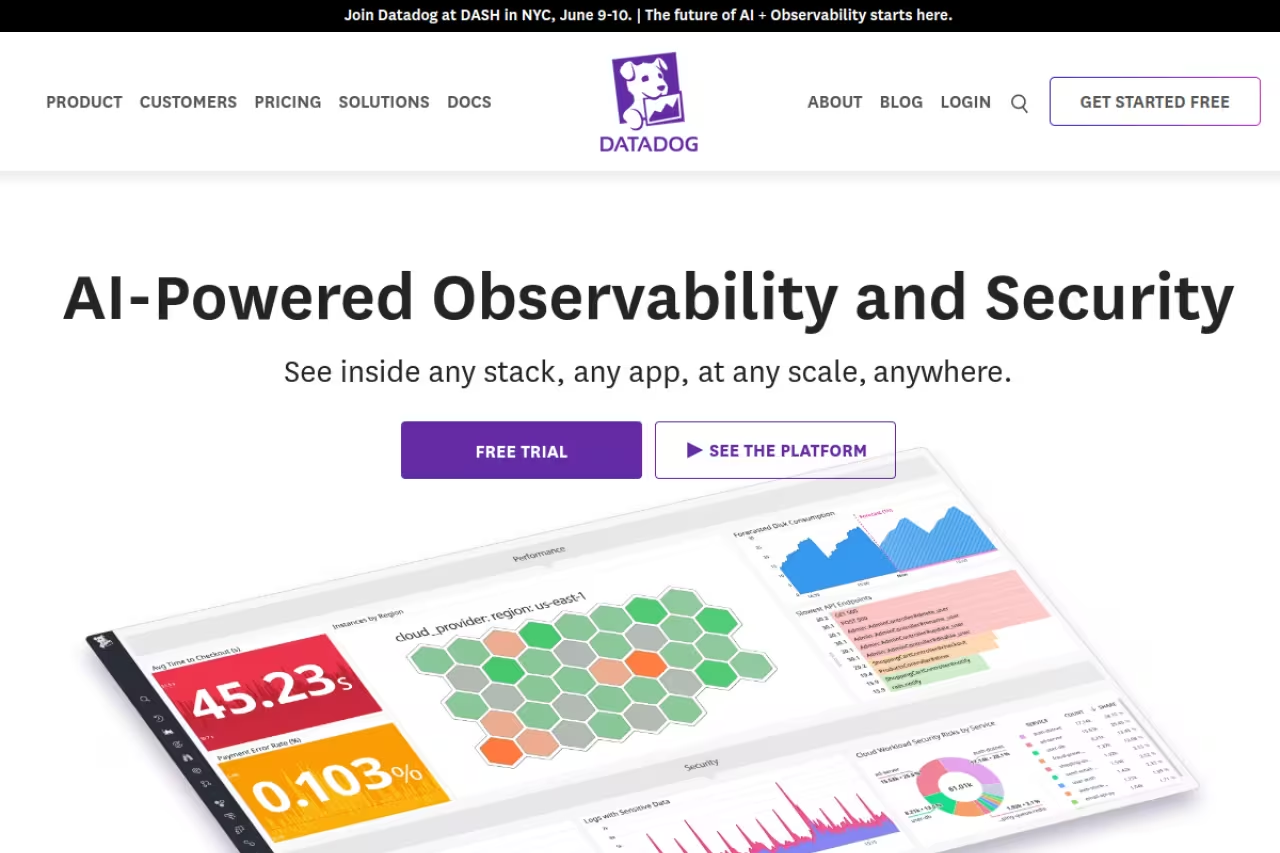
Datadog is the tool I reach for when the team would rather pay than operate infrastructure. Logs sit next to your traces and metrics, so when a latency spike shows up on a dashboard you click straight through to the logs from that exact service and time window. That correlation is the whole pitch, and it works.
The pick when you would rather pay than operate infrastructure, especially if you already use Datadog APM. Logging without Limits is clever, but the dual ingest and index meter makes forecasting hard and careless indexing blows up the bill.
Pricing is split, which trips people up. Per the Datadog pricing page, ingestion is $0.10/GB (annual), then you pay separately to index logs for search: $1.70 per million events for 15-day retention. Long-term Flex storage drops to $0.05 per million events stored. The trick is "ingest everything, index selectively," and if you index it all your bill explodes.
The standout is the Logging without Limits model: you can ingest a firehose, route most of it cheaply to archive, and only pay search rates on what matters.
The catch: the dual meter makes forecasting hard, and if you index carelessly Datadog becomes one of the most expensive options on this list. Budget for someone to own log pipeline rules.
Grafana Loki
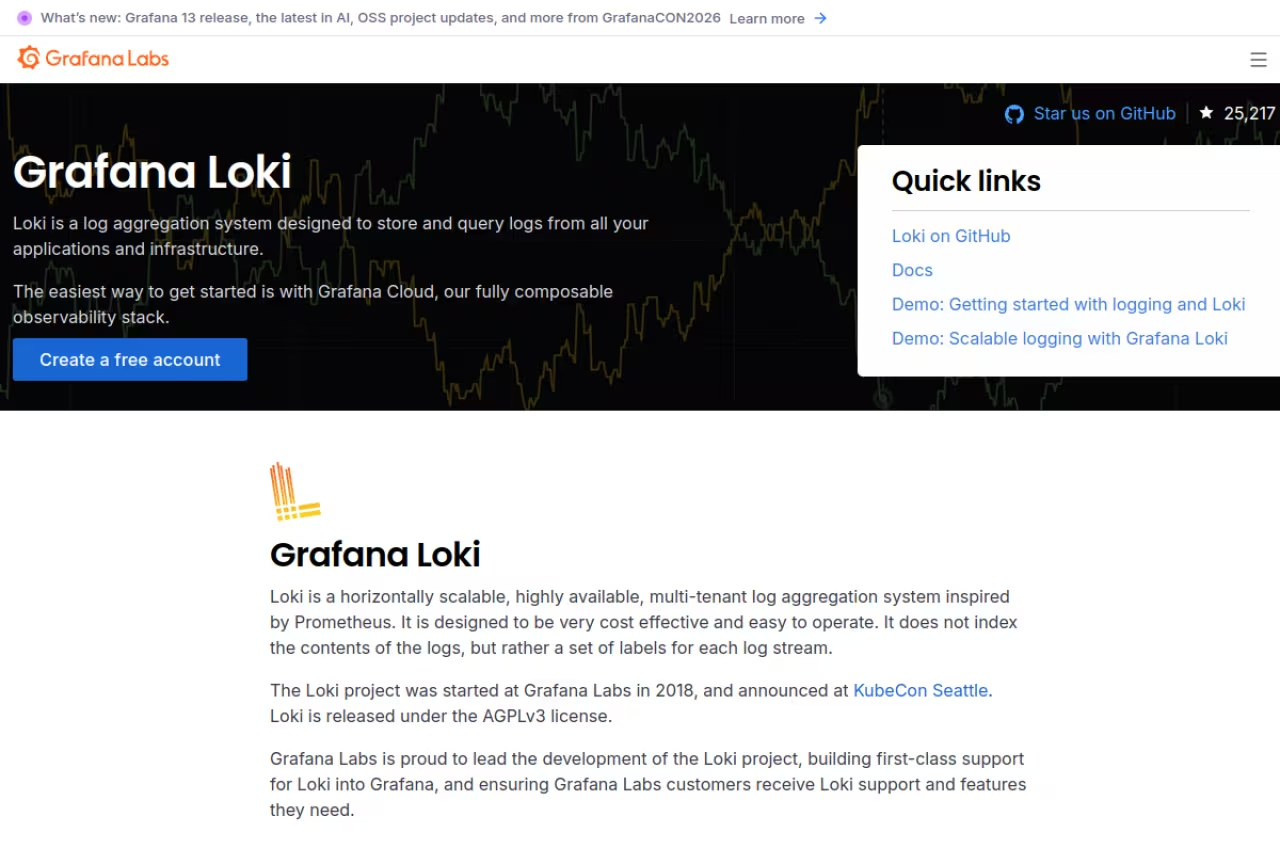
Loki is the answer when your log volume is large and your finance team is watching. Instead of indexing the full text of every line, Loki only indexes a small set of labels and stores the rest as compressed chunks in object storage. That design makes ingest dirt cheap, and it's why teams pushing terabytes a day land here.
The cost-at-scale choice for Kubernetes-heavy, Grafana-native shops that can live with a label-first query model. Ingest is dirt cheap, but full-text search across huge ranges is slower than Elastic.
The open-source version is free under AGPLv3, so your only cost self-hosting is infrastructure plus the engineering time to run a multi-component stack. If you'd rather not, Grafana Cloud has a genuinely useful free tier of 50GB/month with 14-day retention. The Grafana Cloud paid plan charges roughly $0.40/GB to write, $0.05/GB to process, and $0.10/GB to retain, on top of a $19/month platform fee.
The standout is cost at scale. Nothing else here ingests high volume this cheaply.
Where it falls short: querying. Loki's label model means full-text search across huge ranges is slow compared to Elastic, and you have to think about labels up front. Get your labels wrong and queries crawl.

SigNoz
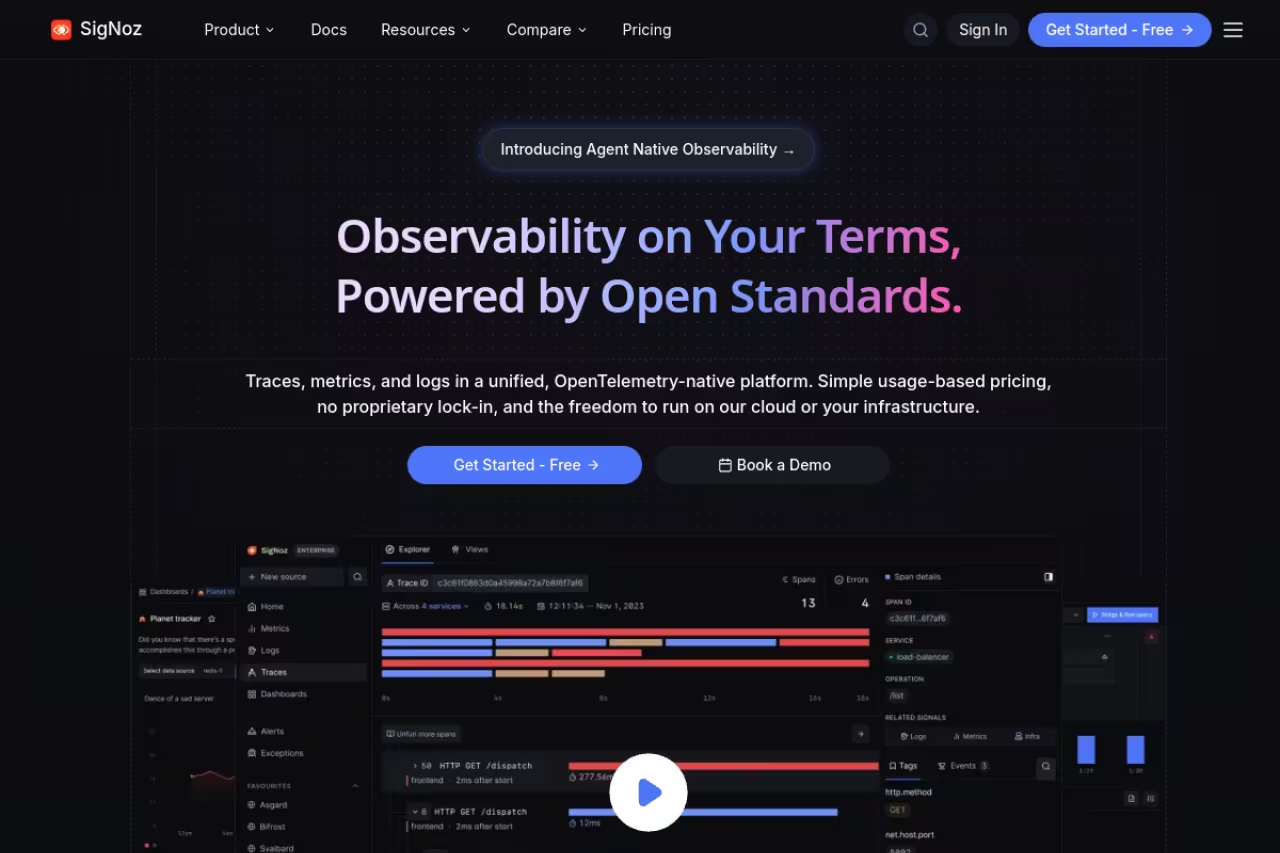
SigNoz is the open-source tool I recommend most to teams who don't want to glue together three separate systems. It handles logs, traces, and metrics in one app, built on ClickHouse and OpenTelemetry from day one. If you're already instrumenting with OTel, ingestion is close to plug-and-play.
A strong choice for teams who want logs, traces and metrics in one open-source app built on ClickHouse and OpenTelemetry, with no per-host pricing. It is younger than the incumbents, so integrations and enterprise polish are not as deep.
The community edition is free to self-host. SigNoz Cloud starts at $49/month for the Teams plan, which includes $49 of usage, then bills $0.30/GB for logs and traces and $0.10 per million metric samples. Per SigNoz's pricing, there's no per-host, no per-user, and no charge for running queries or building dashboards.
The standout is the pricing model itself. You pay for data in, not for the number of engineers who log in or the number of machines you monitor, which is where Datadog and Splunk quietly run up the bill.
The catch: it's younger than the incumbents, so the integration library and enterprise polish aren't as deep. Self-hosting ClickHouse at scale is also real work. If you want more on this category, see our guide to the best LLM observability tools.

Better Stack
Better Stack (formerly Logtail) is the one I point smaller teams to when they want logs and uptime monitoring without a procurement cycle. The UI is fast, you query logs with SQL-style syntax, and incident management and status pages come bundled. It feels built for a startup, not an enterprise security team.
Pick it if you are a smaller team that wants logs, uptime monitoring and on-call in one affordable product without a procurement cycle. It is not built for terabyte-a-day volumes or SIEM-grade correlation, so you may outgrow it.
Logs start at $24/month including 10GB of ingestion and 30-day retention, with additional retention billed around $0.08/GB/month. The company's whole positioning is being dramatically cheaper than Datadog for similar everyday use, and for low-to-moderate volumes that holds up.
The standout is the bundle. Logs, uptime monitoring, and incident response in one tool at a price a seed-stage team can absorb is rare.
Where it falls short: it isn't built for the terabyte-a-day, deep-analytics use cases. If you need SIEM-grade correlation or massive retention, you'll outgrow it. Pair this read with our best application monitoring tools guide if uptime is your real priority.
Elastic / ELK Stack
The ELK Stack (Elasticsearch, Logstash, Kibana) is still the most capable raw log search engine on this list. When you genuinely need full-text search across billions of events with complex queries, Elasticsearch is hard to beat, which is why it's the backbone of so many in-house logging platforms.
The most capable raw log search on this list, best for teams with the engineering depth to run it. Self-managing ELK is a project, not a setup, with cluster tuning and upgrades eating real engineering time.
Self-managed open-source is free, with cost being infrastructure and operations. If you don't want to run clusters, Elastic Cloud Serverless bills per GB on a tiered model: per Elastic's serverless pricing, high-volume customers pay roughly $0.60/GB for the first tier, dropping toward $0.11/GB at scale, billed for both ingest and retention.
The standout is search power and flexibility. Few tools match Elastic for ad-hoc querying across enormous datasets.
The catch: running ELK yourself is a project, not a setup. Cluster tuning, shard management, and version upgrades eat real engineering time, and serverless pricing can climb fast on hot data.
Splunk
Splunk is the tool enterprise security and compliance teams keep buying despite the price, because nothing matches its analytics depth and the Search Processing Language (SPL) is genuinely powerful once your team learns it. After the Cisco acquisition, the product roadmap is shifting, but it remains the default for large SOCs.
The default for large SOCs and enterprise security and compliance teams that need unmatched analytics depth and can afford it. It is the priciest major platform here and SPL has a real learning curve, so skip it for small teams.
Pricing is the elephant in the room. List ingest pricing runs roughly $150-225 per GB/day, though most large customers move to workload pricing based on Splunk Virtual Compute (SVC) units, where a single SVC can run $55,000-$75,000/year. Real contracts are softer than list, but Splunk stays the priciest major platform here.
The standout is depth. For advanced security analytics, threat hunting, and compliance reporting, Splunk's maturity is unmatched.
Where it falls short: cost and complexity. It's overkill and over-budget for most small and mid-size teams, and SPL has a real learning curve.
Graylog
Graylog is the on-prem favorite for security teams that want strong alerting and log processing pipelines without Splunk money. It's purpose-built around centralizing logs, parsing them with pipeline rules, and triggering alerts, with a security-focused edition layered on top.
A good on-prem option for security and compliance teams that want self-hosted control and strong alerting without Splunk money. The free Open edition is capped at 5GB/day, which pushes growing teams toward paid plans quickly.
Graylog Open is free and self-hosted, but it's now capped at 5GB/day of ingestion, which is a meaningful limit. Paid tiers start around $15,000/year for Enterprise and $18,000/year for Security, with cloud options like Operations at roughly $1,250/month for 10GB/day. Actual per-GB rates aren't published and depend on a sales conversation.
The standout is its processing pipelines and alerting, which give you fine control over how logs are parsed and routed before they hit storage.
The catch: the free tier's 5GB/day cap pushes growing teams toward paid plans quickly, and self-hosting still means you own the infrastructure and upgrades.
Sumo Logic
Sumo Logic is the cloud-native pick for teams wanting both operational logs and SIEM-style security analytics without running anything themselves. It was cloud-first before most competitors, and its tiered storage model lets you keep hot data searchable while pushing older logs to cheaper tiers.
The cloud-native pick for managed log analytics plus security monitoring, with hot, warm and cold tiering as a clean cost knob. The credit-based model makes upfront cost estimation hard, so expect to model your usage before trusting a quote.
Pricing is credit-based, which takes a minute to parse. Credits run roughly $1.80 each at large commits up to $3.30 at small ones, and the same GB costs 0.5 credits on the Frequent (hot) tier, 0.3 on Cloud Flex, and 0.1 on the Infrequent (cold) tier. Mapping your access patterns to the right tier is where the savings live, and Sumo positions itself as 25-40% cheaper than Splunk at equal volume.
The standout is the hot/warm/cold tiering, which gives you a clean knob for trading search speed against cost.
Where it falls short: the credit model makes upfront cost estimation genuinely hard, and you'll spend time modeling your usage before you trust a quote.
How to choose
Skip the feature matrix and answer three questions in order.
First, can you operate infrastructure? If you have the engineers and want the lowest possible bill, self-host Loki (cheapest ingest), SigNoz (one tool for everything), or ELK (best search). If you'd rather pay to make the problem disappear, you're in managed territory: Datadog, Better Stack, Sumo Logic, or a vendor's cloud tier.
Second, what's your daily volume? Under ~50GB/day, Better Stack or Grafana Cloud's free tier will carry you cheaply. From 50GB to a few hundred GB/day, Datadog and SigNoz Cloud are the sweet spot. Past a terabyte a day, Loki self-hosted or negotiated enterprise contracts are the only sane economics.
Third, is this a security or an engineering problem? For SIEM, compliance, and threat hunting, Splunk, Graylog, and Sumo Logic are built for it. For debugging production and correlating with traces and metrics, Datadog and SigNoz win because logs don't live in a silo.
If you're standardizing your whole observability stack, the same logic applies to adjacent tools. Our best AI DevOps tools roundup and the broader top tools directory are good next stops.
A quick aside: if you're a founder or operator trying to keep up with which observability and AI tools are actually worth adopting, Dupple X is the membership we built for exactly that. It cuts through the noise so you're not learning about a 30%-cheaper logging tool a year too late. Start a yearly trial if that sounds useful.
FAQ
What is the best log management tool in 2026?
There's no single winner, it depends on your constraints. Datadog is the best managed option for teams that want logs correlated with traces and metrics. Grafana Loki is the cheapest at high volume if you can self-host. SigNoz is the best open-source all-in-one. For enterprise security, Splunk still leads on analytics depth.
What is the cheapest log management tool?
Self-hosted open-source tools have no license cost: Grafana Loki, SigNoz Community, ELK, and Graylog Open (capped at 5GB/day) are all free to run, so your only cost is infrastructure and engineering time. Among managed tools, Grafana Cloud's free tier (50GB/month) and Better Stack (from $24/month) are the most budget-friendly entry points.
Is Datadog worth the cost for log management?
For teams already using Datadog APM, usually yes, because the value is logs sitting next to traces and metrics during an incident. The risk is the indexing meter: ingestion is cheap at $0.10/GB, but indexing logs for search at $1.70 per million events adds up fast if you index everything. Use ingest-and-route rules to keep it in check.
Should I self-host or use a managed log management tool?
Self-host if you have the engineering capacity and want the lowest bill at scale: Loki, SigNoz, and ELK reward teams that can operate them. Use a managed tool if your team is small and you can absorb a 2-3x premium for zero operational overhead. The break-even usually arrives around a terabyte a day.
What's the difference between log management and observability?
Log management focuses on collecting, storing, searching, and alerting on log data. Observability is the broader practice of understanding system behavior through three signals: logs, metrics, and traces. Modern tools like Datadog and SigNoz blur the line by combining all three, which is why "log management" decisions increasingly become full observability decisions.
Pick the tool that matches how your team works, not the one with the longest feature list. Optimize for the operating model you can actually sustain, then worry about per-GB rates. And if you want our shortlist of new tools worth your attention each week, Dupple X covers it.
Related guides
Some offers on this page may be paid placements or contain affiliate links.
