
The 8 Best SaaS Directories in 2026 (Where to List Your Product)

Key facts8 directories compared: G2, Capterra, Product Hunt, TrustRadius, SaaSHub, SourceForge…
- 8 directories compared: G2, Capterra, Product Hunt, TrustRadius, SaaSHub, SourceForge, AlternativeTo, StackShare
- G2 (best for: B2B SaaS, broad buyer reach): Free profile, paid from low thousands/yr
- Capterra (best for: SMB discovery, category browsing): Free listing, PPC paid
- Product Hunt (best for: Launch-day spike, indie founders): Free
- TrustRadius (best for: Enterprise procurement): Free, paid ~$30k/yr
Most software buyers decide who to call before they ever fill out a form. By the time a B2B buyer reaches out to a vendor, they're already about 70% through their decision, and the company they ranked first wins the deal roughly 80% of the time, according to Corporate Visions' 2026 buying research. That shortlist gets built on review sites and directories, not your homepage.
So if your product isn't listed where buyers look, you're not on the list. The catch is that "SaaS directory" now covers everything from a $30,000-a-year enterprise review platform to a free indie listing you can finish in four minutes, and they're not interchangeable.
I spent the last few weeks digging through pricing pages, domain authority scores, and submission flows to figure out which ones still earn the effort in 2026. If you only have time for one, claim your free G2 profile first. Below is the full ranked list, who each one is for, and where each falls short.
Quick comparison
| Directory | Best for | Price to list | Standout |
|---|---|---|---|
| G2 | B2B SaaS, broad buyer reach | Free profile, paid from low thousands/yr | 6M+ reviews, owns Capterra/GetApp now |
| Capterra | SMB discovery, category browsing | Free listing, PPC paid | Syndicates to GetApp + Software Advice |
| Product Hunt | Launch-day spike, indie founders | Free | DR 91 link, fast SEO boost |
| TrustRadius | Enterprise procurement | Free, paid ~$30k/yr | Long, vetted reviews |
| SaaSHub | Indie SaaS, SEO backlinks | Free | DR 76-79 dofollow link |
| SourceForge | Open source, B2B software | Free | DR 92, 104k+ listings |
| AlternativeTo | "X alternative" search traffic | Free | 124k+ apps, community-ranked |
| StackShare | Developer-facing tools | Free | Real tech-stack data |

G2: the one nobody can skip
G2 is the closest thing software has to a default. It holds more than 6 million verified reviews and the profiles consistently rank on page one when someone searches "[your product] reviews." In 2026 it got even harder to ignore: G2 closed its roughly $110 million acquisition of Capterra, Software Advice, and GetApp from Gartner in February, folding four of the biggest review sites under one roof.
The one nobody can skip for B2B SaaS companies selling to teams: if your buyers compare options, they compare them here. Claiming a profile is free, but paid placement is pay-to-play and you need a steady stream of fresh reviews to hold position.
If your buyers compare options, they compare them here.
Pricing: claiming and maintaining a profile is free, and you should do that today. Paid Marketing Solutions plans unlock buyer-intent data, lead capture, and competitor comparison placement, starting in the low thousands per year and climbing with add-ons.
The standout: review velocity compounds. A profile with 40 recent reviews outranks one with 200 stale ones, and G2's category grids give buyers a tidy shortlist they trust.
The catch: it's pay-to-play above the free tier, and you need a steady stream of fresh reviews to hold position, which means an ongoing ask to customers. Set up before you've nailed that, and your profile just sits there.

Capterra: still the SMB front door
Capterra has always been the discovery-first cousin to G2's review-first focus. Buyers browse it by category, read comparison guides, and shortlist from there. It carries millions of verified reviews across close to 1,000 software categories, and it's especially strong for small and mid-market buyers who start with "what are my options" rather than "is this specific tool any good."
The SMB front door for products in categories where buyers browse before they search, with one listing syndicating across Capterra, GetApp and Software Advice. A basic listing is free, but pay-per-click placement gets expensive fast in crowded categories.
Pricing: a basic listing is free. Visibility above that runs on a pay-per-click model, so you bid for placement in category pages and pay per qualified click.
The standout: one listing now syndicates across Capterra, GetApp, and Software Advice, so a single profile shows up in three places. That reach got more valuable after the G2 deal consolidated the data behind it.
The catch: the PPC model means your spend scales with competition, and in crowded categories like CRM or project management the top spots get expensive fast. The free listing alone won't put you near the top of a popular category.

SaaSHub: the indie favorite that earns its link
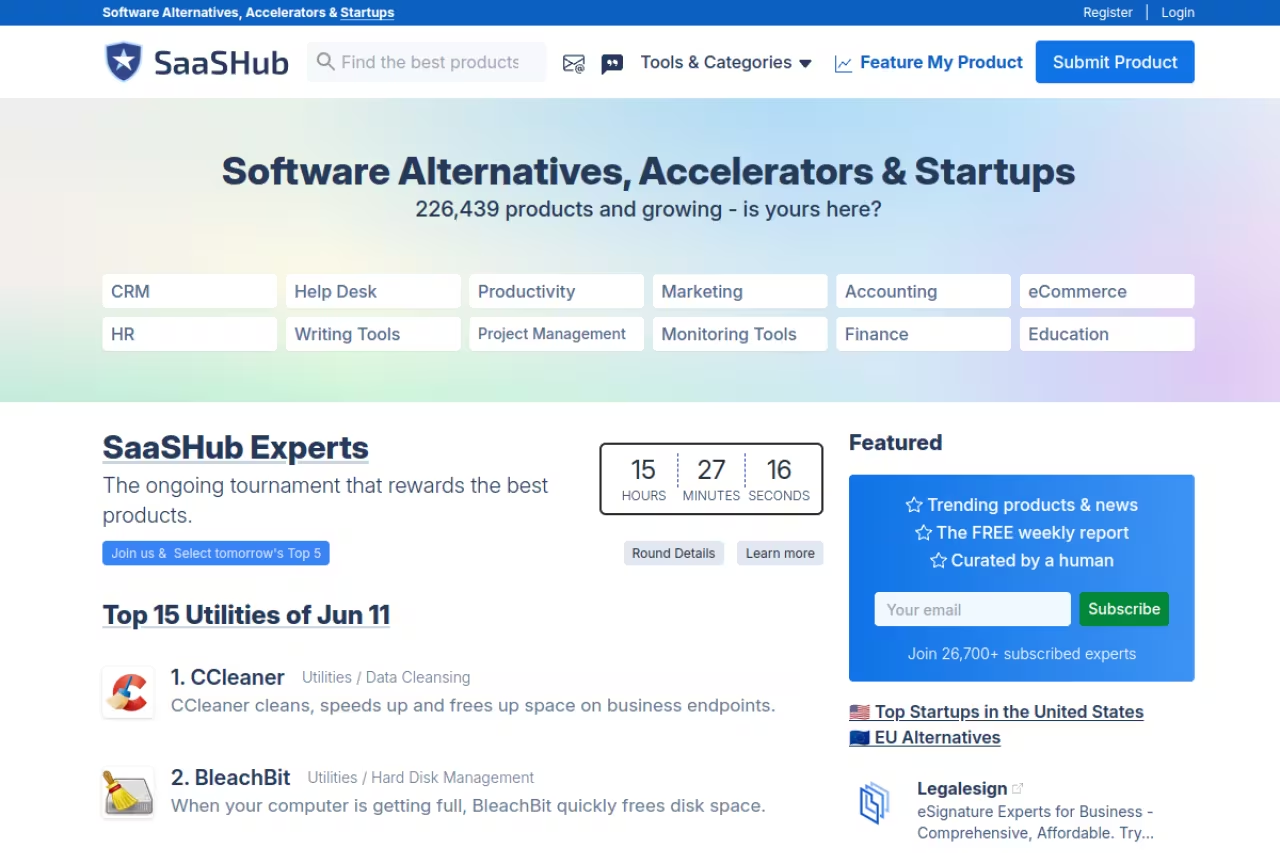
SaaSHub is the independent directory founders actually like. It runs clean, focuses purely on software, and built its traffic around "alternatives" pages. It lists more than 227,000 products and ranks well for "[tool] alternatives" queries, which is exactly where buyers land when they're shopping around.
Best for: bootstrapped and indie SaaS that competes with a known name and wants a strong, free backlink.
The indie favorite for bootstrapped SaaS that competes with a known name and wants a strong free backlink plus alternatives-page traffic. Do not expect enterprise deals, since approval can be slow and traffic is modest next to G2 or Capterra.
Pricing: free to submit. There are premium and featured placements if you want them, but the base listing costs nothing.
The standout: a dofollow link from a domain rating of around 76 to 79. For SEO, that's a genuinely useful link you can get without a sales call, and the listing keeps sending trickle traffic for years.
The catch: it's not where enterprise procurement teams hang out, so don't expect six-figure deals to come through it. Approval can take a while, and the traffic, while steady, is modest compared to G2 or Capterra.
If you're a founder building your own product's visibility from scratch, getting listed here is one of the cheapest wins available. It pairs well with the broader playbook in our guide to B2B tech lead generation.

TrustRadius: the one procurement actually reads
TrustRadius trades volume for depth. It hosts around 470,000 in-depth reviews and sees roughly 12 million visitors a year, and the reviews tend to be long, structured, and written by people who genuinely used the product at scale. Where G2 can feel optimized for review count, TrustRadius reads like due diligence.
Choose TrustRadius for enterprise software where a six-figure purchase needs internal justification, because its in-depth reviews carry weight in procurement. The vendor program runs around $30,000 a year, so it only pays off at $50k+ MRR.
Pricing: a basic presence is free. The vendor program that unlocks intent data and lead access runs around $30,000 a year, which tells you exactly who it's built for.
The standout: the reviews carry weight in procurement. A skeptical buyer evaluating a shortlist will dig into TrustRadius for the detail G2's star ratings gloss over.
The catch: the price. It only makes sense once you're generating consistent enterprise revenue, typically $50k+ MRR. Below that, you're paying enterprise rates for an audience you can't yet close.

Product Hunt: a spike, not a foundation
Product Hunt is a 24-hour event more than a directory, but the listing it leaves behind is the point. A launch puts you in front of an early-adopter crowd for a day, and the permanent page sits on a domain rating of 91, one of the highest-authority links you can earn for free.
Best for: indie founders and new products that want a launch-day traffic burst plus a strong evergreen backlink.
Pricing: completely free. There's no fee to submit, post, or get featured.
The standout: pages get crawled within minutes and often rank page one for "[your tool] reviews" inside 48 hours. Even a last-place finish gets you the DR 91 link.
The catch: it's a one-day spike, not durable discovery, and the traffic drops off hard after launch day. Product Hunt also actively bans paid upvote rings in 2026, so gaming it isn't an option. Treat it as a launch tactic, not a place buyers return to.
If you're planning a launch, it's worth pairing Product Hunt with the discovery angle on our own top tools roundup and a few category directories so the momentum compounds instead of evaporating.

SourceForge: underrated for the right products
SourceForge outgrew its open-source-hosting roots and now runs a B2B software directory with more than 104,500 business software listings. People sleep on it, but the SEO value is hard to argue with.
A strong free pick for open-source projects, developer tools and B2B software that want a high-authority backlink, with a domain rating of 92. The audience skews technical and the interface is dated, so treat it as a link and niche-discovery play.
Pricing: free to submit and list.
The standout: a dofollow link from a domain rating of 92, among the highest of any directory here, and it costs nothing. For pure link equity, few free options beat it.
The catch: the audience skews technical and the interface feels dated next to G2 or Capterra. If your buyer is a non-technical marketing manager, this isn't where they're looking. It's a backlink and a niche-discovery play, not a primary buyer channel.

AlternativeTo: owns the "switching" moment
AlternativeTo catches buyers at a specific, high-intent moment: when they're unhappy with their current tool and searching for a replacement. It runs on a crowdsourced model with over 124,000 apps ranked by more than 1.8 million user opinions, so the results feel community-driven rather than pay-to-play.
Go with AlternativeTo if your product is a better, cheaper or simpler alternative to an established incumbent, since it catches buyers who are already shopping to leave. Listing is free, but the crowd decides your ranking, so you do not control placement.
Pricing: free. You or your users can submit and the community votes it up the rankings.
The standout: it ranks for "[incumbent] alternatives" searches, which is some of the warmest discovery traffic there is. Someone searching that phrase is already shopping to leave.
The catch: you don't fully control the listing. The crowd decides where you rank, and a competitor's product can sit above yours regardless of how you'd like the page to read. It rewards a real community, not a marketing budget.
StackShare: built for the developer audience
StackShare is the directory developers use to see what tools other companies actually run in production. It's less about reviews and more about real tech-stack data, which makes it uniquely credible for infrastructure, dev tooling, and API products.
Built for developer-facing tools where the buyer is an engineer, not a procurement lead, using real tech-stack data as social proof. Listing is free, but it is narrow and momentum has cooled since its peak, so skip it for marketing or finance SaaS.
Pricing: free to add a tool and claim a profile.
The standout: the tech-stack format. Seeing that a company you admire runs your tool in production is more persuasive to an engineer than any star rating.
The catch: it's narrow. Outside developer tools the audience thins out fast, and momentum on the platform has cooled since its peak. For a marketing SaaS or a finance tool, your time is better spent elsewhere.
How to choose where to list
Don't spread yourself across all eight on day one. Sequence it by who you sell to and what you can support.
Start with the free links that compound: claim G2 and Capterra, submit to SaaSHub and SourceForge, and add yourself to AlternativeTo if you compete with a known name. That's a weekend of work and a handful of dofollow links from high-authority domains, all free.
Then match the paid platforms to your buyer. Selling to SMBs who browse categories? Capterra's PPC is your lever. Selling six-figure deals into enterprises with procurement committees? TrustRadius pays off, but only once you're past roughly $50k MRR. Spend below that threshold and you're renting an audience you can't convert.
Planning a launch? Use Product Hunt for the spike, then immediately point that attention at your permanent directory listings so the traffic has somewhere to compound. And whichever platforms you pick, the one variable that beats placement is review velocity. A G2 profile with fresh reviews outranks a dormant one every time, so build the habit of asking happy customers before you worry about the next directory.
For the broader picture on getting your product found, our roundups of the best AI SEO tools and AI lead generation tools cover the channels that feed traffic into these listings. And if you want a single place to track which AI and SaaS tools are gaining traction, Dupple X sends the signal without the noise.
Want the tools and tactics professionals are using before they hit the directories? Dupple X gives you a yearly trial with the playbooks and tool breakdowns the Techpresso audience relies on.
FAQ
What is the best SaaS directory in 2026?
For most B2B software, G2 is the highest-priority directory. It holds 6 million-plus verified reviews, ranks for "[product] reviews" searches, and after acquiring Capterra, GetApp, and Software Advice in early 2026, it sits behind four of the biggest review sites at once. Claim your free profile there before anything else, then layer on others based on your buyer.
Are SaaS directory listings free?
Many are. Product Hunt, SaaSHub, SourceForge, AlternativeTo, and StackShare are free to submit, and G2 and Capterra both offer free basic profiles. The paid tiers (G2 Marketing Solutions, Capterra PPC, TrustRadius at roughly $30k/yr) buy you intent data, lead capture, and category placement, not the listing itself.
Do directory backlinks actually help SEO?
Yes, when the domain is strong and the link is dofollow. SourceForge (DR 92), Product Hunt (DR 91), and SaaSHub (DR 76-79) all pass real link equity, and their pages tend to rank for branded and "alternatives" queries that send qualified traffic. Use Ahrefs Domain Rating to compare opportunities, not to predict exact rankings.
How many SaaS directories should I list my product on?
Start with five or six high-authority free ones (G2, Capterra, SaaSHub, SourceForge, Product Hunt, plus AlternativeTo if you have a named competitor). Each one is a referring domain and a discovery surface. Add paid platforms only when your buyer profile and revenue justify the spend.
Is G2 better than Capterra for software vendors?
They serve different buyers, and since both are now owned by G2 you can treat them as one strategy. G2 leans review-first and reaches mid-market to enterprise; Capterra leans discovery-first and is stronger for SMB buyers browsing categories. Claim both, since a Capterra listing also syndicates to GetApp and Software Advice.
What's the difference between a SaaS directory and a review site?
The line has mostly blurred. Pure directories (SourceForge, AlternativeTo) focus on browsing and discovery, while review sites (G2, TrustRadius) center on verified user feedback. In 2026 most of the big platforms do both: they list products by category and host reviews, so the practical question is which audience each one reaches, not which label it wears.
Related guides
Some offers on this page may be paid placements or contain affiliate links.
