
What Is Lusha?
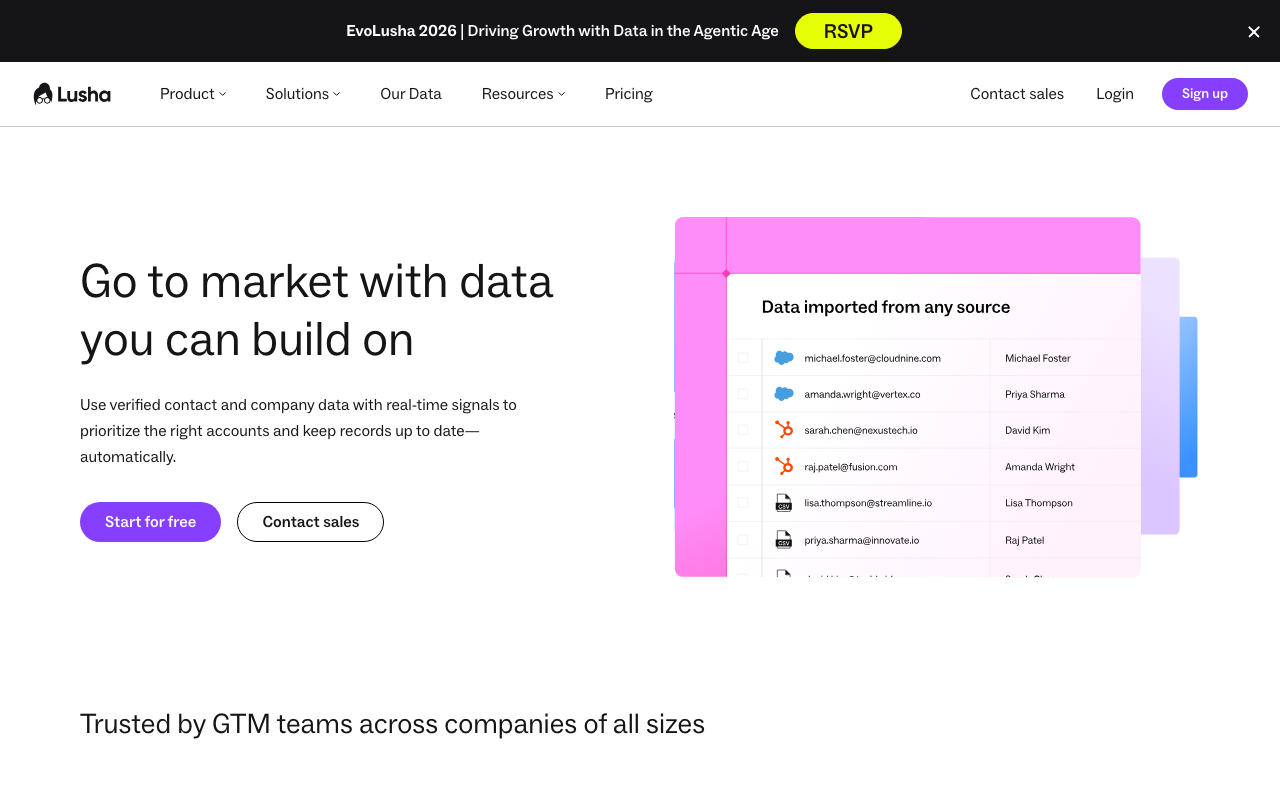
Lusha is the B2B contact data platform that gives sales and recruiting teams quick access to business email addresses, direct phone numbers, and company data. Founded in 2016 in Tel Aviv, Lusha has 800,000+ users globally and built its reputation on a fast Chrome extension that overlays contact data on LinkedIn profiles and company websites.
The pitch is simple: quick prospecting data inside your daily workflow without an enterprise contract. Lusha sits between cheap free lookups and full-featured platforms like ZoomInfo. Solo SDRs, recruiters, and small sales teams use Lusha because the credit-based pricing fits their volume without requiring a $20K annual commit.
The product targets individual sales reps, small sales teams (under 20 people), recruiters, and businesses that need contact lookup without bundled sequencing or intent data. Larger sales orgs typically upgrade to Apollo, ZoomInfo, or Cognism.
Try Lusha Free Get started →How Lusha Works
Install the Chrome extension. Browse LinkedIn or company websites; Lusha's overlay shows verified email addresses and phone numbers for the person on screen. Each contact view costs credits; reveal only the contacts you need rather than buying bulk lists.
The platform also handles bulk prospecting. Filter the database by industry, role, geography, employee count, and technology stack. Export lists to CSV or push directly into CRM and outreach tools.
Lusha's data verification combines crowdsourced contributions (users adding contacts they have), public web scraping, and partnerships with data providers. Confidence scores indicate accuracy; verified contacts come with green checkmarks.
Integrations include Salesforce, HubSpot, Pipedrive, Outreach, SalesLoft, Greenhouse (for recruiting), and Zapier. Push contacts directly to CRM with field mapping and de-duplication.
Team plans share credit pools across users. Admins control credit allocation; reporting shows who uses how many credits monthly.
Lusha Pricing in 2026
Free: 5 credits/month. Trial-grade.
Pro: $36/user/month annually. 480 credits/year, integrations, basic features.
Premium: $59/user/month annually. 960 credits/year, advanced features.
Scale: Custom pricing. Unlimited credits, advanced integrations, SSO.
One credit = one phone number OR one email. Combined views cost two credits.
See Lusha Plans See plans →Where Lusha Wins
- Fast Chrome extension: data appears instantly inside LinkedIn.
- Credit-based pricing: pay for what you use, not for unlimited unused contacts.
- Simple UX: easier than enterprise platforms for individual users.
- Strong North American data: well-covered for US and Canada prospecting.
- Quick onboarding: install extension, start prospecting same day.
Where It Falls Short
- European data thinner: weaker than Cognism for EMEA.
- No bundled sequencing: data only; sequencing needs separate tool.
- Limited intent data: less than ZoomInfo or Apollo.
- Credit-based pricing can frustrate: heavy users burn through allocations fast.
Lusha vs Apollo vs ZoomInfo vs Seamless.AI
Apollo bundles data with sequencing at similar pricing. Better fit for small teams wanting all-in-one.
ZoomInfo is the enterprise alternative with massive data depth at much higher price.
Seamless.AI competes on real-time data verification at similar price.
RocketReach targets recruiters with similar credit model.
Who Should Use Lusha
Individual SDRs and recruiters: Chrome extension fits daily workflow.
Small sales teams (under 20 reps): predictable pricing without enterprise contracts.
Founders prospecting their own deals: credit-based works for sporadic use.
Skip it if: you need bundled sequencing (use Apollo), enterprise-grade data depth (use ZoomInfo), or strong European coverage (use Cognism).
How Lusha works
Lusha is a B2B contact and company database that sells verified work emails and direct-dial phone numbers, alongside firmographic and technographic data and buying signals. The vendor positions it as "the B2B data and intelligence layer for GTM teams and AI agents." It claims 300M+ verified contacts (285M+ on the prospecting page) with 98% email accuracy and 85% US / 86% global phone accuracy, refreshed daily. Important framing: it is a data source, not a sequencer. You pull records out of it and push them into your CRM or outreach tool.
There are three ways in: a web workspace, a Chrome extension, and an API. In the workspace you filter a contact search by role, seniority, company size, recent job changes and technologies used, or filter companies by firmographics and technographics against your ICP. Matching records get saved into lists that support ownership and routing, then synced to CRM or exported to CSV. Reveals are metered in credits: 1 credit per email, 10 credits per phone number. The Chrome extension surfaces the same reveals on LinkedIn and company websites.
Setup is mostly field mapping. You map Lusha fields onto your CRM object fields for Salesforce, Pipedrive, Zoho, Bullhorn, Capsule, monday CRM, Salesloft and Outreach. For anything not natively supported you route through Zapier, Make, n8n, Pipedream, Workato, Albato or Clay, all of which can trigger enrichment. There is also an MCP server plus connectors for Claude, ChatGPT, Gemini and Perplexity, so an AI assistant can query the database directly. Newer AI features let you build and refine lists in natural language and enrich records with live web signals. Compliance credentials listed are GDPR and CCPA, SOC 2 Type II, ISO 27001 and ISO 27701.
Where Lusha wins
- A real free tier: 40 credits per month, no credit card required, with the browser extension and CRM integrations included rather than gated out.
- Phone coverage is the differentiator versus email-only databases, with vendor-stated 85% US and 86% global direct-dial accuracy.
- An unusually deep automation surface for a data vendor. Zapier, Make, n8n, Pipedream, Workato, Albato and Clay all connect, so you can trigger enrichment from almost any workflow without writing code.
- First-class AI-agent access via MCP plus Claude and ChatGPT connectors, meaning you can query the database from an assistant and not only from the app.
- A strong compliance stack for EU buyers: GDPR and CCPA alongside SOC 2 Type II, ISO 27001 and ISO 27701.
Where it falls short
- Credit economics punish phone-heavy prospecting. At 10 credits per phone reveal, the $49.90 Starter plan's 400 credits buys only 40 direct dials a month, and the free tier's 40 credits buys exactly four.
- Per-tier feature gating is not published. The pricing page does not state which plans include API access, bulk operations or buying signals, so you cannot tell what you are buying without talking to sales.
- Teams over about 5 users are pushed to a custom-priced Scale plan. There is no self-serve path, and controls like per-user credit caps are described as Scale-only.
- Native CRM coverage is narrower than the integration count implies. Salesforce, HubSpot, Pipedrive, Zoho, monday, Bullhorn and Capsule are covered, but Microsoft Dynamics, Close, Copper and most others need a Zapier-style middle layer.
- It is a database, not an outreach platform. No sequencing, no dialer, no email sending, so you still pay separately for Outreach, Salesloft or similar.
Who should use Lusha
Lusha suits SDR and RevOps teams under roughly 5 seats who need direct-dial phone numbers for cold calling and want enrichment wired into an existing CRM or into an n8n or Clay workflow. The free tier is enough to test data quality against your own ICP before you pay anything, which is the sensible way to evaluate any contact database.
Skip it if you want a full outreach platform in one tool, if your team is large enough to need per-user credit governance (that means custom pricing and a sales conversation), or if you prospect by phone at volume, because the 10-credit phone cost adds up quickly.
Frequently Asked Questions
Does Lusha find phone numbers?
Yes. Direct dials and mobile numbers when available.
How accurate is Lusha data?
Confidence scores indicate verification quality. Most users report 70-85% deliverable emails.
Can I export contact lists?
Yes. CSV export and CRM sync supported on paid plans.
What is the credit model?
One credit per contact view (email OR phone). Combined view costs two credits.
Does it integrate with Greenhouse?
Yes. Native integration for recruiting workflows.