
Best Subscription Management Software (2026)

Key facts9 tools compared: Whop, Stripe Billing, Chargebee, RevenueCat, Paddle, Recurly, Maxio, Lago…
- 9 tools compared: Whop, Stripe Billing, Chargebee, RevenueCat, Paddle, Recurly, Maxio, Lago, Zuora
- Whop (best for: Small SaaS teams without a billing engineer): 2.7% + $0.30, +0.5% Billing
- Stripe Billing (best for: Teams already on Stripe): 0.7% pay-as-you-go, plans from €500/mo
- Chargebee (best for: Finance teams, complex pricing): Free to $250K billing, then 0.75%
- RevenueCat (best for: iOS and Android subscription apps): Free to $2,500 MTR, then ~1%
Recurring revenue sounds simple until you actually run it. Then you hit failed cards, proration math, tax in 40 jurisdictions, upgrade and downgrade timing, dunning emails, and a finance team that wants clean revenue recognition. The tool you pick to handle all of that quietly decides how much engineering time you burn for the next three years.
I compared each platform's pricing page, documentation, and public user reports, from Stripe's API docs to teams migrating between RevenueCat and Chargify or Maxio. Most of these platforms can technically charge a card on a schedule. The differences show up in who babysits them, what happens when a payment fails, and whether your accountant trusts the numbers.
If you want the short version: most teams already on Stripe should start with Stripe Billing and not overthink it. Non-technical or finance-heavy teams with complex pricing get more out of Chargebee. Mobile app teams should use RevenueCat. This guide covers those three in depth plus five more, with real pricing and the catch on each.
Quick comparison
| Tool | Best for | Price | Standout |
|---|---|---|---|
| Whop | Small SaaS teams without a billing engineer | 2.7% + $0.30, +0.5% Billing | No-code plans and trials on hosted checkout links |
| Stripe Billing | Teams already on Stripe | 0.7% pay-as-you-go, plans from €500/mo | Best API and developer experience |
| Chargebee | Finance teams, complex pricing | Free to $250K billing, then 0.75% | No-code dunning and pricing workflows |
| RevenueCat | iOS and Android subscription apps | Free to $2,500 MTR, then ~1% | Cross-store in-app purchase handling |
| Paddle | SaaS that hates tax compliance | 5% + $0.50 per transaction | Merchant of Record (handles all tax) |
| Recurly | Consumer and ecommerce subscriptions | Core from $199/mo, ~1.25% MRR | ML-driven payment retry recovery |
| Maxio | B2B SaaS needing revenue recognition | Grow from $599/mo | Billing plus ASC 606 rev rec in one |
| Lago | Engineering teams wanting control | Free self-hosted, open source | Usage-based metering, no vendor lock-in |
| Zuora | Large enterprise, $50M+ ARR | Custom (typically five figures/mo) | Handles the messiest contract logic |
Whop: subscription billing for small SaaS teams
Whop is subscription billing software that suits small SaaS teams that want recurring plans live without an API project. You set up plans and free trials in a no-code dashboard and share a hosted checkout link. Whop's Billing feature handles automated invoices, failed-payment retries, and renewals, and customers can update cards, view invoices, or cancel from a self-service portal.
What you get: Whop's Billing feature handles automated invoice generation, payment retries, and subscription lifecycle events, while real-time retries and automatically updated cards cut the involuntary churn that comes from expired or replaced cards. Customers get a self-service portal where they update payment methods, view invoices, or cancel without emailing support. Checkout supports 100+ payment methods across 195 countries and 135+ currencies, and when you do want code, the Whop API and CLI let you manage plans, subscriptions, and checkout links programmatically.
The fastest way for a small SaaS team without a billing engineer to get subscriptions live, with no-code plans and trials, built-in dunning, a self-serve customer portal, and published per-transaction pricing. It focuses on running subscriptions day-to-day rather than finance-team reporting.
2.7% + $0.30 per domestic card transaction, plus 0.5% when Billing is turned on (international cards +1.5%, currency conversion +1%).
The catch: Whop is built to run subscriptions, not to act as your accounting system. It isn't designed for ASC 606 revenue recognition or heavier B2B finance workflows like multi-entity billing and contract-based invoicing, so that reporting stays in your accounting stack.
Stripe Billing: the default for most teams
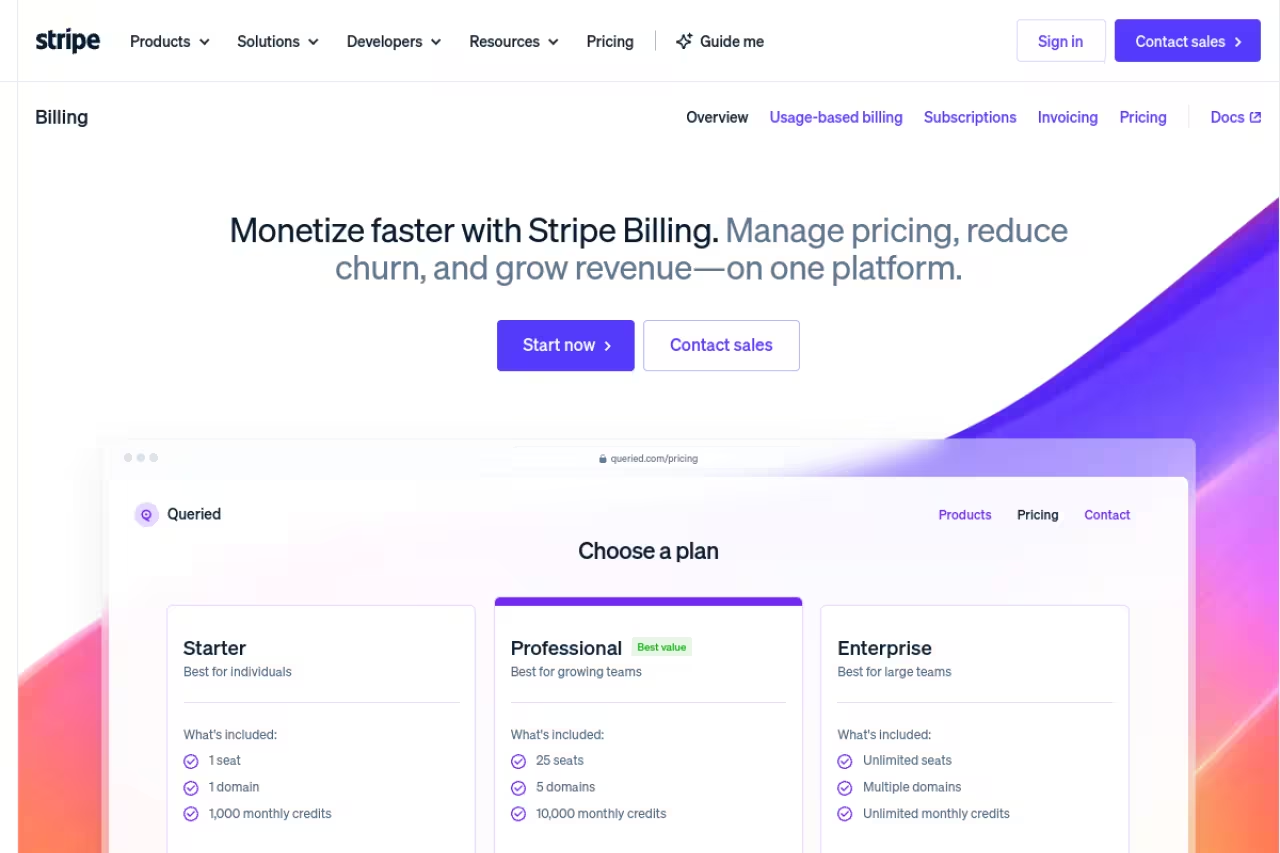
Stripe Billing is the recurring-revenue layer on top of Stripe's payment processing. If you accept payments with Stripe already, turning on Billing is a config change, not a migration. That alone makes it the right starting point for a huge share of SaaS companies.
What you get: subscriptions, usage-based and metered billing, a hosted customer portal for self-serve plan changes, automated invoices, Smart Retries for failed cards, and quotes. The API and TypeScript SDK are the best in the category. If you have engineers, they will be productive on day one.
The right starting point for a huge share of SaaS companies already on Stripe, with the best API in the category and 0.7% pay-as-you-go pricing. It is billing, not finance, so rev rec, tax, and multi-entity needs are add-ons.
Pricing is the cleanest part. Pay-as-you-go is 0.7% of Billing volume with no recurring fee and no minimum, on top of standard Stripe processing fees. Once volume grows, the monthly plans get cheaper per dollar: €500/mo covers up to €80,000 in monthly volume, scaling up to €4,900/mo for €850,000. Additional volume runs about 0.67%.
The catch: Stripe Billing is billing, not finance. Revenue recognition, complex multi-entity setups, and deep ASC 606 reporting are weaker than purpose-built tools, and Stripe's own rev rec product costs extra. Tax handling exists via Stripe Tax but it's another add-on, and you remain the merchant of record, so you own the compliance risk. Great engine, but you assemble the rest of the car.

Chargebee: for finance teams and complicated pricing
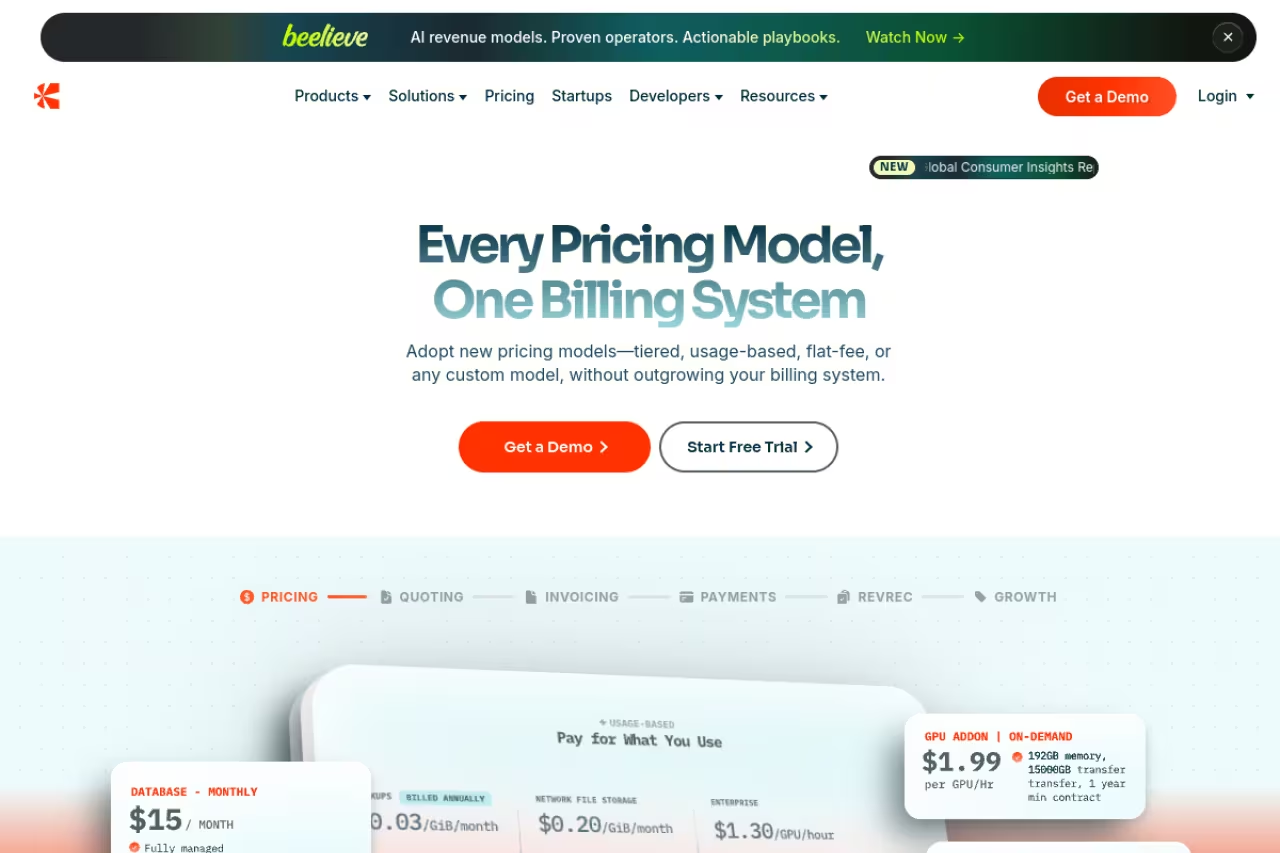
Chargebee is what you reach for when your pricing has gotten weird. Ramp deals, multi-year contracts, regional pricing, coupons stacked on coupons, mid-cycle upgrades with proration your finance lead actually agrees with. Chargebee handles this through configuration instead of code, which is the whole point.
The dunning and revenue recovery tooling is the real reason people stay. Failed-payment retry sequences, smart dunning emails, and self-serve portals all work without an engineer touching them. For a non-technical operator running a subscription business, that independence is worth a lot.
Reach for Chargebee when your pricing has gotten weird and finance wants to configure it instead of code it, with strong dunning and recovery. The percentage-of-billing model gets expensive at scale, and the admin is a project.
Pricing starts genuinely free: the Starter tier is free until $250K of cumulative billing, then 0.75% of billing after that. The Performance plan runs $7,188/year (about $599/mo) and covers up to $100K in monthly billing, adding smart dunning, advance invoices, and migration support. Enterprise is custom for multi-entity and account hierarchy needs.
Where it falls short: the free tier feels generous until you realize most serious features sit on Performance and above, and the percentage-of-billing model gets expensive at scale compared to flat-rate options. Setup also has a learning curve. The flexibility that makes Chargebee powerful is the same thing that makes the admin a project, not an afternoon.

RevenueCat: if you ship a mobile app
If your subscriptions live inside an iOS or Android app, the web billing platforms above don't apply. App Store and Play Store in-app purchases follow their own rules, and reconciling receipts across both stores by hand is miserable. RevenueCat is the standard fix, and its share of the mobile subscription market is large enough that its annual State of Subscription Apps report is treated as industry benchmark data.
It handles receipt validation, entitlements, cross-platform subscription status, and a clean analytics dashboard, plus built-in A/B testing for paywalls and pricing. One SDK, both stores, and now web billing too. For a small mobile team, it removes the single most error-prone part of going paid.
The standard fix for subscriptions inside iOS and Android apps, with one SDK for both stores and built-in paywall testing. It is mobile-first, and the 1% fee on gross revenue stacks on top of app store commissions.
Pricing is free up to $2,500 in monthly tracked revenue, then roughly 1% of tracked revenue on paid tiers. The Grow plan starts around $99/mo. Worth noting: the 1% applies to gross revenue before app store commission, so after Apple or Google take their 15 to 30%, your effective rate on net proceeds is higher than the headline number suggests.
The catch: it's mobile-first by design. If you sell on the web too, you'll still want a separate web billing stack, and the percentage fee on top of app store commissions is a real cost line once you scale. For app-only teams, though, nothing else comes close.

Paddle: when you never want to think about tax again
Paddle is a Merchant of Record, which is the key distinction. Paddle becomes the legal seller of your product. It collects and remits sales tax and VAT in every jurisdiction, handles fraud and chargebacks, and pays you a clean amount. For a small SaaS selling globally, that removes an entire category of compliance work you'd otherwise hand to accountants or piece together with add-ons.
A Merchant of Record for small SaaS selling globally that never wants to think about tax, at a flat 5% + $0.50 per transaction. That is a lot at real volume, with less checkout control than a direct Stripe setup.
Pricing is flat and honest: 5% + $0.50 per transaction, all in. That's more than Stripe's raw processing on paper, but it includes the tax compliance, the chargeback handling, and the merchant-of-record liability. Compare total cost of ownership, not the headline percentage.
Where it falls short: 5% is a lot once you're doing real volume, and you have less control over the checkout and payment experience than a direct Stripe setup. Payout timing and currency conversion can nibble at the effective rate too. Paddle is a brilliant choice early, and a number you'll renegotiate or outgrow later.
Recurly: built for consumer and ecommerce subscriptions
Recurly leans toward subscription businesses with high transaction counts: media, streaming, boxes, consumer apps. Its standout is involuntary churn recovery. Recurly's intelligent retry logic uses machine learning to pick the optimal time to re-attempt a failed card based on decline reason, card type, and historical recovery patterns. At consumer scale, recovering even a few extra percent of failed payments pays for the platform.
Built for consumer and ecommerce subscriptions with thousands of small recurring charges, where its machine-learning retry engine pays for the platform. MRR-based pricing is hard to predict, and B2B SaaS with a few large contracts will find it overkill.
Pricing for the Core plan starts around $199/mo, structured as a percentage of monthly recurring revenue (roughly 1.25 to 1.5%). Professional and Elite tiers add native Shopify commerce, advanced engagement, and ASC 606 revenue recognition starting around $1,200/mo.
The catch: the MRR-based pricing and custom quoting on higher tiers make costs hard to predict, and smaller deployments sometimes get quoted higher percentage rates. For B2B SaaS with a handful of large contracts, Recurly is overkill. For a consumer business with thousands of small recurring charges, the retry engine is the reason to buy.

Maxio: billing plus revenue recognition for B2B SaaS
Maxio (the merger of Chargify and SaaSOptics) targets one job: bridging billing and finance for B2B SaaS. If your CFO wants ASC 606 compliant revenue recognition, SaaS metrics, and billing in one system instead of three, this is the lane. It manages over $17B in billings across 2,000+ companies, so it's proven at mid-market scale.
The Grow plan starts around $599/year as an entry point, with Scale quote-only for billings above $100K monthly. Multi-year commitments typically unlock meaningful discounts. The value is consolidation: billing, rev rec, and reporting that your finance team and auditors both trust, without exporting to spreadsheets every month-end.
Where it falls short: it's purpose-built for B2B SaaS finance, so if you just need to charge cards and don't care about rev rec yet, it's heavier and pricier than you need. Onboarding is a finance project. The payoff is real, but you have to be at the stage where revenue recognition is an actual pain before it makes sense.
The lane for B2B SaaS companies whose CFO wants billing, ASC 606 revenue recognition, and metrics in one system. If you only need to charge cards, it is heavier and pricier than necessary, and onboarding is a finance project.

Lago: open source billing you control
Lago is the engineering team's answer. It's open source and self-hostable, built around event-based usage metering: send usage events, aggregate them into billable metrics, turn those into invoices. For AI and infrastructure companies billing on tokens, API calls, or compute, that metering model fits where seat-based tools don't.
The self-hosted version is free with no revenue caps and no per-event fees. Running it on a platform like Railway costs roughly $5 to $10/mo for the core app plus database and cache. The managed cloud version has its own pricing if you'd rather not operate it yourself.
The catch: "free" means free software, not free time. You own deployment, scaling, upgrades, and reliability. That's the right trade for teams who want zero vendor lock-in and full control over billing logic, and the wrong one for a two-person startup that should be shipping product. Strong fit for usage-based AI billing specifically.
The engineering team's pick for usage-based billing on tokens, API calls, or compute, open source and self-hostable with no revenue caps. Free means free software, not free time, so a two-person startup should be shipping product instead.

Zuora: the enterprise heavyweight
Zuora is built for large enterprises and public companies with $50M+ ARR and genuinely complex contract logic: usage-based billing, sophisticated revenue recognition, multi-entity finance, the works. If a smaller tool keeps hitting walls on edge cases your contracts create, Zuora is where companies land.
Buy Zuora only once you have genuinely outgrown everything else, as it suits large enterprises with $50M+ ARR and complex contract logic. Expect custom five-figure monthly pricing and a multi-month implementation.
Pricing is custom and typically lands in five figures per month once you're at the scale that needs it. There's no meaningful free path, and implementation is a multi-month engagement with consultants.
Where it falls short: cost and complexity. For anyone under roughly $10M ARR, Zuora is almost certainly the wrong answer, and even mid-market teams often find Chargebee or Maxio handle their needs at a fraction of the price. Buy Zuora when you've genuinely outgrown everything else, not before.
How to choose
Skip the feature checklists and answer four questions in order.
Where do your subscriptions live? Mobile app: RevenueCat. Web SaaS: keep reading. Both: RevenueCat for the app plus a web billing tool.
How much do you want to own tax and compliance? If the answer is "as little as possible," use a Merchant of Record like Paddle and accept the 5%. If you have a finance function, Stripe Tax or a direct setup gives you more control and a lower rate.
Who maintains billing day to day? Engineers who like APIs: Stripe Billing or Lago. A non-technical operator or finance team: Chargebee or Maxio, where workflows are no-code.
Does your accountant need revenue recognition now? If month-end close is already painful, Maxio or Zuora earn their cost by consolidating billing and rev rec. If you just need to charge cards, that's premature.
For most teams reading this, the honest answer is: start on Stripe Billing because you're probably already there, and only move when you hit a specific wall. Picking the right financial stack early is the same discipline as picking the rest of your tooling. Our team uses Dupple X to stay on top of which tools are worth switching to before the pain forces a rushed migration. You can see how it works here.
FAQ
What is the best subscription management software in 2026?
For most teams, Stripe Billing is the best starting point because it sits on top of payment processing you likely already use and has the strongest API. Chargebee is better for finance-led teams with complex pricing, and RevenueCat is the standard for mobile apps. The "best" tool depends on where your subscriptions live and who maintains billing.
How much does subscription management software cost?
It varies widely. Stripe Billing is 0.7% of billing volume pay-as-you-go. Chargebee is free up to $250K of cumulative billing, then 0.75%. RevenueCat is free to $2,500 monthly tracked revenue then about 1%. Paddle charges 5% + $0.50 per transaction but includes tax compliance. Recurly and Maxio start around $199 to $599/mo. Enterprise tools like Zuora run into five figures monthly.
What is the difference between a payment gateway and subscription management software?
A payment gateway processes a single card transaction. Subscription management software sits above it and handles the recurring logic: billing cycles, proration on upgrades, dunning when cards fail, invoicing, and often revenue recognition. You usually need both. Stripe is one of the few that does the gateway and the subscription layer together.
What is a Merchant of Record and do I need one?
A Merchant of Record (like Paddle) becomes the legal seller of your product, taking on the responsibility to collect and remit sales tax and VAT globally, plus fraud and chargebacks. You need one if selling internationally and you'd rather not register for tax in dozens of jurisdictions. The trade-off is a higher fee (around 5%) and less control over checkout.
Can I use subscription billing software for a mobile app?
Yes, but use a mobile-specific tool. App Store and Play Store in-app purchases follow their own rules, so web billing platforms like Chargebee or Stripe Billing don't manage them well. RevenueCat is purpose-built for iOS and Android subscriptions and handles receipt validation and entitlements across both stores from one SDK.
Is open source subscription billing worth it?
For engineering teams that want full control and zero vendor lock-in, yes. Lago is open source, free to self-host, and strong for usage-based metering, which suits AI and infrastructure billing. The cost is the time your team spends running it. For most early-stage startups, a managed tool is the better use of engineering hours. Pair your billing stack with the right invoicing software and expense management tools to keep finance clean as you scale.
Related guides
Some offers on this page may be paid placements or contain affiliate links.
