
The Best Recruiting Software in 2026 (Compared and Ranked)

Key facts10 tools compared: Pin, Ashby, Greenhouse, Gem, Workable, Lever, Zoho Recruit, Juicebox…
- 10 tools compared: Pin, Ashby, Greenhouse, Gem, Workable, Lever, Zoho Recruit, Juicebox, Tellent Recruitee, SeekOut
- Pin (best for: Teams that need to find candidates, not just track them): Free / $99/mo (Solo)
- Ashby (best for: Data-driven startups & scaleups): $400/mo (≤100 employees)
- Greenhouse (best for: Mid-market & enterprise structured hiring): ~$6,500/yr
- Gem (best for: All-in-one sourcing + ATS + CRM): $270/mo (startups)
Most recruiting software demos look identical. A pipeline board, some scorecards, an AI badge slapped on a sourcing tab. Then you sign a 12-month contract, your team logs in, and you find out which parts actually work and which ones were Figma mockups in the sales deck.
I've spent the last few months comparing these tools' pricing pages, documentation, and public user reviews against what they charge and what they deliver. The gap is wider than you'd think. A startup hiring its first ten people has wildly different needs than a 500-person company running structured panels across six departments, and almost every "best ATS" list ignores that.
If you want one answer for the applicant tracker, Ashby is a strong choice for growth-stage teams, and Pin is the pick when finding candidates is the bottleneck, not tracking them. It's fast, the analytics are solid, and the pricing is transparent under 100 employees. But it's not right for everyone, so here's the full breakdown for founders, recruiters, and ops people who have to live with whatever they pick.
Quick comparison
| Tool | Best for | Price (entry) | Standout |
|---|---|---|---|
| Pin | Teams that need to find candidates, not just track them | Free / $99/mo (Solo) | AI sourcing, outreach and CRM in one product |
| Ashby | Data-driven startups & scaleups | $400/mo (≤100 employees) | Best-in-class analytics |
| Greenhouse | Mid-market & enterprise structured hiring | ~$6,500/yr | Integration ecosystem |
| Gem | All-in-one sourcing + ATS + CRM | $270/mo (startups) | AI sourcing across 800M profiles |
| Workable | SMBs hiring at steady volume | $299/mo | Simple, fast setup |
| Lever | Mid-market relationship-led hiring | ~$6,000/yr | CRM + ATS in one |
| Zoho Recruit | Budget teams & agencies | $0 free / $25 user/mo | Real free tier |
| Juicebox | Outbound sourcing specialists | $139 seat/mo | Natural-language candidate search |
| Tellent Recruitee | Mid-sized & growing teams with collaborative hiring | Custom | Collaborative ATS + AI, automation & WhatsApp Hiring |
| SeekOut | Technical & diversity sourcing | ~$833 user/mo | GitHub, patents, niche profiles |
Pin: AI sourcing, outreach and CRM in one
Pin bundles AI sourcing, outreach sequences, interview scheduling and a recruiting CRM into one product. It comes from the team that built Interseller, which Greenhouse acquired in 2021. You describe the role in plain English, Pin searches 850M+ profiles, and candidates sync into the ATS you already use (it lists 120+ supported platforms).
Who it's best for: Startups and scaleups past their first hires, in-house TA teams that need more pipeline than inbound gives them, and agencies running several searches at once.
A good fit for teams whose bottleneck is finding candidates rather than tracking them. It isn't an ATS, so it sits alongside yours, and ATS sync is a paid add-on below the Business plan.
There's a permanent free plan with no credit card. Solo is $99/month billed annually. Professional is $135 per user per month billed annually ($179 month-to-month) and adds a shared inbox and team collaboration. Business is custom-priced, with unlimited seats and contact credits, premium ATS integrations, SSO/SAML, and SCIM.
The standout: The data behind the search. Profiles draw on GitHub, Stack Overflow, open-source contributions, patents and publications as well as professional networks, which helps for engineering roles that don't show up well in a standard profile search. Pin is SOC 2 Type II certified. Pin reports a 4.8/5 rating on G2, and its 2026 user survey reports an average time-to-fill of 14 days, 12 hours saved per recruiter a week and 83% of recommended candidates accepted into pipelines. These figures are reported by Pin and not independently audited.
The catch: Pin isn't an ATS, so most teams run it alongside Greenhouse, Lever, or Ashby. ATS sync is included on Business but is a paid add-on on Solo and Professional.

Ashby: all-in-one for data-driven teams
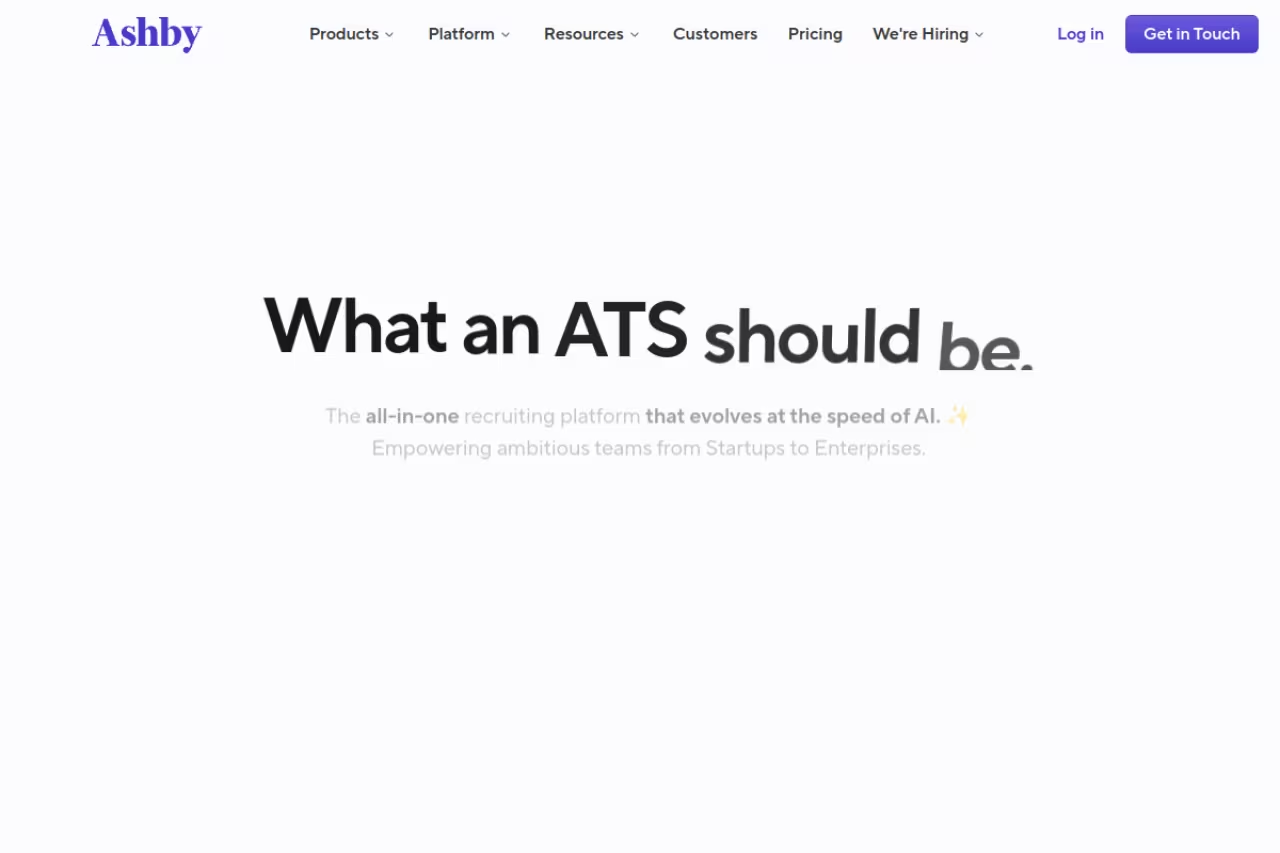
Ashby bundles applicant tracking, sourcing, scheduling, and analytics into one product, and it's the only tool on this list where the reporting feels like it was built by people who actually run recruiting teams. You can slice funnel conversion, source quality, and time-to-hire without exporting to a spreadsheet, which is the thing most ATS vendors quietly expect you to do.
Who it's best for: Startups and scaleups between 20 and 1,000 employees that care about hiring data and want one tool instead of four.
The best all-in-one for startups and scaleups between 20 and 1,000 employees that care about hiring data, with analytics that make funnel and source quality legible. Pricing jumps and goes non-public past 100 employees, and the dense interface takes a week to click.
The Foundations plan is $400/month for companies up to 100 employees, dropping to about $360/month on annual billing. Past 100 employees you move to seat-based pricing on the custom Plus tier (roughly $795 per user per year on annual deals), and Enterprise is quote-only.
The standout: The analytics. I've watched recruiters who hated reporting actually start using dashboards because Ashby makes the data legible. The scheduling automation is also a real time-saver for panel-heavy interviews.
The catch: Once you cross 100 employees the price jumps and stops being public, so the friendly $400 number is a starting line, not a destination. The interface is also dense. New recruiters need a week before it clicks.

Greenhouse: structured hiring for mid-market and enterprise
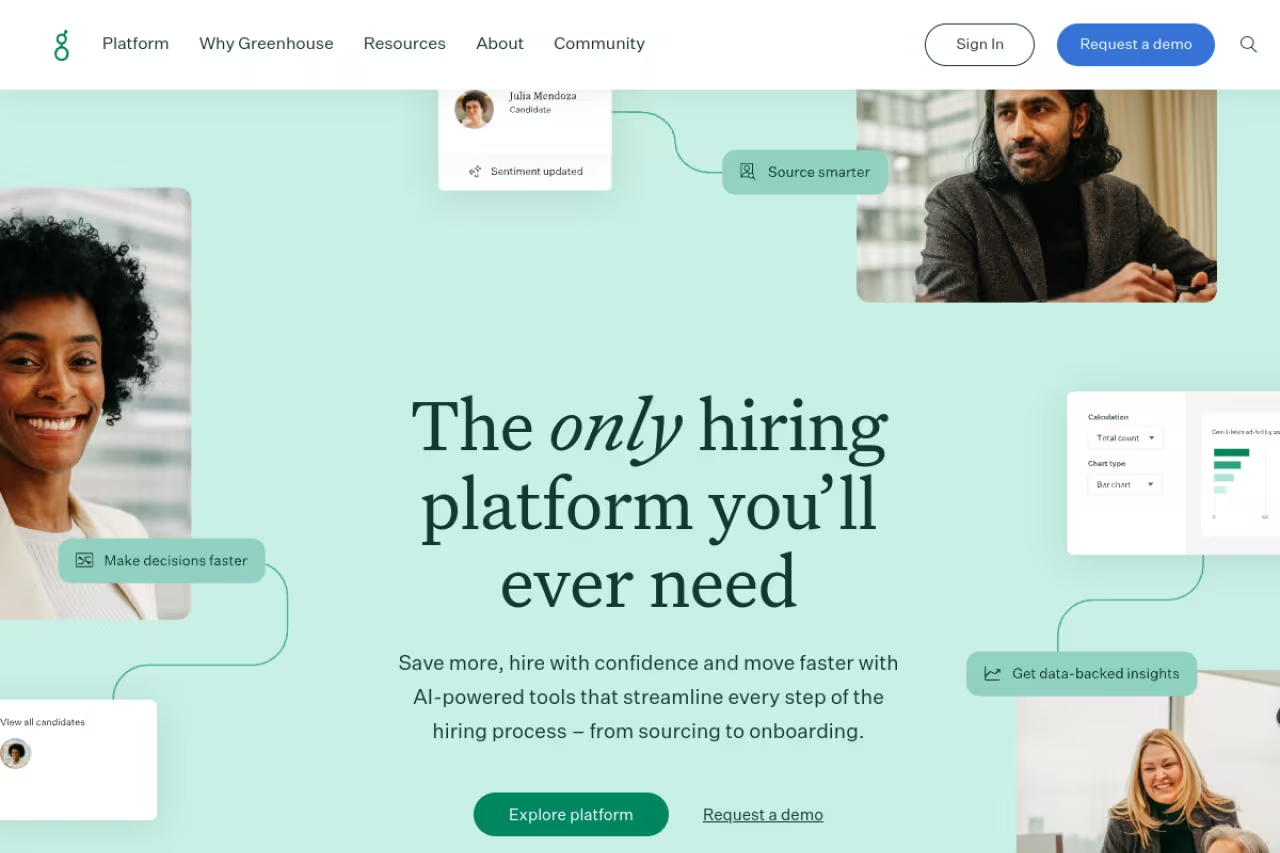
Greenhouse is the tool most large companies standardize on, and for good reason. Its whole philosophy is structured hiring: defined scorecards, interview kits, and a consistent process that holds up when you're running hundreds of reqs across teams that don't talk to each other. The integration ecosystem is the deepest in the category, so it plugs into your HRIS, background checks, and assessment tools without drama.
Who it's best for: Mid-market and enterprise teams that need process consistency and audit trails more than they need speed.
The standard for mid-market and enterprise teams that need structured hiring, consistent scorecards and audit trails, backed by the deepest integration ecosystem. It is expensive and slow to set up, so a sub-50-person company will be overpaying.
Greenhouse doesn't publish numbers, but buyer data puts the Essential tier around $6,500/year for small teams, with the Advanced tier landing between $10,000 and $40,000 annually depending on headcount. Implementation runs an extra $1,000 to $15,000.
The standout: Process rigor at scale. If you're hiring across many departments and need everyone following the same playbook, nothing enforces that better.
The catch: It's expensive and slow to set up, and renewals creep up 8 to 15% a year. The sourcing automation is a separate, pricey add-on. For a sub-50-person company, this is overkill you'll pay dearly for.

Gem: sourcing, CRM, and ATS in one box
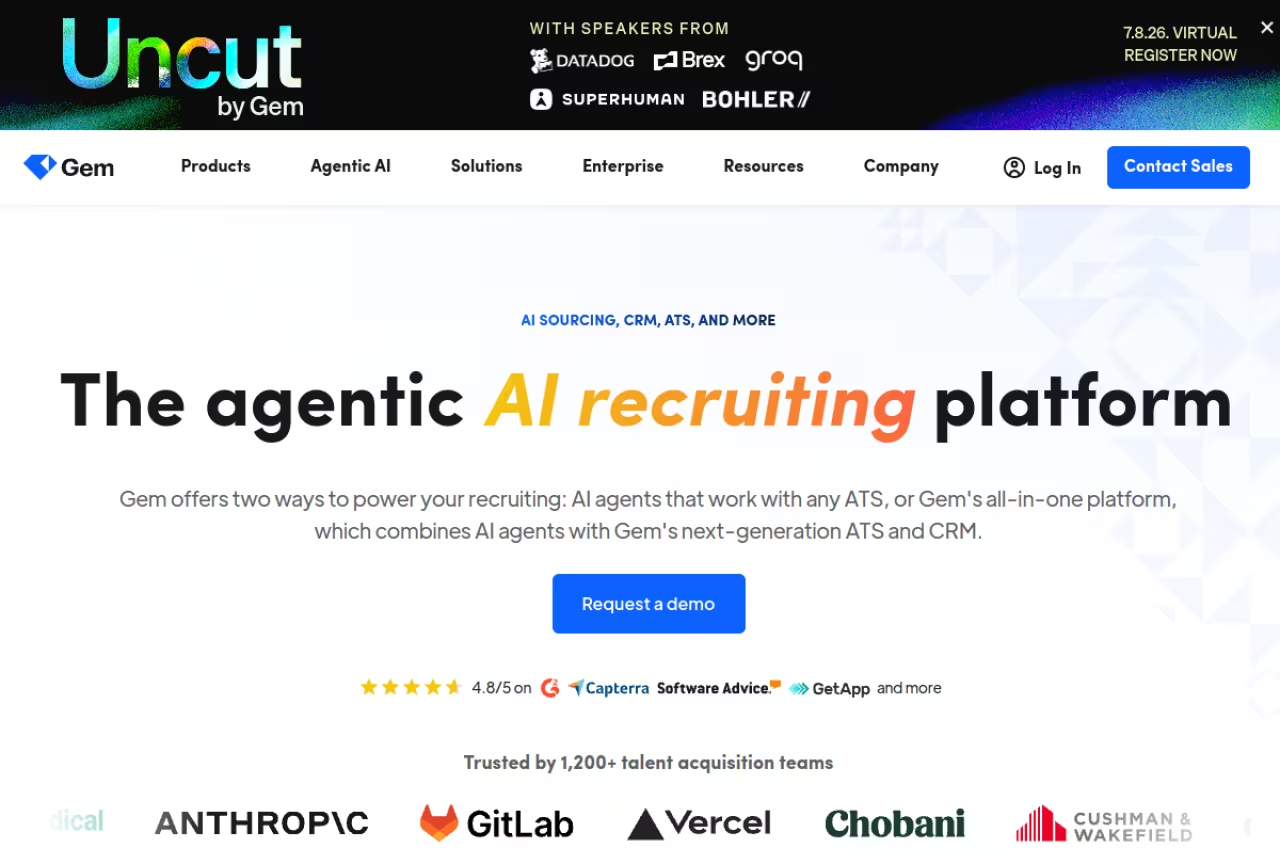
Gem started as a sourcing and candidate-relationship tool and grew into a full ATS, which means its outbound DNA is stronger than anyone else here. It pulls from over 800M profiles, automates outreach sequences, and keeps your talent CRM and pipeline in the same place. If a big chunk of your hiring is proactive sourcing rather than inbound applications, Gem earns its keep.
Who it's best for: Teams that source heavily and want CRM, outreach, and tracking unified instead of stitched together.
Gem is the choice if a big chunk of your hiring is proactive sourcing, with CRM, outreach and ATS in one place. Individual modules are less deep than specialists, its ATS is less refined than Ashby's, and price climbs steeply past the startup tier.
The Startups plan (up to 100 employees) is $270/month annually, and the Gem Startup Program gives eligible companies 6 months free then 50% off the first paid year (about $135/month). Median annual contracts across all customers sit near $24,900, so larger deals climb fast.
The standout: AI sourcing and outreach baked into the same tool as your ATS. You're not paying for a separate sourcing product and a separate tracking product.
The catch: The all-in-one breadth means individual modules aren't always as deep as a specialist. The pure ATS workflow is solid but less refined than Ashby's, and the price scales steeply once you outgrow the startup tier.
If you're building out a lean hiring stack and want help connecting these tools to the rest of your workflow, Dupple X is worth a look for the ops glue around them.

Workable: the no-fuss SMB pick
Workable is what I recommend to founders who want to post a job, collect applicants, and move people through stages without a 60-day onboarding. Setup takes an afternoon. It's an ATS with light HR features bolted on (onboarding, time-off tracking), plus an AI agent that sources against a large candidate database.
Who it's best for: Small and mid-sized businesses hiring at steady, mid-volume who value simplicity over depth.
A no-fuss pick for small and mid-sized businesses that value simplicity over depth, with setup in an afternoon. Reporting is shallow, and headcount-based pricing means costs can jump as you grow even if the recruiting team stays the same size.
The Standard plan is $299/month billed monthly, Premier is $599/month (adds video interviews, texting, assessments), and Enterprise is $719/month. All plans include 1,000 free AI agent credits. Pricing is based on total headcount, not seats.
The standout: Speed to value. Nothing else here gets a non-technical team from zero to a working pipeline this fast.
The catch: The reporting is shallow compared to Ashby or Greenhouse, and headcount-based pricing means a growing company can see costs jump even if the recruiting team stays the same size. Power users hit the ceiling quickly.

Lever: relationship-led recruiting
Lever pairs an ATS with a built-in CRM, which makes it strong for teams that nurture candidates over months rather than filling reqs transactionally. The interface is clean, the pipeline view is intuitive, and the candidate-relationship features are genuinely useful for keeping warm leads warm.
Who it's best for: Mid-market teams who treat hiring as a long-term relationship game and want sourcing plus tracking together.
Lever suits mid-market teams that nurture candidates over months, pairing an ATS with a strong built-in CRM for re-engaging past candidates. Pricing is opaque and custom-quoted, and some reviewers feel feature velocity has slowed against Ashby and Gem.
Lever doesn't publish tiers. Buyer-reported data starts around $6,000/year for small teams and climbs past $144,000 for 1,000+ employee organizations. Everything is custom-quoted on annual contracts.
The standout: The CRM and nurture workflows. If you re-engage past candidates often, Lever handles that better than a pure ATS.
The catch: Opaque pricing means you can't self-serve, and feature velocity has slowed compared to Ashby and Gem. You're paying mid-market money for a tool that some reviewers feel has stopped innovating as fast as its rivals.
Zoho Recruit: the budget and free option
Zoho Recruit is the only ATS here with a genuinely free plan, and it's the obvious starting point if budget is the binding constraint. It comes in two editions, Corporate HR and Staffing Agency, with resume parsing, automation, and background-check workflows that punch above the price.
Who it's best for: Solo recruiters, very small teams, agencies, and anyone who needs a working ATS without a budget approval meeting.
Zoho Recruit is the obvious starting point for solo recruiters, tiny teams and agencies on a tight budget, with real automation and parsing for the price. The free plan is limited to 1 active job, and the busier UI is less polished than dedicated tools.
The Forever Free plan is $0 but limited to 1 active job with no AI or sourcing. Standard is $25/user/month, Professional is $50/user/month, and the top tier reaches $75/user/month, all billed annually.
The standout: Value. You get real automation and parsing at a price the premium ATS vendors can't touch, especially if you already use other Zoho apps.
The catch: The free tier is barely usable for active hiring (one job, no parsing), and the broader Zoho ecosystem feel means the UI is busier and less polished than the dedicated recruiting tools. Agencies will want the higher tiers to get the good stuff.
Juicebox: natural-language candidate sourcing
Juicebox (its search engine is called PeopleGPT) replaces Boolean strings with plain English. You describe the person you want, and it searches 800M+ profiles across 30+ sources, then shows you the exact phrases that triggered each match. It's a sourcing tool, not a full ATS, but it's one of the most talked-about AI recruiting products of 2026 for a reason.
Who it's best for: Recruiters and founders who source outbound and want to skip the Boolean syntax tax.
Skip Boolean strings with Juicebox if you source outbound, since plain-English search shows why each profile matched. It is a sourcing layer, not an ATS, and integrations and outreach automation cost extra, pushing the real bill well past $139.
The Starter plan is $139/seat/month and Pro is $199/seat/month, both billed annually. The AI Agent add-on for automated outreach is another $199/month, and ATS integrations sit behind the Enterprise plan.
The standout: Search that feels like asking a smart colleague. The transparency about why a profile matched is a small thing that builds a lot of trust.
The catch: It's a sourcing layer, not a system of record, so you still need an ATS underneath it. The good integrations and outreach automation cost extra, which pushes the real monthly bill well past the headline $139.
Tellent Recruitee: collaborative talent acquisition and automation
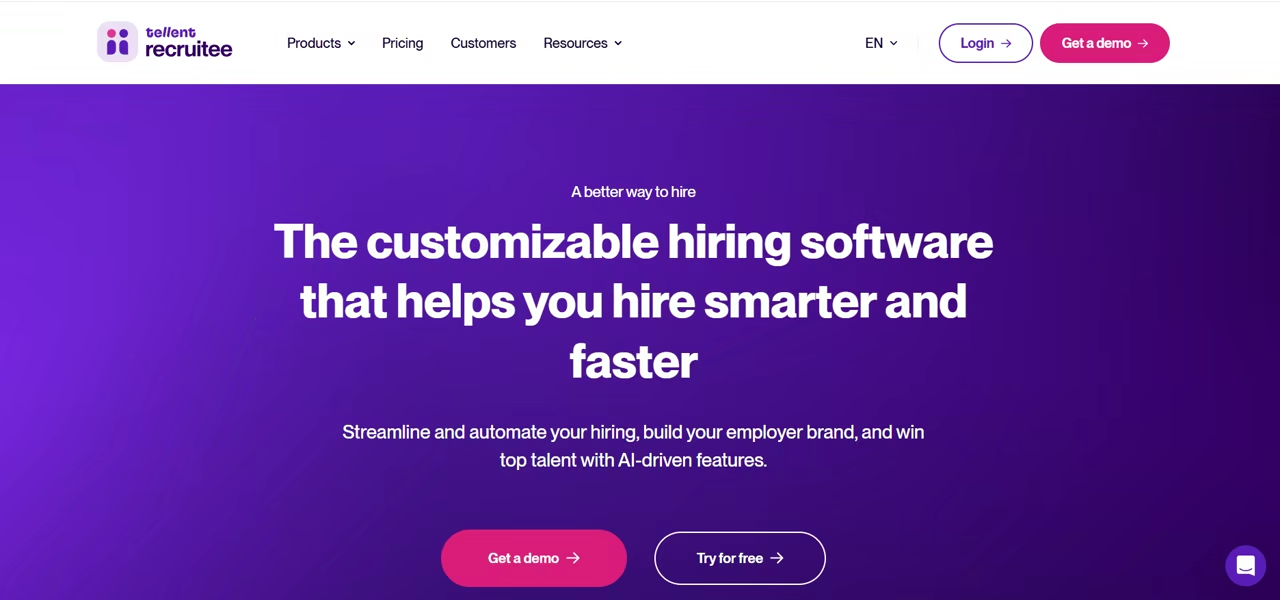
Tellent Recruitee is a talent acquisition platform that brings job posting, candidate sourcing, application management, hiring workflows, collaboration, and reporting into one shared workspace. It combines core ATS functionality with automation, AI-powered candidate matching and screening, and multichannel candidate communication, including WhatsApp Hiring.
Who it's best for: Growing and mid-sized companies that want to coordinate hiring across recruiters, HR teams, and hiring managers, or move from spreadsheets and email to a more structured recruitment process.
Tellent Recruitee fits growing and mid-sized companies moving from spreadsheets and email to a structured, collaborative hiring process, with AI matching, automation and WhatsApp Hiring. It focuses on recruitment only, so employee management needs a separate product.
Pricing depends on your chosen plan, organization size, and billing period. See their current pricing directly rather than using an outdated figure.
The standout: The combination of collaboration, automation, and candidate engagement. Recruiters, hiring managers, and interviewers can work from the same recruitment workspace, while features such as AI candidate matching and screening, automated workflows, and WhatsApp Hiring help reduce manual work and keep candidates engaged throughout the hiring process.
The catch: Tellent Recruitee focuses on recruitment. Companies that also need employee management and development tools will need a separate product, such as Tellent HR.

SeekOut: technical and specialized sourcing
SeekOut is the sourcing tool to reach for when you're hiring hard-to-find people: senior engineers, researchers, security-cleared candidates. It indexes GitHub contributions, Stack Overflow activity, patents, and academic publications, plus it has the most detailed diversity filters in the market.
Who it's best for: Technical recruiters and teams with diversity-hiring goals or niche specialist reqs.
The sourcing tool for hard-to-find technical, research and security-cleared candidates, with deep technical signal and detailed diversity filters. It is expensive and overkill for generalist hiring like sales or ops roles.
SeekOut Recruit starts around $833/user/month billed annually, with enterprise deals averaging near $27,000/year. It's sales-led with annual-only contracts.
The standout: Depth of technical and academic signal. For finding a specific ML researcher with three relevant papers, nothing matches it.
The catch: It's expensive and overkill for generalist hiring. If you're filling sales or ops roles, you're paying engineer-sourcing prices for data you won't use.
How to choose the right recruiting software
Skip the feature checklists. Pick based on three questions.
What's your headcount and budget? Under 20 people with no budget: start with Zoho Recruit's paid tier or Workable. 20 to 1,000 with real budget: Ashby. Mid-market or enterprise that needs process control: Greenhouse.
Is your hiring inbound or outbound? If applicants come to you, a clean ATS like Workable or Ashby is enough. If you have to hunt for candidates, you need sourcing muscle: Gem if you want it built in, or Pin, Juicebox and SeekOut layered on top of a lighter ATS.
How much do you care about data? If reporting is a board-deck afterthought, most tools are fine. If you make hiring decisions from funnel data, Ashby is the answer and it's not close.
One rule that has saved me money: don't buy for the company you'll be in three years. Buy for the next 12 to 18 months. Migrating an ATS is annoying but survivable, and overbuying locks you into enterprise pricing while you're still small. For the broader stack around hiring, our guides to the best AI recruiting tools and best enterprise HR software go deeper, and if you want to automate the busywork around your pipeline, the best AI agents roundup is a good next read. You can also browse the full top tools directory for adjacent picks.
FAQ
What is the best recruiting software in 2026?
For most growth-stage teams, Ashby is the best overall pick thanks to its analytics, all-in-one workflow, and transparent pricing under 100 employees. Greenhouse wins for mid-market and enterprise teams that prioritize structured, repeatable hiring, and Gem is a good choice if proactive sourcing is the core of how you hire. Pin is the pick for teams that need to find candidates, with sourcing, outreach and a CRM in one product that sits alongside your ATS.
Is there free recruiting software that's actually usable?
Zoho Recruit has a Forever Free plan, but it's limited to one active job with no resume parsing or AI, so it's more of a trial than a working system. For real free use, you're better off on Zoho's $25/user/month Standard tier or Workable's affordable plans. Most quality recruiting software starts around $250 to $400/month.
How much does recruiting software cost?
It ranges enormously. Budget tools like Zoho Recruit start at $25/user/month. Mid-tier ATS platforms like Ashby and Workable run $300 to $600/month. Enterprise tools like Greenhouse and Lever start around $6,000/year and climb into six figures with implementation fees and add-ons. Most platforms price on headcount or seats, billed annually.
Do I need a separate sourcing tool and an ATS?
It depends on your hiring mix. If most candidates apply inbound, an ATS like Ashby, Workable, or Tellent Recruitee is enough on its own. If you do heavy outbound sourcing, you'll want dedicated sourcing power: either an all-in-one like Gem, or a specialist tool like Pin, Juicebox or SeekOut layered on top of your ATS.
What's the difference between an ATS and recruiting CRM software?
An ATS (applicant tracking system) manages people who are already in your pipeline: applications, interview stages, scorecards, and offers. A recruiting CRM manages relationships with candidates before they apply, like nurturing passive talent over time. Tools like Gem and Lever combine both, while Greenhouse is ATS-first and Juicebox is sourcing-first.
Which recruiting software is best for startups?
Ashby's Foundations plan ($400/month under 100 employees) and Gem's Startup Program (6 months free, then 50% off) are the two strongest startup picks. Both give you sourcing, tracking, and analytics in one tool at a price that won't wreck a seed-stage budget. Tellent Recruitee is another option for growing teams that want a collaborative ATS, while Workable is a simpler alternative if you want the fastest possible setup.
Related guides
Some offers on this page may be paid placements or contain affiliate links.
