
Best Shipping Software in 2026: 9 Tools Compared and Ranked

Key facts9 tools compared: ShipStation, Pirate Ship, Shippo, ClickPost, Easyship, EasyPost, Sendcloud…
- 9 tools compared: ShipStation, Pirate Ship, Shippo, ClickPost, Easyship, EasyPost, Sendcloud, AfterShip, ShipBob
- ShipStation (best for: All-around store operations): Free trial, then $14.99/mo
- Pirate Ship (best for: Cheapest USPS/UPS, no fee): Free (carrier-funded)
- Shippo (best for: Lean/tech-forward teams): Free 30 labels, Pro $17/mo
- ClickPost (best for: Brands managing shipments across multiple carriers): Custom, usage-based
Shipping is where a lot of ecommerce margin quietly disappears. You negotiate a good product cost, you run lean ads, and then you hand 12% of the order value to a carrier because you bought a label at retail rate inside Shopify. Good shipping software fixes that. It rate-shops across carriers, prints labels in bulk, and automates the rules that you'd otherwise click through 200 times a day.
The honest truth is that the "best" tool depends entirely on what you're optimizing for: cheapest postage, deepest automation, international duties, or just zero monthly fee. So I compared eight platforms against the real-world tasks that matter: connecting a store, rate shopping a domestic and an international parcel, printing a batch of labels, and setting up a returns flow.
If you want the short version: ShipStation is still the best all-around pick for a growing store that ships from its own space, and Pirate Ship is the one to use if you only ship USPS or UPS and refuse to pay a monthly fee. The rest earn their place for specific jobs. Here's the full breakdown.
Quick comparison
| Tool | Best for | Price | Standout |
|---|---|---|---|
| ShipStation | All-around store operations | Free trial, then $14.99/mo | Automation rules + batch printing |
| Pirate Ship | Cheapest USPS/UPS, no fee | Free (carrier-funded) | Zero monthly cost, real discounts |
| Shippo | Lean/tech-forward teams | Free 30 labels, Pro $17/mo | Clean API + flat per-label pricing |
| ClickPost | Brands managing shipments across multiple carriers | Custom, usage-based | AI carrier allocation plus a single control tower for shipment exceptions, NDR, and RTO |
| Easyship | International + duties | Free, paid from $29/mo | DDP/DDU duties at checkout |
| EasyPost | Developers building shipping | Free 3,000 labels/mo | 100+ carrier API, no per-seat fee |
| Sendcloud | EU multi-carrier shipping | Free, paid from €28/mo | EU carrier network + returns |
| AfterShip | Post-purchase tracking | Free 50/mo, paid from $11/mo | Branded tracking across 1,000+ carriers |
| ShipBob | Outsourcing fulfillment | Quote-based, ~$7-8/order | Stores and ships inventory for you |

ShipStation: the default for most stores
ShipStation is the tool most ecommerce operators end up on, and it's easy to see why. It connects to basically every sales channel (Shopify, Amazon, eBay, Etsy, WooCommerce, BigCommerce), pulls in orders, and lets you rate-shop across USPS, UPS, FedEx, DHL and regional carriers from one screen. The automation engine is the real reason to pay: you can write rules like "any order over 1 lb to a West Coast ZIP, use UPS Ground, apply this preset, drop into this batch."
The default for stores shipping a few hundred to a few thousand orders a month who want serious automation without a developer, thanks to batch printing and a rule engine. Costs climb with volume, and the Premium plan jumps to $349.99/month.
A 30-day free trial with no card required, then plans start at $14.99/month for Starter (3 users, basic automation). Most growing stores land on the Standard plan at $29.99/month, which unlocks unlimited automation rules, API access, a branded returns portal, and bring-your-own-carrier accounts. All tiers scale by shipment volume up to 100,000+ per month. The full breakdown is on the ShipStation pricing page.
The standout: batch label printing combined with the rule engine. I imported 50 mock orders and had labels generated in under two minutes after the rules were set. That's the difference between shipping being a 5-minute task and a 90-minute one.
The catch: the base shipment allotment is low (50/month on every tier), so your real cost climbs with volume, and the interface has gotten busier over the years. New users feel the learning curve on day one. The Premium plan also jumps to $349.99/month, which is a steep cliff if you need its inventory features.

Pirate Ship: free, and genuinely cheap
Pirate Ship is the one that makes people suspicious because it's free, with no catch I could find. No monthly fee, no per-label markup, no minimum volume. They make money on a small commission the carriers pay them, so the rates you see are the rates you pay. For USPS that means genuinely at-cost commercial pricing.
The obvious answer for small sellers, resellers and Etsy or eBay shops shipping mostly USPS or UPS who hate subscription fees. It supports only those two carriers and automation is light, so you will outgrow it once routing gets complex.
Free. You pay only for postage. According to Pirate Ship's rates page, the discounts can reach up to 87% off retail counter rates, and you get access to deeply discounted UPS pricing without negotiating a contract.
The standout: the price-to-friction ratio. There's nothing to evaluate against budget. You sign up, connect a store or upload a CSV, and start printing discounted labels. For a side hustle that ships 30 packages a week, this is the obvious answer.
Where it falls short: it only supports USPS and UPS. No FedEx, no DHL, no deep international carrier network. The automation is light compared to ShipStation, and there's no real inventory or order management. Once you're juggling four carriers and complex routing rules, you'll outgrow it.

Shippo: clean, flat, and API-friendly
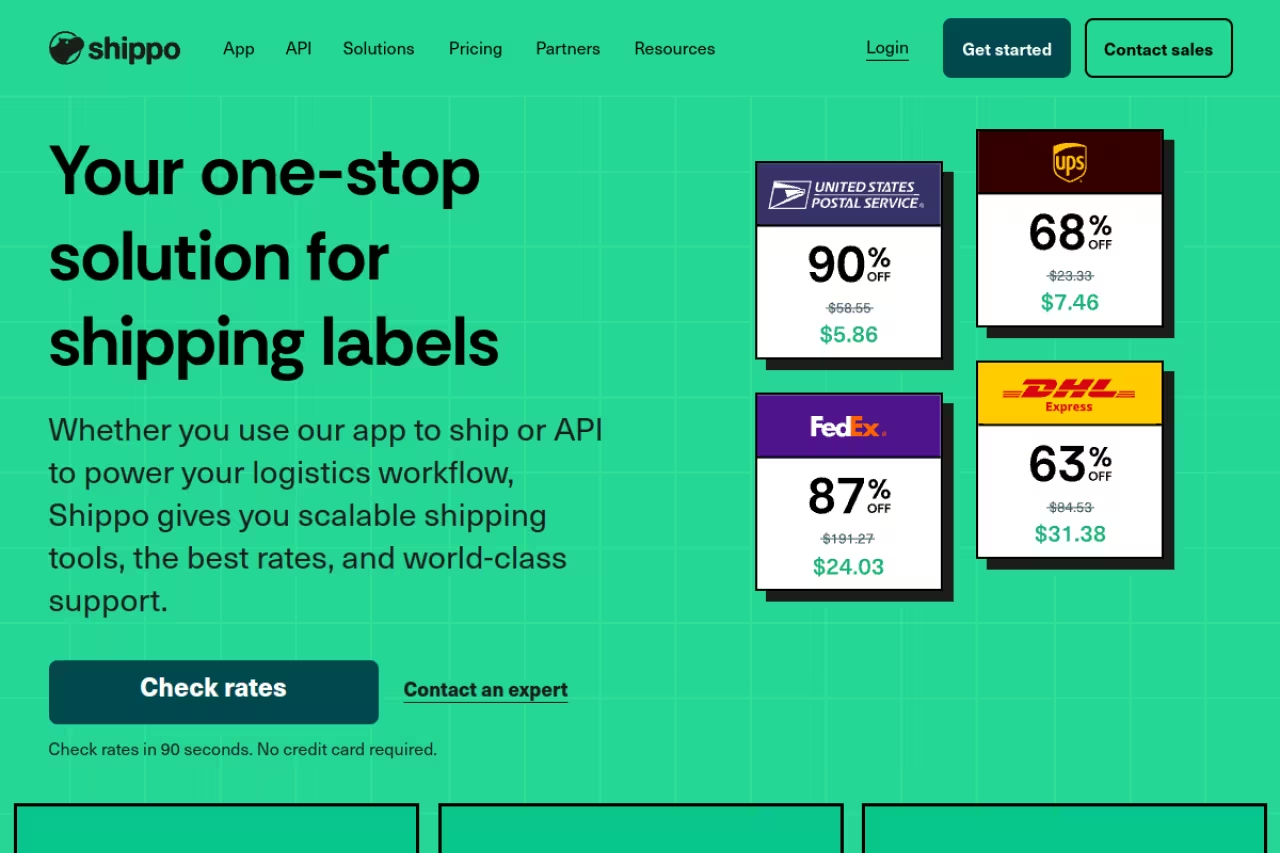
Shippo sits between Pirate Ship's simplicity and ShipStation's depth. It's a multi-carrier platform with a notably clean interface and a developer API that lean teams love. If you're a tech-forward brand that wants predictable pricing and the option to build shipping into your own app later, Shippo is a smart bet.
A smart bet for lean DTC teams and startups that want a clean interface, predictable per-label pricing and API access included at every tier. The free tier's 30 labels run out fast, and automation rules are thinner than ShipStation's.
The Starter plan is free for up to 30 labels per month with an $0.08 per-label overage fee. The Pro plan starts at $17/month and scales up to 10,000 labels, with free own-carrier connections, branded tracking, and AI delivery estimates. Full details are on the Shippo pricing page. The flat, transparent per-label model is easier to forecast than ShipStation's volume tiers.
The standout: API access is included even on lower plans, and the docs are clean. For a team that wants to start in the dashboard and graduate to programmatic shipping, you don't have to switch tools.
The catch: the free tier's 30 labels run out fast, and once you're on Pro the per-label overages and add-ons (address validation runs 6-9 cents per non-US lookup) add up. International support exists but isn't as deep as Easyship's. Power users also find the automation rules thinner than ShipStation's.
ClickPost: built for multi-carrier management
ClickPost connects to 600+ carriers across 30+ countries and uses an AI engine to allocate each shipment to a carrier based on cost, turnaround time, and SLA. It also runs a control tower (Apex) that surfaces shipment exceptions, NDR, and RTO risk across forward and reverse journeys in one dashboard.
ClickPost is for brands juggling many carriers that want AI-based allocation and one control tower for exceptions, NDR and RTO. There is no public pricing or self-serve signup, and single-courier shippers will not need it.
No published free plan or fixed pricing tiers. ClickPost runs a custom, usage-based pricing tied to shipment volume and the modules selected. Book a demo for a quote.
The standout: AI-based carrier allocation combined with a single control tower for shipment exceptions, NDR, and RTO across forward and reverse logistics.
The catch: There's no public pricing or self-serve signup. You'll need to book a demo and go through a sales conversation before you know what it costs. It's also built for brands juggling multiple carriers, so if you're shipping through one courier, you probably don't need what ClickPost is offering.
Easyship: built for international
Easyship is the tool I reach for when a brand ships globally. It handles the messy parts of cross-border shipping: customs paperwork, tax and duty calculation, and showing landed cost (DDP/DDU) to the buyer at checkout so there are no surprise fees on delivery. It also surfaces a wide set of international couriers with pre-negotiated rates.
The pick for stores with meaningful international volume that need customs, duties and landed cost shown at checkout. For purely domestic US shipping it is overkill, and some reviewers note support slows during peak season.
There's a free plan aimed at solo sellers and crowdfunding creators shipping under roughly 50 parcels a month. Paid plans run Plus at $29/month, Premier at $69/month (adds tax and duty display at checkout plus returns), then Scale and custom Enterprise for higher volume. You pay subscription plus postage and insurance, with no hidden fees per Easyship.
The standout: the checkout rate and duties display. Showing a customer in Germany their all-in cost including duties, before they buy, cuts abandoned international carts noticeably. That's a feature most domestic-first tools simply don't have.
Where it falls short: for purely domestic US shipping it's overkill, and the rate tables can feel opaque when you're comparing couriers you've never heard of. Some reviewers note that support response times stretch during peak season.
If shipping is one piece of a broader ecommerce stack you're building, our guide to the best AI tools for ecommerce covers the operations side, and a yearly Dupple X membership bundles the tooling research so you're not testing nine platforms yourself.

EasyPost: the developer's shipping layer
EasyPost isn't really a dashboard tool. It's a shipping API for engineering teams who want to build label buying, rate shopping, tracking, and address validation directly into their own product or internal system. If you run a marketplace, a 3PL, or any platform where shipping is a feature you ship to other people, this is the layer underneath.
A shipping API for developers and platforms, such as marketplaces and 3PLs, that want label buying, rate shopping and tracking built into their own product, with no per-seat fees. Without a developer it is not for you, since there is no merchant dashboard.
The Developer/Free plan includes a generous free allotment (around 3,000 labels per month, or up to 120,000 labels per year on the free access tier), then $0.08 per label after that. The BYOCA plan is $20/month plus per-label fees for high-volume shippers using their own negotiated carrier rates. Current numbers are on the EasyPost pricing page. There are no per-seat fees, which matters when several engineers hit the API.
The standout: breadth and developer experience. It connects 100+ carriers globally (USPS, UPS, FedEx, DHL and many regional ones), and the documentation gets consistent praise. No seat-based pricing is a real cost advantage for engineering teams.
The catch: if you don't have a developer, this isn't for you. There's no polished merchant dashboard to fall back on, and you're responsible for building the workflow around the API. It solves a different problem than ShipStation.

Sendcloud: the European pick
Sendcloud is the multi-carrier platform I'd point any EU-based store toward first. Its strength is the European carrier network (PostNL, DPD, DHL, Colissimo, GLS and more) plus localized tracking notifications and a strong returns portal. For cross-border shipping inside Europe, it's purpose-built in a way the US-first tools aren't.
Point any EU-based store here first, with strong European carriers, localized tracking and a returns portal. Per-label fees on top of the subscription raise the effective cost, and US carrier coverage is thin for North American shippers.
There's a free plan for up to 20 parcels a month with no courier contract required. Paid plans start at Lite (€28/month plus €0.10 per label), then Growth (€87/month), Premium (€175/month, the popular tier with advanced returns), and Pro (€639/month) per the Sendcloud pricing page. Each tier lowers the per-label fee as volume grows.
The standout: branded tracking and returns built for the European buyer, in multiple languages. The returns portal alone saves a lot of support tickets for stores selling across several EU countries.
Where it falls short: the per-label fee on top of the subscription means your effective cost is higher than the headline price suggests, and US carrier coverage is thin. If you ship mostly inside North America, the value isn't there.

AfterShip: own the post-purchase moment
AfterShip solves a different problem than the label tools above. It's about what happens after the label prints: branded tracking pages, proactive delivery notifications, and returns, across more than 1,000 carriers. The "where is my order" support ticket is one of the most common in ecommerce, and AfterShip's job is to kill it.
AfterShip is an addition to your stack, not a replacement, for stores that buy labels elsewhere but want branded tracking, notifications and returns across more than 1,000 carriers. It does not buy labels or rate-shop, and lower-tier quotas are tight.
The free plan covers 50 shipments per month. The Essentials plan is $11/month (or $9/month billed annually) for 100 shipments with $0.08 per-shipment overage, then Pro and Premium tiers scale up, with custom Enterprise pricing. Annual billing saves around 18%, and extra users are $5 each per month. See the AfterShip pricing page for the current tiers.
The standout: tracking that pulls from over 1,000 carriers into one branded page with automated email and SMS updates. It turns the tracking page into a retention channel instead of a dead end on a carrier site.
The catch: it doesn't buy labels or rate-shop, so it's an addition to your stack, not a replacement for ShipStation or Shippo. The shipment quotas are tight on lower tiers, and a high-volume store can blow past 100 shipments in a day.

ShipBob: when you'd rather not ship at all
ShipBob belongs on this list with an asterisk, because it isn't shipping software in the same sense. It's a third-party logistics provider (3PL) with a software layer. You send your inventory to their warehouses, and they store, pick, pack, and ship every order. The software gives you visibility and distributed inventory across multiple fulfillment centers.
A different decision than label software: a 3PL with a software layer for brands that have outgrown in-house shipping and want to outsource the whole operation. Pricing is quote-based and opaque, and you give up direct control of fulfillment.
Quote-based, with no public dollar rates. Independent analyses put the all-in per-order cost in roughly the $7 to $8 range once storage, pick-and-pack, and shipping are added up. Inbound receiving runs about $25 to $40 for the first two hours per receiving order, then $45/hour after. Expect to request a custom quote.
The standout: distributed inventory. Splitting stock across regional warehouses cuts shipping zones, which lowers cost and speeds up delivery. For a brand doing real volume, that math can beat self-fulfillment once you price in labor and warehouse rent.
Where it falls short: opaque, quote-based pricing makes it hard to compare, and you give up direct control of fulfillment. The per-order economics only make sense above a certain volume, and the line items (storage, WRO fees, surcharges) can surprise you. It's a different decision than buying label software.
How to choose
Match the tool to your actual constraint, not the feature list.
- You ship USPS or UPS and hate fees. Start with Pirate Ship. It costs nothing and the rates are real. Outgrow it later.
- You ship a few hundred to a few thousand orders from your own space. ShipStation. The automation pays for itself in hours saved.
- You're a lean or technical team that wants flat pricing and an API. Shippo for the dashboard plus light API, EasyPost if shipping is something you're building into a product.
- You ship internationally. Easyship for duties and checkout rates, Sendcloud if you're EU-based.
- You want to fix the "where's my order" problem. Add AfterShip on top of whatever you use for labels.
- You're done with in-house fulfillment. Get a ShipBob quote and run the per-order math against your current cost.
One rule that saved me money: run a real rate-shop before committing. Take ten of your actual orders, price them across two tools, and compare the all-in cost including the subscription. The cheapest postage with a $30 monthly fee can lose to a free tool at low volume, and the math flips again as you scale. Shipping software is one piece of the operations stack, so if you're also sorting out inventory or fulfillment forecasting, our guides on inventory management software and AI supply chain tools cover the next steps.
FAQ
What is the best shipping software for a small ecommerce business?
For most small stores, ShipStation is the best all-around choice because it connects to every major sales channel and automates label printing, with plans starting at $14.99/month after a free trial. If you only ship USPS or UPS and want to avoid any monthly fee, Pirate Ship is the better pick since it's free and passes through real carrier discounts. The right answer depends on whether you value automation depth or zero subscription cost.
Is there genuinely free shipping software?
Yes. Pirate Ship is free with no monthly fee, no per-label markup, and no minimum volume. It's funded by carrier commissions, so the USPS rates you see are essentially at cost. Shippo, Easyship, AfterShip, EasyPost, and Sendcloud also have free tiers, but those cap you at a set number of labels or shipments per month (between 20 and 3,000 depending on the tool) before you have to pay.
What's the difference between shipping software and a 3PL like ShipBob?
Shipping software (ShipStation, Shippo, Pirate Ship) helps you buy labels, rate-shop carriers, and manage shipping from inventory you store and pack yourself. A 3PL like ShipBob physically stores your inventory in its warehouses and handles picking, packing, and shipping for you. Shipping software is a tool you operate; a 3PL is an operation you outsource. The 3PL costs more per order (around $7 to $8 all-in) but removes the labor entirely.
Which shipping software is best for international orders?
Easyship is the strongest for cross-border shipping because it calculates customs duties and taxes, generates the right paperwork, and shows buyers their landed cost (DDP/DDU) at checkout. For stores based in the European Union, Sendcloud is purpose-built for regional EU carriers and localized tracking. US-first tools like ShipStation and Shippo support international shipping but handle duties and customs less thoroughly.
Do I need shipping software if I use Shopify?
You don't strictly need it, but you usually save money with it. Buying labels directly through Shopify is convenient but often costs more than rate-shopping across carriers in a dedicated tool. Even a free option like Pirate Ship or Shippo's free tier can cut your per-label cost meaningfully, and the automation in a tool like ShipStation saves time once you're past roughly 50 orders a month.
How much should shipping software cost?
For a small store, expect to pay between $0 and $30 a month for the software itself, plus postage. Pirate Ship and the free tiers of Shippo or Easyship cost nothing beyond postage. Paid plans like ShipStation Standard ($29.99/month) or Shippo Pro ($17/month) make sense once automation and higher label volume save you more than the fee. A 3PL is a different model entirely, billed per order rather than per month.
Related guides
Some offers on this page may be paid placements or contain affiliate links.
Across our whole catalogue the median is $24 a month and 33% of tools advertise a free tier. Figures are the lowest recurring monthly price quoted in our own review of each tool, read on 2026-08-19. Full method and every category.
