
The Best Enterprise HR Software in 2026

Key facts8 tools compared: Workday, Rippling, Deel, Dayforce, SAP SuccessFactors, Oracle Fusion HCM…
- 8 tools compared: Workday, Rippling, Deel, Dayforce, SAP SuccessFactors, Oracle Fusion HCM, HiBob, BambooHR
- Workday (best for: Large global enterprises): ~$34-$42, often higher at scale
- Rippling (best for: Companies that want HR + IT + payroll unified): $8 core + $35 base, ~$22-$30 fully loaded
- Deel (best for: Global teams, EOR and contractors): Free HR to 200; EOR ~$599
- Dayforce (best for: Hourly and shift-heavy workforces): Custom quote
Buying enterprise HR software is one of those decisions where the price tag is the least scary part. You're signing a multi-year contract, migrating years of employee data, retraining a few hundred HR and payroll people, and betting that the platform you pick today can still handle your headcount in five years. Get it wrong and you're stuck, because re-platforming a 5,000-person HRIS is a project nobody volunteers for twice.
The market has also split into two camps. On one side sit the classic HCM suites built for global enterprises with complex org structures and 100-country compliance needs: Workday, SAP, Oracle. On the other side are the newer, faster platforms that started in the mid-market and kept climbing: Rippling, Deel, HiBob. Both can carry an enterprise now. The right call depends on how global you are, how much you want HR and finance in one system, and how much implementation pain you can stomach.
If you want the short answer: Workday is still the safe default for large, complex enterprises that need HR and finance in one place, and most evaluators won't get fired for choosing it. But it's expensive and slow to roll out, so I'd genuinely push you to look at Rippling and Dayforce before you sign. This guide covers eight platforms I'd actually shortlist, with real pricing and the catch on each.
Quick comparison
| Tool | Best for | Price (PEPM) | Standout |
|---|---|---|---|
| Workday | Large global enterprises | ~$34-$42, often higher at scale | HR + finance in one data model |
| Rippling | Companies that want HR + IT + payroll unified | $8 core + $35 base, ~$22-$30 fully loaded | One system for people and devices |
| Deel | Global teams, EOR and contractors | Free HR to 200; EOR ~$599 | Hiring in 150+ countries |
| Dayforce | Hourly and shift-heavy workforces | Custom quote | Continuous, real-time payroll |
| SAP SuccessFactors | SAP shops, deep global compliance | Custom quote | Compliance in 100+ countries |
| Oracle Fusion HCM | Regulated industries, Oracle stack | Custom quote | Embedded gen-AI workflows |
| HiBob | Mid-market scaling to enterprise | ~$16-$25 | Modern UX and culture tooling |
| BambooHR | Smaller enterprise teams, simplicity | ~$10-$25 | Fast setup, clean interface |
Workday
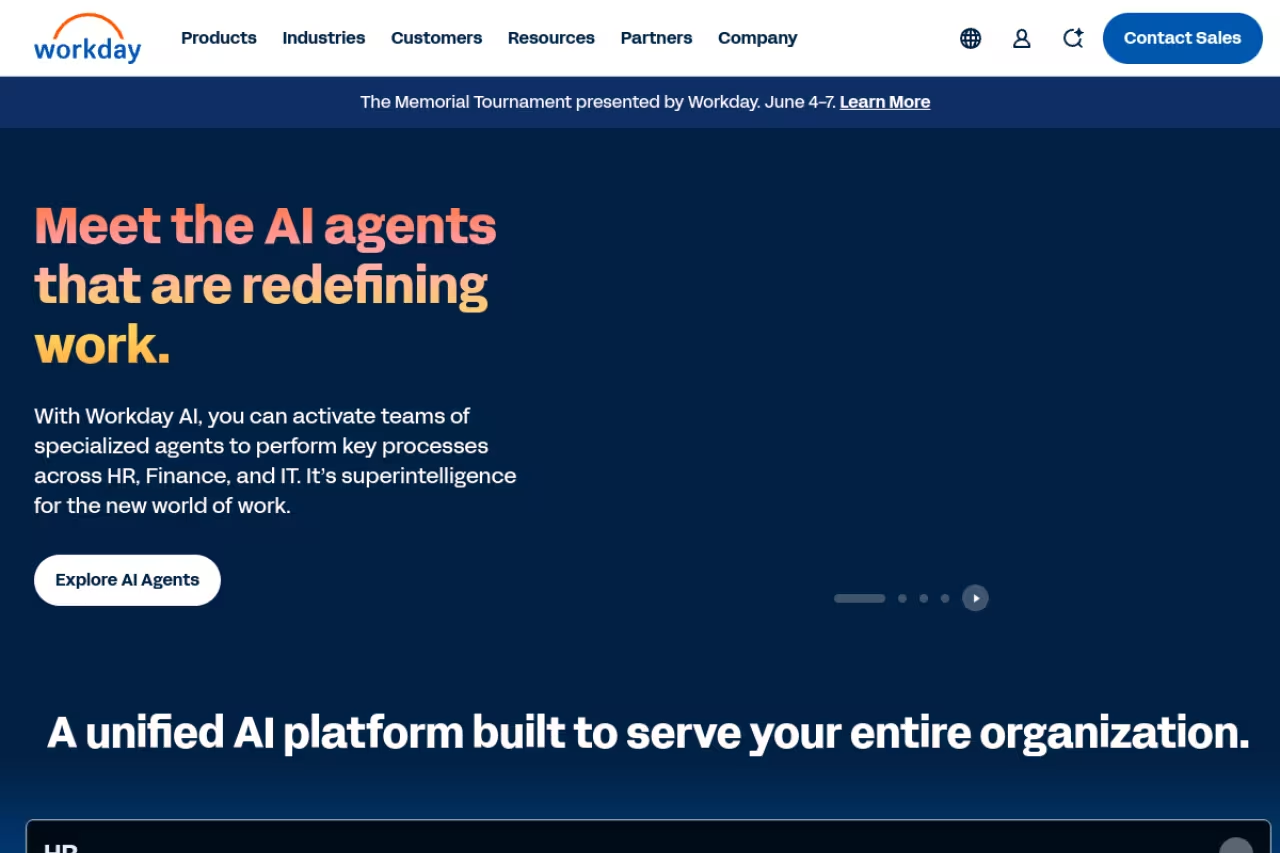
Workday is the platform you compare everything else against. It's a single cloud system that runs HR, payroll, finance, planning, and talent off one data model, which is the whole pitch: your headcount numbers and your budget numbers come from the same source, so workforce planning isn't a spreadsheet reconciliation exercise. For enterprises over a few thousand employees, that unification is hard to replicate.
Who it's best for: large, multi-entity organizations that want HR and finance on the same platform and have the budget and project team to do a serious rollout.
The platform everything else is compared against, for large multi-entity organizations that want HR and finance on one data model and can fund a serious rollout. Expect 9 to 18 months to go live, and it is overkill for a 500-person company needing clean HR and payroll.
Workday never publishes prices, so everything is estimate territory. Industry benchmarks put it around $34 to $42 per employee per month for HCM at scale, and a 1,000-person rollout commonly lands in the high six figures per year once you add finance modules. Implementation is the part that stings: it often costs as much as a full year of licensing, and large global rollouts run into the millions.
The standout: the unified HR-and-finance data model, plus its newer AI layer (branded Sana) that automates work across departments. Skills-based talent planning here is genuinely good.
The catch: cost and time. You're looking at 9 to 18 months to go live for a big org, and the configuration depth that makes Workday powerful also makes it a beast to administer. It's overkill for a 500-person company that just needs clean HR and payroll.

Rippling
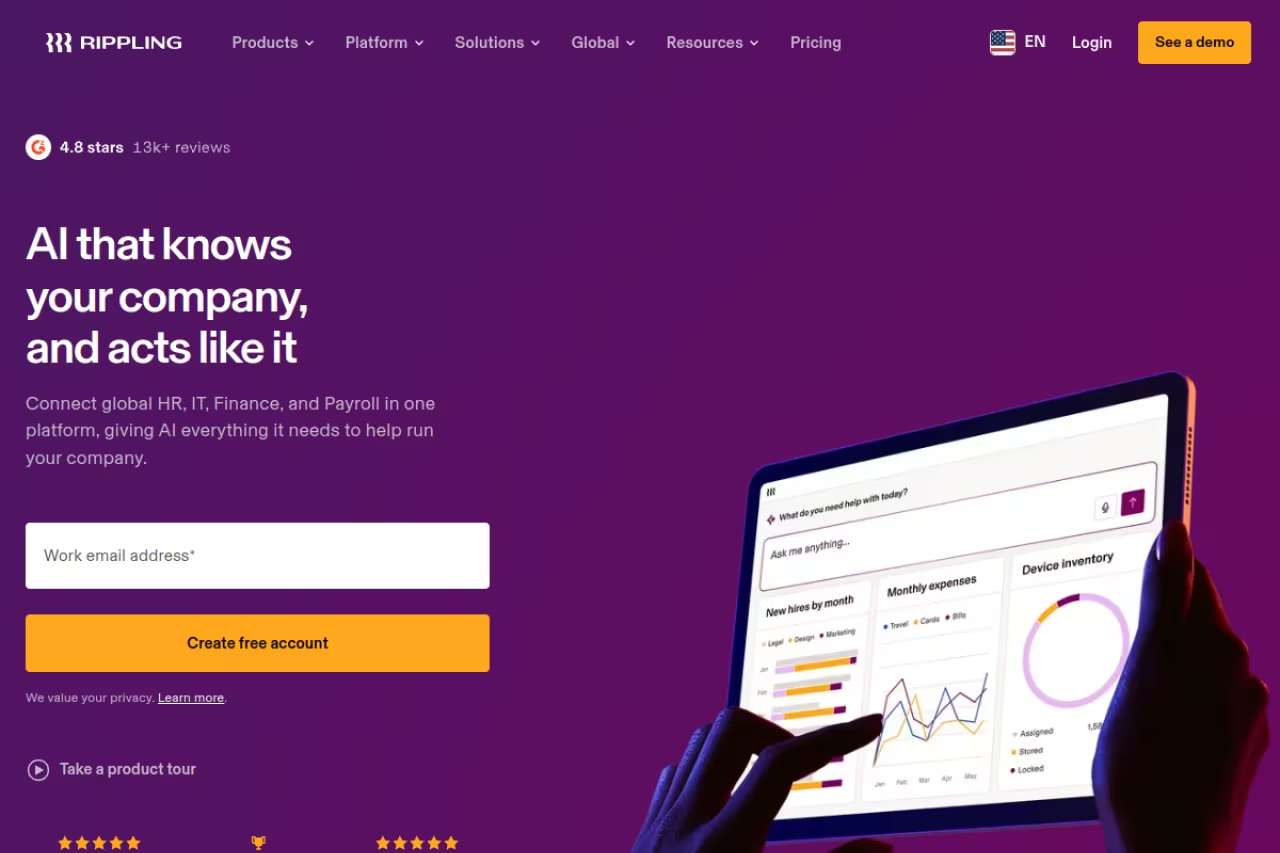
Rippling is the platform I'd push hardest on if you're frustrated with how many separate systems your IT and HR teams juggle. It started as HR and payroll, then absorbed device management, app provisioning, and spend, all on one employee record. Onboard someone once and Rippling can run payroll, order their laptop, set up their accounts, and enroll their benefits from the same action. For enterprises tired of stitching HRIS to IT tools, that's the differentiator.
Who it's best for: tech-forward companies, especially distributed ones, that want HR, IT, and finance operations under a single system rather than five vendors.
Push it hardest if your IT and HR teams juggle too many separate systems, with the strongest workflow automation in this comparison. Modular pricing creeps up on big deployments, and global payroll is less localized than SAP or Dayforce in some countries.
Rippling starts at $8 per employee per month for the core platform plus a $35 monthly base fee. A realistic fully loaded stack of HR, payroll, benefits, and time tracking lands around $22 to $30 per employee per month. It's modular, so the sticker price climbs as you add products.
The standout: one source of truth for people and their devices and apps. The automation engine ("workflow" triggers across HR and IT) is the strongest in this comparison.
Where it falls short: Rippling is younger than the legacy suites at the very top of the enterprise market, and its global payroll, while growing fast, isn't as deeply localized as SAP or Dayforce in every country. The modular pricing also means a big deployment can creep up in cost faster than you expect. Build a budget before you fall in love with the demo.

Deel
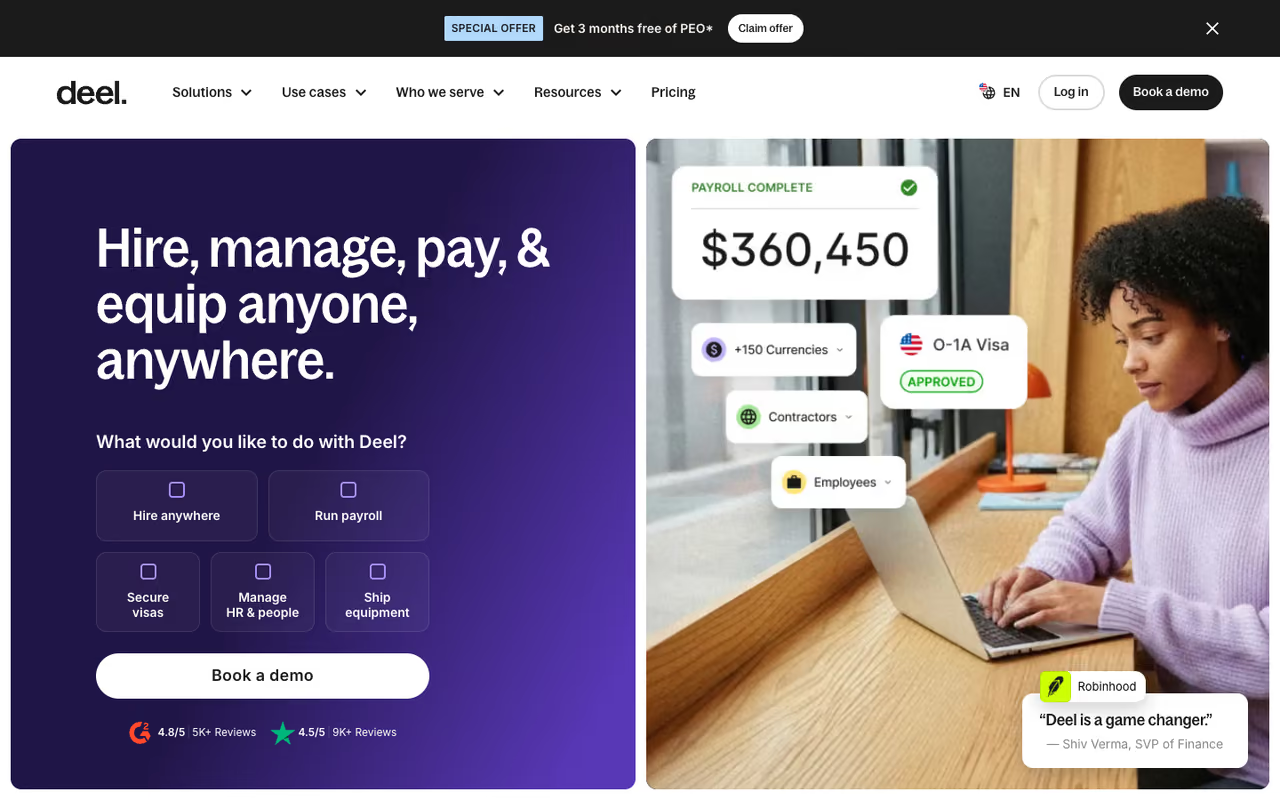
Deel solves a specific, painful problem better than anyone: hiring and paying people across borders. If your enterprise has employees and contractors scattered across dozens of countries, Deel's Employer of Record service lets you hire them legally without setting up local entities. It's grown from a contractor-payment tool into a full global HR platform, and the breadth of countries it covers is the reason large companies adopt it.
Who it's best for: globally distributed enterprises, companies expanding into new markets, and anyone managing a large contractor or international workforce.
Best used as the global layer for enterprises with employees and contractors across dozens of countries, hiring in 150+ countries with compliance handled. EOR gets expensive once employer taxes and FX spreads are added, so a traditional HCM is cheaper for your core domestic workforce.
Deel's HR module is free for up to 200 employees, which is unusually generous. EOR services start around $599 per employee per month, contractor management runs about $49 per contractor per month, and global payroll sits near $29 per employee. EOR rates often drop to the $400-$500 range with volume.
The standout: hiring in 150+ countries with compliance handled for you. The contractor and EOR coverage is the widest in the category.
The catch: EOR is expensive once you factor in employer taxes (15-45% of salary depending on the country), FX spreads on each payroll run, and refundable deposits that tie up working capital. EOR is a bridge, not a forever home. For your core domestic workforce, a traditional HCM is cheaper. Deel shines as the global layer, not necessarily the whole stack.
If you're building out a global team and weighing how AI fits into your hiring and operations, our guide to the best AI agents and our top AI tools roundup are worth a look alongside this. And if you want one running list of what's working in AI ops right now, Dupple X tracks it weekly.
Dayforce
Dayforce (formerly Ceridian Dayforce) is built around one idea that matters enormously for hourly workforces: continuous, real-time payroll. Instead of running payroll in a batch every two weeks and praying the numbers are right, Dayforce calculates pay continuously as time and attendance data flows in. For retail, hospitality, healthcare, and manufacturing, where shift differentials and overtime rules get messy, that's a real advantage.
Who it's best for: enterprises with large hourly, shift-based, or unionized workforces where time, attendance, and payroll complexity is the core problem.
The better pick if your workforce clocks in and out, thanks to continuous real-time payroll and strong scheduling for hourly, shift-based or unionized staff. Talent and analytics trail Workday for salaried planning, and the early 2026 go-private deal is worth watching.
custom quotes only, negotiated by headcount and modules. Expect it to land in the same broad enterprise range as Workday and SAP. Get a few competitive bids before signing, because there's room to negotiate.
The standout: real-time continuous payroll and best-in-class workforce management for complex scheduling.
Where it falls short: the talent management and analytics modules, while solid, aren't as deep as Workday's for white-collar, skills-based planning. Dayforce is the better pick if your workforce clocks in and out; it's less compelling for a software company full of salaried engineers. Worth noting: Dayforce went private in early 2026 after a $12.3 billion Thoma Bravo acquisition, so watch how the roadmap evolves.
SAP SuccessFactors
SAP SuccessFactors is the choice when global compliance depth and an existing SAP footprint outweigh everything else. It offers localization and statutory compliance across 100+ countries, which is genuinely hard to match. If your finance and ERP run on SAP S/4HANA, plugging SuccessFactors in gives you one connected HR-and-finance backbone.
Who it's best for: very large multinationals, especially those already invested in the SAP ecosystem, that need deep country-by-country compliance.
The choice when global compliance depth and an existing SAP footprint outweigh everything else, with localization across 100+ countries. The suite is sprawling with long implementations, and outside SAP shops it tends to lose to Workday on user experience.
custom, enterprise-only. Like Workday, expect significant licensing plus heavy implementation costs.
The standout: unmatched global localization and tight integration with the rest of the SAP stack.
The catch: it's a sprawling, module-heavy suite, and the user experience has historically lagged the newer platforms. Implementations are long and usually need a specialist partner. If you're not already an SAP shop, the integration argument loses most of its force, and you're left comparing it head-to-head with Workday on UX, where it tends to lose.
Oracle Fusion Cloud HCM
Oracle Fusion Cloud HCM is the third pillar of the legacy enterprise trio, and it's strongest for organizations in heavily regulated industries that already lean on Oracle's database and cloud. Oracle has put real effort into embedding generative AI across the workflow: digital assistants, automated self-service, and AI-drafted job descriptions and summaries are baked in.
Who it's best for: large enterprises in regulated sectors (finance, healthcare, government) and existing Oracle Cloud customers who want one vendor across HR, ERP, and database.
A we-already-run-Oracle decision, strongest for regulated industries and existing Oracle Cloud customers, with deep generative AI built in. It is complex and slow to deploy, and without an Oracle footprint the case over Workday is thin.
custom enterprise quotes, in the same league as Workday and SAP.
The standout: a strong compliance engine and deep gen-AI integration on a single data model shared with Oracle's ERP and finance products.
Where it falls short: like its peers, it's complex and slow to deploy, and the value really concentrates if you're already standardized on Oracle. For a company with no Oracle footprint, the case for choosing it over Workday is thin. It's a "we already run Oracle" decision more than a greenfield winner.
HiBob
HiBob (the product is called "Bob") climbed out of the mid-market by being the platform employees actually enjoy using. The interface is modern, the culture and engagement tooling is genuinely good, and it's grown enough to serve companies pushing past a thousand employees. If your HR team has been burned by clunky legacy suites, Bob feels like a breath of fresh air.
Who it's best for: fast-growing mid-market and lower-enterprise companies (roughly 100 to 1,500 employees) that prize usability and a strong people experience.
The one employees actually enjoy using, for companies of roughly 100 to 1,500 employees that prize usability and culture tooling. Native payroll is limited and varies by region, and above a few thousand employees with complex needs it shows its mid-market roots.
custom, but third-party reports put it around $16 to $25 per employee per month, plus a one-time implementation fee in the 10-20% of first-year contract range.
The standout: the best-in-class user experience and culture tooling in this list. Adoption is rarely a fight.
The catch: native payroll is limited and varies by region, so larger or more global deployments often bolt on a payroll partner. HiBob is excellent core HR; it's not the all-in-one financial backbone that Workday or Dayforce is. Above a few thousand employees with complex needs, it starts to show its mid-market roots.

BambooHR
BambooHR is the simplicity play. It's the easiest platform here to set up and run, with a clean interface that smaller HR teams pick up in days, not months. It's more SMB than true enterprise, but for smaller "enterprise" teams (or a division inside a larger company) that want core HR without a heavy project, it earns its spot.
Who it's best for: smaller organizations and lean HR teams that want solid core HR, onboarding, and employee records without complexity.
The simplicity play for smaller organizations and lean HR teams that want core HR live in about a week. Payroll, benefits and time tracking are paid add-ons that push real cost 30 to 50% above base, and you will outgrow it past a few hundred employees.
roughly $10 per employee per month on Core, $17 on Pro, and $25 on Elite per third-party 2026 reports, with a flat $250/month minimum under about 25 employees.
The standout: speed to value. You can be live in a week, and people understand it immediately.
Where it falls short: payroll, benefits administration, and time tracking are paid add-ons, so the real cost runs 30-50% above the base sticker once you build the stack most companies actually need. It also doesn't scale to the depth a 5,000-person multinational requires. Past a few hundred employees with global complexity, you'll outgrow it.
How to choose
Skip the feature-checklist arms race. Every platform here has a long feature list. The decision comes down to three questions.
How global and complex are you? If you operate in many countries with statutory payroll in each, you're choosing between SAP, Dayforce, and Deel (for EOR-heavy footprints). If you're mostly single-country with some international, Rippling or HiBob covers it for far less pain.
Do you need HR and finance on one system? If yes, and you're large, Workday is the cleanest answer, with Oracle close behind if you're already on Oracle. If HR can live separately from finance, the modern platforms get much more attractive.
What's your appetite for implementation? Be honest. Workday, SAP, and Oracle are 9-to-18-month projects with specialist partners. Rippling, HiBob, BambooHR, and Deel get you live in weeks to a few months. If you don't have a dedicated project team, the legacy suites will hurt.
My rule of thumb: under ~1,500 employees, start with Rippling, HiBob, or Deel. Over that with real global complexity, get competitive bids from Workday, Dayforce, and SAP, and negotiate hard, because those prices move.
Want the same kind of honest, well-researched breakdown for the AI tools reshaping how teams operate? Dupple X is where we track what's actually worth your budget.
FAQ
What is the best enterprise HR software in 2026?
For large, complex global enterprises, Workday remains the strongest all-around choice because it unifies HR and finance on one data model. But Rippling and Dayforce are serious contenders that often deliver faster and cheaper, and Deel wins specifically for global hiring. The best pick depends on your size, how global you are, and whether you need HR and finance in one system.
How much does enterprise HR software cost per employee?
Modern platforms like Rippling, HiBob, and BambooHR typically run $10 to $30 per employee per month depending on modules. Legacy enterprise suites like Workday land around $34 to $42 per employee per month for HCM, often higher at scale, and that's before implementation, which can cost as much as a full year of licensing.
What's the difference between HRIS, HCM, and HRMS?
HRIS is the core system of record: employee data, time off, org charts. HCM is broader and adds talent management, workforce planning, and analytics on top. HRMS usually means HRIS plus payroll and time management. In practice the terms overlap heavily, and most enterprise platforms here cover all three. Focus on the actual modules, not the acronym.
Is Workday or Rippling better for enterprise?
Workday is better for very large organizations that need deep HR-and-finance unification and global complexity, and it's the safer bet above several thousand employees. Rippling is better for tech-forward companies that want HR, IT, and payroll on one system and value faster setup and lower cost. Below about 1,500 employees, Rippling usually wins on speed and price.
Which HR platform is best for global and remote teams?
Deel is the strongest for global hiring because its Employer of Record service lets you hire in 150+ countries without local entities, and its HR module is free up to 200 employees. For large international workforces with in-country payroll, SAP SuccessFactors and Dayforce offer deeper localization. Many companies run Deel as their global layer alongside a domestic HCM.
How long does it take to implement enterprise HR software?
It varies enormously. Workday, SAP, and Oracle rollouts typically take 9 to 18 months for a large organization and need a specialist implementation partner. Modern platforms like Rippling, HiBob, BambooHR, and Deel can go live in a few weeks to a few months. Implementation time and cost should weigh as heavily as the license price in your decision.
Related guides
Some offers on this page may be paid placements or contain affiliate links.
