
The Best ETL Tools in 2026: 8 Platforms I'd Actually Trust With Your Data

Key facts8 tools compared: Fivetran, Airbyte, dbt, Matillion, Hevo Data, Integrate.io, Stitch, Apache…
- 8 tools compared: Fivetran, Airbyte, dbt, Matillion, Hevo Data, Integrate.io, Stitch, Apache Airflow
- Fivetran (best for: Hands-off, managed pipelines): Free tier; usage-based after 500K MAR
- Airbyte (best for: Engineering teams wanting control): Free open source; Cloud from $10/mo
- dbt (best for: SQL-based transformation): Free Developer; Starter $100/user/mo
- Matillion (best for: Cloud-native ELT with AI agents): Free Developer; paid via sales
Most "best ETL tools" lists read like the vendor brochures they were copied from. This one doesn't. ETL pricing is notoriously hard to predict for analytics teams, and pipeline bills are known to balloon once warehouse compute gets added in. The tool you pick decides how much of that pain you sign up for.
Here's the tension nobody warns you about: ETL pricing is designed to be hard to predict. Row-based, event-based, credit-based, capacity-based. Two teams running the same five connectors can pay wildly different amounts depending on how chatty their source data is. So the question isn't "which tool is best," it's "which tool is best for your volume, your team, and your tolerance for a surprise invoice."
If you want the short answer: Fivetran is still the default for teams that want pipelines to just work and have budget to match. Airbyte is the pick for engineering teams that want control and can self-host. And if your real problem is transformation rather than extraction, dbt is the standard you build everything else around. The rest of this guide is for the cases those three don't cover.
Quick comparison
| Tool | Best for | Price | Standout |
|---|---|---|---|
| Fivetran | Hands-off, managed pipelines | Free tier; usage-based after 500K MAR | 700+ connectors, zero maintenance |
| Airbyte | Engineering teams wanting control | Free open source; Cloud from $10/mo | Self-host option, 600+ connectors |
| dbt | SQL-based transformation | Free Developer; Starter $100/user/mo | The transformation standard |
| Matillion | Cloud-native ELT with AI agents | Free Developer; paid via sales | Maia agentic pipeline builder |
| Hevo Data | No-code, fast setup | From ~$239/mo (annual) | 5-minute connector setup |
| Integrate.io | Predictable flat-fee billing | $1,999/mo, unlimited volume | No surprise usage bills |
| Stitch | Simple SaaS-to-warehouse loads | From $100/mo | Singer-based, cheap entry |
| Apache Airflow | Custom code-first orchestration | Free (open source) | Total flexibility, huge ecosystem |

Fivetran: the one you pick when you don't want to think about pipelines
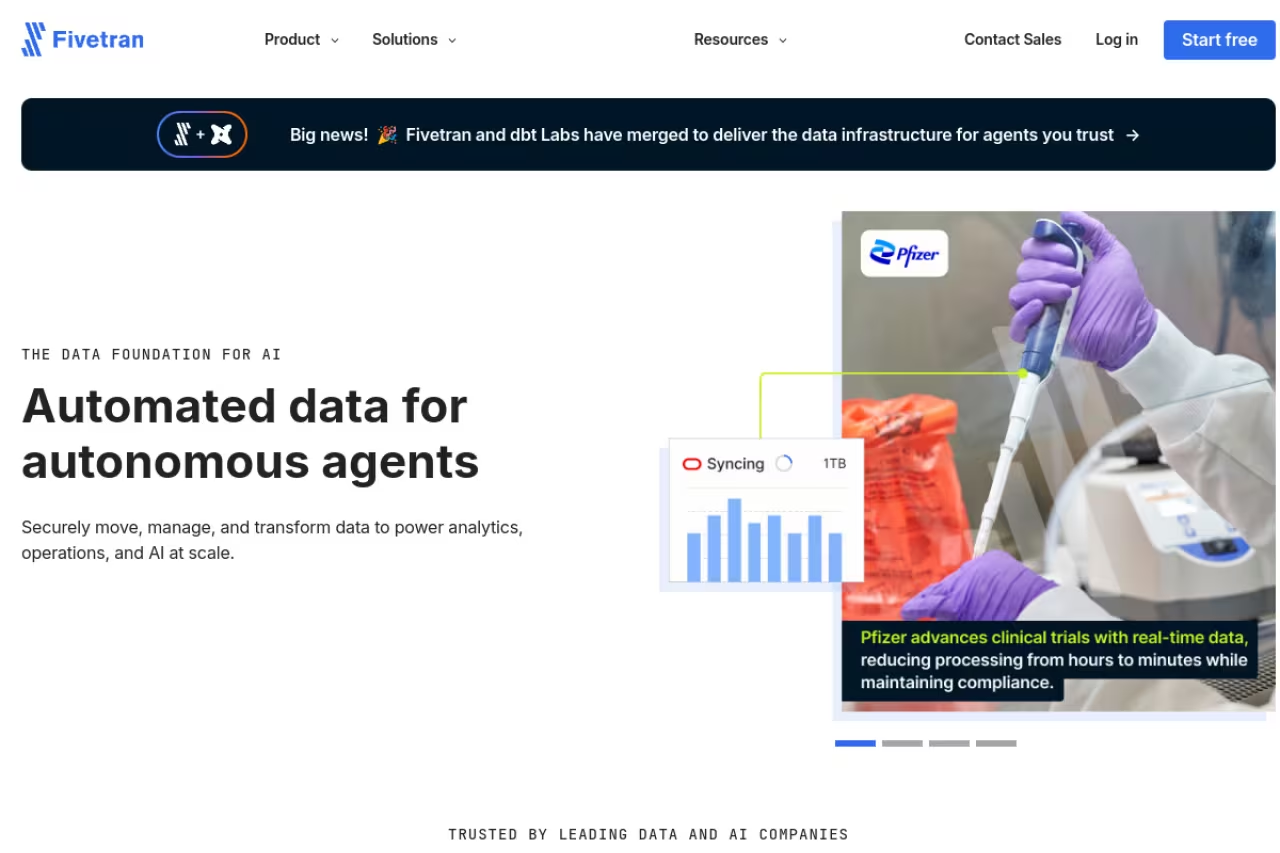
Fivetran is the managed ELT tool most data teams reach for first, and for good reason. You connect a source, point it at your warehouse, and Fivetran handles schema drift, retries, and connector maintenance for you. With 700+ connectors it covers nearly any SaaS source you'll throw at it, and syncs run as fast as every 15 minutes on the Standard plan, down to one minute on Enterprise.
The big 2026 story is that Fivetran and dbt Labs completed their merger on June 1, folding the two category leaders into one company aimed at building data infrastructure for AI agents. Practically, that means extraction and transformation are converging under one roof, which is good news if you already live in both products.
Who it's best for: Teams that value engineering time over software spend, and anyone who wants pipelines they never have to babysit.
The managed ELT tool most data teams reach for first, with 700+ connectors that handle schema drift and retries for you. Monthly Active Rows pricing is unpredictable, and teams at scale routinely report costs north of $5,000/month, so budget with a real volume estimate.
There's a genuinely usable free tier (500,000 monthly active rows for connections, plus model runs for transformations). Beyond that, pricing is consumption-based on Monthly Active Rows, with a $5 base charge on standard connections up to 1M MAR and volume discounts as you scale. Annual contracts shave off 5% to 22%.
The catch: MAR pricing is unpredictable. A source that updates the same rows repeatedly can balloon your bill, and teams at scale routinely report costs north of $5,000/month. Budget with a real volume estimate, not the demo numbers.

Airbyte: the open-source pick for teams that want control
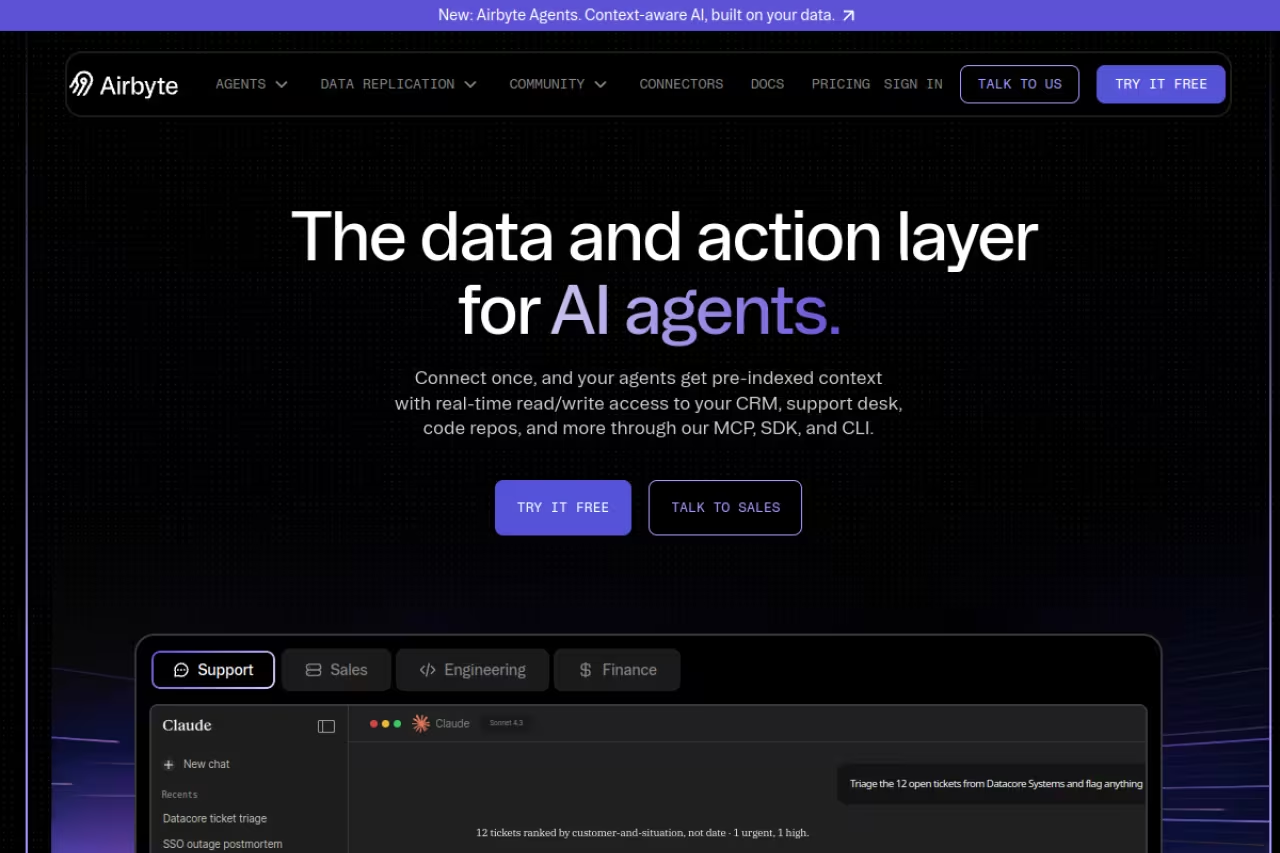
Airbyte flipped the script by being open source first. You can self-host the Core edition for free on your own infrastructure, which means your data never leaves your environment and your bill never surprises you. By 2026 it had become the go-to for engineering-driven teams that wanted extensibility and cost control over a fully-managed black box.
It ships with 600+ connectors, and its Connector Builder lets you spin up new ones quickly when something you need isn't covered. That matters more than connector count alone, because the long tail of niche SaaS tools is exactly where managed platforms tend to leave you stranded.
Who it's best for: Data engineering teams comfortable running infrastructure, and anyone with compliance reasons to keep data in-house.
The open-source pick for engineering-driven teams that want control, with 600+ connectors and a free self-hosted Core edition. Self-hosting is not free in the sense that matters, since you own uptime, upgrades and 2am debugging, and Cloud brings back volume-based billing.
Core (self-managed) is always free and open source. Airbyte Cloud's Standard plan starts at $10/month with volume-based pricing, the Plus plan runs $500/month with 50 credits included, and there's a capacity-based Pro tier plus Enterprise Flex for larger deployments. Airbyte's pricing page lays out all five tiers.
Where it falls short: Self-hosting isn't free in the sense that matters. You're now responsible for uptime, upgrades, and debugging connector edge cases at 2am. The managed Cloud removes that, but then you're back to volume-based billing you have to watch.

dbt: not really ETL, but the transformation layer you'll build on
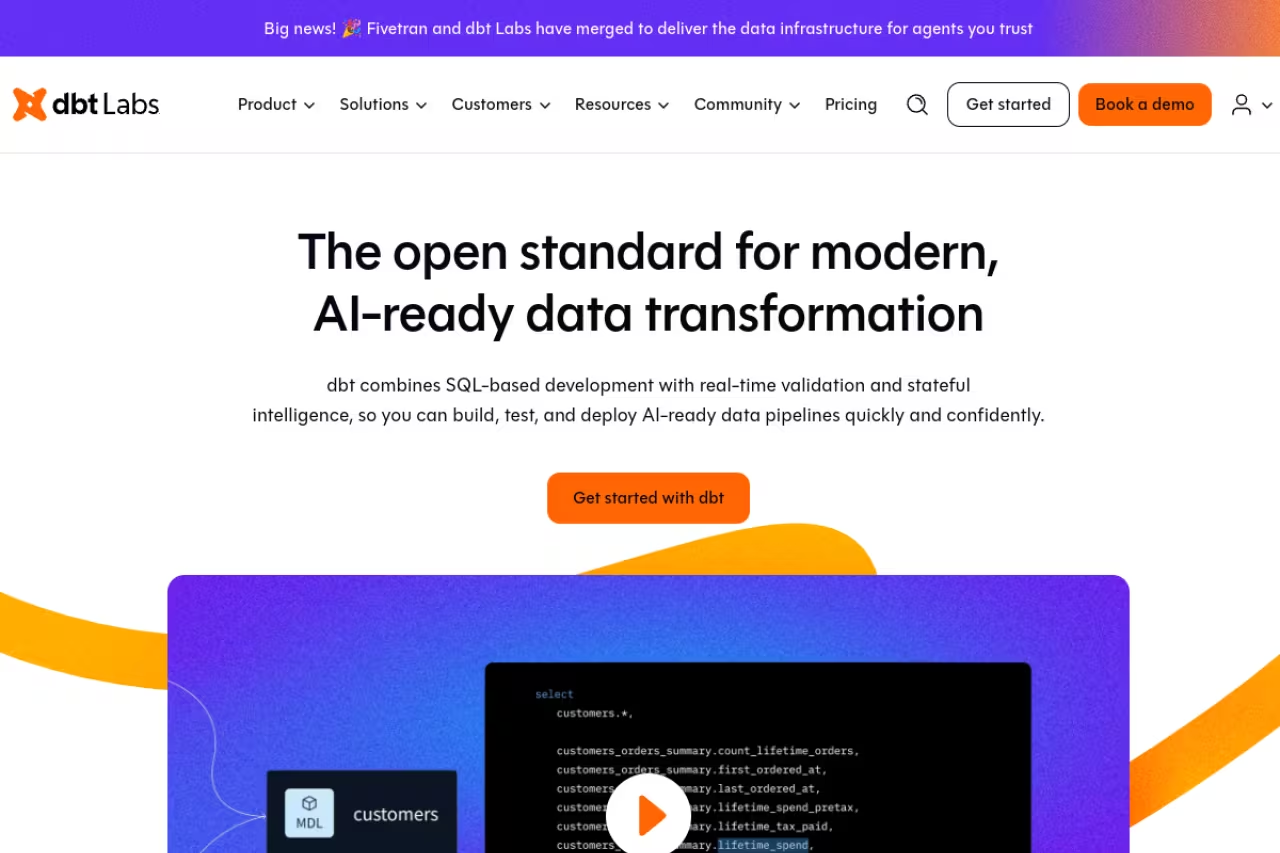
dbt is the odd one out on this list because it doesn't extract or load anything. It handles the T. But it's become so central to modern data stacks that leaving it off would be dishonest. dbt lets analysts transform data in the warehouse using plain SQL, with version control, testing, and documentation borrowed straight from software engineering.
The pattern most teams land on: use Fivetran or Airbyte to load raw data, then use dbt to model it into clean, tested tables your BI tools can trust. Post-merger, dbt sits alongside Fivetran under one company, and its semantic layer and Copilot code generation are pushing it further into AI-assisted modeling.
Who it's best for: Analytics engineers and any team where SQL is the lingua franca. If you're cleaning and reshaping data after it lands, this is the tool.
For analytics engineers, the transformation layer to build on after loading raw data with Fivetran or Airbyte, with a free Developer tier. It is not ETL, so it assumes your data is already in a warehouse and that you know SQL.
The Developer tier is free and genuinely useful, with 3,000 model builds per month. The Starter plan is $100/user/month for up to 5 seats with 15,000 model builds, and Enterprise tiers move to custom pricing with Mesh, Catalog, and stronger governance. Details on dbt's pricing page.
The catch: dbt assumes you already have data in a warehouse and that you know SQL. It's a transformation tool, not a pipeline. Pair it with one of the loaders above, don't expect it to replace them.

Matillion: agentic ELT for the cloud-native crowd
Matillion is a cloud-native ELT platform built around Snowflake, Databricks, and AWS. Its differentiator in 2026 is Maia, an agentic AI layer that builds, validates, and optimizes pipelines from natural-language prompts. If you've ever wanted to describe a pipeline in English and have it generated, this is one of the most serious attempts at that on the market.
Who it's best for: Mid-size to enterprise teams already standardized on Snowflake or Databricks who want low-code plus the option to drop into SQL or Python.
A serious option for mid-size to enterprise teams standardized on Snowflake or Databricks, with Maia generating pipelines from natural-language prompts. Warehouse compute is billed separately, so a $50,000 license can become a $230,000 annual commitment.
There's a free single-user Developer tier. Paid tiers (Teams, Scale) use a credit-based consumption model, and you'll need to talk to sales. Real-world license costs reportedly start around $5,000/month and climb into six figures for enterprise.
Where it falls short: Because Matillion pushes transformations down to your warehouse, every run racks up compute charges billed separately by your cloud provider. As Integrate.io's pricing analysis notes, a $50,000 license can become a $230,000 annual commitment once warehouse compute is counted. Watch that number.

Hevo Data: no-code pipelines that set up in minutes
Hevo Data is the friendliest tool here for non-engineers. It's a no-code, bi-directional pipeline platform covering ETL, ELT, and reverse ETL, with 150+ connectors that genuinely take about five minutes each to configure. In early 2026 Hevo shipped an architecture overhaul claiming 20-40x faster replication and big total-cost-of-ownership reductions.
Who it's best for: Marketing and ops teams that need data flowing without a dedicated data engineer, and startups wanting speed over deep customization.
The friendliest option for marketing and ops teams that need data flowing without a data engineer, with 150+ connectors that take about five minutes each to configure. Event-based pricing gets expensive at high volume, and its connector library is smaller than Fivetran's or Airbyte's.
Event-based, starting around $239/month annually for 5M events and scaling to roughly $679/month for 100M events. Enterprise features like HIPAA, RBAC, and SSO sit behind a Business Critical tier with custom pricing.
The catch: Event-based pricing has the same predictability problem as row-based: high-volume sources get expensive fast. And the connector library, while polished, is smaller than Fivetran's or Airbyte's, so check your specific sources are covered before committing.
Before we get to the more technical picks, a quick aside. If your team is buried in this kind of tooling research, Dupple X tracks the AI and data tools worth your attention so you spend less time comparing pricing pages and more time shipping.

Integrate.io: flat-fee billing for people who hate surprises
Integrate.io takes the opposite stance to everyone else: fixed-fee pricing. Its Core plan is $1,999/month flat for unlimited data volume, unlimited pipelines, and unlimited connectors, with 60-second pipeline frequency. For teams burned by usage-based invoices, that predictability is the entire selling point.
Who it's best for: Operational data teams with high or unpredictable volume who'd rather pay a known number than gamble on usage. It also covers ETL, ELT, CDC, reverse ETL, and API generation in one low-code platform.
Choose it if you hate usage-based surprises: $1,999/month flat covers unlimited volume, pipelines and connectors. That is a steep floor for small teams, and the flat fee only pays off once metered usage would have blown past it.
$1,999/month flat for Core, with 220+ drag-and-drop transformations and a dedicated solution engineer. No per-row or per-event metering.
Where it falls short: $1,999/month is a steep floor if you're a small team with modest volume. The flat fee only pays off once your usage would have blown past it on a metered plan. For a startup loading a few SaaS sources, the cheaper entry tiers elsewhere make more sense.

Stitch: the cheap, simple way to get SaaS data into a warehouse
Stitch is the no-frills option, now part of the Qlik Talend family. It's built on the open-source Singer framework, supports 140+ connectors, and is genuinely simple: connect sources, pick a destination, done. The Singer foundation also means you can build your own connector if your source isn't covered.
Who it's best for: Smaller teams who want to load standard SaaS sources into one warehouse without paying for a heavyweight platform.
A solid budget loader for smaller teams moving standard SaaS sources into one warehouse, starting at $100/month with 140+ connectors. Development has slowed under Qlik, and it lacks transformation depth, so expect to migrate if you outgrow it.
Standard starts at $100/month (5M rows, one destination, ten sources), Advanced at $1,250/month, and Premium at $2,500/month for up to a billion rows across five destinations.
The catch: Development has slowed under Qlik ownership, and it lacks the transformation depth and connector breadth of newer tools. It's a solid budget loader, not a platform you'll grow a sophisticated stack on. If you outgrow it, you'll be migrating.

Apache Airflow: maximum flexibility, maximum responsibility
Apache Airflow isn't an ETL tool so much as the orchestration engine teams use to build their own. You write pipelines as Python code, schedule them as DAGs, and Airflow runs and monitors them. It's been the default orchestrator since Airbnb open-sourced it in 2015, and in 2026 it still runs critical infrastructure at thousands of companies.
Who it's best for: Engineering teams that want complete control over custom logic and don't mind writing and maintaining code. If your pipelines are too bespoke for connector-based tools, this is where you land.
Pick it when your pipelines are too bespoke for connector-based tools and your engineers want complete control. It is free and open source, but everything is on you, with no prebuilt connectors, managed schema handling or support line.
Free and open source. Your cost is the infrastructure to run it and the engineering time to maintain it.
Where it falls short: Everything is on you. There are no prebuilt connectors in the Fivetran sense, no managed schema handling, no support line. Modern alternatives like Dagster offer a more asset-centric, developer-friendly model, but Airflow's ecosystem and community remain unmatched. Pick it knowing you're buying flexibility with engineering hours.
How to choose
Forget the feature matrices for a second. Work backward from three questions.
What's your team? No data engineers? Go no-code: Hevo or Stitch get you running fastest. Strong engineering team that wants control? Airbyte or Airflow. Somewhere in between with budget? Fivetran.
What's your real problem? If it's getting data from SaaS tools into a warehouse, that's extraction and loading: Fivetran, Airbyte, Stitch, Hevo. If your data is already landing and you need to clean and model it, that's transformation: dbt. Most mature stacks run a loader plus dbt, not one or the other.
What's your tolerance for billing surprises? Usage-based tools (Fivetran, Airbyte Cloud, Hevo) scale cost with volume and can spike. Flat-fee (Integrate.io) trades a higher floor for predictability. Self-hosted (Airbyte Core, Airflow) is "free" until you price in the engineering time.
Start with the free tiers. Fivetran, Airbyte, dbt, and Matillion all have them. Load one real source, watch the actual numbers for a week, and let your true volume pick the tool. If you're also weighing the broader stack, our guides on the best AI agents and top tools are worth a look.
Frequently asked questions
What is the difference between ETL and ELT?
ETL (extract, transform, load) cleans data before it hits the warehouse. ELT (extract, load, transform) loads raw data first, then transforms it in the warehouse using its compute. Most modern tools, including Fivetran and Airbyte, are ELT, which is why dbt's warehouse-based transformation pairs with them so naturally. ELT scales better with cheap cloud compute, which is why it's become the default pattern.
Which ETL tool is best for a small team or startup?
For a small team without dedicated data engineers, Hevo Data or Stitch get you running fastest with no-code setup and entry pricing around $100 to $239/month. If you have engineering muscle and want to avoid bills entirely, self-hosted Airbyte Core is free. Fivetran's free tier (500K monthly active rows) is also a strong place to start before you commit to anything paid.
Is dbt an ETL tool?
Not on its own. dbt only handles the transformation step, turning raw warehouse data into clean, tested models using SQL. You still need a tool like Fivetran or Airbyte to extract and load the data first. In practice, dbt is half of most modern data stacks, paired with a separate loader rather than replacing one.
Why is ETL pricing so hard to predict?
Because most tools meter on data volume, monthly active rows, events, or credits, and that volume depends on how often your sources change, not just how much data you have. A source that updates the same rows repeatedly can cost far more than its size suggests. Flat-fee tools like Integrate.io exist specifically to remove that uncertainty, and self-hosting sidesteps metered billing entirely.
What does the Fivetran and dbt Labs merger mean for users?
The two companies completed their merger on June 1, 2026, bringing extraction (Fivetran) and transformation (dbt) under one company aimed at AI data infrastructure. For now both products continue to operate, but expect tighter integration over time. If you already use both, the convergence works in your favor.
Do I need a separate orchestration tool like Airflow?
Only if your pipelines are custom enough that connector-based tools can't express them. Managed platforms like Fivetran handle scheduling and retries for you. Airflow (or alternatives like Dagster) makes sense when you're writing bespoke Python logic, chaining many dependent steps, or orchestrating across multiple systems that no single ETL tool covers.
Related guides
Some offers on this page may be paid placements or contain affiliate links.
