
Best Property Management Software in 2026

Key facts7 tools compared: DoorLoop, TurboTenant, Buildium, AppFolio, Yardi Breeze, Avail, Hemlane
- 7 tools compared: DoorLoop, TurboTenant, Buildium, AppFolio, Yardi Breeze, Avail, Hemlane
- DoorLoop (best for: Small-to-mid portfolios (10-500 units)): From $69/mo billed yearly
- TurboTenant (best for: Landlords with 1-20 doors on a budget): Free; Premium $149-$999/yr
- Buildium (best for: Growing managers who need real accounting): From $62/mo
- AppFolio (best for: Firms with 200+ units): From $1.49/unit/mo, $298 min
Most property management software gets sold by unit count, and that single number decides almost everything about which tool will actually fit you. Manage 8 doors as a side hustle? The platform built for a 2,000-unit firm will bury you in features you never touch and a minimum monthly bill you can't justify. Run a growing portfolio with staff and trust accounting? The free landlord app will fall apart the first time you need a real general ledger.
This guide reviews the current crop and reads the pricing fine print vendors love to hide behind a "Get a quote" button. The gap between marketing and reality is wide here. Some "free" tools push every real cost onto your tenants. Some "all-in-one" platforms charge separately for screening, e-signatures, and payments until your bill doubles.
If you want the short version: DoorLoop is my top overall pick for small-to-mid portfolios because it nails the balance of price, ease of use, and genuinely useful AI. TurboTenant wins if you have a handful of doors and want free. AppFolio is where you go once you cross a few hundred units. Below is who each tool is for, what it really costs, and where it falls down.
Quick comparison
| Tool | Best for | Price | Standout |
|---|---|---|---|
| DoorLoop | Small-to-mid portfolios (10-500 units) | From $69/mo billed yearly | AI assistant that handles tenant requests |
| TurboTenant | Landlords with 1-20 doors on a budget | Free; Premium $149-$999/yr | Genuinely usable free tier |
| Buildium | Growing managers who need real accounting | From $62/mo | Built-in double-entry bookkeeping |
| AppFolio | Firms with 200+ units | From $1.49/unit/mo, $298 min | Enterprise automation + adoption |
| Yardi Breeze | Mixed residential + commercial | From $1/unit/mo, $100 min | Commercial lease handling |
| Avail | DIY landlords who want a free portal | Free; Plus $9/unit/mo | State-specific lease templates |
| Hemlane | Landlords who self-manage remotely | Free plan; paid from $28/mo + $2/unit (annual) | Local agent network for showings |

DoorLoop: the best all-around pick for most landlords
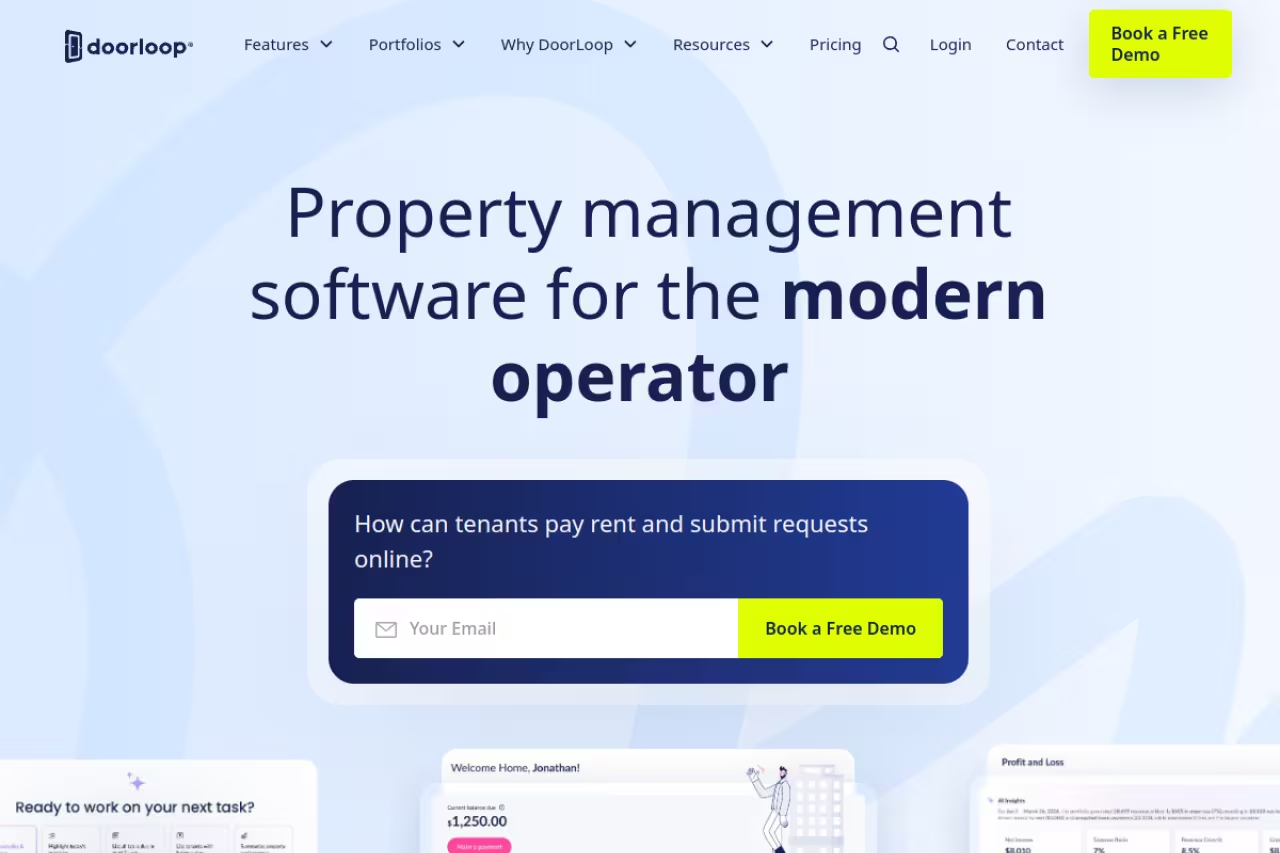
DoorLoop is the one I'd hand to a landlord or small property manager who wants everything in one place without a steep ramp. It covers online rent payments, a tenant portal, maintenance tickets, accounting, listings, and screening, and the interface doesn't make you hunt.
The thing that's changed this tool over the past year is the AI. DoorLoop's AI Assistant now handles a big chunk of routine tenant messages, and the company says property managers save around 23 hours a month using its automation. They also rolled out AI Inspections in early 2026, a mobile flow that flags issues during a walkthrough and spins them into work orders automatically. That's the kind of feature that actually returns time, not a chatbot bolted on for the press release.
Who it's best for: anyone running roughly 10 to 500 units who wants strong software without enterprise pricing.
A strong all-in-one for landlords running roughly 10 to 500 units who want capable software without enterprise pricing. The AI Assistant is the standout, but it starts on the Pro tier, and Starter caps at 10 units.
the Starter plan is $99/month, or $69/month billed yearly, capped at 10 units. Pro is $189/month ($149 yearly) and adds the AI Assistant, advanced accounting, bank sync, and QuickBooks Online. Premium is $239/month ($209 yearly) with API access, CAM reconciliation, and unlimited users.
The catch: the AI Assistant lives on Pro and up, so the cheap Starter tier is missing the feature that makes DoorLoop special. And the 10-unit cap on Starter pushes most real portfolios straight to the $149/month tier.

TurboTenant: the best free option for small landlords
If you own a few doors and balk at paying a monthly subscription, TurboTenant is the tool I point people to. The free plan is real, not a crippled demo. You get listing syndication, tenant screening with credit and background reports, online applications, messaging, rent collection, and maintenance requests at no monthly cost.
The model is simple: TurboTenant makes money on add-ons and tenant-paid fees, so the landlord side stays free. For someone managing 1 to 20 units who mostly needs to fill vacancies and collect rent, that's hard to beat.
Who it's best for: budget-conscious landlords with small portfolios who don't need full trust accounting.
The tool to pick if you own a few doors and refuse a monthly subscription. The free plan is real, covering screening, rent collection and listings for 1 to 20 units, but accounting is light and larger portfolios will outgrow it.
free forever for core features. The Premium tiers run on an annual basis. Essentials lands roughly between $149 and $349 per year, and Pro (which adds accounting tools) ranges from about $199 up to $999 per year depending on how many units you manage.
Where it falls short: the accounting is light compared to Buildium or DoorLoop, and some convenience features sit behind Premium or get charged to tenants. Once you grow past a couple dozen doors or hire staff, you'll outgrow it.

Buildium: the best for accounting-heavy managers
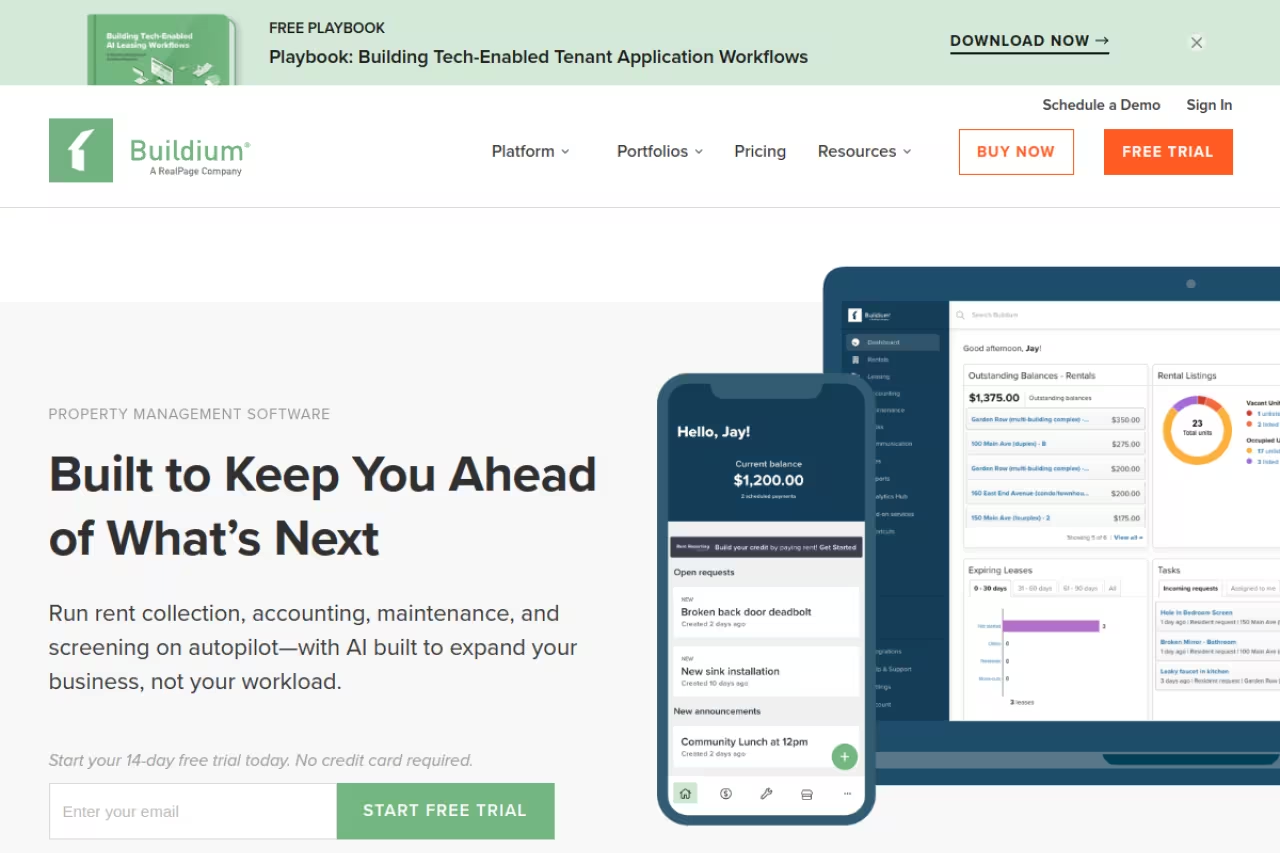
Buildium has been a default for residential and community-association managers for years, and the reason is the books. Its double-entry accounting, bank reconciliation, and reporting are built for people who answer to owners and need clean financials, not just a rent tracker. If accounting is the part of the job that keeps you up at night, this is the strongest mid-market option.
It also handles the operational side well: leasing, maintenance, tenant and owner portals, and an AI assistant that's improved through 2026. For a firm that manages on behalf of multiple owners, the owner-statement and reporting tools alone justify the seat.
Who it's best for: property managers scaling from SMB to mid-market who put accounting first.
The strongest mid-market option for property managers scaling from SMB who put accounting first, with double-entry books and solid owner reporting. The cheap Essential tier is basic, and Growth and Premium require paid onboarding.
the Essential plan starts at $62/month, Growth at $192/month, and Premium at $400/month. There's a 14-day free trial with no card required, and custom pricing kicks in above 5,000 units.
The catch: the cheap tier is genuinely basic, and the features most growing firms want (better screening, lower-cost e-signatures, business analytics) live on Growth at $192. Growth and Premium also require paid onboarding, so your real first-month cost is higher than the sticker.

AppFolio: the best for larger firms
Once you cross a few hundred units, the small-landlord tools stop scaling and AppFolio becomes the conversation. It's an enterprise platform with strong automation, full mobile functionality, integrated accounting and operations, and in 2026 the highest user-adoption scores among the big players in G2's grid reports. The onboarding and AI-driven workflows are built for teams, not solo owners.
Who it's best for: professional management firms and larger portfolios that need one system across residential, commercial, and operations.
Built for professional management firms and larger portfolios that need one system across residential, commercial and operations. Below roughly 200 units the monthly minimums make it a bad deal, so small landlords should look elsewhere.
AppFolio charges per unit with monthly minimums. The Core plan runs about $1.49 per unit per month with a $298 monthly minimum (so you're paying for ~200 units of capacity regardless). Plus is roughly $3.20 per unit with a $960 minimum, and Max sits near $5 per unit with a $7,500 minimum for very large portfolios.
Where it falls short: the minimums make AppFolio a bad deal below ~200 units, and the public pricing page hides numbers behind a quote request. It's overkill, and overpriced, for anyone running a small portfolio.
Building out a marketing or ops stack alongside your property software? Our running list of the top tools we actually use is worth a look, and if you want AI that speeds up the research, Dupple X is the assistant I lean on for comparison work like this.
Yardi Breeze: the best for mixed residential and commercial
Yardi is the giant of this industry, and Breeze is its approachable tier, sitting below the heavyweight Voyager platform. The reason to pick Breeze over a residential-only tool is commercial coverage. If your portfolio mixes apartments with retail or office space, you need CAM charges, percentage rent, and commercial lease handling, and Breeze does that on one platform without Voyager's complexity.
Who it's best for: managers with mixed residential and commercial property who want Yardi's depth at an entry price.
Choose Breeze if you mix apartments with retail or office space and want Yardi's depth at an entry price. It handles commercial leases and CAM charges, but it feels dated and moving up to Voyager means a big implementation.
residential Breeze starts around $1 per unit per month with a $100 monthly minimum. Commercial starts at $2 per unit with a $200 minimum. Breeze Premier adds more features and carries higher minimums (around $400/month). Always confirm on Yardi's site, since tiers vary by property type.
The catch: Breeze feels dated next to DoorLoop or TurboTenant, and the cheapest residential tier is light. The real Yardi power lives in Voyager, which means a much bigger implementation if you ever need to move up.
Avail: the best free portal for DIY landlords
Avail, owned by Realtor.com, is the other strong free option alongside TurboTenant, and I lean toward it when state-specific compliance matters. The free Unlimited plan covers listing syndication to 19+ sites, applications and screening, state-specific digital leases, rent collection, maintenance tracking, and a tenant portal, all at $0 per unit.
Who it's best for: hands-on landlords who self-manage and want lawyer-vetted lease templates without paying monthly.
A strong free portal for hands-on landlords who self-manage and want lawyer-vetted, state-specific leases. Stay on the free tier, because the $9 per unit Plus plan gets expensive fast and card payments carry a 3.5% fee.
the free tier covers most needs. Unlimited Plus is $9 per unit per month and adds FastPay deposits, waived ACH fees, custom application questions, editable leases, and branded property sites.
Where it falls short: the $9-per-unit Plus tier gets expensive fast as you scale, so it's really priced for landlords who stay on free. Card payments carry a 3.5% fee, and some costs land on tenants.
Hemlane: the best for remote, self-managing owners
Hemlane fills a specific gap: you want to self-manage to save the 8-10% a full property manager charges, but you don't live near your rentals. Hemlane pairs standard software (screening, rent collection, maintenance coordination) with an optional network of local agents who can handle showings and on-the-ground tasks. That hybrid is the whole point.
Who it's best for: out-of-state or remote landlords with 1 to 200 units who want partial local help without a full management contract.
Go with Hemlane if you are an out-of-state landlord with 1 to 200 units who wants local agents without a full management contract. The base price is modest, but the plans with hands-on help run $20 to $58 per unit per month on annual billing.
Hemlane has a free Starter plan. On annual billing, paid plans are a $28 monthly platform fee plus $2 per unit per month for Basic, $20 per unit for Essential (adds repair coordination and state-specific leases), or $58 per unit for Complete (adds full management help, including tenant communications). Monthly billing raises the platform fee to $34 and the per-unit prices to $2.50, $24, and $65. Each paid plan starts with a 14-day free trial.
The catch: the local-agent help and some leasing services are add-ons that can tack on $5 to $20 per unit per month, so the modest base price isn't the whole story. Read the tier breakdown closely before you commit.
How to choose the right one
Start with unit count and the type of property, because those two facts eliminate most of the list before you compare a single feature.
If you have 1 to 20 units and want free, start with TurboTenant or Avail. Pick Avail if state-specific leases and compliance matter most; pick TurboTenant if marketing and screening volume is your priority.
If you run 10 to 500 units and want one polished system, DoorLoop is my default. It's the best mix of price, usability, and AI. Choose Buildium instead if trust accounting and owner statements are the core of your job.
If you manage mixed residential and commercial, go Yardi Breeze for the commercial lease handling that residential tools skip.
If you're a remote landlord who wants local hands without a full manager, Hemlane is purpose-built for that.
If you've crossed 200+ units with staff, AppFolio earns its minimums through automation and adoption. Below that line, its pricing makes no sense.
One rule that saved me money: add up the real cost. Take the base subscription, then add screening, e-signatures, and payment processing fees, and see what a typical month actually looks like. A "cheaper" plan that nickel-and-dimes every transaction often beats a pricier one only on the sticker.
If you're assembling the rest of your real estate stack, our guides to the best CRM for real estate and best accounting software for real estate pair well with whichever platform you land on, and the best AI tools for real estate covers the newer automation worth watching.
FAQ
What is the best property management software for small landlords?
For landlords with a handful of doors, TurboTenant and Avail are the strongest picks because both have genuinely free plans that cover listings, screening, rent collection, and maintenance. If you want more polish and AI-assisted tenant communication and can spend a bit, DoorLoop's Starter plan at $69/month billed yearly is a strong step up.
Is there free property management software that's actually good?
Yes. TurboTenant and Avail both offer free tiers that are usable for real portfolios, not just demos. They make money through tenant-paid fees and optional add-ons rather than landlord subscriptions. The trade-off is lighter accounting and fewer automation features than paid platforms like Buildium or DoorLoop.
How much does property management software cost?
It ranges widely. Free tools like TurboTenant and Avail cost $0/month for landlords. Mid-market platforms like DoorLoop and Buildium start around $62-$99/month and scale with features. Enterprise tools like AppFolio and Yardi charge roughly $1-$5 per unit per month with monthly minimums from $100 to $7,500, which only make sense at larger unit counts.
DoorLoop vs Buildium: which should I choose?
Choose DoorLoop if you want the easiest interface, strong AI tenant tools, and a lower entry price. Choose Buildium if accounting is your priority, since its double-entry bookkeeping and owner-statement reporting are deeper. Both serve small-to-mid managers well, so it often comes down to whether usability or financial depth matters more to your day.
What property management software do large companies use?
Large firms typically run AppFolio, Yardi Voyager, or Entrata. These are enterprise platforms built for hundreds or thousands of units with full automation, commercial lease handling, and dedicated support. AppFolio leads on ease of use and user adoption in 2026 industry reports, while Yardi Voyager is favored for complex commercial and mixed portfolios.
Whichever you choose, run a free trial with a real test property before you migrate. The right tool should disappear into the background and give you your weekends back. Try Dupple X free if you want an AI assistant to speed up the comparison and migration research while you decide.
Related guides
Some offers on this page may be paid placements or contain affiliate links.
