
The Best Procurement Software in 2026: 8 Tools I'd Actually Recommend

Key facts8 tools compared: Ramp, Procurify, Zip, Precoro, Coupa, Tipalti, SAP Ariba, Spendflo
- 8 tools compared: Ramp, Procurify, Zip, Precoro, Coupa, Tipalti, SAP Ariba, Spendflo
- Ramp (best for: Finance teams wanting spend in one platform): Free; paid from $15/user/mo
- Procurify (best for: Real-time budget control for mid-market): From ~$12/user/mo (custom on site)
- Zip (best for: Cross-functional intake (legal, IT, security)): Custom, ~$40K-120K/yr
- Precoro (best for: SMBs wanting flat, predictable pricing): From $499/mo (annual)
Procurement software has a reputation problem. For years it meant six-figure contracts, year-long rollouts, and a system so clunky that employees routed around it with credit cards and email threads. That gap between "what we bought" and "what people actually use" is where most spend leaks out.
The good news in 2026: the category split open. AI now reads your contracts, drafts your purchase orders, and routes approvals to finance, legal, and IT in parallel instead of one inbox at a time. You no longer need an SAP-sized budget to get real spend control. A 40-person startup can stand up intake-to-pay in a week.
If you want the short answer, my top pick for most teams is Ramp because it ties procurement to cards and bill pay in one place and starts free. If you need deep purchasing controls and budgets that update in real time, Procurify is the better fit. And if procurement at your company means herding legal, security, and IT through approvals, Zip was built for exactly that. The rest of this guide is for figuring out which of those situations is yours.
Quick comparison
| Tool | Best for | Price | Standout |
|---|---|---|---|
| Ramp | Finance teams wanting spend in one platform | Free; paid from $15/user/mo | Procurement + cards + bill pay together |
| Procurify | Real-time budget control for mid-market | From ~$12/user/mo (custom on site) | Live budget tracking before money moves |
| Zip | Cross-functional intake (legal, IT, security) | Custom, ~$40K-120K/yr | Parallel approval routing |
| Precoro | SMBs wanting flat, predictable pricing | From $499/mo (annual) | Transparent published pricing |
| Coupa | Large enterprise, complex spend | Custom, often $50K-500K+/yr | Agentic AI and benchmarking data |
| Tipalti | Global AP and mass payments | AP from $99/mo; procurement custom | Pays suppliers in 196 countries |
| SAP Ariba | Enterprises in the SAP ecosystem | Custom enterprise | Largest supplier network |
| Spendflo | SaaS-heavy teams wanting negotiation help | Custom | Managed SaaS buying and renewals |

Ramp
Ramp started as a corporate card and grew into a full spend platform, and that origin is its biggest advantage. Procurement, expense management, cards, and bill pay all live under one login, so an approved purchase request can turn into a virtual card or a scheduled payment without you re-keying anything into a second system.
The procurement flow is genuinely fast. AI pulls vendor details and contract terms out of an uploaded PDF, then dynamic routing sends the request to finance, IT, legal, and security at the same time. Ramp says one customer cut approvals from weeks to roughly 48 hours, and that pattern tracks with what I'd expect from parallel routing. Three-way matching validates invoices against POs and receipts and blocks payment when something doesn't line up.
Ideal for finance-led teams, from startups to mid-market, who want one tool instead of a stack of four, with a genuinely free tier and parallel approval routing. It leans on financial automation over deep sourcing and is US-centric, so formal RFP shops will feel the ceiling.
there's a genuinely free tier, and paid plans (Ramp Plus and up) start around $15 per user per month. Advanced procurement features mean a sales conversation.
The standout: the connective tissue. When your card data, bills, and POs share one ledger, reconciliation stops being a monthly fire drill.
The catch: Ramp leans on financial automation more than deep sourcing. If you run formal RFPs, manage complex supplier scorecards, or need detailed contract lifecycle management, you'll feel the ceiling. It's also US-centric, so global teams should check coverage before committing.

Procurify
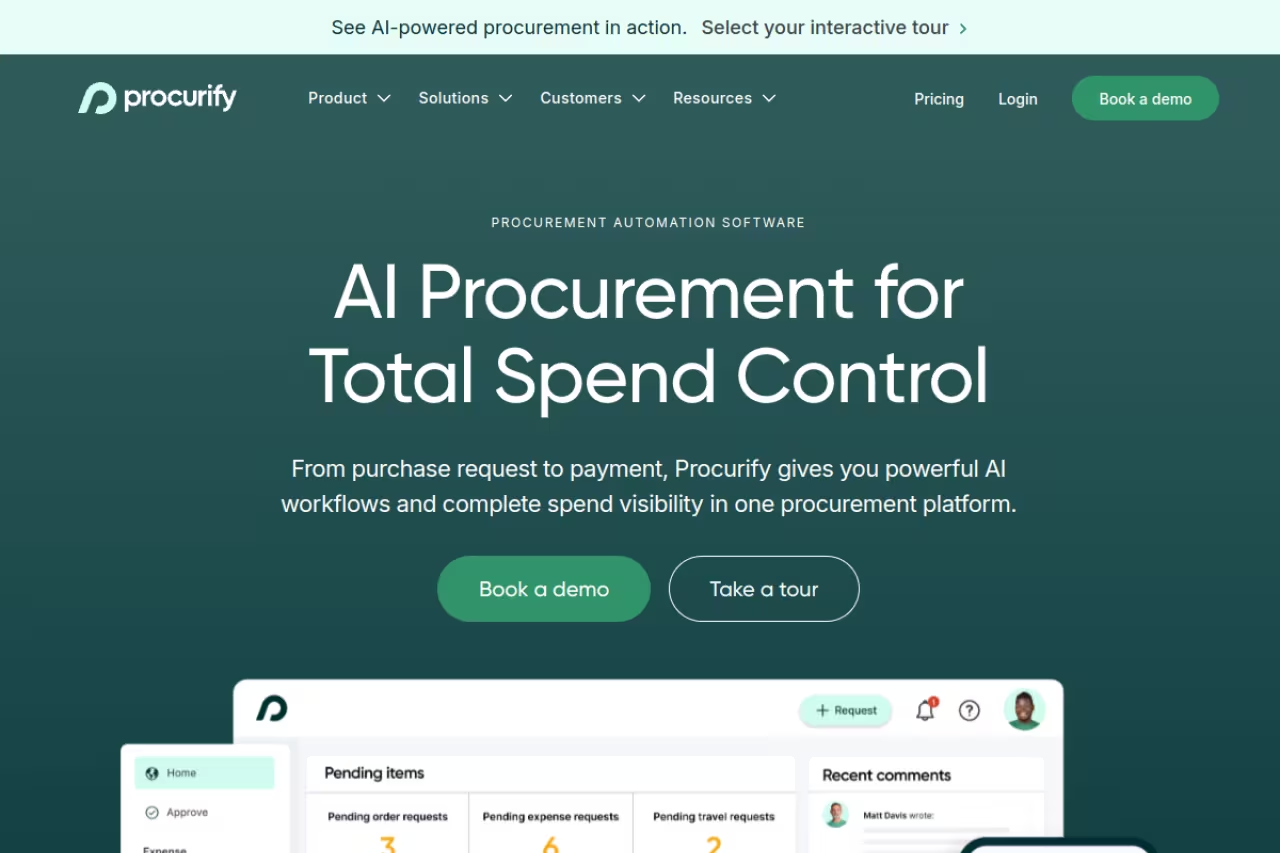
Procurify sits in the sweet spot between a credit-card app and an enterprise suite. Its core idea is that you should see whether a purchase fits the budget before you approve it, not three weeks later when finance closes the books. Budgets update in real time as requests move through the system, which makes it a favorite of operations and finance teams who hate end-of-month surprises.
The platform is modular. You start with the Procurify Platform plus Purchasing, then bolt on Accounts Payable, Contracts, or an Expense and Card module as you grow. The AP module does AI invoice processing and automated matching, and the Contracts add-on tracks renewals so you stop auto-paying for software nobody opens.
Fits mid-market companies that need approval controls and live budget visibility without an enterprise rollout. Entry plans run around $12 to $39 per user per month plus an implementation fee, so it is pricier than a card-first tool for very small teams.
Procurify moved to custom quoting on its site, but third-party listings put entry plans around $12 to $39 per user per month billed annually, plus a one-time implementation fee. Budget for the setup cost, not just the seats.
The standout: real-time budget tracking. Spending against a live number, not a stale spreadsheet, is the feature people keep using.
Where it falls short: the per-user pricing and implementation fee make it pricier than a card-first tool for very small teams, and some users find the reporting less flexible than they'd like once they outgrow the defaults.
Zip
Zip attacks a specific pain: the moment an employee wants to buy something and has no idea who needs to approve it. Zip is an intake-to-procure platform, which means its whole job is turning a messy request into a clean, routed workflow. A single intake form collects what's needed, then routes the request through finance, legal, IT, and security based on rules you set, in parallel.
This is the tool for companies where buying anything touches four departments. No-code workflow design, automated vendor onboarding with due-diligence checks, and native Slack and Teams integration mean requests happen where people already work instead of in a portal they avoid. It plays nicely alongside your ERP and AP tools rather than trying to replace them.
The tool for larger, fast-scaling companies where buying anything touches four departments, and it removes approval bottlenecks better than anything else here. Third-party estimates run $40,000 to $120,000 per year, and it is intake first, so pair it with an AP tool.
custom only. Third-party estimates land in the $40,000 to $120,000 per year range depending on scale, with entry points reported above $1,000. This is not an SMB budget.
The standout: orchestration. If approvals are your bottleneck, Zip removes it better than anything else here.
The catch: Zip is intake and orchestration first. It is not a full procure-to-pay suite on its own, so you'll likely pair it with a payments or AP tool. For a small team with simple approvals, it's overkill.
If wrangling tools and approvals across a team is eating your week, a curated stack helps. Our team uses Dupple X to keep the AI side of that workflow sharp.

Precoro
Precoro earns a spot for one reason a lot of buyers care about: it publishes its prices. The Core plan is $499 per month billed annually, Automation is $999, and there's a standalone AP module at $499. No "request a demo to learn the number" dance.
Core covers requisitions, POs, receipts, two- and three-way matching, custom approval workflows, and vendor management, with integrations to QuickBooks Online, Xero, and Slack. Step up to Automation and you get AI document scanning, e-invoicing, intake management, a supplier portal, RFPs, and an AI assistant.
Pick Precoro if you are an SMB or mid-market team that wants predictable, flat pricing and a quick rollout: Core is $499 per month billed annually, published openly. It is less of an all-in-one platform than Ramp, so cards and payments are not its strength.
The standout: transparency and value. Flat monthly pricing that doesn't scale punishingly with headcount is rare in this category.
Where it falls short: it's less of an all-in-one financial platform than Ramp, so cards and payments aren't its strength. Heavy enterprise users may want deeper analytics than the lower tiers provide.

Coupa
Coupa is the heavyweight, a business spend management platform covering procurement, invoicing, sourcing, and expense management for large, multi-entity organizations. In 2026 it pushed hard into agentic AI: at its Inspire conference it launched Coupa Compose and Navi Agent Studio, a no-code way to build AI agents for tasks like sanctions risk and scenario ranking.
Coupa's real moat is data. It benchmarks your spend against anonymized transaction data across its customer base, which surfaces savings you can't see from inside your own numbers.
The heavyweight for large enterprises with complex, high-volume, multi-entity spend, with benchmarking against anonymized transaction data as its moat. At commonly $50,000 to $500,000+ per year it is more platform than most need, and implementations are long.
custom and modular, commonly $50,000 to $500,000+ per year depending on modules and volume. It now uses outcome-based pricing for some offerings.
The catch: cost and complexity. For anyone under a few hundred million in revenue, Coupa is usually more platform than you need, and implementations are long. Don't buy it to control a small team's software spend.

Tipalti
Tipalti is the answer when paying suppliers is the hard part. It combines procurement, AP automation, and global mass payments across 196 countries and 120 currencies, which makes it a fit for marketplaces, agencies, and any business with a long international vendor list.
The AP automation is strong: AI Smart Scan for invoices, a supplier portal for self-onboarding, W9/W8 collection, TIN validation, and tax compliance baked in. Procurement is available on higher tiers.
The answer when paying suppliers is the hard part, with global payments across 196 countries and strong AP automation. Starter begins at $99 per month for AP only, and procurement is secondary, so read the per-transaction fees closely.
the Starter plan begins at $99 per month for core AP, but that doesn't include procurement. Premium and Elite, which unlock procurement and multi-entity support, are custom, and there's a setup fee plus per-transaction costs on some payment methods.
Where it falls short: procurement is secondary to payments here, and the entry price only buys AP basics. Read the per-transaction fees closely before you sign.
SAP Ariba
SAP Ariba remains the default for enterprises already living in the SAP ecosystem. Its supplier network is the largest in the industry, which matters if your sourcing depends on reaching a wide vendor pool. Source-to-pay, supplier management, and contract management are all mature.
The default for large enterprises already running SAP ERP, with the industry's largest supplier network. It carries enterprise baggage of long implementations and a dated UI, and outside the SAP world you'd likely be happier with a more modern tool.
custom enterprise quoting only, in the same range as Coupa.
The catch: it carries every bit of enterprise-software baggage you'd expect. Long implementations, a steep learning curve, and a UI that feels its age. Outside the SAP world, the integration advantage mostly evaporates, and you'd likely be happier with a more modern tool.
Spendflo
Spendflo takes a different angle: it's a procurement platform with a managed buying service attached. For SaaS-heavy companies, its team will negotiate renewals and new contracts on your behalf, often clawing back enough to cover the subscription. The software side handles intake, approvals, and renewal tracking.
For teams whose biggest spend category is software and who'd rather outsource the haggling, since its team negotiates renewals on your behalf. It is narrower than the full P2P suites, and light software buyers won't see the same return.
custom, based on the volume of spend under management.
Where it falls short: it's narrower than the full P2P suites here, and the value depends on how much SaaS spend you actually run through it. Light software buyers won't see the same return.
How to choose
Match the tool to your actual bottleneck, not to a feature checklist.
- Your problem is reconciliation and scattered spend. Pick Ramp. One platform for cards, bills, and POs kills the monthly cleanup.
- Your problem is going over budget before anyone notices. Pick Procurify. Real-time budget tracking stops the leak at the request stage.
- Your problem is approvals that touch legal, IT, and security. Pick Zip. Parallel routing is its entire reason to exist.
- Your problem is paying global suppliers. Pick Tipalti.
- Your problem is software renewals you keep overpaying. Pick Spendflo.
- You want a flat, knowable price. Pick Precoro.
- You're a true enterprise with multi-entity complexity. Coupa or SAP Ariba, and budget for a long rollout.
One more rule: run a real pilot with real purchase requests before you sign anything annual. The demo always looks clean. Your messy approval chain is the actual test.
If you're building out the rest of your operations stack too, our guides on the best AI agents and top AI tools pair well with this one, and you can browse categories at Dupple's tools directory.
FAQ
What is the best procurement software for small businesses?
For most small businesses, Ramp is the strongest starting point because it has a free tier and combines procurement with cards and bill pay. If you want flat, published pricing instead of a sales call, Precoro at $499 per month is a solid alternative. Both avoid the long implementations that enterprise tools require.
How much does procurement software cost in 2026?
It ranges widely. Entry tools like Ramp start free or around $15 per user per month, while mid-market platforms like Procurify run roughly $12 to $39 per user per month. Enterprise suites such as Coupa and SAP Ariba use custom pricing that commonly lands between $50,000 and $500,000 per year depending on modules and transaction volume.
What's the difference between procurement software and procure-to-pay (P2P)?
Procurement software covers the buying side: intake, approvals, purchase orders, and sourcing. Procure-to-pay extends that all the way through to paying the supplier, adding AP automation, invoice matching, and payments. Tools like Tipalti and Coupa cover full P2P, while Zip focuses on the intake and approval portion and pairs with a payments tool.
Do I need procurement software if I already use accounting software?
If purchases routinely slip through on personal cards or untracked emails, yes. Accounting software records spend after it happens, while procurement software controls it before money moves through approvals and budget checks. The two integrate, so good procurement tools sync POs and invoices into QuickBooks, Xero, or NetSuite.
Which procurement tools have the best AI features in 2026?
Coupa leads on agentic AI with its Compose platform and no-code agent builder, plus benchmarking against anonymized spend data. For smaller teams, Ramp's AI intake (pulling vendor and contract details from a PDF) and Precoro's AI document scanning and assistant deliver the most practical day-to-day automation without enterprise pricing.
If you want spend visibility without a six-month rollout, start with a free or low-commitment tool like Ramp or a transparent one like Precoro, pilot it on real requests, and only graduate to an enterprise suite when complexity forces your hand. And if you're sharpening the AI tooling behind your team's workflows, Dupple X is worth a look.
Related guides
Some offers on this page may be paid placements or contain affiliate links.
