
Best OKR Software in 2026: 8 Tools Compared for Goal-Setting That Sticks

Key facts8 tools compared: Weekdone, Lattice, Mooncamp, Perdoo, Leapsome, WorkBoard, 15Five, ClickUp
- 8 tools compared: Weekdone, Lattice, Mooncamp, Perdoo, Leapsome, WorkBoard, 15Five, ClickUp
- Weekdone (best for: Small/mid teams wanting weekly cadence): Free for 3 users, then ~$10.80/user/mo
- Lattice (best for: OKRs tied to performance reviews): $8/seat/mo (Goals module)
- Mooncamp (best for: Modern, flexible setup, MS Teams users): ~$8/user/mo
- Perdoo (best for: Budget teams that want strategy maps): Free for 5 users, then €8/user/mo
Most OKR rollouts die in a spreadsheet. Someone sets objectives in Q1, the tab gets buried, and by Q3 nobody can tell you what the company is actually trying to do. The tool you pick decides whether OKRs become a rhythm or a forgotten document.
I compared eight of the most popular OKR platforms on their pricing pages, documentation, and public user reviews. The gap between them is bigger than the marketing suggests. Some are dedicated goal engines with weekly cadence built in. Others bolt OKRs onto a project tool or an HR suite, which works until you need a real alignment view.
If you want the short answer: Weekdone is my pick for small and mid-size teams that want a focused OKR tool with weekly check-ins, and it is free for up to 3 users. If you need OKRs tied to performance reviews and engagement, Lattice is the stronger buy. This guide is for founders, ops leads, and people teams who are tired of goals that don't move. Here is how the eight stack up.
Quick comparison
| Tool | Best for | Price | Standout |
|---|---|---|---|
| Weekdone | Small/mid teams wanting weekly cadence | Free for 3 users, then ~$10.80/user/mo | Built-in weekly check-ins |
| Lattice | OKRs tied to performance reviews | $8/seat/mo (Goals module) | People + goals in one place |
| Mooncamp | Modern, flexible setup, MS Teams users | ~$8/user/mo | Custom dashboards, Teams native |
| Perdoo | Budget teams that want strategy maps | Free for 5 users, then €8/user/mo | Strategy maps + KPI tracking |
| Leapsome | People enablement beyond goals | $8+/user/mo per module | Modular HR + OKR suite |
| WorkBoard | Large enterprises, agentic AI | Custom quote | Microsoft Copilot OKR agent |
| 15Five | Performance-first orgs | $11/user/mo (Perform) | Reviews + OKRs + check-ins |
| ClickUp | Teams already living in ClickUp | Free, paid from $7/user/mo | OKRs inside your project tool |

Weekdone: best for focused weekly cadence
Weekdone is one of the few tools built around the idea that OKRs only work if you check in every week. It pairs quarterly objectives with a weekly PPP structure (Plans, Progress, Problems), so the goal and the work that feeds it sit in the same view. That sounds small. In practice it is the difference between OKRs you set and OKRs you actually run.
Who it's best for: small and mid-size teams, especially startups that want a real OKR tool without the weight of an HR platform.
Pick it if you want OKRs you actually run, thanks to its weekly Plans, Progress, Problems check-in rhythm, free for up to 3 users. It is opinionated, so a team that dislikes the weekly rhythm will fight it, and it tops out for large enterprises.
free for up to 3 users, which is genuinely usable, not a crippled demo. Paid plans start around $10.80 per user per month and scale down as you add seats, per Weekdone's pricing. They run on a sliding scale, so a 25-person team pays less per head than a 5-person one.
The standout: the weekly check-in flow. You get automated reminders, a team dashboard showing who updated what, and a clean traffic-light view of which objectives are on track. The newsfeed keeps everyone honest without a meeting.
The catch: it is opinionated. If your team doesn't want the weekly PPP rhythm, you are paying for a feature you'll fight against. It also tops out fast for large enterprises that need deep custom permissions and multi-level cascading.

Lattice: best when OKRs live next to performance
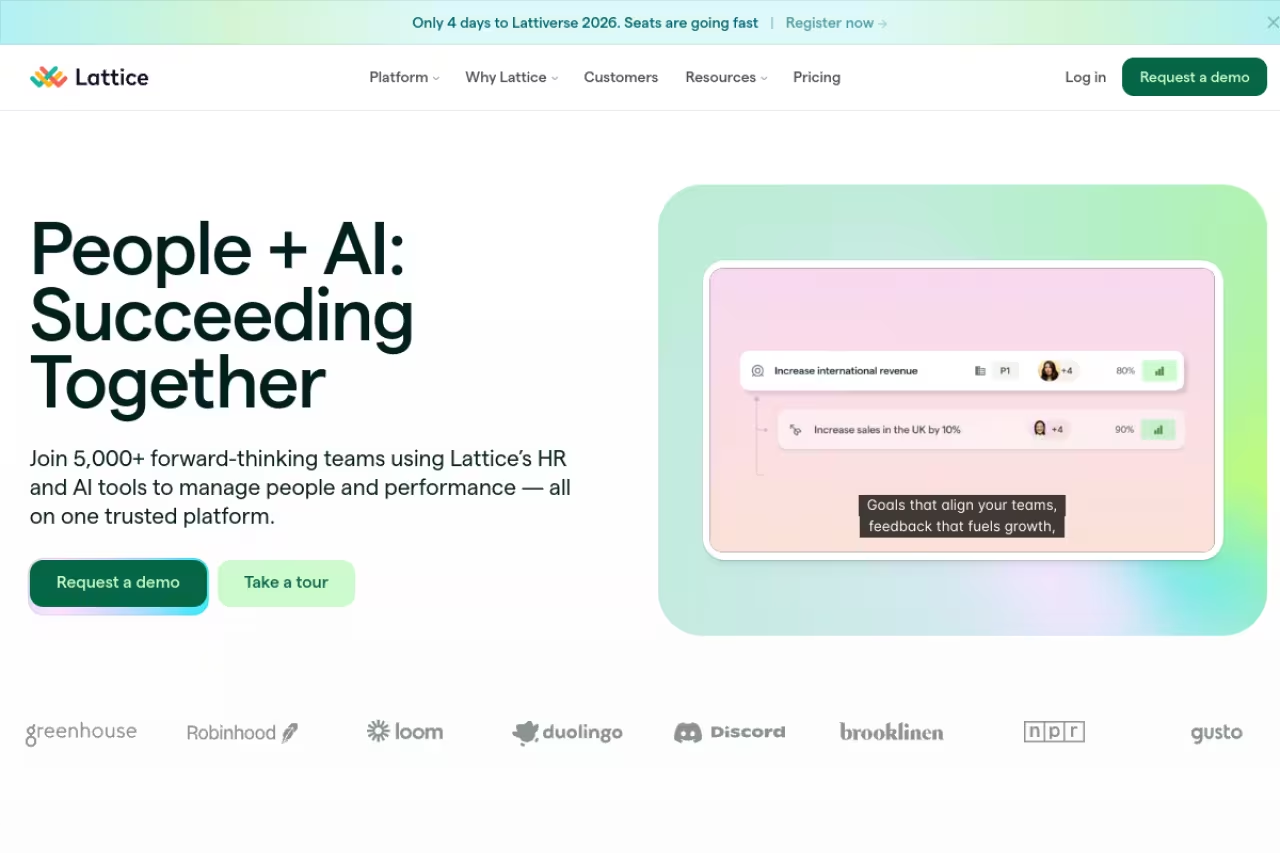
Lattice treats goals as one piece of a people platform. Objectives connect to performance reviews, 1:1s, feedback, and engagement surveys, so a manager can see a report's goals and their review history in the same place. For companies where OKRs and performance are the same conversation, that integration is worth a lot.
Who it's best for: mid-market and growing companies with a real HR or people-ops function that wants goals and reviews under one roof.
The right choice when OKRs and performance are the same conversation, with cascading goals tied to reviews and 1:1s. The $4,000 annual minimum and modular pricing add up, so it is wrong for tiny teams that only want OKRs.
the Goals & OKRs module is $8 per seat per month on annual billing, with Performance at another $8 and Engagement at $4, per Lattice's pricing page. There is a $4,000 annual minimum, so it is not built for tiny teams.
The standout: cascading goals that roll up cleanly from individual to team to company, plus an analytics layer that ties goal progress to performance data. The Salesforce and Jira integrations mean sales and engineering goals can pull real numbers.
The catch: the $4,000 floor and the modular pricing add up. Buy Goals, Performance, and Engagement together and you're at $20 per seat before add-ons like Compensation. For a team that only wants OKRs, you're paying for an ecosystem you may not use yet.

Mooncamp: best modern, flexible setup
Mooncamp is the one that felt the least dated. The interface is clean, setup is fast, and the dashboards are genuinely customizable instead of locked to one template. Its Microsoft Teams integration is the deepest on this list, which matters if your company runs on Teams rather than Slack.
Who it's best for: startups and growing companies that want a modern tool, plus any org standardized on Microsoft 365.
A modern, flexible option for startups and Microsoft 365 organizations, with the deepest Teams integration on this list. It is younger than Lattice or WorkBoard, so the integration library is thinner outside the Microsoft world.
starts around $8 per user per month on a freemium model. There are three tiers, and the entry plan covers the core OKR workflow for small teams. Check Mooncamp's pricing for the current breakdown since it varies by currency.
The standout: flexible cascading and custom check-in cadences. You can run OKRs your way (top-down, bottom-up, or a mix) and the dashboards adapt. The Teams app lets people update goals without leaving chat.
The catch: it is younger than Lattice or WorkBoard, so the integration library is thinner outside the Microsoft world. If your stack is Slack plus a dozen niche tools, you may hit gaps.
If you're building a stack of AI-era tools to run your team, our Dupple X bundle pairs nicely with whatever OKR tool you land on.

Perdoo: best budget option with strategy maps
Perdoo packs more into its free tier than almost anyone. The free plan covers up to 5 users and includes strategy maps, OKR and KPI tracking, check-ins, 1:1s, pulse surveys, and Slack and Teams integrations. That is a lot of capability for zero dollars.
Who it's best for: budget-conscious teams that want strategy visualization, not just goal tracking.
The budget pick for teams that want strategy maps, with a free plan for up to 5 users that is unusually capable. The jump to paid is steep, and the 10-license minimum means a 6-person team pays for 10 seats.
free for 5 users, then €8 per user per month on the Premium plan with a 10-license minimum, so a floor of €80 per month, per Perdoo's pricing. Premium adds performance dashboards, SSO/SCIM, and data export.
The standout: strategy maps. Most OKR tools only show you objectives. Perdoo connects your long-term strategic pillars to the quarterly OKRs underneath them, which helps leadership see whether the day-to-day work actually serves the strategy.
The catch: the jump from free to paid is steep, and the 10-license minimum means a 6-person team pays for 10 seats. The free tier is so capable that some teams never feel a reason to upgrade, which tells you the paid value is narrower than it looks.

Leapsome: best for people enablement beyond goals
Leapsome sells OKRs as one module in a wider people-enablement suite that includes reviews, 360s, learning, engagement surveys, and compensation. The à la carte model lets you start with Goals and expand into adjacent workflows later.
Who it's best for: HR-led organizations that want goals as the entry point into a broader performance and development platform.
Choose it if an HR-led organization wants goals as the entry point into reviews, learning and engagement from one vendor. As a pure OKR tool it is less specialized than Weekdone or Mooncamp, and modular pricing climbs.
starts at $8 per person per month, modular, so your real cost depends on which modules you switch on. Pricing is quote-based for the full suite.
The standout: the breadth. If you want OKRs, performance reviews, learning paths, and engagement surveys from one vendor, Leapsome covers all of it with a consistent interface. The goal module connects individual objectives to company goals with visual dashboards.
The catch: as a pure OKR tool it is less specialized than Weekdone or Mooncamp. You're buying it for the suite, not the goal engine. And modular pricing has a way of climbing once you add the modules that make the platform worth it.

WorkBoard: best for large enterprises
WorkBoard is the enterprise heavyweight, and it got heavier in 2025 when it acquired Quantive, the other major enterprise OKR player. The two are merging under the WorkBoard brand, with Quantive customers folded in over time. Its customer list reads like a Fortune 500 directory: Boeing, Cisco, Capital One, Unilever.
Who it's best for: large enterprises running strategy execution across thousands of people who need agentic AI, deep integrations, and serious change management support.
The enterprise heavyweight for large organizations that want agentic AI, Microsoft Copilot and Workday integration, and change management support. It is quote-only and overkill for small teams, and the Quantive merger adds uncertainty for those customers.
custom quote only, billed annually, typically with multi-year minimums. There is no public price and no meaningful free tier.
The standout: WorkBoardAI and the Microsoft Copilot agent that brings OKRs directly into Microsoft 365, plus the Workday integration. For a company that lives in those tools, having OKRs surface inside Copilot is a real adoption lever.
The catch: it is overkill for small teams, and the custom-quote model means you can't even price it without a sales call. The Quantive merger also adds uncertainty if you were a Quantive customer, since you're being migrated to a different product.

15Five: best for performance-first orgs
15Five comes at OKRs from the performance-management side. Its Perform plan bundles reviews, 360-degree feedback, OKRs, check-ins, and 1-on-1 agendas, so goals sit inside a continuous-performance workflow rather than standing alone.
Who it's best for: companies that prioritize manager-employee cadence and reviews, with OKRs as a supporting layer.
Pick it when performance and manager-employee cadence come first and OKRs are a supporting layer, built on a proven weekly check-in habit. If goal alignment and cascading are your main need, a dedicated tool goes deeper.
the Perform plan is $11 per user per month on annual billing. The cheaper Engage plan is $4 and the Total Platform is $16, per 15Five's pricing. AI tools and compensation modules cost extra.
The standout: the weekly check-in plus 1-on-1 structure. 15Five built its name on the "15 minutes to write, 5 to read" weekly update, and that habit-forming cadence is its real strength. OKRs ride on top of an engagement engine that already works.
The catch: OKRs are not the headline. If goal alignment and cascading are your main need, a dedicated tool will go deeper. You're buying 15Five for the performance and engagement layer first.

ClickUp: best if you already live in it
ClickUp is a project-management suite with Goals baked in. If your team already runs tasks, docs, and sprints in ClickUp, adding OKRs there means no new login and your goals link directly to the work.
Who it's best for: teams already standardized on ClickUp who want lightweight OKR tracking without buying another tool.
A fine choice if your team already lives in ClickUp, since goals link directly to the work with no new login. Goals is a side feature that lacks structured check-ins and alignment views, so it is thin for a company-wide rollout.
the Free Forever plan exists, Unlimited is $7 per user per month, and Business is $12, per ClickUp's pricing. ClickUp Brain AI is a $9-per-user add-on.
The standout: zero context-switching. Goals connect to the tasks that drive them, so progress can update automatically as work gets done. For a team that hates app-hopping, that is the whole pitch.
The catch: ClickUp Goals is a side feature, not a real OKR system. It lacks structured check-ins, goal-level comments, alignment network views, and a health dashboard. Fine for a small team, thin for a serious company-wide rollout.
How to choose
Skip the feature checklists and answer three questions.
First, is this a goals problem or a performance problem? If you just need company-wide alignment and weekly cadence, buy a dedicated OKR tool: Weekdone, Mooncamp, or Perdoo. If goals are inseparable from reviews and engagement, buy a people platform: Lattice, Leapsome, or 15Five.
Second, how big are you? Under 5 people, start free with Weekdone or Perdoo. 20 to 500, the $8-per-seat dedicated tools hit the sweet spot. Thousands of employees with formal strategy execution, that's WorkBoard territory and the sales call that comes with it.
Third, where does your team already work? If you're a Microsoft 365 shop, Mooncamp or WorkBoard surface OKRs inside Teams and Copilot. If you live in ClickUp, its Goals feature may be enough to start. Adoption beats features. The best OKR tool is the one your team will actually open on a Monday.
A final note: whatever you pick, the tool is 20% of the job. The other 80% is writing good objectives, keeping the cadence, and not setting 15 goals per person. Buy for the workflow you'll sustain, not the dashboard that looks best in the demo. For more on building an AI-era operating stack, see our roundups of the best AI tools and the best AI agents for running lean teams.
FAQ
What is the best OKR software for small teams?
For small teams, Weekdone and Perdoo lead because both have real free tiers (3 and 5 users respectively) and focus on the OKR workflow rather than a heavier HR suite. Weekdone is the better pick if you want a strong weekly check-in rhythm. Perdoo wins if you want strategy maps and KPI tracking on the free plan.
Is there free OKR software?
Yes. Weekdone is free for up to 3 users, Perdoo is free for up to 5 users with a surprisingly full feature set, and ClickUp has a Free Forever plan with basic Goals. For a tiny team testing the OKR habit, any of these gets you started at zero cost before you commit to a paid plan.
How much does OKR software cost per user?
Dedicated mid-market OKR tools run roughly $7 to $12 per user per month on annual billing. Lattice Goals and Mooncamp sit around $8, ClickUp Unlimited is $7, and 15Five Perform is $11. Enterprise platforms like WorkBoard are custom-quote only and typically cost more, with multi-year minimums.
What happened to Quantive?
WorkBoard acquired Quantive (formerly Gtmhub) in May 2025. The two products are merging under the WorkBoard brand, and Quantive customers are being moved onto the WorkBoard platform over time. If you were evaluating Quantive as a standalone tool, you should now look at WorkBoard or a different vendor.
Do I need dedicated OKR software or can I use a project tool?
If OKRs are a core operating ritual for your company, a dedicated tool pays off through structured check-ins, alignment views, and health dashboards that project tools lack. If you only need light goal tracking and already run on ClickUp or a similar suite, its built-in Goals feature can be enough to start. Upgrade to a dedicated tool when cadence and alignment start to break down.
Which OKR tool is best for Microsoft Teams users?
Mooncamp has the deepest native Microsoft Teams integration among the tools on this list, letting people update goals without leaving chat. At the enterprise level, WorkBoard offers an OKR agent for Microsoft Copilot that brings objectives directly into Microsoft 365, which is a strong fit for large organizations standardized on Microsoft.
Related guides
Some offers on this page may be paid placements or contain affiliate links.
Across our whole catalogue the median is $24 a month and 33% of tools advertise a free tier. Figures are the lowest recurring monthly price quoted in our own review of each tool, read on 2026-08-19. Full method and every category.
