
Best Fund Accounting Software (2026)

Key facts7 tools compared: Aplos, MIP Fund Accounting, Sage Intacct, MonkeyPod, RestrictedBooks…
- 7 tools compared: Aplos, MIP Fund Accounting, Sage Intacct, MonkeyPod, RestrictedBooks, Blackbaud Financial Edge NXT, Xero
- Aplos (best for: Small/mid nonprofits & churches): From $79/mo
- MIP Fund Accounting (best for: Government, K-12, large nonprofits): Custom quote
- Sage Intacct (best for: Large, multi-entity nonprofits): ~$15k+/yr
- MonkeyPod (best for: Orgs wanting accounting + CRM in one): From $167/mo
Regular accounting software answers one question: did we make money? Fund accounting answers a harder one: did every restricted dollar go where the grantor said it had to? That distinction is the whole game for nonprofits, churches, school districts, and government agencies, and it is exactly where QuickBooks and Xero start to creak.
A real fund accounting system treats each fund as its own self-balancing set of books. You can hand a board treasurer a clean answer to "how much is left in the capital campaign fund?" without exporting to a spreadsheet and hoping the formulas hold. Come audit season, it spits out a Statement of Financial Position and a Statement of Activities your CPA will actually accept. That architecture is the line between true fund accounting and the class-and-location workarounds most general ledgers offer.
I compared the last few weeks' worth of pricing pages, documentation and public user reviews for these tools, from $20-a-month plug-ins to enterprise platforms built for $10M+ budgets. If you want the short answer: Aplos is the best fund accounting software for most small and mid-sized organizations, because it does genuine restricted-fund tracking without the enterprise price tag. But the right pick depends on your size, your auditor, and whether you're chasing federal grants. Here's the full rundown.
Quick comparison
| Tool | Best for | Price | Standout |
|---|---|---|---|
| Aplos | Small/mid nonprofits & churches | From $79/mo | Purpose-built fund accounting |
| MIP Fund Accounting | Government, K-12, large nonprofits | Custom quote | FASB + GASB compliance built in |
| Sage Intacct | Large, multi-entity nonprofits | ~$15k+/yr | Dimensions-based grant tracking |
| MonkeyPod | Orgs wanting accounting + CRM in one | From $167/mo | Flat-rate, unlimited users |
| RestrictedBooks | Lean nonprofits on a tight budget | From $20/mo | Cheapest true fund accounting |
| Blackbaud Financial Edge NXT | Large orgs needing donor + finance | Custom quote | Deep Raiser's Edge integration |
| Xero | Tiny orgs with simple restricted needs | ~$22/mo (nonprofit rate) | Cheap, clean, well-supported |

Aplos: the best fund accounting software for most organizations
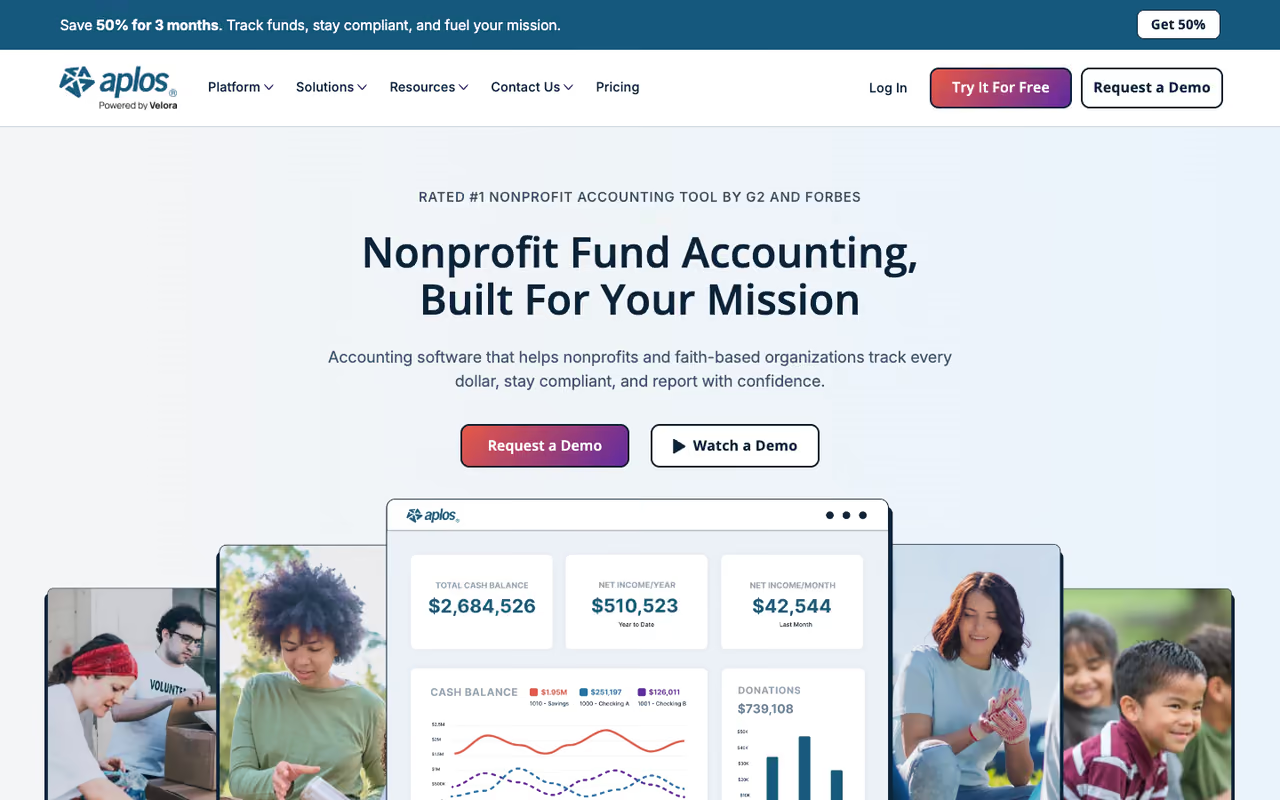
Aplos was built from the ground up for nonprofits and churches, and it shows. Every transaction is tagged to a fund, so restricted and unrestricted money stay separated automatically instead of by hand. You get donor management, online giving forms, and FASB-ready reports in the same place, which means a small finance team isn't stitching three products together.
Who it's best for: small and mid-sized nonprofits, churches, and foundations that need real fund accounting but don't have a controller on payroll.
A strong default for small and mid-sized nonprofits, churches and foundations that need real fund accounting without a controller, with fund tagging, giving tools and FASB-ready reports. Lite starts at $79/month, but larger organisations with dozens of federal grants will find it light.
Pricing runs in three tiers per the Aplos pricing page: Lite at $79/month covers core fund accounting, donation tracking, and reports. Core at $129/month adds budgeting, AP/AR, recurring transactions, and integrations. Advanced starts at $229/month and unlocks budgeting by fund or project, fixed-asset tracking, and income and expense allocations. Be aware that giving and online donations carry processing fees on top of the subscription.
The standout is how little accounting knowledge you need to run it well. The reports map directly to what your auditor and board expect, and the giving tools are good enough that a lot of orgs drop a separate donation platform.
Where it falls short: power users at larger organizations hit a ceiling. If you're running dozens of federal grants with complex allocations across entities, Aplos starts to feel light. And data migration can tack on $1,000 to $5,000 in one-time costs if your old books are messy.
MIP Fund Accounting: the compliance heavyweight
MIP Fund Accounting from Community Brands has been doing this for 40 years, and it's the name you hear most when an organization answers to both FASB and GASB. It calls itself "True Fund Accounting," and the platform was built by and for nonprofit and government finance people, so the audit, fraud-deterrence, and grant-management tooling is unusually deep.
Who it's best for: government agencies, K-12 school districts, healthcare orgs, and larger nonprofits juggling many funds, grants, and restricted streams at once.
The compliance heavyweight for government agencies, school districts, healthcare orgs and larger nonprofits answering to both FASB and GASB, with deep audit and grant tooling. Pricing is quote-only, and the dated interface and implementation partner make it overkill for small charities.
Pricing isn't public. MIP sells through quotes based on modules (procurement, payroll, HR, fixed assets, grant management) and user count, so expect a real sales conversation and a five-figure annual commitment for anything beyond the basics. The cloud version, MIP Advance, layers on dashboards and KPI reporting that the legacy product never had.
The standout is breadth of compliance. Built-in FASB and GASB plus advanced audit reporting means you're not bolting on extra tools to satisfy a single audit under 2 CFR 200. For a school district or a city department, that matters more than a slick interface.
Where it falls short: the interface feels dated next to newer cloud tools, and it's overkill for a small charity. You'll likely need an implementation partner, which adds cost and a learning curve a two-person finance team won't enjoy.
Sage Intacct: dimensions-based grant tracking at scale
Sage Intacct takes a different approach. Instead of rigid fund structures, it uses customizable dimensions (fund, grant, program, location, restriction) you tag onto transactions, then slice reports however you need. The AICPA endorses it as a preferred financial management solution, which carries weight with auditors and federal grant officers.
Who it's best for: large, growing, or multi-entity nonprofits with real finance teams and budgets north of $10M.
Suits large or multi-entity nonprofits with real finance teams, using customizable dimensions and compliance automation such as FASB ASC 958 reports and Form 990 worksheets. It is costly and complex, with implementation running months, so skip it under a few million in budget.
Pricing is custom and steep. Industry estimates put nonprofit deployments around $15,000 to $25,000 a year for the core platform, with implementation often adding $5,000 to $25,000 on top, per ERP Research's pricing breakdown. This is not a tool you adopt to save money; you adopt it because manual reporting is eating your team alive.
The standout is its compliance automation. Sage Intacct auto-generates GAAP statements, FASB ASC 958 compliance reports, and Form 990 worksheets, and its FASB 958 dashboards surface the four required statements plus restriction tracking in one view. Multi-year conditional grants that would wreck a simpler system get handled cleanly through configurable revenue schedules.
Where it falls short: cost and complexity. For an org under a few million in budget, the total cost of ownership is hard to justify, and the implementation timeline runs months, not days.
If you're evaluating finance tools across your whole stack, our roundups of the best accounting software for medium business and the best enterprise accounting software are useful companion reads.
MonkeyPod: accounting and CRM under one roof
MonkeyPod is the all-in-one play. Beyond fund accounting, it bundles donor CRM, email marketing, online fundraising pages, and grant tracking, so a small org can retire two or three separate subscriptions. Online donations and ticket sales auto-record to the ledger, and bank transactions import automatically.
Who it's best for: lean nonprofits tired of paying for and reconciling separate accounting, CRM, and email tools.
Pick MonkeyPod if you want accounting, donor CRM, email and fundraising pages in one system at a flat $167/month with unlimited users and contacts. It is younger than the incumbents, so you may outgrow its accounting depth on multi-entity or heavy grant compliance.
Pricing starts at a flat $167/month, and the pitch is that it doesn't climb as you grow. Every plan includes unlimited users, unlimited CRM contacts, unlimited email subscribers, and unlimited fundraising pages, per the MonkeyPod pricing page. Premium apps like Grant Tracker and Membership Management cost extra, but the base is generous.
The standout is that the accounting and the donor data live in the same system. When someone gives to your capital campaign fund, it lands in the right account and the contribution statement is ready at year-end without an export-import dance.
Where it falls short: it's younger than the incumbents, so the accounting depth doesn't match MIP or Sage Intacct. If you need sophisticated multi-entity consolidation or industrial-strength grant compliance, you'll outgrow it.
RestrictedBooks: true fund accounting on a shoestring
RestrictedBooks is the newcomer aimed squarely at the gap between free spreadsheets and enterprise platforms. It bakes in real fund accounting (restricted, temporarily restricted, and unrestricted funds tracked across every transaction) at a price that won't make a tiny board flinch.
Who it's best for: small nonprofits that genuinely need fund accounting but can't stomach $79+ a month or a sales call.
True fund accounting on a shoestring for small nonprofits that cannot stomach $79+ a month or a sales call, from $20/month with donor management built in. It is new, so integrations and auditor familiarity are thinner than the established names.
Pricing is the headline: $20/month to start, $49/month for Professional, and $99/month for Premium, with no setup fees or annual contract. For an organization running on a volunteer treasurer's time, that's a meaningful difference from Aplos's entry tier.
The standout is that donor management is wired directly into the accounting. A gift to a specific fund hits the right account automatically, and contribution statements generate with a click at year-end. You're getting the core of what bigger tools charge four times as much for.
Where it falls short: it's new, so the ecosystem, integration library, and track record are thinner. If you want a deep bench of third-party connectors or a decade of auditor familiarity, the established names still win.

Blackbaud Financial Edge NXT: fundraising and finance, tightly coupled
Blackbaud Financial Edge NXT is the enterprise option for organizations already living in the Blackbaud world, especially those running Raiser's Edge for fundraising. The two products talk to each other, so development and finance share a single source of truth on every gift.
Who it's best for: large, established nonprofits, universities, and foundations that need donor management and finance to operate as one system.
The enterprise fit for large nonprofits, universities and foundations already running Raiser's Edge, where finance and fundraising share one source of truth. Without Raiser's Edge the advantage evaporates, and cost, contract length and support complaints count against it.
Pricing is quote-only. User reports put it in the range of several hundred to over a thousand dollars a month depending on size, users, and modules, with implementation that can run well into five figures. Like the other enterprise tools here, this is a committed investment, not a quick sign-up.
The standout is the Raiser's Edge integration. If your fundraising team already lives in Blackbaud, having the ledger speak the same language eliminates a constant reconciliation headache.
Where it falls short: cost, contract length, and a reputation for support that frustrates some users. For an org that doesn't already use Raiser's Edge, the integration advantage evaporates and there are cleaner, cheaper choices.

Xero: the cheap, clean option (with caveats)
Xero isn't a true fund accounting system, and I want to be honest about that up front. But for a tiny org with simple restricted-fund needs, its tracking categories can stand in for fund tracking, and the software itself is a pleasure to use.
Who it's best for: micro nonprofits and associations whose "restricted funds" amount to a handful of designated buckets, not dozens of federal grants.
A cheap, pleasant option for micro nonprofits with a handful of designated buckets, at $29/month or roughly $22 with the nonprofit discount. It is not true fund accounting, so multiple restricted grants or a Uniform Guidance audit will expose its tracking-category workarounds.
Pricing starts at $29/month, and registered nonprofits qualify for a 25% discount that brings the entry plan to roughly $22/month, per Xero's nonprofit page. That's among the cheapest credible options for double-entry accounting with a clean interface and strong bank feeds.
The standout is value and usability. You get a modern, well-supported platform with a deep integration marketplace (Keela and Infoodle handle donations) for the price of a couple of coffees.
Where it falls short: this is the big one. Xero leans on tracking categories and chart-of-accounts workarounds, not real funds. The moment you're managing multiple restricted grants or prepping for a single audit under Uniform Guidance, those workarounds add friction exactly when you can least afford it.
How to choose
Skip the feature checklist and answer three questions instead.
First, do you actually need true fund accounting, or do you have a few designated buckets? If it's the latter, Xero at $22/month is plenty and the dedicated tools are overkill. If donors and grantors genuinely restrict money and an auditor will check, you need a real fund architecture, which rules Xero out.
Second, what's your scale and who do you answer to? Under a few million in budget with a small team: Aplos for the polished all-rounder, RestrictedBooks if budget is brutally tight, MonkeyPod if you want to collapse accounting and CRM. Government, school district, or large multi-grant nonprofit with FASB and GASB exposure: MIP or Sage Intacct, full stop.
Third, where does your fundraising data live today? If you're already on Raiser's Edge, Financial Edge NXT's integration is worth a lot. If you're starting fresh, an all-in-one like MonkeyPod or Aplos avoids that lock-in entirely.
One practical tip: 501(c)(3)s should check TechSoup before buying anything. Several vendors offer donated or deeply discounted subscriptions through it, which can change the math on what you can afford.
If you want a faster way to compare these and adjacent tools side by side, our top tools directory and the related guide to the best accounting software for nonprofits go deeper on the donor-management angle. Churches specifically should read our best church accounting software roundup, since the giving features there matter more than raw fund depth.
And if your team is trying to keep up with how AI is reshaping finance and back-office work, Dupple X is the daily brief built for exactly that. Start a yearly trial here.
FAQ
What is the difference between fund accounting and regular accounting?
Regular accounting tracks overall profit and loss for one entity. Fund accounting splits the books into separate self-balancing funds so you can prove that restricted money (a grant, a designated gift, an endowment) was spent only on its intended purpose. Nonprofits, churches, and government agencies need it because their donors and regulators demand that accountability.
Can I use QuickBooks or Xero for fund accounting?
You can approximate it. QuickBooks uses Classes and Locations, and Xero uses tracking categories, to tag transactions by fund. But neither is true fund accounting, so each fund isn't a self-balancing set of books. For a handful of designated buckets that's fine. For multiple restricted grants or a federal single audit, the workarounds break down and a purpose-built tool like Aplos or MIP is worth the cost.
How much does fund accounting software cost in 2026?
It spans a wide range. Budget tools like RestrictedBooks start at $20/month and Xero's nonprofit rate is around $22/month. Mid-market platforms like Aplos run $79 to $229/month and MonkeyPod is a flat $167/month. Enterprise systems like Sage Intacct and MIP are quote-only and typically start around $15,000 a year before implementation.
What is the best free fund accounting software?
There's no genuinely free option with real fund accounting built in. Wave offers free general accounting but lacks true fund tracking. Your cheapest credible path to actual fund accounting is RestrictedBooks at $20/month or a discounted nonprofit subscription, and 501(c)(3)s should check TechSoup for donated licenses before paying full price.
Is Aplos better than QuickBooks for nonprofits?
For fund accounting specifically, yes. Aplos was built for nonprofits, so restricted and unrestricted funds stay separated automatically and the reports match what auditors expect. QuickBooks is more familiar to outside accountants and cheaper through TechSoup, but you're bending a for-profit tool to do a nonprofit job. If your books are grant-heavy, Aplos saves you the most pain.
Does fund accounting software handle FASB and GASB compliance?
The serious ones do. Sage Intacct and MIP generate FASB ASC 958 reports automatically, and MIP also covers GASB for government entities, which matters for school districts and city departments. Aplos produces FASB-ready statements for nonprofits and churches. Always confirm the specific reports your auditor needs before committing, since coverage varies by plan and tier.
Related guides
Some offers on this page may be paid placements or contain affiliate links.
Across our whole catalogue the median is $24 a month and 33% of tools advertise a free tier. Figures are the lowest recurring monthly price quoted in our own review of each tool, read on 2026-08-19. Full method and every category.
