
The 8 Best Church Accounting Software Tools (2026)

Key facts8 tools compared: Aplos, ChurchTrac, QuickBooks Online, PowerChurch, Realm, ChMeetings, Sage…
- 8 tools compared: Aplos, ChurchTrac, QuickBooks Online, PowerChurch, Realm, ChMeetings, Sage Intacct, Wave
- Aplos (best for: Most churches wanting real fund accounting): From $79/mo
- ChurchTrac (best for: Small churches on a tight budget): From ~$6/mo + $15 accounting add-on
- QuickBooks Online (best for: Churches that want a familiar mainstream ledger): $80/yr via TechSoup (Plus)
- PowerChurch (best for: Churches that hate subscriptions): $359 one-time (desktop)
Most accounting software assumes you run a business. A church doesn't. You have a building fund, a missions fund, a benevolence fund, and a memorial gift someone gave with strict instructions about how it gets spent. Generic tools treat all of that as one pile of money. Fund accounting treats each pile separately, and that distinction is the whole reason "church accounting software" is its own category.
The tension is that real fund accounting platforms cost more and have a learning curve, while the cheap or free tools that volunteers love can't track restricted gifts or spit out a year-end giving statement without a manual workaround. Pick wrong and you either overpay for features a 60-person congregation will never touch, or you spend January untangling a spreadsheet the IRS would frown at.
This is for whoever keeps the books at a church: the volunteer treasurer, the part-time bookkeeper, the office admin who inherited QuickBooks. My top pick for most churches is Aplos, because it does true fund accounting and giving statements in one place without enterprise pricing. But the right answer depends a lot on your size and budget, so here's the full rundown.
Quick comparison
| Tool | Best for | Price | Standout |
|---|---|---|---|
| Aplos | Most churches wanting real fund accounting | From $79/mo | Fund accounting + giving in one system |
| ChurchTrac | Small churches on a tight budget | From ~$6/mo + $15 accounting add-on | Cheapest path to fund tracking |
| QuickBooks Online | Churches that want a familiar mainstream ledger | $80/yr via TechSoup (Plus) | Donated nonprofit pricing |
| PowerChurch | Churches that hate subscriptions | $359 one-time (desktop) | Buy-it-once perpetual license |
| Realm | Mid-size to large multi-staff churches | Custom quote | Accounting tied into a full ChMS |
| ChMeetings | Small churches wanting free all-in-one | Free up to 50 people | Genuinely free starting tier |
| Sage Intacct | Large churches and multi-campus orgs | Custom (enterprise) | Audit-grade dimensional reporting |
| Wave | Tiny all-volunteer churches | Free | $0 basic bookkeeping |

Aplos: the best all-around pick
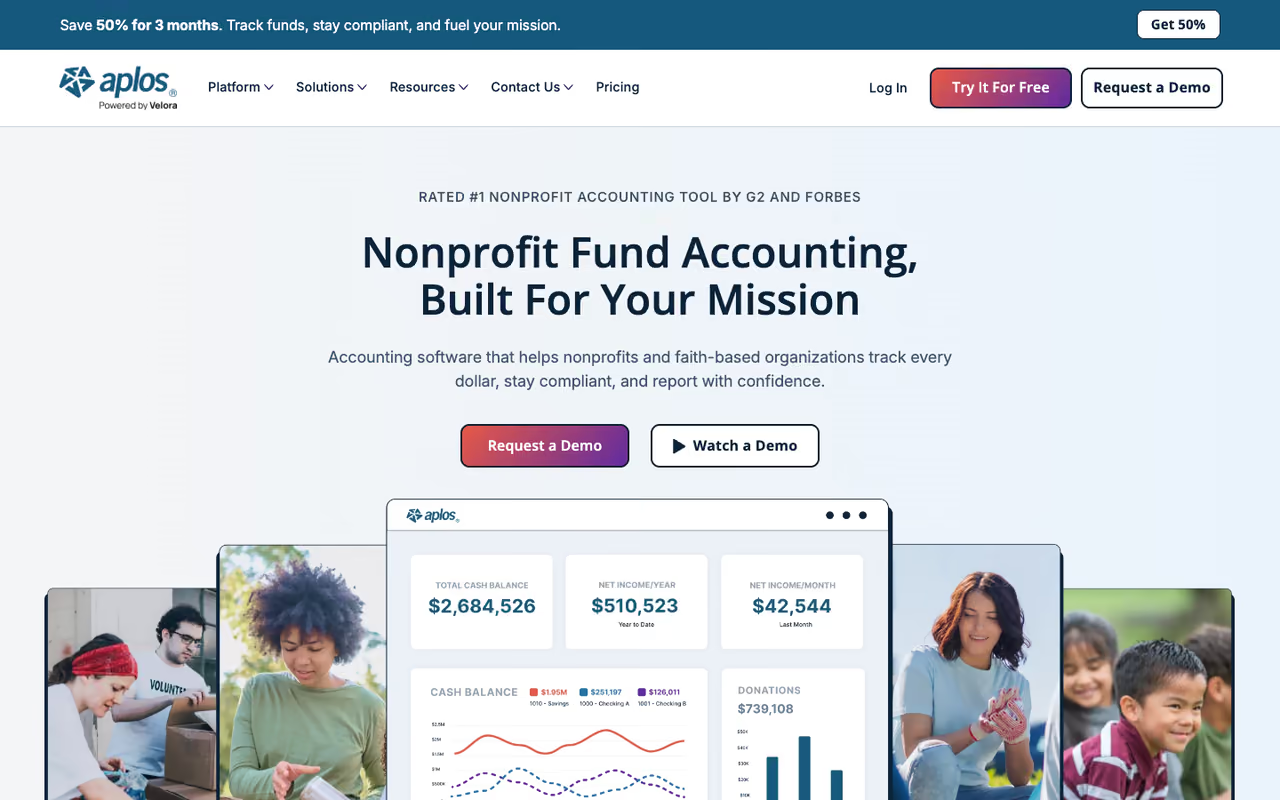
Aplos was built from the ground up for churches and nonprofits, and it shows. It's not QuickBooks with a nonprofit skin bolted on. Restricted vs. unrestricted funds, donor tracking, online giving, budgeting, and reconciliation all live in one system, which means a tithe someone gives online flows into your books and onto their year-end statement without you re-keying anything.
Who it's best for: the church that's outgrown spreadsheets and wants fund accounting done properly without hiring an accountant. Treasurers and volunteer bookkeepers can actually learn it, which is the part that matters when your finance "team" is one person who also runs the nursery rota.
The best all-around pick for churches that have outgrown spreadsheets and want proper fund accounting without an accountant. Volunteers can learn it, but at $79 a month minimum it is more than a tiny church plant needs.
Pricing runs $79/month for Lite, $129/month for Core, and $229/month for Advanced, per the Capterra pricing breakdown. There's a free trial. Lite covers the core accounting and giving; you climb the tiers for things like advanced budgeting by fund, deeper reporting, and more user seats.
The standout is how little you have to think about the accounting rules. Aplos enforces fund balance logic in the background, so your reports already separate restricted money the way an auditor expects.
The catch: at $79/month minimum, it's more than a 40-person church plant wants to spend, and the cheaper tiers still gate some reporting you might assume is standard. If your books are five transactions a week, this is more tool than you need.

ChurchTrac: the budget fund-accounting option
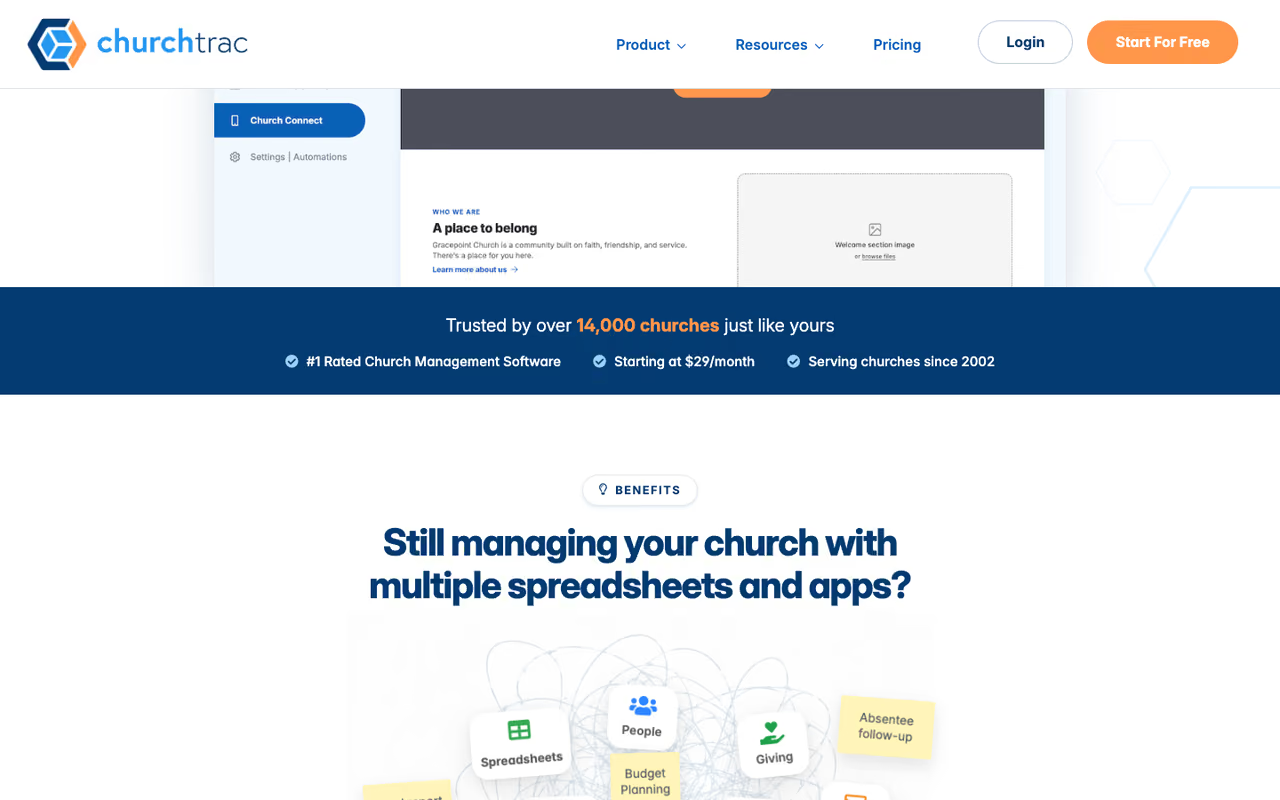
ChurchTrac is the value play. The base subscription handles people, giving, check-in, groups, and a church website, and pricing scales by the number of names in your database, starting around $6/month for up to 75 people. Real fund accounting isn't included by default. It's a +$15/month add-on that unlocks finances, budgets, deposit and expense tracking, and fund balances.
Who it's best for: small to mid-size churches that want a single low-cost system for both membership and money. If you're already eyeing ChurchTrac as your church management tool, the accounting add-on is a no-brainer compared to running a second platform.
Even with the add-on, a 250-person church lands in the low-double-digits per month, which is a fraction of what dedicated platforms charge. Of ChurchTrac users who rated its fund accounting on Software Advice, the large majority called the feature important to their work, so this isn't a token feature.
Where it falls short: the accounting module is competent, not deep. If you need grant tracking, complex allocations across many funds, or the kind of reporting a large finance committee expects, you'll feel the ceiling. It's a "do the essentials well and cheaply" tool, not an enterprise ledger.
A value play for small to mid-size churches wanting membership and money in one low-cost system. Fund accounting is a $15 monthly add-on, and the module is competent but not deep, so grant tracking or complex allocations hit a ceiling.
QuickBooks Online: the mainstream ledger
QuickBooks Online isn't church software, and it doesn't do true fund accounting out of the box. So why is it on the list? Because thousands of churches already use it, your bookkeeper probably knows it, and you can approximate fund tracking using "classes" and "locations" to tag revenue and expenses by fund or program.
Who it's best for: churches that already have a QuickBooks-literate volunteer or a contracted bookkeeper, and want a tool that any accountant in the country can pick up cold.
Here's the real reason to consider it: price. List pricing for QuickBooks Online Plus is around $115/month, but eligible 501(c)(3) churches can get Plus for roughly an $80/year admin fee (or Advanced for about $170/year) through TechSoup's Intuit program. That's not a typo. It's per year. For a church that already lives in QuickBooks, that's the cheapest serious ledger you'll find.
The catch: classes are a workaround, not fund accounting. You won't get automatic restricted-fund balance reports, and giving statements need a separate tool or add-on. You're trading purpose-built features for familiarity and a donated price. For some churches that trade is worth it; for others it's a slow leak of volunteer hours every month.
Consider it if you already have a QuickBooks-literate volunteer or bookkeeper, and eligible 501(c)(3) churches can get Plus through TechSoup for roughly $80 a year. Classes are a workaround, not fund accounting, and giving statements need another tool.
If you want to see how QuickBooks stacks up against tools built for mission-driven orgs, my guide to the best accounting software for nonprofits goes deeper on that comparison.
PowerChurch Plus: buy it once, own it
PowerChurch Plus is the throwback, and I mean that as a compliment for the right church. It's a perpetual-license desktop product: pay roughly $359 one time and you own it, no monthly subscription draining the bank account in perpetuity. It uses proper fund accounting and tracks restricted gifts under FASB 117 guidelines, with audit trails and month-end reporting baked in.
Who it's best for: churches that resent subscriptions on principle and have someone comfortable with software that looks like it's from an earlier era. There's also a cloud version, PowerChurch Online, at about $47/month or $499/year if you'd rather not manage a local install.
The standout is genuinely the pricing model. Over five years, a one-time $359 purchase crushes any subscription on total cost, and the fund accounting is the real thing.
Where it falls short: the interface is dated, the desktop version ties you to one computer (or a manual file-sharing dance), and you'll pay for support renewals and version upgrades over time. It's not the tool to hand a brand-new volunteer who expects a modern web app.
Choose PowerChurch Plus if you resent subscriptions on principle, since roughly $359 once buys real fund accounting you own. The interface is dated, the desktop version ties you to one computer, and support renewals and upgrades add up.
Realm: accounting inside a full church platform
Realm from ACS Technologies bundles accounting into a full church management system: giving, groups, communication, member management, and the books all under one roof. The accounting side is one of its strengths, with proper fund accounting aimed at churches that have real staff and real complexity.
Who it's best for: mid-size to large churches with multiple staff, multiple campuses, or a finance team that wants giving and accounting connected without exporting between systems.
The standout is integration. When your member database, giving records, and general ledger are the same platform, you skip a whole class of reconciliation headaches that smaller churches solve with copy-paste.
The catch: pricing is quote-only, so you can't comparison-shop on a webpage, and reviewers consistently note Realm is more complex than lean tools like Breeze. For a 75-person church this is overkill and overspend. It earns its keep at scale, not at the small end.
The fit for mid-size to large churches with multiple staff or campuses that want giving, members and the ledger on one platform. Pricing is quote-only and it is more complex than lean tools, so it is overspend for a small church.
Running the books is only one of the operational jobs a church juggles. If you're modernizing your whole stack, our Dupple X brief tracks the AI and software tools founders and operators are adopting, and a lot of it maps cleanly onto church admin.
ChMeetings: the free all-in-one starter
ChMeetings is one of the most affordable church management platforms going, and it has a genuinely free permanent tier covering up to 50 people, plus accounting features you can trial for 30 days with no card required. Paid pricing scales by congregation size, staying low even as you grow.
Who it's best for: brand-new church plants and small congregations that want membership, giving, and basic accounting in one place without paying anything to start.
The standout is the price floor: $0 to begin, and the upgrade path is gentle. For a church under 50 people, that's hard to argue with.
Where it falls short: the accounting depth is modest compared to Aplos or PowerChurch, and as you cross a few hundred members the per-person pricing and feature ceiling both start to matter. Treat it as a strong starting point, not a forever home for a growing church's finances.
A strong free starter for new church plants and small congregations, with a permanent free tier up to 50 people and a gentle upgrade path. Accounting depth is modest next to Aplos, so treat it as a starting point, not a forever home.
Sage Intacct: enterprise-grade for large churches
Sage Intacct is what large churches and multi-campus organizations graduate to when fund accounting gets genuinely complicated. It's cloud-based, automates tithes, donations, and grant tracking, and produces the kind of dimensional reporting an external auditor or a board finance committee actually wants.
Who it's best for: churches with budgets in the millions, multiple entities or campuses, dedicated finance staff, and donors or grantors who demand serious reporting.
The standout is reporting depth. You can slice financials by fund, location, program, and more, all at once, which spreadsheets and small-church tools simply can't do at this scale.
The catch: it's enterprise software with enterprise pricing (custom quotes, real implementation cost) and a real learning curve. A volunteer treasurer should not be opening Sage Intacct. If you don't have a finance professional on staff, this is the wrong tool, full stop.
What large, multi-campus churches graduate to when fund accounting gets complicated, with dimensional reporting auditors and boards want. It carries custom pricing and a real learning curve, so it is wrong without a finance professional on staff.

Wave: free bookkeeping for the smallest churches
Wave is free accounting software that handles income, expense tracking, invoicing, and bank reconciliation at no cost. For an all-volunteer church just getting off the ground, it covers the absolute basics without a subscription.
Who it's best for: tiny churches with simple finances and revenue under roughly $50,000, where the goal is just clean income-and-expense records, not formal fund reporting.
The standout is obvious: it's free, and it's a real accounting tool, not a stripped trial.
Where it falls short, and this is the big one: Wave is not a fund accounting system. You can't track restricted funds, generate giving statements, or produce nonprofit financial reports without clumsy workarounds, as multiple nonprofit software comparisons point out. The moment your church has a restricted gift or needs year-end donor statements, you've outgrown it. Use it as a stepping stone, not a destination.
Fine for tiny all-volunteer churches with simple finances and revenue under roughly $50,000 who only need clean income and expense records, for free. It is not fund accounting, so restricted gifts or donor statements mean you have outgrown it.
How to choose
Start with two questions: how many people, and do you have restricted funds?
If you're under 50 people with simple money, start free with ChMeetings or Wave and don't overthink it. You can graduate later.
If you have restricted funds (building, missions, benevolence) and want it done right without an accountant, Aplos is the default answer. If budget is the hard constraint, ChurchTrac's $15 accounting add-on gets you real fund tracking for pocket change, especially if you'll use it for membership too.
If you already run on QuickBooks and have someone who knows it, claim the TechSoup nonprofit pricing and stay put, accepting that classes are a workaround. If you hate subscriptions, PowerChurch's one-time license wins on five-year cost.
And if you're a large or multi-campus church with finance staff, you're choosing between Realm (if you want accounting fused with your ChMS) and Sage Intacct (if reporting rigor is the priority). Neither belongs in a small church.
One rule that saves regret: match the tool to your actual bookkeeper, not your aspirations. The most powerful platform is worthless if the volunteer running it quits in frustration.
Frequently asked questions
What is the difference between church accounting software and regular accounting software?
Church accounting software does fund accounting, which tracks money in separate "funds" (building, missions, general) so restricted gifts stay restricted. Regular software like Wave treats all money as one pool. It also handles giving statements and contribution tracking that businesses don't need. That's why a tool like Aplos or ChurchTrac fits churches better than a plain business ledger.
Can I use QuickBooks for church accounting?
Yes, and many churches do, but QuickBooks Online doesn't do true fund accounting out of the box. You approximate it with "classes" to tag income and expenses by fund. Eligible churches can get QuickBooks Online Plus through TechSoup for roughly $80/year, which is the cheapest serious ledger available. The trade-off is more manual work for restricted-fund reports and giving statements.
Is there free church accounting software?
Yes. ChMeetings has a permanent free tier for up to 50 people including basic accounting, and Wave offers free bookkeeping for small organizations. Both have limits: Wave can't track restricted funds or produce giving statements, and ChMeetings' free accounting is shallow. They're good starting points for very small churches but most congregations outgrow them.
How much does church accounting software cost?
It ranges widely. Free tools (Wave, ChMeetings starter) cost $0. Budget fund accounting like ChurchTrac runs about $15/month for the accounting add-on. Purpose-built platforms like Aplos start at $79/month. PowerChurch is a one-time $359 purchase. Enterprise tools like Sage Intacct and Realm use custom quotes that climb into the thousands per year.
Does church accounting software handle year-end giving statements?
Most dedicated church tools do. Aplos, ChurchTrac, and Realm generate contribution statements directly from giving records, so donors get tax-ready summaries with minimal effort. Wave and plain QuickBooks don't produce these natively. If donor statements matter to you (they should for a tax-exempt church), prioritize a tool with built-in giving tracking.
Ready to modernize the rest of your operation too? Start a Dupple X trial and keep up with the tools changing how small organizations run.
Related guides
Some offers on this page may be paid placements or contain affiliate links.
Across our whole catalogue the median is $24 a month and 33% of tools advertise a free tier. Figures are the lowest recurring monthly price quoted in our own review of each tool, read on 2026-08-19. Full method and every category.
